Short, punchy climbs can expose a weakness very quickly.
You hit the bottom of the climb hard, get out of the saddle and drive over the steepest section—but reaching the top of that initial rise doesn’t necessarily mean the work is finished.
You may still need to keep producing strong, sustained power while your legs are already loaded and your breathing is elevated.
That’s exactly what Preparing for Climbing is designed to train.
This 90-minute smart-trainer workout combines short Level V+ standing efforts with longer Level IV seated efforts, challenging you to produce high power before settling into sustained threshold work.
It’s particularly useful for cyclists, mountain bikers and triathletes who want to become stronger and more resilient across rolling terrain and short, punchy climbs.
The hardest part isn’t necessarily the initial attack.
It’s what you can do after it.
Session Inspiration
The inspiration for this week’s session comes from cycling coach Taylor Thomas of Thomas Endurance Coaching and his work on indoor mountain-bike-specific training. His full article can be found here.
I’ve structured the workout around a climbing scenario you’ll commonly experience outdoors: a short, hard section that requires a significant increase in power, immediately followed by sustained climbing where you still need to maintain a strong effort.
Rather than treating VO₂ max and threshold work as completely separate intervals, this session deliberately combines them.
That creates a very different challenge.
Today’s Workout
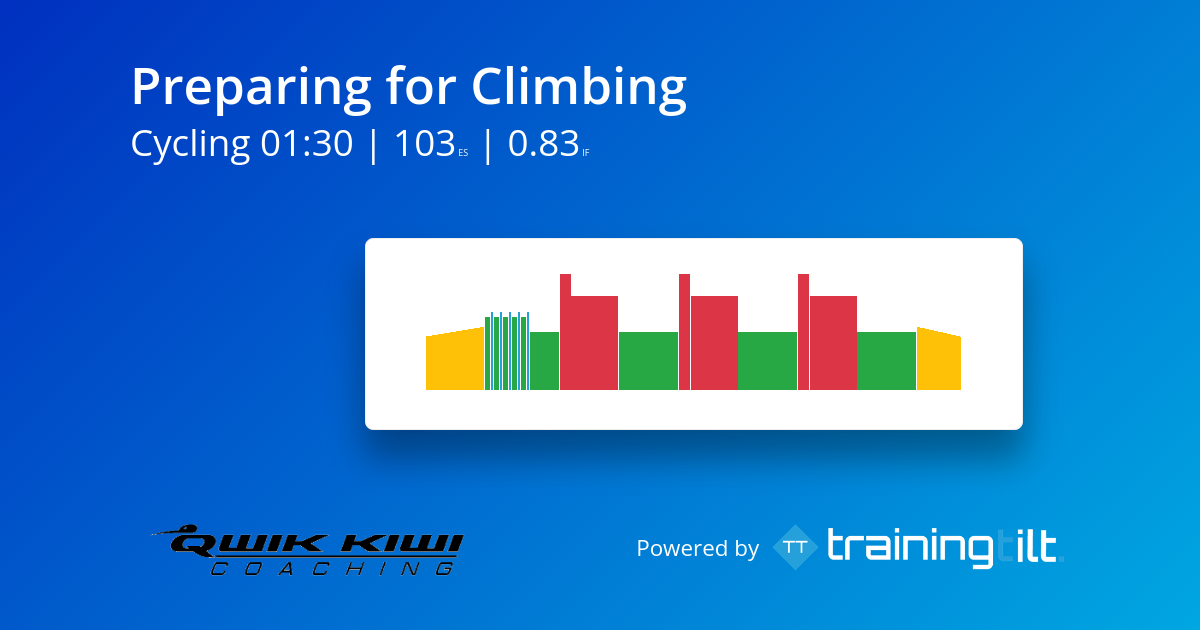
Preparing for Climbing
Warm-Up
- 10min Level II
Primer Set – 5x:
- 1min Level II+
- 30sec Level III-
Pre-Main-Set Recovery
- 5min Level II
Main Set – 3x:
- 2min Level V+ — standing
- 8min Level IV — seated
- 10min Level II Rest Interval (RI)
Cool-Down
- 7:30min Level II
Post-Ride
- 10min Stretching
Total Riding Time: 1hr 30min
Why You’re Doing This Session
The main set is designed to simulate the changing demands of climbing rather than simply having you ride at one steady intensity.
Each repetition starts with two minutes at Level V+ while standing out of the saddle.
Think of this as hitting the steepest section of a climb.
You’re producing substantial power, your breathing rate rises quickly and your legs begin accumulating fatigue.
But after two minutes, you don’t get to recover.
Instead, you sit down and immediately transition into eight minutes at Level IV.
That’s where this workout becomes particularly valuable.
You need to settle yourself, regain control of your breathing and establish a sustainable rhythm—while continuing to produce threshold-level power.
You’re training the ability to go hard and then keep riding strongly afterwards.
That can translate particularly well to short climbs, rolling terrain and mountain biking, where repeated changes in gradient can force you above threshold before requiring you to continue riding hard.
The Purpose of the Primer Set
Before tackling the main set, you’ll complete five repetitions alternating between Level II+ and Level III-.
Don’t turn these into intervals.
Their purpose is to gradually lift your heart rate and prepare your cardiovascular system and legs for the considerably harder work that’s coming.
Move smoothly between the two intensities and remain controlled throughout.
After completing the primer, you’ll have five minutes at Level II before starting the first climbing repetition.
Use it.
Allow your breathing to settle, keep your legs moving smoothly and prepare yourself mentally for the first Level V+ effort.
What You Should Focus On
Make the Standing Efforts Powerful, Not Chaotic
When the two-minute Level V+ effort begins, move smoothly out of the saddle and establish your intensity.
Standing doesn’t mean sprinting.
Keep your movement controlled and avoid throwing your upper body excessively from side to side.
You need to sustain the effort for two minutes and then continue working for another eight.
Make the Transition Count
The most important moment in each repetition may be the transition from Level V+ standing to Level IV seated.
Don’t collapse into the saddle and spend the next minute recovering.
Sit down smoothly, change gear if necessary and establish Level IV as quickly as you can.
Your legs will initially want you to back right off.
Resist that temptation.
You’re not recovering—you are changing from one type of hard work to another.
Settle Into Level IV
Once seated, find a rhythm you can sustain for the remainder of the eight minutes.
Your breathing should gradually become more controlled, but the effort should remain firmly at Level IV.
Think about producing smooth, consistent power rather than repeatedly surging.
Respect the Recovery
After each ten-minute work block—including the third—you have 10 minutes at Level II.
That’s a substantial recovery because the quality of the next repetition matters.
Don’t turn the recovery into extra training.
Ride easily, hydrate and prepare yourself to repeat the work properly.
Common Mistakes To Avoid
Going too hard during the primer. The primer prepares you for the workout; it isn’t supposed to become another hard set.
Treating the standing Level V+ effort like a sprint. Two minutes is a long time. Establish Level V+ and control it.
Recovering after sitting down. There is no recovery between the Level V+ and Level IV portions. The transition should be immediate.
Starting the eight minutes at Level IV too hard. You’ve still got eight minutes to ride. Settle into the appropriate intensity rather than chasing the power you were producing while standing.
Allowing your technique to deteriorate. Fatigue shouldn’t mean excessive upper-body movement or increasingly ragged pedalling.
Making the recoveries too hard. Ten minutes at Level II is there to help you produce another quality repetition.
Winning the first repetition. You have three. Judge the workout by how consistently you can execute all of them.
Coach Ray’s Tips
I’d approach the three main repetitions with one word in mind:
Repeatability.
Your first repetition establishes your benchmark.
The second tests whether you judged the first correctly.
The third tells you how well you can reproduce the effort when fatigue has accumulated.
I’d much rather see three well-executed repetitions than an enormous first effort followed by declining power across the remaining two.
Pay particular attention to the first 30–60 seconds after sitting down.
That’s where the workout asks an important question:
Can you regain control without backing off?
Your power should drop from Level V+ to Level IV because that’s what the session prescribes. But it shouldn’t fall through Level IV because you’re trying to recover.
Sit down. Settle in. Keep working.
That’s the skill we’re developing.
Coach Ray Rode This Session
I’ve completed Preparing for Climbing, and this is an especially useful session to analyse afterwards because the relationship between power, heart rate and cadence can show how well you managed each transition and how fatigue developed across the workout.
My Strava Activity
My Workout Data

What My Data Shows
When reviewing my data from this workout, there are several things I’d be interested in.
First, can I clearly identify the three two-minute Level V+ efforts and the transition into the eight-minute Level IV sections?
I’d compare power across all three repetitions. Did I produce a similar Level V+ effort each time? More importantly, was I able to settle quickly into Level IV and maintain it for the full eight minutes?
I’d also look at heart rate. I’d expect it to rise rapidly during the standing effort and remain elevated when transitioning into Level IV. Across the three repetitions, cardiac drift and accumulated fatigue may also become apparent.
Cadence can provide another useful insight, particularly around the transition from standing to seated riding.
Finally, I’d compare repetition one with repetition three.
The goal isn’t necessarily for every number to be identical. It’s to determine whether I remained capable of producing the prescribed intensity with good technique despite accumulating fatigue.
Ride Preparing for Climbing With Me on Velocity
Want to put this workout into practice?
Preparing for Climbing is available to ride on demand on Velocity, where you can complete the full 90-minute session with me coaching you through every stage.
I’ll guide you through the primer before we tackle the three key climbing blocks—each beginning with a hard Level V+ standing effort before transitioning directly into sustained Level IV seated riding.
It’s a great session if you want to become stronger when the road kicks upwards, particularly on those short, punchy climbs where the hard work doesn’t finish once you’ve cleared the steepest section.
Ride Preparing for Climbing on Velocity
New to Velocity? Get 14 Days FREE
If you’re not already using Velocity, you can get 14 days completely FREE through Qwik Kiwi Coaching.
That gives you the opportunity to experience my coach-led indoor cycling workouts for yourself—and Preparing for Climbing is an ideal workout to tackle during your trial if developing your climbing strength and ability to sustain power after a hard effort is one of your goals.
Start your FREE 14-day Velocity trial
Once you’re set up, find Preparing for Climbing, jump on the bike and ride it with me.
Hit the climb. Settle in. Keep producing power. 🚴⛰️