
Some cycling workouts target one very specific component of fitness. This one throws almost everything into the mix.
220’s Kitchen Sink combines high-cadence riding, low-cadence strength work, standing efforts, short Level V sprints and a sustained Level IV time trial into one varied indoor cycling session.
That variety makes it a particularly useful workout when you’re training indoors and want something that keeps both your legs and your mind occupied. It’s suitable for triathletes, road cyclists and mountain bikers looking for a challenging all-round cycling session.
Today’s Goal
The goal of this workout is to challenge your cycling fitness in several different ways within one session.
Rather than repeating one type of interval, you’ll move through four distinctly different ten-minute blocks:
- High-cadence spin-ups
- Seated and standing Level IV climbing
- Short Level V sprints
- A sustained Level IV time trial
Each block asks something different of you, making this as much about adapting to changing demands as it is about completing any individual effort.
Why You’re Doing This Session
Cycling performance isn’t built from one type of fitness.
You need aerobic endurance, the ability to sustain harder efforts, muscular strength, neuromuscular coordination and the capacity to produce short bursts of high power.
This workout touches several of those qualities.
The spin-ups develop cadence control and your ability to pedal smoothly at higher leg speeds without unnecessarily increasing the intensity.
The mixed hill-climbing block challenges muscular strength and your ability to maintain Level IV while alternating between seated riding at 80–90rpm and standing in a bigger gear.
The Level V sprints introduce short bursts of high-intensity power followed by controlled recovery.
Finally, the ten-minute Level IV time trial asks you to settle down after all that variation and produce a strong, controlled sustained effort.
That final block can be particularly revealing. It’s one thing to ride at Level IV when you’re fresh. It’s another to settle into a sustained Level IV effort after 30 minutes of changing demands.
Session Inspiration
This workout was originally inspired by a turbo-training session published by 220 Triathlon.
I’ve retained the underlying “kitchen sink” concept because it’s a great description of the workout: you’re putting several very different cycling demands into a single session rather than concentrating on just one.
Today’s Workout

220’s Kitchen Sink
- 10min WU – Level II
- 10x:
- 30sec – Level II @ 110rpm+
- 30sec – Level II @ 90–100rpm
- 5x:
- 1min – Level IV seated @ 80–90rpm
- 1min – Level IV Big Gear (BG), standing
- 4x:
- 30sec – Level V sprint
- 90sec – Level II RI
- 1min – Level II
- 10min – Level IV @ 90–100rpm
- 10min CD – Level II
- 10min stretching
Total cycling time: 59 minutes
How to Complete the Session
Start with a ten-minute Warm-Up (WU) at Level II.
The effort should feel comfortable and controlled. Use this time to gradually bring your cadence up, settle into your riding position and prepare yourself for the variety of work ahead.
The main set is then divided into four ten-minute blocks.
Block One: Spin-Ups
Your first ten-minute block consists of ten one-minute repetitions.
Ride for 30 seconds at Level II with your cadence at 110rpm or higher, then spend 30 seconds at the same Level II intensity while reducing your cadence to 90–100rpm.
Repeat this ten times.
The important point here is that cadence changes, but intensity doesn’t.
Don’t turn the 110rpm sections into sprints. Adjust your gearing or resistance as necessary so that you remain at Level II while increasing your leg speed.
Concentrate on staying relaxed through your shoulders and upper body. Your hips should remain stable rather than bouncing on the saddle as your cadence rises.
Block Two: Mixed Hill Climbing
The second block changes the demands completely.
Complete five repetitions consisting of one minute seated at Level IV and 80–90rpm, immediately followed by one minute standing at Level IV in a Big Gear (BG).
For the seated minute, select enough resistance to give you the feeling of climbing while maintaining 80–90rpm.
When you reach the standing minute, shift into a bigger gear and rise out of the saddle.
The goal isn’t to dramatically increase your intensity when you stand. Both portions are prescribed at Level IV.
Think of this as a simulated climb where you’re alternating your riding position while maintaining a strong, controlled effort.
Block Three: Level V Sprints
After the climbing block, ride for one minute at Level II.
You’ll then complete four repetitions of:
30 seconds at Level V, followed by 90 seconds at Level II.
Use plenty of resistance and a suitably big gear for each sprint. Start the effort standing, accelerate the gear, then sit once you’re on top of it and continue driving through to the end of the 30 seconds.
These efforts should be hard, but don’t sacrifice your technique simply to produce a bigger number.
Use each 90-second Level II Rest Interval (RI) properly. Reduce the resistance, keep pedalling and allow yourself to recover sufficiently to produce another quality effort.
This block is only nine-minutes.
Block Four: The Time Trial
Now comes a very different challenge.
Settle into Level IV at 90–100rpm and hold it continuously for ten minutes.
After the changing cadences, standing climbing and short sprints, your job is now to become controlled and consistent.
Avoid attacking the opening minute.
Find an intensity you can sustain across the entire ten minutes and concentrate on maintaining good position, smooth pedalling and an even effort.
The aim is to finish strongly rather than gradually fading because you started too aggressively.
What You Should Focus On
The challenge with a workout containing this much variety is making sure each block retains its intended purpose.
During the spin-ups, focus on cadence rather than power.
During the climbing block, maintain Level IV rather than allowing the standing portions to become uncontrolled surges.
During the sprints, produce strong, technically sound efforts and then genuinely recover at Level II.
During the time trial, forget about everything that came before it and settle into the best sustainable Level IV effort you can produce for the full ten minutes.
Treat each block as its own mini-workout.
Common Mistakes
One of the easiest mistakes is turning the opening spin-ups into hard efforts. Riding at 110rpm doesn’t automatically mean riding harder. Keep them at Level II and concentrate on leg speed and technique.
During the hill-climbing block, don’t let standing automatically mean increasing your intensity. You’re changing your gearing and body position while remaining at Level IV.
For the Level V efforts, avoid selecting such a large gear that you spend half of the 30-second sprint simply trying to get it moving. You want resistance, but you also need to be able to accelerate effectively.
Finally, don’t treat the ten-minute time trial as a maximal ten-minute test. It’s prescribed at Level IV, so control the effort accordingly.
Tips for Completing the Session
Keep a towel and drink within reach before you start. With several different blocks and frequent changes in cadence, gearing and intensity, you don’t want to interrupt the session unnecessarily.
Pay particular attention to your technique during the high-cadence and standing portions. Fatigue can cause unnecessary upper-body movement, so periodically check that your shoulders and hands remain relaxed.
Use the Level II sections as prescribed rather than trying to turn every minute of the workout into additional training stress.
And when you reach the final Level IV block, aim for consistency. If you can finish the final couple of minutes feeling strong and controlled, you’ve probably paced it well.
If you’re unfamiliar with my training Levels, read my guide to Cycling Training Intensity before completing the workout.
If you’re working directly with me, I’ll normally prescribe the appropriate Power Zone or Heart Rate Zone when you’re training with these tools.
What This Workout Looks Like in Practice
It’s one thing to read through a workout. Seeing what happens when it’s actually ridden provides another useful perspective.
I’ve completed the session myself, and below I’ll include both my Strava ride details and a screenshot of my training data.
My Ride on Strava
My Training Data
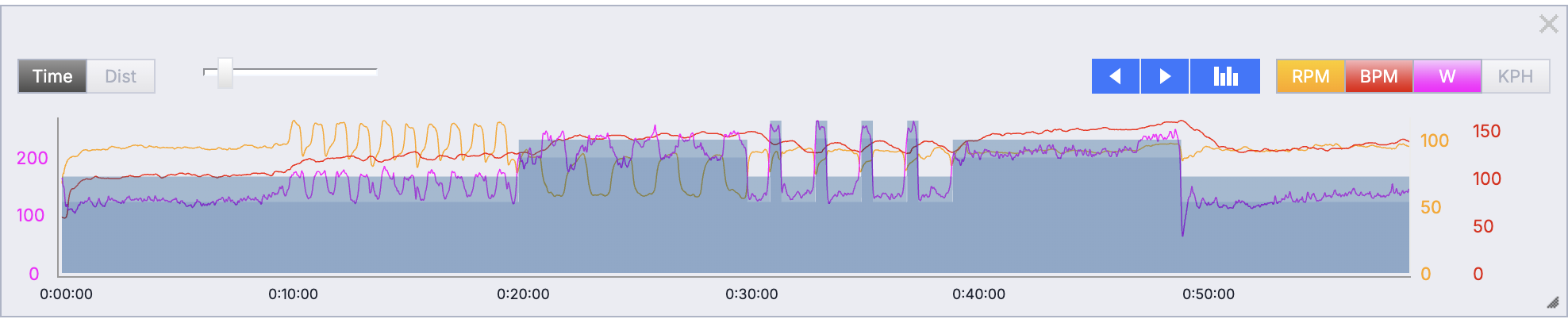
When looking at my data, remember that it is an example rather than a target for you to reproduce.
Your power, heart rate, cadence and overall training load will reflect your own fitness, training zones and individual response to the workout.
Instead, look at how the demands change across the session. You should be able to identify the high-cadence opening block, the sustained Level IV climbing work, the short Level V efforts and finally the more consistent ten-minute Level IV effort.
Want to Ride This Workout With Me?
You can complete 220’s Kitchen Sink with me on Velocity rather than trying to follow the written workout and manage all of the changes in cadence, gearing and intensity yourself.
Velocity is more than simply loading an interval workout onto your smart trainer and following targets in the style of Zwift.
The session is coach-led via video, with your training data displayed on screen while you ride. I’ll guide you through each part of the workout, explain what you should be focusing on and help you transition between the spin-ups, climbing, Level V sprints and final Level IV effort.
With this workout changing its focus every ten minutes, having the session coached for you means you can concentrate on riding each block properly rather than watching the clock.
Ride 220’s Kitchen Sink with me on Velocity
If you’re new to Velocity, you can also access a growing library of coach-led indoor cycling workouts covering cadence, endurance, tempo, threshold, VO₂ Max and more.
There are also two live squad sessions each week at 6:00am New Zealand time. Tuesday’s session is 45 minutes or less, while Thursday’s session is approximately an hour.
Train with purpose, execute each component for the reason it’s there, and make your indoor riding count.
Share this session with a cyclist who’d enjoy putting a little bit of everything into one workout.