Being able to produce power on the bike is important, but so is being able to produce it effectively across different cadences and different riding positions.
That’s what makes this week’s Seated, Standing Cadence Mix such an interesting session.
Rather than settling into one comfortable rhythm, you’ll progressively increase your cadence, alternate between seated and standing riding, work at both high and low cadences, and finish with a series of rapid cadence changes.
At 67 minutes of riding, this is a little longer than many of my Sunday Smart-Trainer Sessions. But every part of the workout has a purpose: developing your ability to remain smooth, controlled and efficient when your cadence and riding position change.
Session Inspiration
The inspiration for this session came from a workout featured in an article by Marc Evans in the December 2007 issue of Triathlete Mag.
What I like about the concept is that it doesn’t rely on simply making you ride progressively harder.
Instead, it manipulates cadence and riding position.
That’s an important distinction.
Outdoors, you don’t spend an entire ride sitting in exactly the same position and pedalling at exactly the same cadence. Gradient, gearing, terrain, wind and changes in pace can all alter how you need to ride.
This workout deliberately exposes you to some of that variation in a controlled indoor environment.
Today’s Workout
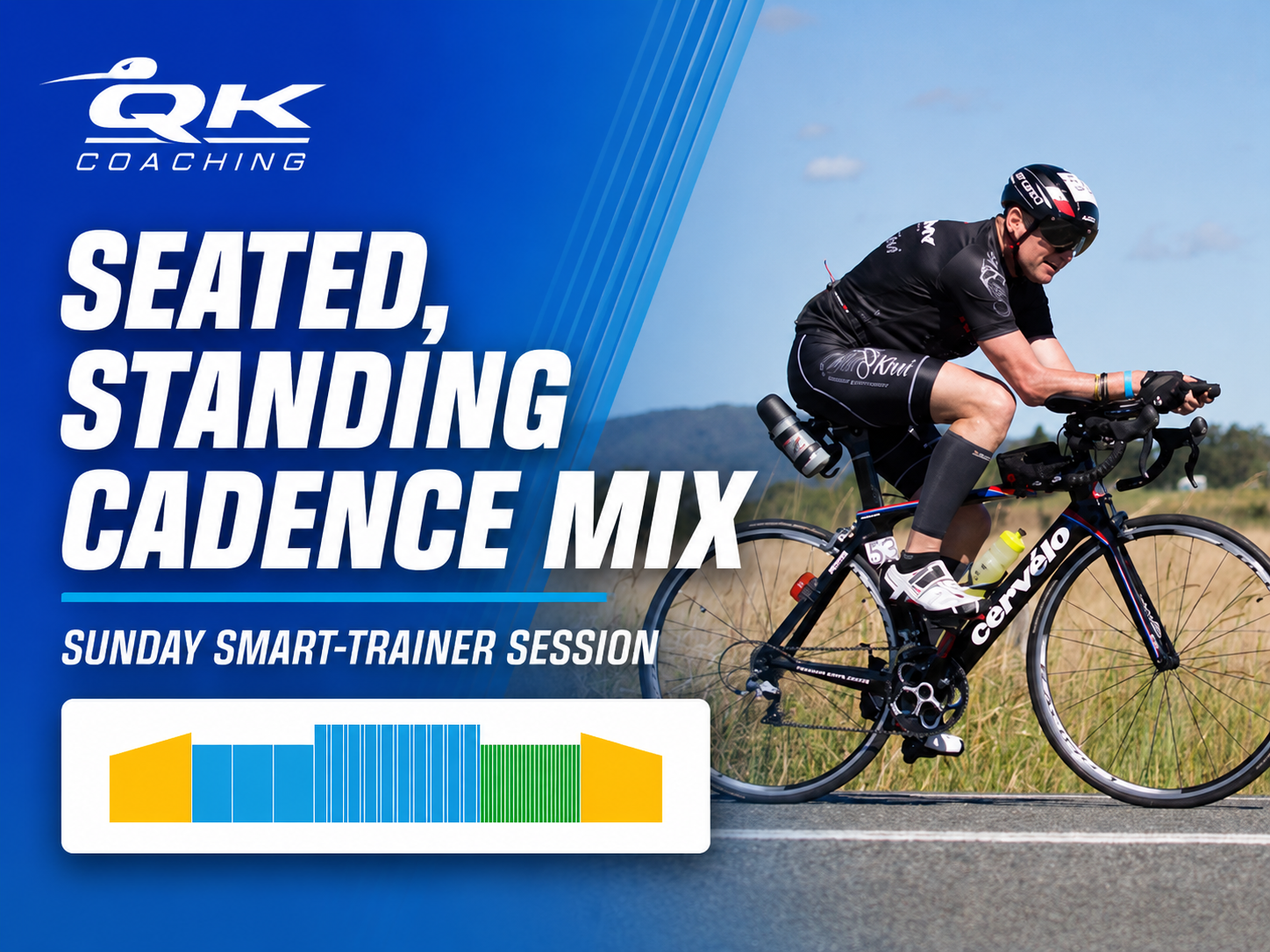
Seated, Standing Cadence Mix

Warm-Up
- 10min Level II
Cadence Progression
- 5min Level II @ 90–95rpm
- 5min Level II @ 95–100rpm
- 5min Level II @ 100–105rpm
Seated/Standing Set – 5x:
- 90sec Level III seated @ 100rpm
- 30sec Level III standing
- 90sec Level III seated @ 75rpm
- 30sec Level III standing
Cadence Changes – 12x:
- 30sec Level II @ 90–100rpm
- 30sec Level II @ 100–110rpm
Cool-Down
- 10min Level II
Post-Ride
- 10min Stretching
Total Riding Time: 67 minutes
Why You’re Doing This Session
There are several different challenges packed into this workout, but they all revolve around one idea:
Can you remain efficient when the way you’re pedalling changes?
The opening cadence progression gradually moves you from 90–95rpm through to 100–105rpm while keeping the intensity at Level II.
That allows you to concentrate on increasing leg speed without simultaneously turning the workout into a harder physiological effort.
The middle section introduces a different challenge.
You’ll alternate between seated and standing riding at Level III, while the seated portions switch between approximately 100rpm and 75rpm.
At 100rpm, the emphasis is on leg speed and smoothness.
At 75rpm, the slower cadence increases the force required through each pedal stroke.
Standing then changes your position again.
Finally, the 12 short cadence changes ask you to repeatedly move between 90–100rpm and 100–110rpm while maintaining Level II intensity.
By the end of the session, you’ve worked through a considerable range of cadences and riding positions without needing maximal intensity.
What You Should Focus On
During the first three five-minute efforts, make each increase in cadence deliberate.
The progression is:
90–95 → 95–100 → 100–105rpm.
Your power shouldn’t suddenly jump each time your cadence increases. Keep the effort at Level II and concentrate on making the transition smooth.
The seated/standing section requires a different focus.
During the 100rpm seated portions, stay relaxed through your shoulders and keep your hips stable.
When you stand for 30 seconds, transition smoothly out of the saddle rather than launching into an acceleration.
When you return to the saddle at 75rpm, concentrate on applying controlled pressure through the pedals. The slower cadence will naturally feel quite different from the 100rpm work you’ve just completed.
Then stand again before beginning the next repetition.
The final 12 repetitions are about changing cadence quickly without changing effort unnecessarily.
Think fast legs, not more power.
Common Mistakes To Avoid
Allowing power to follow cadence. When cadence increases during the Level II sections, don’t automatically increase your power as well. Cadence is the variable we’re deliberately changing.
Turning every standing section into an attack. Standing doesn’t mean sprinting. The prescribed intensity remains Level III.
Grinding the 75rpm sections. The lower cadence should increase the force per pedal stroke, but it shouldn’t become a maximal strength effort.
Bouncing at high cadence. If your hips are bouncing at 100–110rpm, reduce your cadence slightly until you regain control.
Making abrupt seated-to-standing transitions. Aim to make each transition look and feel deliberate rather than throwing your body out of the saddle.
Ignoring technique as fatigue develops. The final part of the workout is where good habits matter most. Don’t sacrifice smoothness simply to hit a cadence number.
Coach Ray’s Tips
I’d approach this workout as three different technical challenges, rather than one long main set.
The first asks:
Can I progressively increase cadence without increasing intensity?
The second asks:
Can I smoothly change cadence and riding position while maintaining Level III?
And the third asks:
Can I repeatedly change leg speed while keeping the effort controlled?
Breaking the session down this way gives you something specific to concentrate on during each section.
I’d also pay particular attention to your upper body.
As cadence increases or you become fatigued, it’s common to start gripping the handlebars more tightly, lifting the shoulders or moving excessively through the torso.
Your legs might be doing very different things throughout this workout, but your upper body should remain as relaxed and controlled as possible.
Coach Ray Rode This Session
I completed Seated, Standing Cadence Mix myself, and this is a workout where looking at the data afterwards can tell you considerably more than simply checking your average power.
My Strava Activity
My Workout Data

When reviewing this workout, I wouldn’t be particularly interested in chasing impressive headline numbers.
I’d look at whether the different sections are visible in the data.
Can you see the progressive cadence increase during the opening 15 minutes?
Can you distinguish the changes between the faster and slower seated work?
What happens to power and heart rate when you stand?
And during the final 12 cadence changes, can you repeatedly increase your leg speed without your power rising every time?
That’s where reviewing your own data becomes useful. You’re not simply checking whether you completed the workout—you’re checking whether you achieved the purpose of the workout.
Want to Ride This Workout With Me?
Reading about Seated, Standing Cadence Mix is one thing. Riding it with me coaching you through every change in cadence and position is another.
This workout is available on demand in Velocity, where I’ll guide you through the complete session—from the progressive cadence work through the seated and standing efforts and into those final rapid cadence changes.
With plenty happening throughout this workout, having me coach you through each transition means you can spend less time watching the clock and more time concentrating on smooth pedalling, controlled intensity and good technique.
👉 Ride Seated, Standing Cadence Mix on Velocity
Get 14 Days of Velocity FREE
Not using Velocity yet?
You can get 14 days of Velocity completely FREE through Qwik Kiwi Coaching.
That gives you the opportunity to experience my coach-led indoor cycling workouts for yourself—and you can start by riding Seated, Standing Cadence Mix with me.
👉 Start your FREE 14-day Velocity trial
Set up your free trial, jump on your indoor trainer and then come and ride the session with me.
Change the cadence. Change the position. Keep the technique.