There’s a very specific feeling that shows up a day or two after a big race.
Your legs are sore—but not as bad as you expected.
You’re a bit tired—but not completely wiped.
Part of you is thinking… “I might actually be okay for next weekend.”
And part of you knows that might not be true.
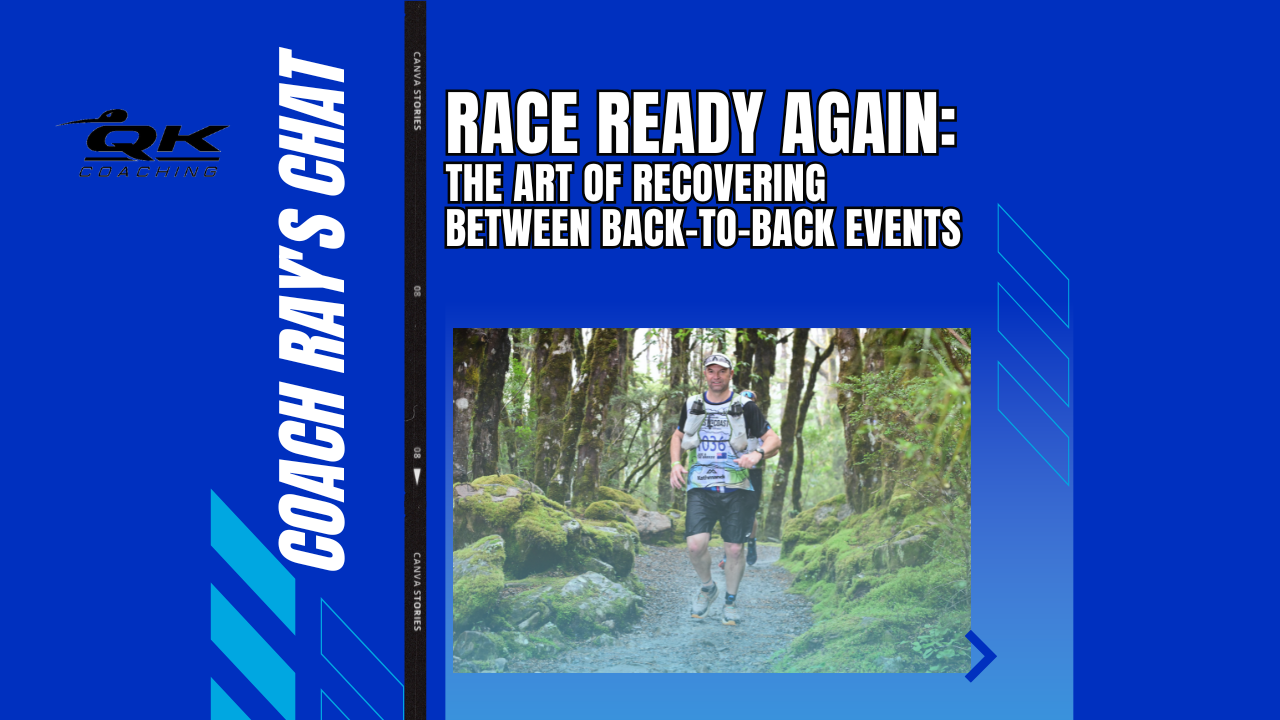
Right now, I’ve got athletes who’ve just come off the Paparoa Ultra Marathon and are lining up again at the Wild West Backyard Ultra. Same story I’ve seen over and over again.
Big effort. Short turnaround. Another start line.
I’ve been there myself recently—racing the Coast to Coast mountain run as part of a team, then backing it up the following weekend at Challenge Wanaka.
And I’ve coached athletes through even bigger blocks—multiple Ironman-distance races in a fortnight, three 70.3 races across consecutive weekends, and Ultraman events where you’re essentially racing long days back-to-back.
The pattern is always the same.
It’s not about toughness.
It’s about decision-making.
The mistake most athletes make
They treat the second race like a continuation of the first.
Same expectations.
Same mindset.
Same approach.
But your body isn’t the same anymore.
Even if you feel okay, there’s still muscle damage, nervous system fatigue, and depleted energy stores sitting under the surface. That’s why things can feel fine early… and then fall apart later.
The biggest trap?
Mistaking feeling better for being recovered.
The first 24 hours matter more than you think
Recovery doesn’t start the next day. It starts the moment you finish.
What you do in that first hour—how you refuel, rehydrate, and look after your body—sets the tone for everything that follows.
Then comes the first night of sleep. That’s where the real repair work begins.
Get that right, and you give yourself a chance.
Get it wrong, and you’re chasing your tail for the rest of the week.
Days 2–5: where it usually unravels
This is the tricky window.
You start to feel a bit better. The soreness fades. You think about doing a bit more.
This is where athletes dig the hole deeper.
Too much intensity, too much volume, or even just one session that’s a little too ambitious—and suddenly you’re carrying fatigue into your next race instead of shedding it.
This isn’t a training block.
You’re not getting fitter this week.
You’re trying to reveal the fitness you already have.
Movement vs rest isn’t black and white
Some athletes shut it down completely. Others can’t sit still.
Neither extreme works particularly well.
The goal is to find that middle ground—easy, controlled movement that actually helps you feel better, not worse.
A simple rule I give athletes:
If you don’t feel better at the end of the session than you did at the start… it was too much.
You have to be honest with yourself
This is probably the hardest part.
Because motivation is high. You’ve committed. You want to go again.
But readiness isn’t about what you want to do—it’s about what your body can handle right now.
How do you feel getting out of bed?
How does easy running feel?
Are there any niggles that weren’t there before?
These are the signals that matter.
Not the plan. Not the expectation.
Arriving at the next start line
You’re not aiming to feel perfect.
You’re aiming to arrive ready enough—with a plan that reflects where your body is actually at.
That usually means starting a little more conservatively. Letting the race come to you. Staying flexible.
Because the athletes who perform best in these situations aren’t the toughest.
They’re the ones who adapt.
Watch the full breakdown
I recently ran a group coaching call on this exact topic, working through how to maximise recovery between races and how to approach that second start line with confidence.
You can watch the full session here:
If you’ve got races coming up close together, or you’re trying to figure out how to structure your training and recovery more effectively, this is something we can map out properly.
You don’t need to guess your way through it.
We’ll look at where you’re at, what you’ve got coming up, and put a plan in place so you can show up ready—not just hopeful.