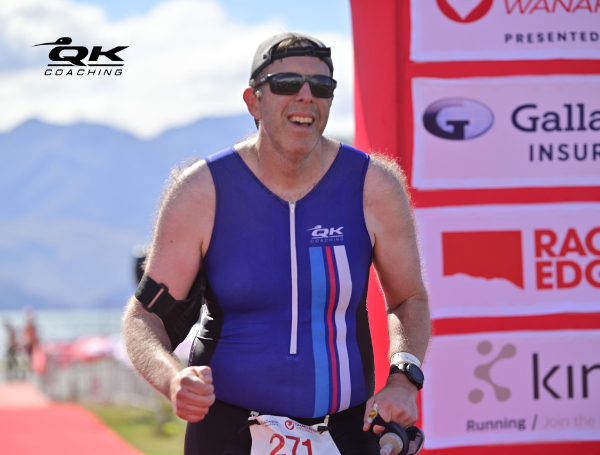
Gareth Evans’ Challenge Wanaka Debrief
There’s a version of endurance sport that looks very tidy from the outside.
The athlete trains exactly as planned. Nothing gets missed. Recovery is perfect. Nutrition is dialled in. Race day unfolds smoothly, and the result reflects the work.
Then there’s the version most age-group athletes actually live.
Work runs late. Family life is full. Sleep matters, but so do a dozen other things. Training is important, but it sits alongside real responsibilities. Sessions get moved, a few get missed, and the question in the back of your mind becomes a familiar one:
Have I done enough?
That’s what made Gareth Evans’ Challenge Wanaka debut such a worthwhile race to reflect on.
This was Gareth’s first half ironman distance event. He went in with the clear goal of finishing. Not chasing a specific time. Not trying to prove anything dramatic. Just stepping up to a new distance, doing the work he could fit around a full life, and seeing it through.
And in many ways, that’s exactly what good age-group triathlon looks like.
The reality of training when life is full
One of the most useful parts of Gareth’s debrief was how honest he was about the lead-in.
He didn’t describe a perfect build. He described a realistic one.
He’s time poor. He’s balancing work, family, sleep, and the wider demands of life. He’s not a professional athlete with the luxury of building his day around training and recovery. Like most athletes, he had to find a way to train within the life he already had.
That matters.
Too many athletes judge themselves against an imaginary standard. They look at missed sessions and think the whole build has fallen apart. In reality, training often works best when it is built around what is sustainable rather than what is ideal.
That was very much the approach here. The goal wasn’t to squeeze in every possible session. The goal was to do enough, consistently enough, to complete the event successfully.
He did that.
Why structure mattered
One of the things Gareth highlighted was how helpful it was to have a known weekly structure.
That doesn’t sound glamorous, but it matters more than people realise.
When life is busy, decision fatigue becomes a training problem. If you are constantly trying to work out what to do, when to do it, and what can be moved, the mental load starts to become almost as tiring as the training itself.
A clear structure reduces that friction.
He knew what the usual rhythm of the week looked like. He knew which sessions tended to land where. And when life forced a change — as it often did — he could adapt without the whole plan feeling like it had come undone.
That’s one of the most underrated parts of coaching. It’s not just about the content of the session. It’s about creating a structure that helps the athlete keep moving forward, even when life gets messy.
The event goal shaped everything
Going into Challenge Wanaka, Gareth’s goal was simple: finish.
That was important.
Because once the goal is clear, the decisions around pacing, effort, and mindset become much easier. He didn’t go into the race holding himself hostage to a time goal. He had a few rough numbers in mind that would have been nice, but they weren’t what defined success.
That took pressure off.
It also helped him make one of the smartest decisions an athlete can make in a first long-course race: pace conservatively enough to stay in the day.
A controlled swim, a disciplined start
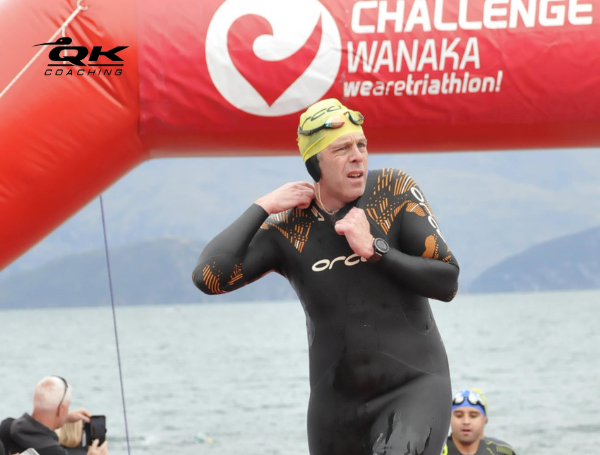
Gareth described the swim exactly as you’d hope for a first-time half ironman athlete.
He didn’t try to force it. He didn’t sprint. He simply swam at a sustainable pace and focused on getting through that first leg without digging a hole.
He came out far back in the field, but happy with how the swim had gone.
That’s a good outcome.
In longer triathlon, the swim is not the place to chase panic-driven gains. A calm, steady swim gives you the best chance of riding and running to your level later.
The bike: where the day started to shift
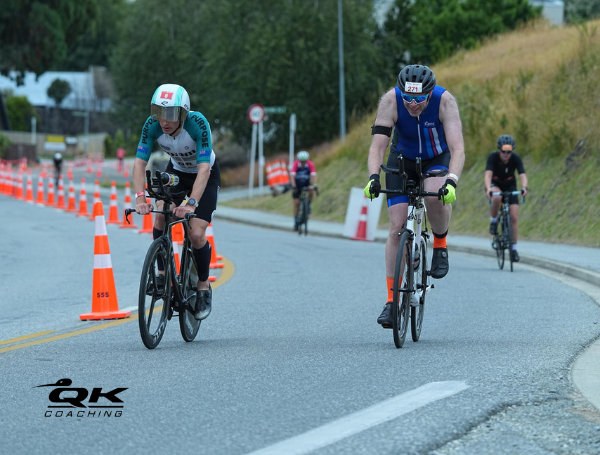
The bike was always going to be the key leg for Gareth.
He had a fueling plan. He had power targets. He had a strategy in place. But as often happens on a course like Challenge Wanaka, the terrain complicated the theory.
The climbs pushed him above where he ideally wanted to be. The descents became recovery. And while he managed the first half of the ride reasonably well, the total load of the course gradually started to catch up with him.
That’s one of the big lessons from events like this. Pacing on a hilly 90km bike leg is never just about what your plan says on paper. It’s about gearing, terrain, confidence, fatigue resistance, and how much muscular load you accumulate without fully noticing it until later.
On top of that, he also ran into neck and shoulder pain late in the ride. That forced him to stop, get off the bike, stretch, and reset before continuing.
That cost time, but more importantly it took energy — both physical and mental.
Still, he got back on the bike and kept going. That matters.
The run: where the grit showed up
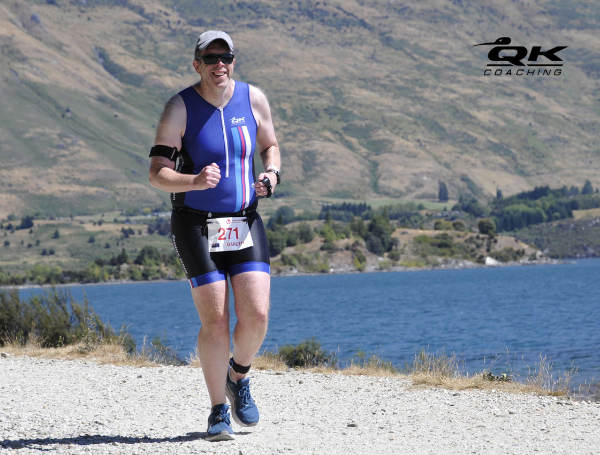
By the time Gareth hit the run, the bike had taken more out of him than he’d hoped.
He’d planned to settle into a moderate pace and run steadily. Instead, it became clear very quickly that this was going to be more of a survival run than an execution run. He found himself run-walking far earlier and far more than expected.
And this is where the debrief became really valuable.
Because this is what a lot of first half ironman runs look like.
Not dramatic collapse. Not complete disaster. Just accumulated fatigue showing up honestly.
He handled it well. He let himself walk when he needed to. He kept taking fuel on board. He didn’t waste energy fighting the reality of the day. He just kept moving forward.
At one point he had to stop and have a moment. Not a meltdown. Just an honest moment of acknowledging that this was hard and unpleasant.
Then he reset and got on with it.
That’s not failure. That’s racing.
Why the result still counts
There can be a temptation after a tough first long-course race to focus too much on what didn’t go perfectly.
The run wasn’t what he wanted. The bike became more costly than planned. Hydration may have been a little light. Training could have been better in places.
All of that can be true.
And still, the race can be a success.
Gareth set out to complete his first half ironman distance event. He did it. He managed his fueling well enough to avoid major gastric issues. He kept moving through the low points. He handled an in-race setback on the bike. He learned where the biggest opportunities for improvement are.
That is a successful first experience.
Sometimes the most important thing an athlete can prove is not how fast they can go, but that they can get through something hard and come out the other side with useful lessons.
The biggest lessons from the day
A few things stood out clearly from Gareth’s debrief.
First, brick-specific preparation would likely help a lot next time. Not just the short transition runs off long rides, but occasional more dedicated bike-to-run sessions that allow him to spend more meaningful time learning how to run under accumulated fatigue.
Second, bike durability and comfort matter. Spending more time in the TT position and improving comfort through the neck and shoulders would reduce the likelihood of the kind of issue he ran into late in the ride.
Third, he probably needs to give himself more credit. He spoke honestly about missing some sessions during the build, but he also recognised that he’d done what he could do. That’s an important distinction. Missing training because life is full is not the same as not committing.
And finally, he showed that he has real grit.
Not the dramatic kind. The useful kind. The kind that keeps moving, resets after setbacks, and refuses to drift into self-pity when the day gets hard.
That quality is a very good thing to take into your next long-course build.
Looking ahead
When we discussed future goals, Gareth talked about wanting to do another half ironman and finish more comfortably, with a meaningful improvement in time.
That’s realistic.
The biggest gains often come after the first one. Not because fitness suddenly changes overnight, but because the athlete now understands the event in a way they couldn’t before. The distance becomes less abstract. The demands are clearer. The training can become more specific.
That alone often creates a much better second race.
And in Gareth’s case, there are obvious areas where improvement is available without needing anything extreme — more comfort on the bike, more targeted brick work, and a build that better reflects the realities of his week.
That’s encouraging.
Because it means this first race wasn’t the ceiling. It was the baseline.
Final thought
A first half ironman doesn’t have to look smooth to be successful.
Sometimes it looks like a controlled swim, a bike leg that gets harder than expected, a run that turns into a grind, and a finish line crossed on determination more than momentum.
That still counts.
In fact, for many athletes balancing real life, that is exactly what success looks like.
You train as consistently as you can. You show up honestly. You manage what the day throws at you. And you finish.
From there, you build.