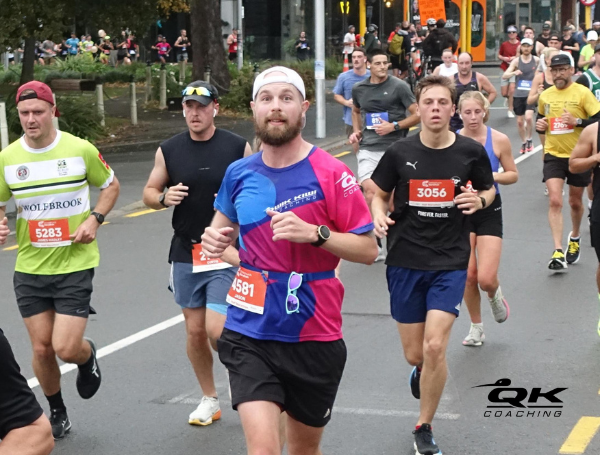
The half marathon is one of the most popular race distances in endurance sport. It is long enough to demand respect, short enough to race hard, and unforgiving if you get the basics wrong.
After catching up with Jason following his Christchurch Half Marathon performance, three themes stood out clearly. None were dramatic mistakes. None required superhuman fitness to fix. But together, they likely cost valuable minutes.
That is good news for everyday runners.
Because if common mistakes cost time, then smart adjustments can help you run faster next time.
Jason’s Christchurch Half Marathon Snapshot
Jason finished in a strong 1:48 after a solid training block. He had good aerobic fitness, some tempo work in the bank, and recent race experience from another half marathon several weeks earlier.
Yet like many runners, he walked away knowing there was more there.
That is where the real lessons begin.
Mistake #1: Starting Too Fast
This is the classic half marathon trap.
You feel fresh. The crowd is buzzing. The adrenaline is flowing. Everyone around you seems to be moving quickly.
Suddenly, your planned pace is gone.
Jason recognised early that he was running faster than intended, but like many runners in mass-start events, it was hard to slow down once caught in the flow.
The issue with starting too fast is not always obvious in the first 5km. Often it feels easy.
The bill arrives later.
When effort rises too early, energy cost increases, glycogen use rises, and the final third of the race becomes far harder than it should be.
How to Fix It
Use a disciplined opening strategy.
For many runners, the smartest first 3km looks like this:
That means starting 5–10 seconds per kilometre slower than goal pace, then gradually building.
This feels conservative early. That is usually a sign you are doing it right.
Mistake #2: Assuming Nutrition Will Be Available
Jason planned to take in gels around the course, assuming gels would be supplied at the aid stations.
They were not.
That left him racing the half marathon with no fuel intake.
Can you complete a half marathon without nutrition? Often yes.
Can it make the final stages harder than necessary? Absolutely.
Especially when combined with an aggressive start.
How to Fix It
Never assume race logistics.
Read the athlete guide. Check aid station details. Carry your own gel if needed.
For many runners targeting 90 minutes to 2 hours+, gels during the race can be useful. Typically every 20-30 minutes.
Simple wins matter.
Mistake #3: Letting the Tough Patch Become Personal
Late-race discomfort is normal.
But many runners interpret slowing slightly as failure.
Jason described the final kilometres feeling like a battle. Yet when we reviewed the data, the slowdown was modest rather than catastrophic.
That distinction matters.
Many runners mentally spiral because the race feels worse than it objectively is.
When emotion overrides data, pacing decisions, posture, and motivation can suffer.
How to Fix It
Break the race into landmarks.
Instead of thinking “I have 5km left,” think:
- Get to the next corner
- Get to the next drink station
- Hold form for 60 seconds
- Relax shoulders
- Quick feet
This shortens the mental horizon and helps you keep racing.
What Jason Actually Did Well
It is easy to focus only on mistakes, but there were plenty of positives:
- Strong base fitness
- Good recent consistency
- Solid middle section of the race
- Mentally stayed engaged when challenged
- Finished strongly enough for a quality result
- Honest reflection afterwards
That final point is underrated.
Runners improve fastest when they review performance honestly without drama.
What Most Half Marathoners Can Learn
You do not always need more mileage or harder sessions.
Sometimes the biggest gains come from better execution:
- Smarter first 5km pacing
- Clear nutrition plan
- Composure during the hardest section
- Confidence built through training
That can be worth minutes.
If You’re Chasing a Faster Half Marathon Time
Before your next race, ask yourself:
- What pace will I run in the first 3km?
- What is my fuel and hydration plan?
- How will I respond when it gets hard at 16km?
- Am I trying to prove fitness too early?
Those answers often predict the result.
Need Help With Your Half Marathon Training?
If you want to run a smarter, faster half marathon with a proven training structure, pacing strategy, and accountability, coaching can make the difference.
Visit QWIK KIWI through www.CoachRay.nz and get in touch, or book an obligation FREE consultation belowc.
Your next PB may not require more suffering.
It may simply require fewer mistakes.