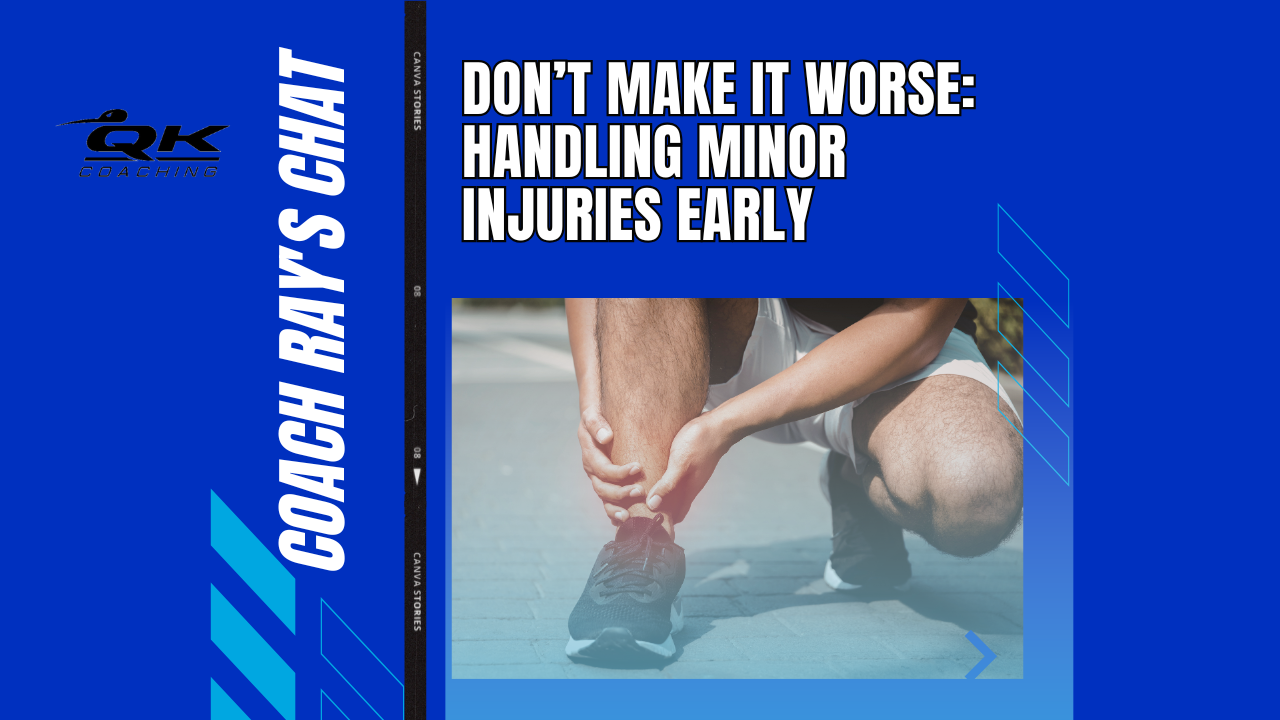
Most injuries don’t sideline endurance athletes because of what they are.
They sideline them because of what happens in the first 24–48 hours.
That’s the part most people get wrong.
A small niggle—tight calf, sore knee, irritated Achilles, a bit of lower back tightness on the bike—doesn’t need much to tip from “manageable” to “weeks off”. And more often than not, it’s not the injury itself that causes the problem… it’s the decisions that follow.
I’ve done it myself recently with a calf. Thought I could run through it. Thought it would settle. It didn’t.
And that’s exactly why this matters.
If you can get those first couple of days right, you stay consistent.
If you don’t, you’re forced to stop.
The First Question: Can I Keep Training?
This is always the starting point.
And this is where most athletes either make a smart call… or dig a hole.
A simple way to think about it:
If the pain settles as you warm up, stays mild, and your movement feels normal, you’re usually okay to continue—but easy only.
If the pain builds during the session, or you find yourself subtly changing your movement—shortening your stride, favouring one side on the bike, altering your swim stroke—that’s your signal to stop.
That “I’ll just get through this session” mindset is what turns a small issue into something more stubborn.
You’re not being soft by stopping.
You’re being smart.
The First 48 Hours Matter More Than You Think
This isn’t a “wait and see” period.
It’s a decision window.
What you do here will either:
- Settle things down quickly
- Or keep the irritation going
You don’t need the perfect rehab plan at this stage. You don’t need to diagnose it yourself.
You just need to avoid making it worse.
What To Do Instead
This is where athletes often go wrong. They either do too much… or nothing at all.
What you’re aiming for is somewhere in the middle.
Reduce the load—but don’t completely shut things down.
That might mean:
- No intensity (no intervals, no hard efforts)
- Shorter sessions or easier efforts
- Swapping to another discipline that doesn’t aggravate it (e.g. cycling instead of running, or easy swimming if pain-free)
At the same time, keep things moving.
Gentle movement helps. Sitting around waiting for it to “heal” doesn’t.
Add in a bit of light activation—glutes, calves, hips, or stabilisers depending on what’s going on. Nothing aggressive. Just enough to keep things switched on.
You’re trying to create the right environment for recovery… not force it.
The Mistakes That Make It Worse
Most athletes don’t realise they’re making these at the time.
Pushing through because “it’s not that bad” is probably the most common one.
Then there’s the opposite—doing nothing for a few days, feeling slightly better, and jumping straight back into normal training as if nothing happened.
Another big one is the “test it” trap. Doing a harder session just to see if it’s okay yet.
And then there’s trying everything at once—every stretch, every strength exercise, every bit of advice you can find.
None of these help.
They just keep you stuck in that frustrating cycle of almost improving… then flaring it up again.
When To Get It Checked
You don’t need to rush off to a physio at the first sign of a niggle.
But you do need to recognise when it’s not settling.
If it’s not improving after a few days, or it’s getting worse despite backing off, that’s your cue.
Sharp, localised pain—especially anything that feels bone-related—is another one to take seriously.
Same with swelling, instability, or anything that’s clearly changing how you move.
That’s not the time to push through.
That’s the time to get a proper assessment.
How This Fits Into Your Training
This is where endurance athletes actually have an advantage.
You’ve got options.
If running is aggravating something, you might still be able to cycle or swim.
If cycling is the issue, you might be able to run easy or get in the water.
The goal isn’t to stop training altogether.
It’s to adjust the load so you can keep moving forward without digging the hole deeper.
Consistency doesn’t come from doing everything perfectly.
It comes from making smart adjustments when things aren’t perfect.
The 48-Hour Rule
Keep it simple.
After a couple of days, ask yourself:
Is it improving?
Is it the same?
Or is it getting worse?
If it’s improving, you can start to build things back gradually.
If it’s the same, keep things easy and give it more time.
If it’s getting worse, that’s your signal to stop and reassess.
Final Thought
You don’t need better rehab plans to stay injury-free.
You need better decisions early.
Get the first 48 hours right…
…and you stay consistent.
Get them wrong…
…and you’re forced to stop.
Want to Talk about Your Training?
If you’d like help managing your training—especially around niggles and injuries—so you can stay consistent and keep progressing: