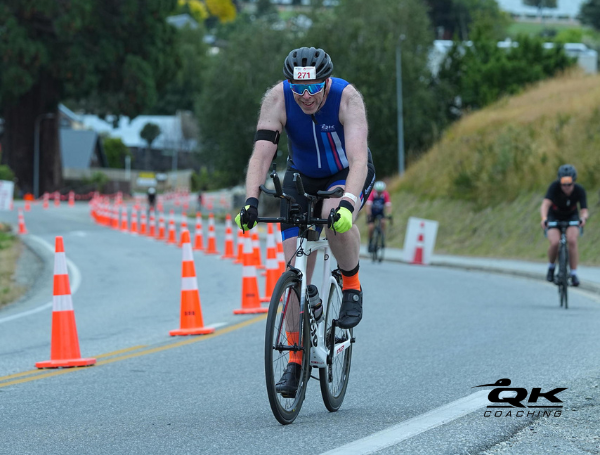
Hills have a reputation for destroying races.
Athletes fear them. They talk about them before race day. They worry about them during training.
But here’s the reality:
Most athletes don’t lose time because of the hill itself.
They lose time because of how they respond to it.
Whether you’re racing an Ironman 70.3, a standard distance triathlon, or even a running event, poor hill pacing can turn a strong race into a struggle. The good news is that it’s one of the easiest mistakes to fix.
The Common Hill Mistake
Imagine you’re riding along comfortably on the bike when a climb appears ahead.
Almost immediately, many athletes do one of two things:
- They attack the hill aggressively.
- They try to maintain exactly the same speed they were riding on the flat.
Both approaches usually lead to trouble.
To maintain the same speed uphill requires significantly more power output. That extra effort might only last a few minutes, but it can have consequences that last for hours.
The same thing happens on the run.
Athletes try to hold pace rather than effort, pushing harder and harder as the gradient increases.
By the time they reach the top, breathing is out of control, heart rate has spiked, and valuable energy has been wasted.
Race Pace vs Race Effort
One of the biggest mindset shifts athletes can make is learning the difference between pace and effort.
Speed changes.
Effort should stay relatively controlled.
When you encounter a hill, it’s perfectly normal for your pace to slow.
That’s not a sign of weakness.
That’s physics.
The athletes who perform best on hilly courses understand this. They focus on maintaining a sustainable effort rather than forcing a particular pace.
Instead of asking:
“How fast am I going?”
Ask:
“How hard am I working?”
The answer to that question is far more important.
Riding Hills in an Ironman 70.3
During an Ironman 70.3 bike leg, every unnecessary surge comes with a cost.
The athletes who ride best on hilly courses typically:
- Shift gears early.
- Maintain a smooth cadence.
- Allow speed to decrease naturally.
- Avoid standing unnecessarily.
- Stay within their planned effort range.
What they don’t do is attack every climb as if it’s the deciding moment of the race.
Because it rarely is.
A small gain on a hill can create a much larger loss later in the run.
Remember, the goal of the bike leg isn’t simply to ride fast.
It’s to arrive at T2 ready to run well.
Running Hills Without Blowing Up
The same principles apply during the run.
Many athletes try to maintain the same pace uphill that they were running on flat ground.
This almost always leads to a spike in effort.
A smarter strategy is to:
- Shorten your stride.
- Increase cadence slightly.
- Maintain good posture.
- Focus on controlled breathing.
- Accept that pace will slow.
If your effort stays under control, you’ll often regain any “lost” time naturally once the terrain levels out.
The Downhill Mistake
Overreacting doesn’t only happen uphill.
Many athletes waste energy flying downhill as well.
While downhills can provide free speed, aggressively attacking them can increase muscular fatigue and damage, particularly in the quadriceps.
This becomes especially important late in an Ironman 70.3 when every bit of energy matters.
Run and ride the downhills smoothly.
Let gravity help you rather than fighting it.
A Better Way to Think About Hills
The next time you see a hill during training or racing, don’t think of it as an obstacle.
Think of it as a pacing test.
The athletes who manage hills best aren’t necessarily the strongest athletes.
They’re often the most disciplined.
They resist the urge to surge.
They stay patient.
They trust their plan.
And when the race enters its final stages, they’re usually the athletes still moving well.
Final Thoughts
Hills are part of endurance sport.
You can’t avoid them.
But you can control how you respond to them.
The next time you encounter a climb, remember:
Don’t chase speed.
Control effort.
Stay smooth.
Stay patient.
Because hills aren’t slowing you down.
Overreacting to them is.
Ready to Take the Guesswork Out of Your Ironman 70.3 Training?
Every successful Ironman 70.3 starts with a plan.
Not just a training plan, but a clear strategy for balancing swim, bike, run, recovery, nutrition, and race-day execution.
If you’re preparing for your first Ironman 70.3, chasing a personal best, or simply want confidence that you’re training the right way, I’d be happy to help.
Book a free, no-obligation coaching consultation and let’s discuss your goals, your current training, and the biggest opportunities to improve your performance.
You’ll leave the call with practical advice and a clearer understanding of what your next steps should be—whether we end up working together or not.