When runners talk about half marathon pacing, the conversation usually focuses on two parts of the race.
The start.
And the finish.
You’ll hear advice about not going out too hard. You’ll hear stories about digging deep over the final few kilometres.
But there’s a section of the race that receives far less attention, despite being where many personal best attempts quietly unravel.
The middle.
Specifically, the kilometres between roughly 6K and 15K.
This is where races are often won or lost.
The Middle Is Where Discipline Matters
The opening few kilometres are relatively easy to manage.
You’re fresh. The crowds are around you. Adrenaline is high.
Most runners know they need to be careful not to get carried away.
The final few kilometres are also relatively straightforward mentally.
The finish line is getting closer. You can sense the end. You know exactly what you’re working towards.
The middle is different.
The excitement of the start has faded.
The finish still feels a long way away.
You’re no longer running on adrenaline, but fatigue hasn’t fully arrived yet either.
It’s an awkward section of the race where focus often drifts.
And that’s where mistakes happen.
The Trap of Chasing Other Runners
One of the biggest pacing errors occurs during the middle section.
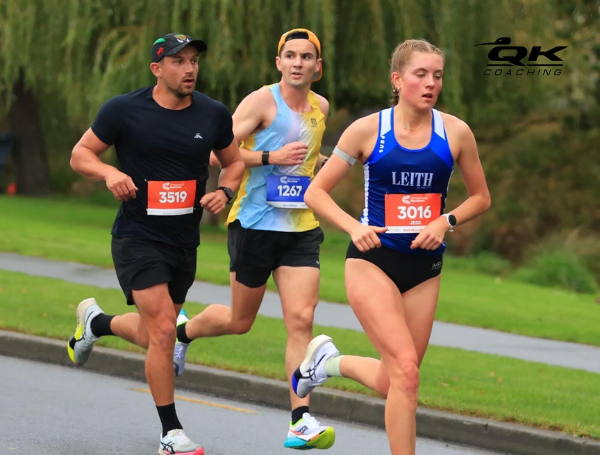
You settle into your rhythm and suddenly another runner comes past.
Then another.
Maybe a small group forms ahead of you.
The temptation is immediate.
“Maybe I should go with them.”
Sometimes that decision works.
More often, it doesn’t.
The problem is that you’re making decisions based on somebody else’s race plan rather than your own.
You have no idea what pace they’re targeting.
You don’t know their fitness level.
You don’t know whether they’re running intelligently or setting themselves up for a difficult final 5K.
Your job is not to race their plan.
Your job is to execute yours.
Why Small Pacing Errors Become Big Problems
The difference between a great half marathon and a disappointing one is often surprisingly small.
Running 5 to 10 seconds per kilometre too fast through the middle section might not feel significant at the time.
In fact, it often feels manageable.
That’s exactly why it’s dangerous.
Small pacing errors accumulate.
The extra effort gradually increases fatigue levels, uses more glycogen, and places additional stress on your body.
Everything can feel fine until suddenly it doesn’t.
Then, somewhere around 16K or 17K, the pace you’ve been holding comfortably starts feeling far less comfortable.
The bill arrives late.
But it always arrives.
Run the Pace You Trained For
The purpose of your training isn’t simply to build fitness.
It’s also to teach you what your goal pace feels like.
By race day, your target pace should feel familiar.
You should recognise the breathing rhythm.
You should understand the level of effort required.
You should know the difference between sustainable discomfort and unsustainable enthusiasm.
The middle kilometres are where that familiarity becomes valuable.
Rather than reacting emotionally to what’s happening around you, you can simply settle into the effort you’ve practised repeatedly during training.
The Best Half Marathoners Look Boring
Watch experienced runners during the middle section of a race.
Very little happens.
They’re not surging.
They’re not responding to every move.
They’re not constantly checking their watch.
They’re simply maintaining rhythm.
From the outside, it can look almost boring.
But that’s exactly the point.
Consistency wins.
Every unnecessary acceleration costs energy.
Every emotional decision increases risk.
The best runners understand that the middle section is not where you prove your fitness.
It’s where you protect it.
Save Your Racing for the Final 5K
The purpose of pacing the middle well isn’t simply to avoid blowing up.
It’s to create an opportunity later.
When you manage the middle section correctly, you arrive at the final 5 kilometres with options.
You can increase the effort.
You can respond to competitors.
You can chase a time goal.
You can actually race.
That’s a much better position to be in than simply trying to hold on.
Trust the Process
Half marathon success often comes down to patience.
The runners who perform best are rarely the ones who feel strongest at 5K.
They’re usually the ones still running strongly at 18K.
And that starts by respecting the middle section of the race.
Stay disciplined.
Trust your pace.
Trust your training.
And remember that half marathons are rarely won in the middle kilometres—but they’re often lost there.
Ready to Build a Smarter Half Marathon Plan?
If you’re preparing for a half marathon and want help with pacing, training structure, race-day preparation, or setting realistic performance goals, book a free 40-minute coaching consultation.
We’ll discuss your current fitness, your race goals, and the training approach that gives you the best chance of success on race day.
No pressure. No hard sell. Just practical advice to help you train and race with confidence.