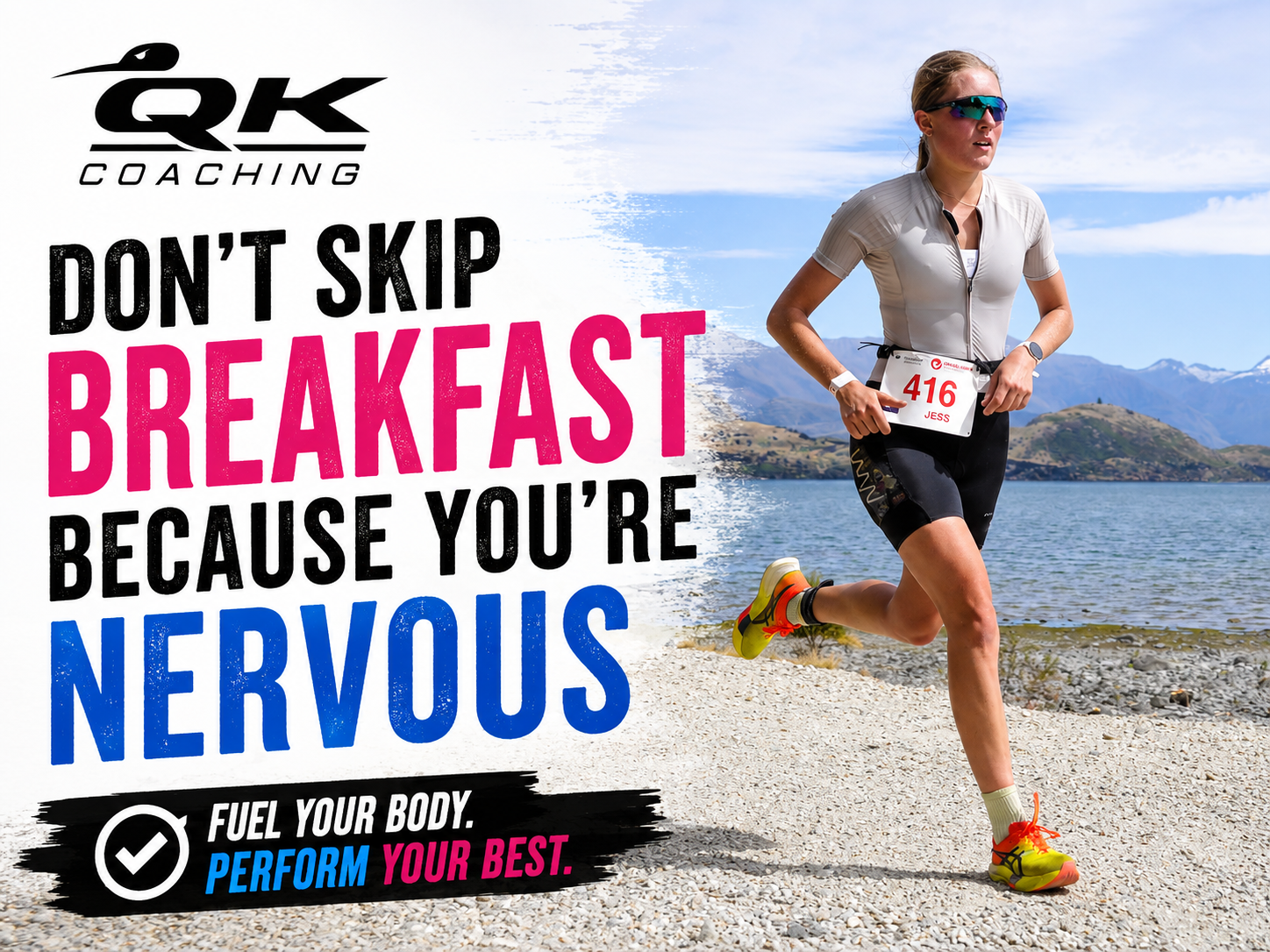
Your alarm goes off ridiculously early.
You’ve barely slept.
Your stomach is full of butterflies.
And the very last thing you feel like doing is eating breakfast.
Sound familiar?
Race-day nerves can completely change your appetite. Foods you normally enjoy suddenly seem impossible to swallow, and it’s tempting to tell yourself:
“I’ll be fine. I’ll just start fuelling once I’m on the bike.”
That’s a risky way to begin an Ironman 70.3.
You might not feel hungry, but your body still needs fuel.
Nerves Don’t Reduce Your Energy Requirements
An Ironman 70.3 is a long endurance event.
You’ve got a 1.9km swim, a 90km bike ride, and a 21.1km run ahead of you.
Skipping breakfast doesn’t make those demands disappear.
A carbohydrate-rich breakfast helps replenish available carbohydrate before you start racing.
Think of it this way:
You’ve spent months preparing the engine.
Race morning isn’t the time to deliberately start with less fuel in the tank.
“But I Can’t Eat When I’m Nervous”
This is the real problem for many athletes.
They know they should eat.
They simply don’t feel like they can.
That’s why your race-morning breakfast needs to be something you’ve practised—not something you decide upon when you wake up on race day.
If nerves affect your appetite, experiment during training with foods that are easy for you to consume and digest.
That could include options such as:
- Toast or a bagel.
- A banana.
- Low-fibre cereal.
- Porridge or oatmeal, if you tolerate it well.
- Rice or rice-based foods.
- Applesauce.
- Sports drink.
- A liquid or semi-liquid meal if solid food is particularly difficult.
There’s no magical Ironman breakfast that works for everyone.
The best breakfast is one that provides the fuel you need and that your stomach reliably tolerates.
Give Yourself Time
This is one reason Ironman 70.3 race mornings often start so early.
Eating well before the start gives your body time to digest your breakfast before you’re standing on the start line.
Sports nutrition guidelines commonly recommend carbohydrate in the hours before prolonged exercise, but your appropriate quantity and timing depend on your body size, tolerance, normal diet, start time, and the strategy you’ve rehearsed in training.
For many athletes, eating several hours before the start works well.
If that means setting the alarm earlier, set the alarm earlier.
I’d much rather have an athlete sacrifice a little extra time in bed than arrive at the swim start having skipped breakfast because they ran out of time.
Keep It Familiar
Race morning isn’t the time to experiment.
Don’t suddenly decide that because another athlete is eating a huge bowl of porridge, three bananas, and four slices of toast, you should do the same.
Their breakfast has nothing to do with yours.
Eat what you’ve practised.
The same principle applies to coffee, sports drinks, gels, supplements, and anything else you intend to consume before the start.
If you haven’t tested it in training, race morning is a poor time to discover how your digestive system responds.
Keep Fat and Fibre Sensible
A large, heavy breakfast may create a different problem.
Foods particularly high in fat or fibre can take longer to digest and may increase the chance of gastrointestinal discomfort for some athletes.
Your race-morning meal should generally emphasise carbohydrate while being relatively easy to digest.
Again, individual tolerance matters.
Some athletes can comfortably eat foods that would leave another athlete desperately searching for the nearest toilet.
That’s precisely why practice matters.
Practise Breakfast During Training
Athletes spend hours practising swimming, cycling, and running.
Race nutrition deserves practice too.
Before some of your important long rides or brick sessions, rehearse your complete race-morning routine.
Wake up.
Eat your planned breakfast.
Drink what you’re planning to drink.
Wait approximately the same amount of time you’ll have before your race.
Then train.
Pay attention to how you feel.
Were you hungry?
Did you feel too full?
Did you experience bloating or stomach discomfort?
Did you have good energy?
Could you comfortably begin fuelling once you were on the bike?
Use those sessions to refine your strategy.
By race week, breakfast shouldn’t be an experiment.
It should be a routine.
What If You Really Struggle With Solid Food?
For athletes whose appetite disappears completely when they’re nervous, liquid carbohydrate can sometimes be easier to manage than a large solid meal.
That doesn’t mean you should suddenly switch to a liquid breakfast on race morning.
Practise it first.
You might find that a combination of smaller amounts of familiar solid food and carbohydrate-containing fluids is much easier to tolerate than forcing down one enormous meal.
The goal isn’t to win a breakfast-eating competition.
It’s to arrive at the swim start appropriately fuelled without making yourself uncomfortable.
Don’t Rely on Fixing It Later
A common thought is:
“I’ll just eat more on the bike.”
But your on-course fuelling strategy already has a job to do.
It’s there to help supply carbohydrate and fluid as the race progresses.
Starting underfuelled and then trying to compensate by suddenly consuming much more than you’ve practised can create another problem—particularly if your gut isn’t accustomed to processing that quantity while exercising.
Start with the breakfast you’ve practised.
Then follow the race fuelling strategy you’ve practised.
Don’t create a nutritional deficit before you’ve even entered the water.
Make Breakfast Part of Your Race Plan
You probably have a target effort for the bike.
You probably know approximately how you want to pace the run.
You may know when you’ll take your gels, how much you’ll drink, and what you’ll carry in transition.
Your breakfast deserves the same level of planning.
Before race week, you should know:
- What you’re going to eat.
- Approximately how much you’re going to eat.
- When you’re going to eat it.
- What you’re going to drink.
- Whether you’ll use caffeine.
- Whether you need anything between breakfast and the swim start.
Then make sure you’ve got everything you need before race morning.
That’s one less decision to make when you’re nervous.
Final Thoughts
Feeling nervous before an Ironman 70.3 is normal.
Losing your appetite can be normal too.
But skipping breakfast shouldn’t automatically become the solution.
Your body has a long day ahead of it, regardless of whether your stomach is asking for food.
Develop a breakfast strategy during training.
Keep it familiar.
Give yourself enough time to eat and digest it.
Adjust the foods and quantities to suit your individual tolerance.
Then trust the routine you’ve practised.
Because when you’re standing on the start line with 113 kilometres ahead of you, you want your nerves to be the only thing giving you butterflies.
Not an empty stomach.
Need Help Getting Your Ironman 70.3 Race Strategy Right?
Successful Ironman 70.3 racing isn’t just about swim, bike, and run fitness. Your pacing, fuelling, preparation, and race-day decisions all need to work together.
If you’re preparing for your first Ironman 70.3, chasing a personal best, or aren’t sure whether your current training and race strategy are setting you up for success, I’d be happy to help.
Book a free, no-obligation 40-minute coaching consultation and we can discuss your goals, current training, and preparation for race day.
You’ll leave with practical advice and a clearer idea of your next steps, whether we end up working together or not.