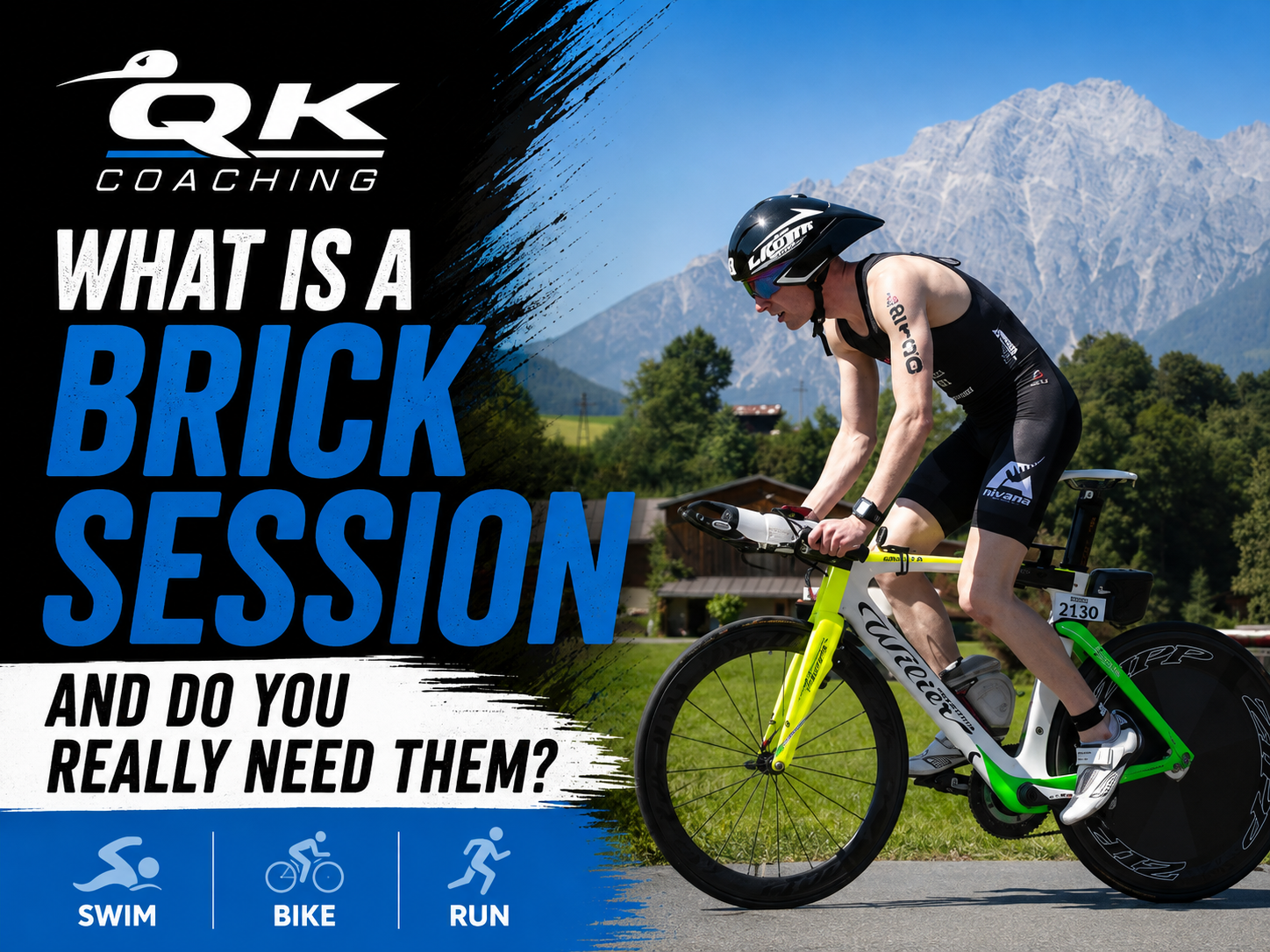
If you’re training for an Ironman 70.3, sooner or later you’re going to hear someone talking about a brick session.
For experienced triathletes, bricks are simply part of training. But if you’re preparing for your first Ironman 70.3, you might reasonably wonder what they are, why people do them, and whether you really need to include them.
A brick session simply combines two disciplines back-to-back, usually cycling followed immediately by running.
And yes, they can be extremely useful.
But that doesn’t mean every bike ride needs to finish with a run.
Like almost everything in endurance training, the key is understanding why you’re doing the session.
What Is a Brick Session?
A brick workout involves completing one discipline and moving almost immediately into another.
For Ironman 70.3 athletes, that normally means:
Bike → Run
You might complete a 90-minute ride and then immediately head out for a 15-minute run.
Or later in your preparation, you might complete a longer race-specific ride followed by a more substantial run.
The transition between the two should generally be relatively quick. You’re trying to recreate the experience of getting off the bike and beginning to run rather than taking a long recovery before starting the second session.
Why Is It Called a Brick?
There are various explanations for where the term originated, but the sensation provides a pretty good description.
Your legs can feel like bricks.
You step off the bike feeling perfectly capable of running, only to discover that your first few hundred metres feel awkward.
Your stride feels strange.
Your cadence might be different.
Your legs can feel heavy.
Fortunately, that sensation usually settles reasonably quickly.
And one of the purposes of brick training is becoming familiar with it.
Why Does Running After Cycling Feel So Strange?
Cycling and running use many of the same muscles, but they use them differently.
You’ve also spent potentially several hours sitting on a bike before suddenly asking your body to support your weight and run.
Your posture changes.
Your movement pattern changes.
The muscular demands change.
Your perception of pace can also become distorted.
That last point is particularly important.
After cycling at a relatively high cadence, you can start running and feel as though you’re moving slowly—even when you’re actually running considerably faster than planned.
That’s one of the biggest lessons a brick session can teach you.
Brick Sessions Aren’t Just About Toughening Your Legs
Athletes sometimes think the purpose of a brick is simply to make running harder.
That’s not really the point.
You’re not trying to destroy your legs.
You’re teaching your body—and your brain—how to manage the transition between disciplines.
That includes learning how your legs feel, finding your running rhythm, controlling your pace and understanding how your nutrition and hydration strategy affects the run.
A good brick session is therefore as much about race execution as physical conditioning.
Bricks Teach You to Control the Start of the Run
One of the easiest Ironman 70.3 mistakes is getting off the bike and running too quickly.
You feel excited.
The crowds around transition give you a lift.
Your legs are turning over quickly.
Your planned pace feels almost ridiculously slow.
So you run faster.
That might feel fantastic for the first couple of kilometres.
Unfortunately, you’ve still got most of a half marathon ahead of you.
A brick provides an opportunity to practise restraint.
When you begin the run, deliberately settle into your planned intensity. For many sessions, that may mean starting around Level II rather than immediately chasing pace.
Learning to control those opening minutes during training makes it much easier to do the same thing on race day.
You Don’t Need to Run Long Off the Bike
This is where many athletes get brick training wrong.
They assume that because they’ll eventually run 21.1 kilometres after cycling 90 kilometres, their brick sessions need to replicate that.
They don’t.
You can gain considerable benefit from a relatively short run off the bike.
Sometimes 10–20 minutes is enough.
The objective might simply be to experience the transition, establish good running mechanics and settle into an appropriate intensity.
You don’t necessarily need another hour of running to achieve that.
Remember that you’re already accumulating fatigue from your other training sessions. Adding unnecessarily long brick runs can increase recovery demands without providing enough additional benefit to justify them.
Not Every Ride Needs to Become a Brick
Once athletes discover brick training, there’s a temptation to add a run after every ride.
More isn’t automatically better.
Your programme already needs to balance swimming, cycling, running, recovery and potentially strength training.
If every ride includes a run, you’re adding more running frequency and impact to your week.
That additional load needs to be accounted for.
A brick should be included because it achieves a specific training objective—not simply because you’re a triathlete.
When Should You Start Doing Brick Sessions?
You don’t need to make brick sessions a major focus from the beginning of your Ironman 70.3 preparation.
Early in your training, developing consistency and building your aerobic foundation are generally more important.
Become comfortable swimming regularly.
Develop your cycling endurance.
Build your running durability.
As your fitness develops, brick sessions can progressively become more relevant.
Initially, that might be as simple as a short Level I–II run after an endurance ride.
Later, your bricks can become more specific to the demands of your Ironman 70.3.
The training should evolve as you do.
Race-Specific Brick Sessions
As race day approaches, some brick sessions can become increasingly specific.
For example, you might use a longer ride to practise your Ironman 70.3 pacing and fuelling before transitioning into a controlled run.
Now you’re rehearsing several things simultaneously:
Your bike pacing.
Your fuelling.
Your hydration.
Your transition routine.
Your opening run pace.
Your ability to maintain good running form while fatigued.
This is where brick training becomes particularly valuable.
You’re no longer simply building fitness.
You’re learning how to put your fitness together.
Practise Your Fuelling During Bricks
Brick sessions are also an excellent opportunity to test your race-day nutrition.
The question isn’t only whether you can consume enough carbohydrate and fluid on the bike.
It’s whether you can then get off the bike and run comfortably.
A fuelling strategy that looks perfect on paper isn’t particularly useful if your stomach rebels five kilometres into the run.
Use appropriate brick sessions to practise what you intend to eat and drink during your Ironman 70.3.
Experiment during training.
Refine the strategy.
Then arrive on race morning already knowing what works for you.
Practise Transition Too
Your transition doesn’t need to resemble a Formula One pit stop.
But it should be familiar.
Brick sessions give you an opportunity to practise simple things such as getting off the bike, changing shoes, putting on your running gear and heading out efficiently.
You can also learn which equipment arrangements work best for you.
The objective isn’t necessarily shaving ten seconds from transition.
It’s reducing uncertainty.
On race day, you want the process to feel familiar.
Don’t Turn Every Brick Into a Race
This is another common mistake.
You finish your ride, pull on your running shoes and immediately hammer the run because you want to know whether you can run your goal half-marathon pace.
That’s not always what the session requires.
Sometimes the correct brick run is deliberately easy.
Sometimes it might progress through different intensities.
Sometimes it may contain race-specific work.
The intensity should be determined by the purpose of the workout.
Don’t measure the quality of a brick session by how exhausted you are afterwards.
Measure it by how well you executed what was prescribed.
So, Do Ironman 70.3 Athletes Really Need Brick Sessions?
Strictly speaking, you could become very fit without doing them.
You can develop excellent cycling fitness by cycling.
You can develop excellent running fitness by running.
But Ironman 70.3 isn’t a collection of three independent sporting events.
You don’t complete the swim, recover for a few hours, ride 90 kilometres, have another rest and then begin a half marathon.
Everything happens continuously.
That’s why some brick training is valuable.
It teaches you how to connect your cycling fitness to your running fitness.
And that is a skill worth practising before race day.
The Bottom Line
Brick sessions are an important tool for Ironman 70.3 preparation, but they don’t need to dominate your training.
Start by building the foundations.
Develop consistency across swimming, cycling and running.
Then introduce bricks progressively and with a clear purpose.
A short run off the bike can teach you how the transition feels. More specific bricks later in your programme can help refine pacing, fuelling, hydration and race execution.
You don’t need to prove that you can survive the entire race during training.
You need to prepare your body to handle the demands of race day.
Build the fitness first.
Then learn how to put it together.
Build Your Ironman 70.3 Foundation First
Before worrying about big brick sessions, race-specific workouts and how fast you can run off the bike, you need the foundations that allow you to handle that training consistently.
Foundation First is designed to help you establish those foundations across swimming, cycling and running before progressing into more demanding Ironman 70.3 preparation.
Rather than rushing towards the hardest sessions, you’ll focus on building the consistency, aerobic fitness and durability that give your later training somewhere to go.
Build the foundation now, and you’ll be in a much better position to handle the training that comes next.