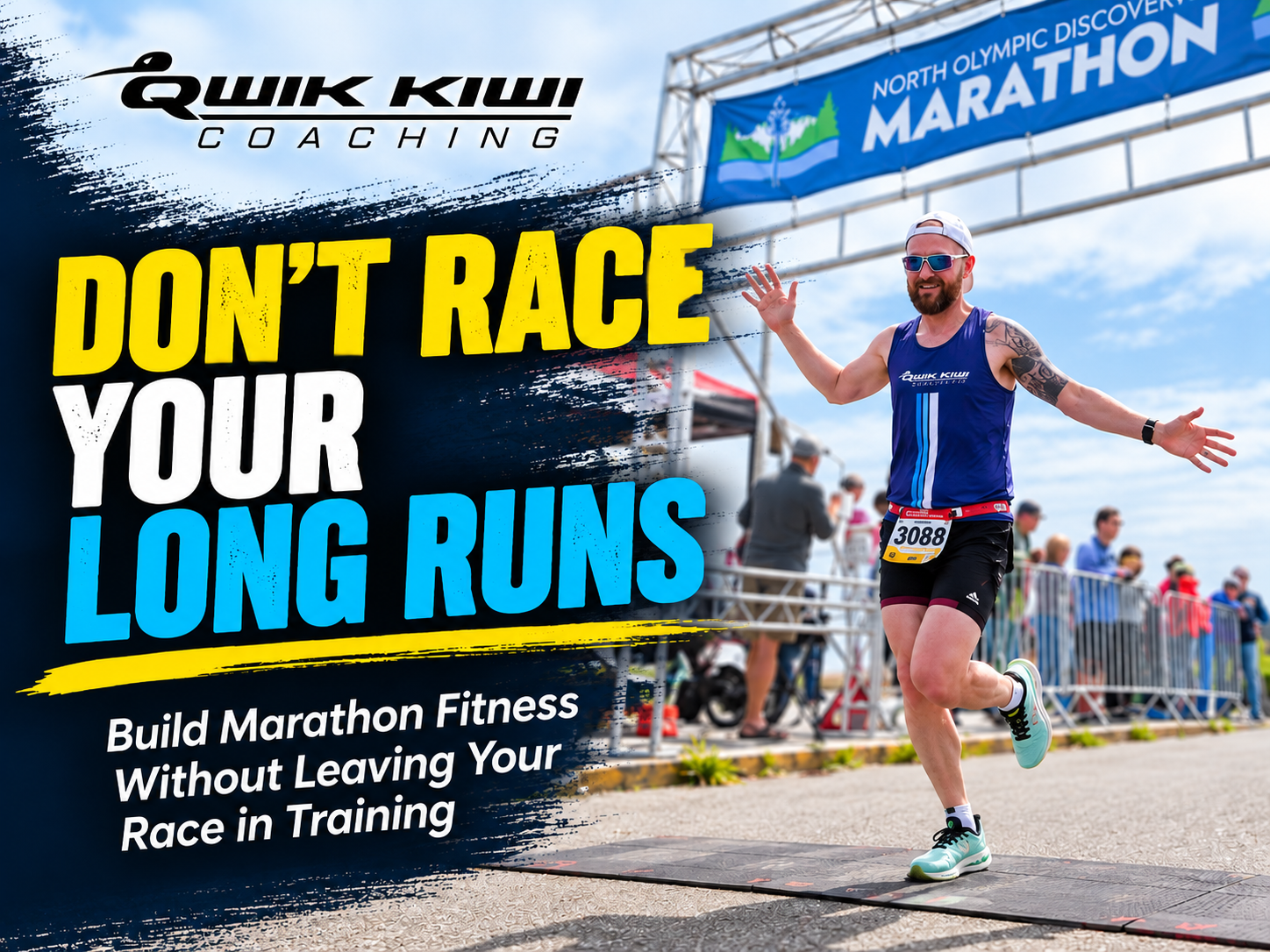
The long run is one of the most important sessions in marathon training. It develops the endurance and durability you’ll need to keep moving efficiently when 30 kilometres becomes 35, and 35 becomes 40.
But because the long run feels so important, it’s also one of the easiest sessions to get wrong.
You finish one long run feeling strong, so the following week you push a little harder. Then you decide to finish the final few kilometres quickly. Before long, Sunday morning has quietly turned into your weekly race.
For most marathon long runs, that isn’t the goal.
You don’t need to prove your marathon fitness every weekend. You need to build it.
Your Long Run Isn’t a Weekly Fitness Test
There’s something psychologically satisfying about finishing a long run faster than expected.
You look at your average pace afterwards and think, That was a good one.
But the quality of a marathon long run shouldn’t automatically be judged by how quickly you completed it.
The purpose of most long runs is to accumulate sustained aerobic work, develop endurance and improve your ability to tolerate the duration and fatigue associated with marathon running. Long runs are widely regarded as a cornerstone of marathon preparation for exactly these reasons.
That requires patience.
If your programme says to complete the run at Level II, then completing it at Level II is the successful workout.
Running faster than prescribed doesn’t automatically make it better.
Why Marathon Runners Race Their Long Runs
Marathon training can create uncertainty.
You’re preparing to run 42.2 kilometres, but you won’t normally cover the entire race distance during training. That can leave you wanting reassurance that your training is working.
So the long run becomes an opportunity to test yourself.
You might push the pace because you feel good. You might try to beat last week’s average pace. You might chase someone who passes you. Or perhaps you start wondering whether you can hold marathon pace for the remainder of the run.
None of these things necessarily feel reckless in the moment.
The problem is that you’ve changed the purpose of the workout.
Instead of training, you’re now testing.
Running Faster Creates a Recovery Cost
A harder long run doesn’t finish when you stop your watch.
You still have to recover from it.
Push too hard and you may carry unnecessary fatigue into the following days. Your easy runs become harder. Your next quality workout suffers. You may need additional recovery, or you start your next training week already tired.
Excessive fatigue following long runs can interfere with subsequent training and, when it becomes a repeated pattern, contribute to burnout or injury.
That’s why the question shouldn’t be:
“How hard can I run today?”
A better question is:
“What do I need to do today so I can complete the rest of my training well?”
Marathon training is a sequence of workouts, not a collection of isolated performances.
Keep Your Level II Long Runs at Level II
For Qwik Kiwi athletes, a standard aerobic long run will typically be completed at Level II.
That should feel controlled and conversational.
The exact pace may change from week to week—or even during the same run.
Heat, wind, hills, accumulated fatigue, sleep and many other factors can affect the pace required to maintain the appropriate effort.
This is why I don’t want you chasing a particular pace simply because you ran that pace last week.
If maintaining Level II means slowing down, slow down.
Easy and aerobic running is supposed to be manageable; pushing the pace simply to produce a better-looking number on your watch can undermine the purpose of the session.
But Aren’t Some Long Runs Supposed to Be Faster?
Yes—and this distinction is important.
“Don’t race your long runs” does not mean every kilometre of every marathon long run must always be easy.
Depending on where you are in your marathon programme, I may deliberately prescribe faster running within a long run.
That could include sections at a specific intensity or marathon-related pace, or a progressive structure where the intensity changes later in the session.
Race-specific running within long runs can be a valuable component of marathon preparation when it is deliberately programmed and appropriately spaced.
The difference is purpose.
If your programme says:
Level II for 120 minutes
then that’s the workout.
If your programme deliberately includes a faster section, then that is the workout.
What I don’t want is for you to turn the first session into the second simply because you were feeling good.
Don’t Race the Final Few Kilometres Just Because You Can
This is another common trap.
You’ve completed most of your long run comfortably. You’re feeling surprisingly good, so you decide to “open up” for the final 20 minutes.
It feels fantastic.
And occasionally, when a faster finish is prescribed, that can be a useful training stimulus.
But doing it spontaneously every week changes the training load.
There’s nothing wrong with finishing a Level II long run thinking:
“I could have gone faster.”
In fact, that can be exactly where I want you.
You’ve completed the required endurance work without unnecessarily emptying the tank.
Stop Competing With Your Training Partners
Running with other people can make long runs much more enjoyable, but it can also make pacing more difficult.
Maybe your training partner is fitter than you.
Maybe they’re training for a different event.
Maybe their Level II pace simply isn’t your Level II pace.
Or perhaps neither of you wants to be the first person to admit that the pace has crept up.
Your body doesn’t care why you’re running too hard.
If the group pace takes you beyond the purpose of your workout, let them go.
There is no prize for winning the Sunday long run.
Your Strava Pace Isn’t the Goal Either
It can be tempting to think about what your run will look like once it’s uploaded.
You don’t want your average pace to appear slow. You want the progression graph to look impressive. Perhaps you’d like a few personal records along the way.
But none of those things determine whether the workout achieved its purpose.
The best marathon training is often remarkably unexciting.
You complete the prescribed workout. You recover. You return for the next session. Then you do it again.
Week after week.
That consistency matters far more than producing one impressive-looking long run.
Practise Discipline, Not Just Endurance
There’s another benefit to keeping your long runs controlled.
You’re practising restraint.
That’s an extremely valuable marathon skill.
On race morning, you’ll be tapered, excited and surrounded by runners. Your marathon pace may initially feel incredibly comfortable.
The temptation will be to run faster.
Learning during training that feeling good doesn’t mean you have to speed up is excellent preparation for that moment.
Sometimes the smartest decision you can make as a marathon runner is to hold back when you know you could do more.
Judge the Long Run by What Happens Afterwards
A useful way to evaluate your long run is not simply to look at your pace.
Look at what happens over the next few days.
Can you complete your following runs appropriately?
Are you recovering between sessions?
Can you execute your next quality workout?
Are you maintaining consistency across the training block?
Some tiredness following a substantial long run is normal, but marathon training shouldn’t become a weekly cycle of destroying yourself, recovering just enough, and then doing it again.
The long run needs to fit within the bigger programme.
Save Your Racing for Race Day
Your marathon training isn’t a competition to see how many impressive workouts you can accumulate before the start line.
It’s preparation for one particular day.
There will be times to run hard. There will be specific sessions designed to challenge your pace, threshold, endurance and fatigue resistance.
But when your long run is prescribed as an aerobic Level II session, respect that purpose.
You don’t need to prove you’re fit every Sunday.
You need to arrive at the marathon start line healthy, prepared, confident and ready to use the fitness you’ve spent months building.
You don’t need to win your long run.
Save your racing for race day.
Ready to Run Your Best Marathon?
If you’re unsure how hard your long runs should be, how they should progress throughout your marathon build, or how to balance endurance work with your quality sessions, I can help.
Whether you’re preparing for your first marathon or chasing a new PB, your long runs should build your fitness without compromising the rest of your training.
Book a free, no-obligation 40-minute coaching consultation and we can discuss your current training, your upcoming marathon and how to structure your preparation effectively.
Book your free marathon coaching consultation: