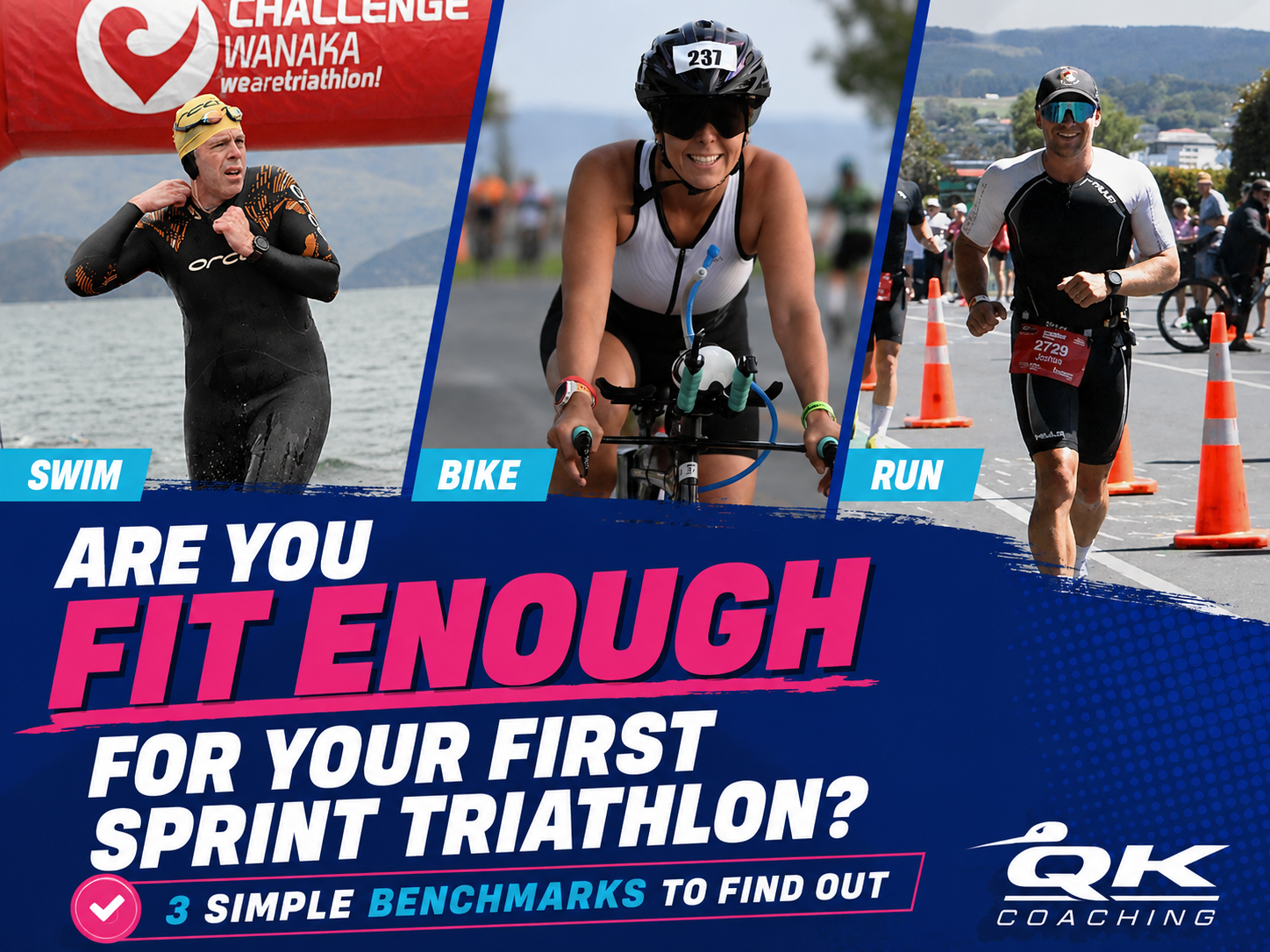
You’ve been thinking about doing a triathlon.
Maybe a friend has entered one. Perhaps you’ve watched an event and thought, I reckon I could do that. Or maybe completing a triathlon has quietly been sitting on your bucket list for years.
Then the doubts start.
Am I fit enough?
Do I need to be a strong swimmer?
How far should I already be able to ride?
Do I need to be able to run 5km quickly?
And perhaps the biggest question:
Do I need to become a “proper triathlete” before I enter my first triathlon?
The good news is that you probably don’t need to be as fit, fast or experienced as you imagine.
But there’s also an important distinction to make.
Being a beginner triathlete doesn’t necessarily mean being a beginner exerciser.
If you already swim, cycle and run, you may be much closer to your first sprint triathlon than you think.
What Is a Sprint Triathlon?
A sprint triathlon is one of the most accessible ways to get started in the sport.
Exact distances vary between events, but a typical sprint-distance triathlon is around a 750m swim, 20km bike and 5km run. Some beginner events use shorter swims or slightly different distances, so always check the details for the particular race you’re considering.
That sounds straightforward when written down.
The challenge is that you’re not doing three separate events.
You swim, transition onto the bike, ride, transition again and then run.
That’s what makes triathlon different.
Being able to swim 750m on Tuesday, ride 20km on Thursday and run 5km on Saturday doesn’t automatically mean you know how to put everything together on race day.
But it does mean you already have some very useful building blocks.
Beginner Triathlete Doesn’t Have to Mean Beginner Athlete
This is one of the most important things to understand when choosing how to prepare for your first triathlon.
There are training programmes designed for people who are relatively new to exercise. Those programmes need plenty of time to progressively develop basic swimming, cycling and running fitness.
Other programmes are designed for people who are already active but new to triathlon.
Those are two very different athletes.
In fact, beginner sprint-triathlon programmes vary enormously in their starting requirements. Some assume very little existing fitness and build over 12–16 weeks, while others expect athletes to already have basic competency across swimming, cycling and running.
Imagine someone who has been running regularly for several years.
They can comfortably run for an hour, ride their bike at weekends and swim at the local pool once or twice each week.
They have never done a triathlon.
Are they a beginner?
At triathlon, absolutely.
At endurance exercise? Not really.
That distinction matters because they probably don’t need to spend months learning how to exercise. They need to learn how to bring the three disciplines together.
So, How Fit Should You Be?
There’s no single fitness test that determines whether somebody is ready to begin preparing for a sprint triathlon.
Your starting point should depend partly on how much time you have before your event and the type of programme you’re going to follow.
If your event is many months away, you have considerably more time to develop your fitness gradually.
If it’s only four weeks away, you need to arrive at those final weeks with much more of your fundamental endurance already established.
Rather than asking whether you’re generally “fit enough”, I prefer looking at the three disciplines individually.
Can You Swim?
For many first-time triathletes, swimming creates the most anxiety.
That’s understandable.
If you become tired while running, you can walk.
If you become tired while cycling, you can slow down or stop somewhere safe.
Swimming — particularly in open water — is different.
So swimming ability and confidence deserve respect.
For the four-week First Sprint programme I’ve developed, I want you to be capable of completing approximately 1,500m within a structured swim workout before you begin.
Notice that I said within a structured workout.
I don’t expect you to swim 1,500m continuously.
A session might involve a warm-up followed by a variety of repetitions with rests between them. What I’m interested in is whether you already have enough swimming ability to complete a structured session totalling approximately that distance.
If 1,500m of swimming currently sounds completely beyond you, that’s okay.
It simply means you need a longer period of swim development before beginning a short race-specific programme.
And if your event involves open water, pool fitness is only part of your preparation. You’ll also want appropriate experience and confidence in the environment in which you’re going to race.
Not Quite at 1,500m Yet?
If swimming is the discipline holding you back from starting First Sprint, don’t rush the process. I’ve created a 7-week Getting Started with Swimming Training Plan specifically for beginner swimmers who need to build their swimming fitness first. It starts with sessions totalling around 500m and progressively develops you towards completing up to 1,700m within a structured swim session, with two swims each week. You only need to be able to swim 100m continuously and complete 500m within a session before starting. Once you’ve built that foundation, you’ll be in a much better position to step into First Sprint and start bringing your swim, bike and run together.
Build Your Swimming Fitness with the 7-Week Getting Started with Swimming Plan
Can You Ride for 90 Minutes?
For the bike, a useful benchmark before starting First Sprint is being able to ride continuously for approximately 90 minutes.
Again, there’s no speed requirement.
You don’t need an expensive triathlon bike.
You don’t need deep-section carbon wheels.
And nobody is going to ask for your average speed before allowing you to become a triathlete.
What matters is having sufficient cycling endurance that the next four weeks can concentrate on preparing you for your event rather than trying to create your basic cycling fitness from scratch.
There’s another consideration here too.
Cycling fitness and cycling skill aren’t exactly the same thing.
You might be very fit from riding indoors but have relatively little experience cornering, braking, changing gears, riding in different weather conditions or drinking while riding.
If you’re going to race your bike outdoors, some of your preparation should involve actually riding it outdoors.
Race day isn’t the ideal time to discover that clipping into your pedals, reaching for your drink bottle or changing gears under load feels unfamiliar.
Can You Run for 45 Minutes?
For running, I’d like somebody beginning First Sprint to be capable of running continuously for around 45 minutes.
Once again, there is no minimum pace.
A 45-minute runner is a 45-minute runner whether they cover 5km, 7km or something else entirely.
That’s important because your first sprint triathlon doesn’t need to be a competition against anybody else’s pace.
The initial goal for many first-time triathletes is much simpler:
Get to the finish line and become a triathlete.
Having 45 minutes of continuous running already established means we can use the final weeks to prepare your running within the context of triathlon.
And that context matters.
Running after cycling feels different from heading out for a normal run with fresh legs.
Your legs may initially feel heavy or slightly uncoordinated when you get off the bike.
That’s something we can prepare for.
Do You Need to Be Fast?
No.
This is worth emphasising because speed can become an unnecessary barrier to entering endurance events.
You might see experienced triathletes swimming quickly, riding expensive bikes and running impressive times.
That’s their race.
Your first triathlon is yours.
If you can safely complete the necessary training at your current ability, speed doesn’t determine whether you’re entitled to stand on the start line.
You can become faster later if that’s what you want.
Your first job is learning how to become a triathlete.
Fitness Isn’t the Only Question
You might comfortably meet all three benchmarks:
1,500m structured swim.
90-minute continuous ride.
45-minute continuous run.
Great.
But that doesn’t automatically mean you’re completely prepared for race day.
Triathlon has another layer.
You need to start thinking about things such as your equipment, transitions, pacing, race clothing, hydration and fuelling, course knowledge and the practicalities of moving from one discipline to another.
If you’re racing in open water, you need to prepare for that environment too.
That’s why I don’t think preparing for your first triathlon should simply involve completing enough swimming, cycling and running to cover the individual race distances.
You’re preparing for the event as a whole.
Don’t Prove Your Fitness by Doing the Race in Training
Here’s another trap I’d avoid.
Once somebody realises their race involves a swim, bike and run, it’s tempting to think:
I’ll do the entire distance in training just to prove I can finish it.
You don’t need to.
Training is preparation, not an exam you have to pass every weekend.
We can develop the different components of your performance through individual sessions and carefully bring them together.
That’s one of the advantages of following a structured programme.
Every workout doesn’t need to replicate race day.
Every workout needs a purpose.
What If You’re Not Ready Yet?
If you’ve read the benchmarks above and realised you’re not there yet, don’t try to cram weeks or months of fitness development into a few days.
Give yourself more time.
If swimming is your limitation, work on developing your swimming fitness and — particularly if technique is holding you back — consider getting some instruction.
If cycling is the problem, gradually build the duration of your rides.
If you can’t yet run continuously for 45 minutes, develop that progressively rather than suddenly increasing your running volume.
There are beginner triathlon programmes that start with much lower prerequisites and use eight, 12, 16 or more weeks to develop an athlete towards their first race.
Choosing a programme appropriate to where you are now is far more sensible than choosing one based purely on where you want to be.
Your first triathlon isn’t going anywhere.
Give yourself enough time to enjoy preparing for it.
What If You Are Ready?
This is where things get exciting.
If you can already complete approximately 1,500m within a structured swim workout, ride continuously for 90 minutes and run continuously for 45 minutes, you’ve already done a lot of the groundwork.
You don’t need to become fitter before you’re “allowed” to think of yourself as a prospective triathlete.
Your next challenge is learning how to take the fitness you already have and bring those three disciplines together.
That means balancing your training.
Understanding intensity.
Practising race-specific skills.
Getting comfortable moving from one discipline to another.
Preparing your equipment.
Recovering appropriately between sessions.
And gradually removing as many unknowns as possible before race morning.
You Don’t Become a Triathlete Before Your First Triathlon
It’s easy to believe you need to look like a triathlete, train like a triathlete and feel completely confident before entering your first event.
You don’t.
Confidence often comes from doing the preparation.
Your first few weeks of triathlon training teach you things.
Your first bike-to-run session teaches you something.
Practising transition teaches you something.
Preparing your race equipment teaches you something.
And race day will teach you plenty more.
You don’t need to know everything before you begin.
You need an appropriate starting level of fitness, a sensible programme and a willingness to learn.
Then you start.
Ready to Turn Your Swim, Bike and Run Fitness Into Your First Triathlon? 🏊🚴🏃
If you can already complete approximately 1,500m within a structured swim workout, ride continuously for 90 minutes and run continuously for 45 minutes, you don’t need a couch-to-triathlon programme.
You need a plan that shows you how to bring those three sports together.
That’s exactly why I created First Sprint: 4 Weeks to Your First Sprint Triathlon.
Over four structured weeks, I’ll guide you through your swimming, cycling and running training so you can stop wondering what you should be doing and concentrate on preparing for your first race.
The plan includes structured workouts delivered through TrainingPeaks, along with my First Sprint – Athlete Guide to help you understand the training, equipment and practical preparation involved in becoming a triathlete.
You already swim.
You already ride.
You already run.
Now let’s put them together.
Four weeks. Three sports. One finish line.
Coach Ray
Qwik Kiwi Coaching