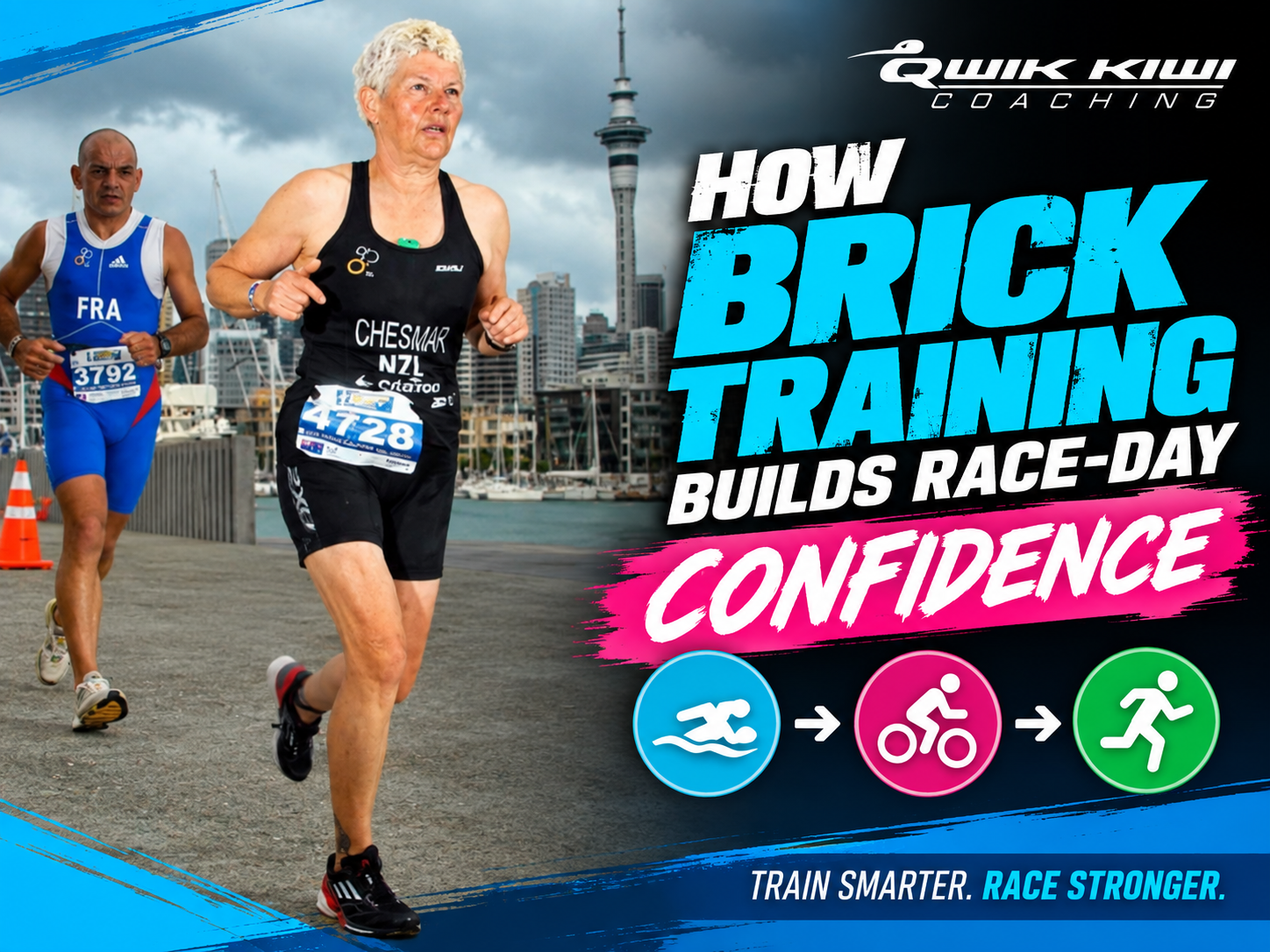
There is a moment in almost every triathlete’s first few races when doubt can creep in.
You’ve finished the bike. You’ve made your way through T2. You start running.
And your legs feel terrible.
They might feel heavy, awkward or reluctant to turn over. Your normal running stride seems to have disappeared, and suddenly you’re wondering:
“How am I supposed to run 5km—or 10km—like this?”
That’s one of the reasons brick training is so valuable for Sprint and Olympic-distance triathletes.
Yes, brick sessions help prepare your body for the transition from cycling to running. But there’s another benefit that shouldn’t be underestimated:
Brick training builds confidence.
It takes something that can feel unfamiliar and worrying on race day and turns it into something you’ve experienced—and successfully managed—many times before.
Confidence Comes From Familiarity
A brick session combines two disciplines back-to-back. For triathletes, that will most commonly be a bike followed immediately by a run.
When you first try it, running off the bike can feel surprisingly difficult.
Your body has spent the bike leg adapting to the demands of cycling and then, almost instantly, you ask it to change what it is doing and start running.
As I explain in my earlier article, Why Are Bricks Important?, this transition places different demands on your body, and brick training helps you become familiar with making that change.
👉 Read: Why Are Bricks Important?
The important thing is that the strange sensation you experience immediately after getting off the bike normally changes as you settle into your run.
Brick training gives you opportunities to experience that process before race day.
You learn:
“Yes, my legs feel strange—but I know what this is.”
Then, after a few minutes:
“There it is. I’ve found my running rhythm.”
Do that often enough in training and the bike-to-run transition stops being an unknown.
That familiarity is where confidence starts.
You Don’t Need to Eliminate the Feeling
An important distinction is that the objective of brick training isn’t necessarily to make the opening metres of every run feel fantastic.
You may still get off the bike on race day and initially feel heavy or awkward.
That’s okay.
The difference is how you respond.
An athlete who hasn’t practised running off the bike might interpret those heavy legs as a sign that something has gone wrong.
They might panic.
They might start questioning their fitness.
Or, ironically, they might try to force the pace because they’re worried they’re running too slowly.
An athlete who has experienced the same sensation repeatedly in training can respond very differently:
“I’ve felt this before. Stay controlled. Find my rhythm. It’ll come.”
That’s an important distinction.
Race-day confidence isn’t simply telling yourself that everything will be okay.
It’s having previous experiences that give you a reason to believe it will be.
Brick Training Teaches You to Trust Your Pace
Confidence isn’t only about knowing your legs will eventually start behaving themselves.
It’s also about knowing how you should run when you leave T2.
The first few minutes of a Sprint or Olympic-distance triathlon can be deceptive.
You’ve been sitting on the bike, your perception of speed has changed, adrenaline is flowing, other athletes are around you and the finish line suddenly feels much closer.
It’s very easy to run too hard.
And because the run is only 5km in a Sprint triathlon or 10km in an Olympic-distance event, you might feel as though you need to attack immediately.
But confidence means being prepared to hold back when everything around you is encouraging you to do the opposite.
Brick training gives you an opportunity to practise that restraint.
You can get off the bike, begin running under control and learn what an appropriate opening effort feels like.
As I discussed in Do You Really Need Brick Sessions for Sprint or Olympic Triathlon?, many brick runs don’t need to be particularly long.
A simple 10–20 minute run can provide plenty of opportunity to practise the transition, establish your rhythm and control your opening pace.
👉 Read: Do You Really Need Brick Sessions for Sprint or Olympic Triathlon?
Start With Simple, Controlled Bricks
One mistake athletes can make is assuming that because they’re preparing for a race, every brick session needs to simulate race intensity.
It doesn’t.
If you’re relatively new to brick training, I like to keep things simple.
Complete your planned bike session, transition into your running shoes and run for around 10 minutes at Level II.
That’s it.
You’re not trying to prove how fast you can run.
You’re learning what the transition feels like.
Pay attention to how your legs feel during the first minute. Notice how your stride changes over the next few minutes. Keep your breathing controlled. Let your running rhythm come to you rather than trying to force it.
Over time, that 10-minute run becomes familiar.
Then, as your fitness develops and you move closer to your goal event, selected brick sessions can become longer or incorporate more race-specific intensity.
The progression has a purpose.
Confidence Starts on the Bike
One of the most valuable lessons brick training can teach you is that your run doesn’t really start when you leave T2.
Your run starts on the bike.
If you ride far harder than your fitness allows, there isn’t a magical reset button when you rack your bike.
You’ll carry the consequences into the run.
Brick sessions allow you to experiment with bike pacing and discover the effort you can sustain while still being able to run effectively afterwards.
That’s particularly valuable for newer triathletes.
You might finish a hard standalone bike ride thinking:
“That was a great ride.”
Add a run immediately afterwards and you get another piece of information:
“Was that actually a great triathlon ride?”
Those aren’t necessarily the same thing.
The fastest possible bike split isn’t much use if the effort required costs you considerably more time during the run.
Repeated brick sessions help you develop confidence in the bike effort you can sustain while preserving your ability to run.
Practise Your Final Minutes Before T2
Your preparation for the run can begin before you even reach transition.
In my earlier article on why bricks are important, I discussed two things athletes can do towards the end of the bike to help prepare for the transition: reducing the intensity during the closing minutes and maintaining a relatively high cycling cadence.
Rather than charging towards transition and then abruptly asking your body to start running, think about how you’re riding as you approach T2.
I generally encourage athletes to maintain an efficient cadence, typically around 90–100rpm, rather than grinding a large gear into transition.
You can practise this during your brick sessions.
Experiment with the final minutes of the bike and pay attention to what happens when you start running.
Does a controlled approach to T2 make it easier to establish your running rhythm?
How does your cadence on the bike influence how your legs feel when you begin running?
You’re not simply training your fitness.
You’re learning what works for you.
And every answer you collect in training removes another uncertainty from race day.
Practise T2 Until It Becomes Routine
Race-day confidence isn’t purely physiological.
There are also shoes, helmets, race belts, nutrition and all the little decisions that suddenly seem much more complicated when your heart rate is elevated and you’re surrounded by other athletes.
Brick sessions provide the perfect opportunity to practise T2.
Set your equipment up before the session.
When you finish your bike:
- Dismount and move efficiently with the bike.
- Rack it.
- Remove your helmet at the appropriate point.
- Change into your running shoes.
- Grab anything you need for the run.
- Start running.
You don’t need to turn every training session into a transition competition.
The goal is simply to make the process familiar and repeatable.
Race day shouldn’t be the first time you’ve tried to change shoes quickly with an elevated heart rate.
The more familiar your routine becomes, the less thinking you’ll need to do when it matters.
Test Your Race-Day Equipment
Brick training also gives you the chance to answer all sorts of small questions.
Are your running shoes easy to put on?
Does your race belt sit comfortably when you start running?
Does anything bounce, rub or annoy you?
Can you drink comfortably towards the end of the bike and then start running?
Does your planned fuelling sit well when you transition from cycling to running?
Individually, these might seem like small details.
Collectively, they contribute enormously to confidence.
Instead of arriving at your event hoping everything works, you arrive knowing you’ve already rehearsed it.
Use Race-Specific Bricks to Rehearse, Not Prove
As your Sprint or Olympic triathlon gets closer, selected brick sessions can become more race-specific.
That’s when you can begin rehearsing combinations of:
- Race-day equipment.
- Bike pacing.
- Fuelling and hydration.
- Your approach to T2.
- Opening run pace.
- Race-specific intensity.
This is where brick training becomes a rehearsal.
But there’s an important distinction:
A rehearsal isn’t a test of how much suffering you can tolerate.
You don’t need to prove your fitness every weekend.
You’re trying to collect information and reinforce good decisions.
A successful brick should leave you thinking:
“I know what I’m going to do on race day.”
That’s far more valuable than finishing exhausted simply because you wanted the session to feel hard.
Confidence Doesn’t Come From One Epic Session
There’s another trap worth avoiding.
You don’t need one enormous brick workout a few weeks before your race to convince yourself you’re ready.
Confidence is better built progressively.
Start with short, controlled bricks.
Become comfortable running off the bike.
Practise your transitions.
Learn your pacing.
Introduce race-specific elements when appropriate.
Repeat the process.
Each session adds another piece of evidence:
I’ve done this before.
I know what this feels like.
I know how hard I should ride.
I know how I want to start the run.
I know my legs will settle.
That’s a much stronger foundation for confidence than completing one huge workout.
Make Race Day Predictable
Ultimately, that’s what good brick training does.
It makes race day more predictable.
You can’t control everything that happens during a triathlon. Weather, course conditions and unexpected problems can all affect your day.
But you can remove many of the avoidable uncertainties.
You can know what running off the bike feels like.
You can know how you want to pace the opening kilometre.
You can know how your equipment works.
You can know your transition routine.
You can know what happens when your legs initially feel heavy.
And instead of reaching T2 and wondering:
“What happens now?”
You’ll be thinking:
“I’ve done this before.”
That’s race-day confidence.
Ready to Put Your Swim, Bike and Run Together?
Training for a Sprint or Olympic triathlon isn’t simply about becoming a better swimmer, cyclist and runner independently.
Eventually, you need to learn how to put all three disciplines together.
That’s exactly what Triathlon Mastery is designed to help you do.
Rather than throwing random sessions together and hoping you’re ready on race day, Triathlon Mastery gives you a structured, progressive approach that develops your fitness before introducing brick sessions and race-specific training at the appropriate time.
You can build the fitness you need, practise the demands you’re going to encounter and arrive on the start line knowing your preparation has had a purpose.
🏊🚴🏃 Learn more and join Triathlon Mastery
Train with purpose. Build consistently. Arrive ready to race.