You’ve completed the swim, settled onto the bike and you’re feeling great.
Your energy is good. Your stomach feels fine. You’re concentrating on pacing and getting comfortable.
So you decide you’ll worry about eating later.
That can be the beginning of a very long day.
During an Ironman 70.3, don’t wait until you feel hungry or low on energy before you start fuelling. By the time your body is sending you obvious warning signs, you may already be playing catch-up.
Your race-day nutrition should be a plan you start executing early—not a response to how you happen to feel.
You’re Fuelling for 113km, Not Just the Bike
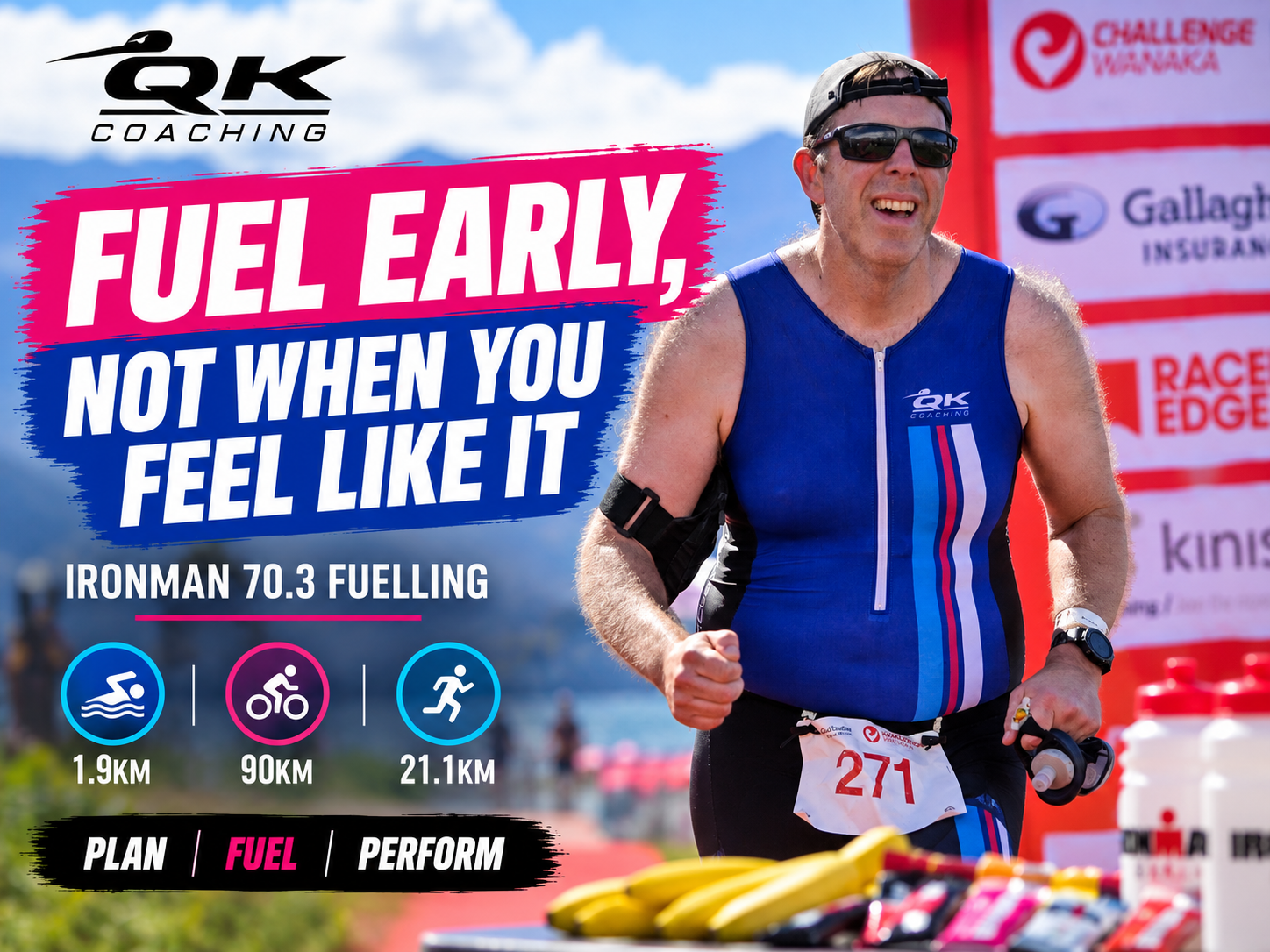
An Ironman 70.3 consists of a 1.9km swim, 90km bike and 21.1km run.
That’s a long time to be exercising.
Carbohydrate is an important fuel for prolonged endurance performance, and established sports-nutrition guidance supports carbohydrate consumption during longer-duration exercise. For events lasting more than 2.5 hours, commonly cited guidelines extend towards 90g of carbohydrate per hour, particularly when multiple types of carbohydrates are used.
That doesn’t mean every athlete should automatically consume 90g per hour. Your requirements and tolerance need to be individualised and, importantly, practised during training.
But it does mean that arriving at kilometre 40 of the bike and thinking, “Maybe I should start eating something” isn’t much of a fuelling strategy.
Hunger Is Not Your Fuelling Cue
In everyday life, eating when you’re hungry makes sense.
During an Ironman 70.3, hunger isn’t necessarily a useful way of deciding when to fuel.
You’re racing.
Your attention is divided between pacing, other athletes, road conditions, aid stations and everything else happening around you.
Adrenaline and exercise can also alter how you perceive hunger.
You can therefore feel perfectly good while gradually working your way through the carbohydrate you started the race with.
That’s why your fuelling should be based on a race plan rather than appetite.
If your plan says it’s time to take carbohydrate, you fuel.
You don’t wait for your body to send you an invitation.
Start Early on the Bike
For most athletes, the bike is where the bulk of their Ironman 70.3 fuelling can be managed.
You’re relatively stable compared with running, you’ve got bottles and nutrition accessible on the bike, and you’ve got a substantial amount of riding ahead of you.
Once you’ve exited T1 and safely settled onto the bike, start executing your nutrition plan early.
That doesn’t mean frantically consuming everything in the first ten minutes.
It means beginning the routine you’ve practised.
Drink.
Fuel.
Ride.
Repeat.
Rather than spending the first hour enjoying how fresh you feel and suddenly realising you haven’t eaten anything.
Feeling Good Is Exactly When You Should Fuel
This is one of the counterintuitive parts of endurance nutrition.
Athletes sometimes think:
“I feel great, so I don’t need anything yet.”
I’d turn that around.
You’re not fuelling because you’re struggling.
You’re fuelling to help prevent yourself from struggling later.
Think of your nutrition as supporting the work you’re about to do, rather than rescuing you from the work you’ve already done.
The athlete who is eating consistently while feeling good is generally in a much better position than the athlete desperately trying to consume carbohydrate once their energy levels have already dropped.
You Can’t Always Catch Up Later
Missing some nutrition early doesn’t mean your race is automatically ruined.
But simply doubling your intake later isn’t necessarily the answer either.
Your gastrointestinal system has limits.
Trying to force large quantities of carbohydrate and fluid into your stomach because you’ve fallen behind can create another problem—bloating, nausea or gastrointestinal discomfort.
That’s why consistency matters.
Rather than alternating between long periods without fuel and suddenly consuming large amounts, aim to follow the fuelling pattern you’ve rehearsed.
Little and often can be much easier to manage than feast and famine.
Fuel the Run While You’re Still on the Bike
One of the most important ways to think about Ironman 70.3 nutrition is that your bike fuelling isn’t only fuelling your cycling.
You’re also preparing for the run.
You don’t want to arrive at T2 already depleted and then expect a few gels at the beginning of the half marathon to magically restore everything.
The run is where many nutritional mistakes made earlier in the race become obvious.
Your pace starts falling.
Your perceived effort climbs.
Concentration becomes harder.
Suddenly every kilometre feels considerably longer than it should.
It may look like a running problem.
Sometimes the groundwork was laid much earlier on the bike.
How Much Carbohydrate Do You Need?
There isn’t one number that is perfect for every Ironman 70.3 athlete.
Research and endurance-sport guidelines commonly place carbohydrate intake for prolonged events in the 60–90g per hour range, with higher intakes generally requiring appropriate carbohydrate combinations and individual tolerance.
Your appropriate target depends on factors including your race duration, body size, intensity, previous nutrition experience and gastrointestinal tolerance.
This is where testing becomes important.
Don’t discover on race day that your theoretical nutrition target doesn’t agree with your stomach.
Train Your Fuelling Strategy
Race nutrition needs training too.
Your long rides and race-specific brick sessions are ideal opportunities to practise.
Don’t simply take enough nutrition to survive the workout.
Practise what you intend to do on race day.
That means testing:
- How much carbohydrate you’re consuming each hour.
- How frequently you’re consuming it.
- Which products or foods you tolerate.
- How you’ll carry your nutrition.
- How much fluid you’re consuming.
- What happens when the temperature changes.
- What you’ll use from aid stations.
- How your stomach responds when you begin running afterwards.
Food and sports-nutrition products can both provide useful carbohydrate during endurance exercise; the key is developing a strategy that works for you and that you can reliably execute.
Know What Will Be on Course
Don’t assume you’ll work this out on race morning.
Read your event’s Athlete Guide.
Find out what nutrition is supplied at the aid stations and where those aid stations are located.
If you’re planning to use the on-course products, practise with them beforehand.
IRONMAN event guides specify the nutrition available on individual courses, and the products can differ between events.
Nothing new on race day.
Your Ironman 70.3 isn’t the place to discover whether your stomach likes a particular gel.
Don’t Forget Your Race-Morning Nutrition
Starting your race properly fuelled also matters.
IRONMAN’s nutrition guidance recommends carbohydrate-focused pre-event fuelling in the hours before racing, with the exact amount and timing adjusted according to individual preference and tolerance.
That complements your during-race strategy.
Breakfast helps you arrive at the start line ready to race.
Your on-course nutrition then helps support you as the hours accumulate.
Neither should be left to chance.
Make Fuelling Automatic
One of the best race-day nutrition strategies is one you barely have to think about.
You know what you’re taking.
You know when you’re taking it.
You know where it is on your bike.
You’ve practised opening it while riding.
You know what you’ll collect from aid stations.
You know what your stomach tolerates.
You shouldn’t need to ask yourself every 20 minutes:
“Do I feel like eating?”
That’s the wrong question.
The question is:
“What does my plan say I need now?”
Final Thoughts
Your Ironman 70.3 nutrition strategy shouldn’t begin when you’re hungry.
It shouldn’t begin when your power starts dropping.
And it definitely shouldn’t begin when you’re halfway through the run wondering where all your energy went.
Fuel early.
Start executing your nutrition plan once you’re safely settled onto the bike.
Fuel consistently.
Practise your strategy during training.
Know what works for your stomach.
And remember that you’re not simply fuelling the kilometre you’re currently racing.
You’re fuelling the kilometres still to come.
Want Help Developing Your Ironman 70.3 Race Strategy?
Getting your Ironman 70.3 fuelling right isn’t about blindly copying what another athlete eats. Your nutrition needs to fit your training, your race duration, your stomach and your race plan.
If you’re preparing for an Ironman 70.3 and aren’t sure whether your fuelling, pacing and training are setting you up for the race you want, I’d be happy to help.
Book a free, no-obligation 40-minute coaching consultation and we can discuss your goals, current training and race-day strategy.
You’ll leave with practical advice and a clearer idea of your next steps, whether we end up working together or not.