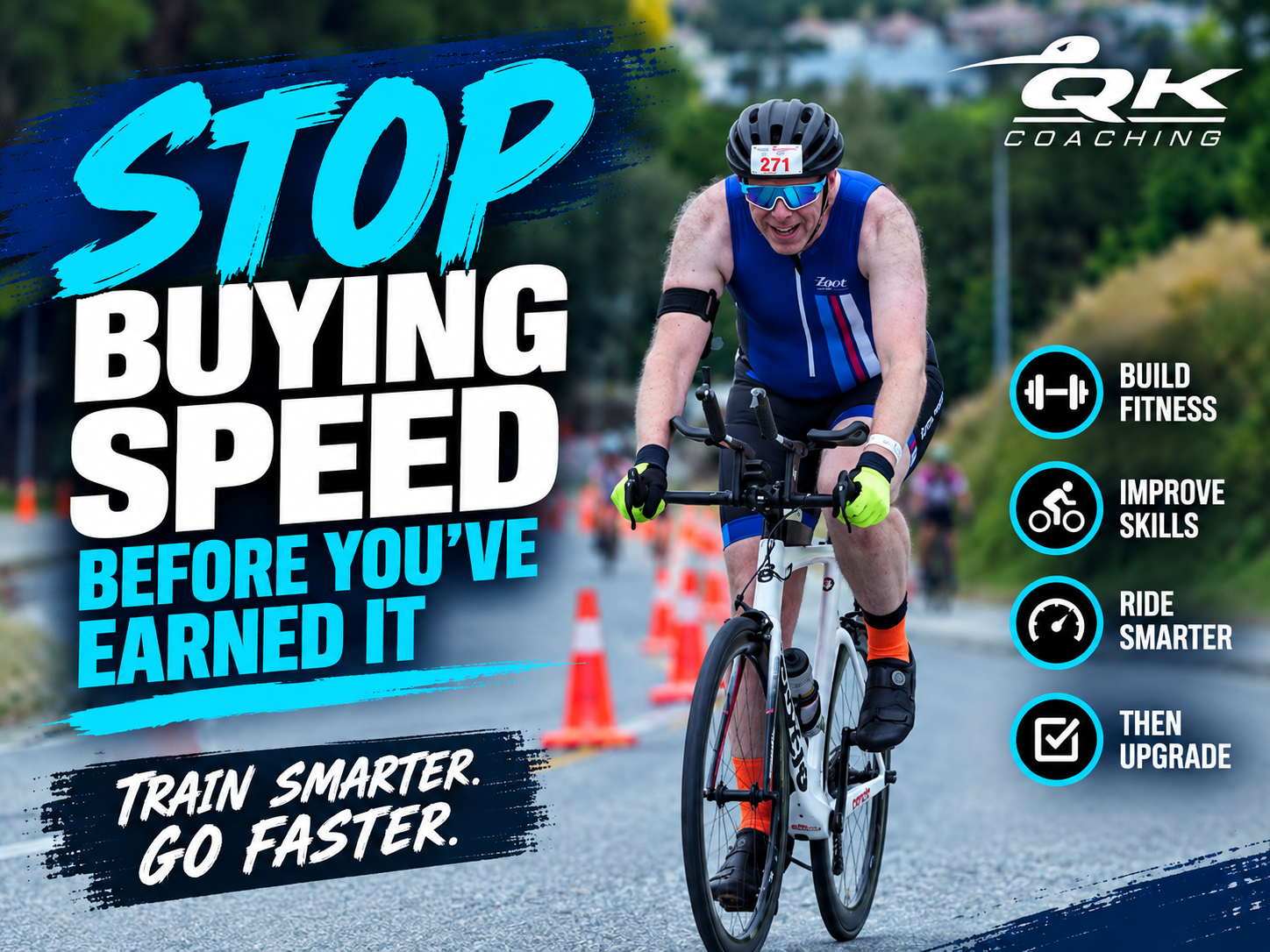
Triathlon can become an expensive sport remarkably quickly.
There’s always something promising to make you faster.
A new bike. Deep-section wheels. An aero helmet. Carbon components. Faster tyres. A different cockpit. Another piece of equipment promising to save a handful of watts.
And to be clear, good equipment can make you faster.
Aerodynamics matter. Rolling resistance matters. Position matters. The right equipment, properly selected and set up, can absolutely improve your performance.
But before spending thousands of dollars trying to make your bike faster, there’s a more important question to ask:
Are you already riding the bike you own as well as you could?
Because some of the biggest improvements available to many age-group triathletes aren’t sitting on the shelf of a bike shop.
They need to be earned through training.
There’s Nothing Wrong With Buying a Fast Bike
Let’s get this out of the way first.
I’m not against nice bikes.
I’m not against aero wheels, aero helmets or other equipment upgrades either.
If you enjoy cycling and can afford the equipment you want, there’s nothing wrong with buying it.
And once you’re chasing marginal gains, equipment choices can make a meaningful difference. Aerodynamic testing consistently shows that equipment and position can reduce drag, while the rider’s position itself remains an enormous part of the equation. (Element Tri & Bicycle Works)
The mistake is believing that buying speed can replace developing speed.
It can’t.
A faster bike doesn’t teach you to pace properly.
Aero wheels don’t improve your cornering.
An expensive cockpit doesn’t teach you to hold your aero position.
A lighter frame doesn’t give you the fitness to maintain your power late in the bike leg.
And none of those upgrades automatically leave you ready to run well when you reach T2.
That’s where training comes in.
Start With the Engine
Before worrying about saving a few watts through equipment, work on your ability to produce and sustain the watts in the first place.
Your aerobic fitness matters.
Your threshold matters.
Your muscular endurance matters.
Your ability to maintain an appropriate cadence matters.
Your ability to hold race-specific power as fatigue develops matters.
And because you’re a triathlete rather than a cyclist completing a standalone time trial, what happens after the bike matters too.
The goal isn’t necessarily to produce the fastest bike split you’re physically capable of.
It’s to ride the bike leg in a way that contributes to your fastest overall triathlon.
That requires fitness, pacing and discipline.
No piece of carbon fibre can replace those.
Earn Your Aero Position
One of the most valuable ways to ride faster is also one that athletes sometimes struggle to use effectively: your riding position.
A good aerodynamic position can reduce the amount of energy required to travel at a given speed.
But it only works if you can actually stay there.
If your aero position is so uncomfortable that you’re constantly sitting up, moving around or coming out of the aerobars, the theoretical aerodynamic advantage becomes much less useful.
A sustainable position needs to balance aerodynamics with comfort, power production, stability and control. (Element Tri & Bicycle Works)
And then you need to train in that position.
Don’t spend your winter doing nearly every ride sitting upright on the indoor trainer and expect to magically hold your aero position comfortably for several hours on race day.
Spend appropriate time riding in your race position.
Build your tolerance progressively.
Learn how your power feels in that position.
Practise drinking and fuelling while you’re there.
Get comfortable looking ahead and maintaining control.
Your aero position isn’t simply something you buy.
It’s something you develop.
Learn to Ride Your Bike
This is another area where money can’t substitute for practice.
You can own an incredibly fast bike and still lose significant time because you aren’t confident riding it.
Can you corner smoothly?
Can you descend confidently?
Do you brake before the corner rather than unnecessarily through it?
Can you select the appropriate gear before the gradient changes?
Can you hold a predictable line?
Can you drink without wobbling across the road?
Can you respond safely to wind?
Can you move smoothly between your aerobars and brakes when the road requires it?
Good bike handling isn’t only about speed. It’s about safety, confidence and efficiency.
The more comfortable you are controlling your bike, the more opportunity you have to use the fitness and equipment you’ve already got.
Bike-handling skills and confidence in the aero position require deliberate practice; they aren’t automatically developed by spending more time on an indoor trainer. (Triathlete)
Learn to Pace Before You Buy More Power
One of the quickest ways to waste both your fitness and your expensive equipment is to pace the bike poorly.
It’s easy to ride too hard early in a triathlon.
You’re tapered.
You’re fuelled.
You’re excited.
The bike feels fantastic.
People are passing you—or perhaps you’re passing them—and suddenly your carefully planned pacing strategy disappears.
But every unnecessary surge has a cost.
Hammer the early kilometres, attack every hill and repeatedly accelerate beyond your sustainable effort, and you may discover later that the bike wasn’t quite as fast as it initially felt.
Worse still, you can carry that cost into the run.
Smart triathlon cycling combines fitness, aerodynamics, pacing and energy management rather than treating bike speed as simply a matter of producing maximum power. (TRI247)
Before asking what equipment could make you faster, ask whether you’re already getting the most from the fitness you have.
Practise Your Fuelling
You can have the fastest bike in transition and still have a terrible race if you don’t fuel properly.
Your bike leg provides an important opportunity to consume the carbohydrate and fluid you’ll need later in the event.
But that doesn’t happen automatically.
You need to practise.
What will you eat or drink?
How much?
How frequently?
Where will you carry it?
Can you reach it easily without leaving your aero position for an unnecessarily long time?
Can you drink confidently while continuing to control the bike?
Does your nutrition strategy still work after two or three hours?
The fanciest integrated hydration system in the world isn’t much use if you forget to drink from it.
Practise the behaviour, not just the equipment.
Don’t Confuse Expensive With Appropriate
There’s another trap worth avoiding.
The most expensive option isn’t automatically the best option for you.
A more aggressive aero setup might test brilliantly but be slower for you if you can’t hold it comfortably.
A very deep front wheel might be fast in ideal conditions but not necessarily the best choice if you struggle to control it in strong crosswinds.
A beautiful new triathlon bike isn’t much help if the fit is wrong.
An aerodynamic position also needs to allow you to produce power, control the bike, fuel effectively and sustain it for the demands of your race. (Triathlon Loop)
Choose equipment based on what helps you perform, rather than simply what looks fastest.
Where Should You Invest First?
If you have some money available to improve your cycling, don’t automatically assume another component is the best investment.
Depending on your circumstances, you might get more value from:
A good bike fit.
Make sure your position allows you to ride comfortably, efficiently and aerodynamically while producing appropriate power.
Coaching or structured training.
Develop the engine rather than continually modifying the machine.
Bike-handling practice.
Especially if confidence in corners, descents or your aero position is limiting you.
Race-specific training.
Prepare for the terrain, conditions and duration you’ll actually encounter.
Appropriate tyres and basic maintenance.
A clean, correctly functioning bike with sensible tyre choice and pressure is a much better starting point than an expensive bike that’s poorly maintained.
Practising your pacing and fuelling.
Both can have consequences well beyond your bike split.
Then, when those fundamentals are becoming well established, equipment upgrades can add another layer of performance.
Marginal Gains Matter—After You’ve Built the Foundation
There comes a point where buying speed makes perfect sense.
Perhaps you’ve trained consistently.
Your position is good.
You can hold it.
Your bike handling is confident.
Your pacing is disciplined.
You’ve practised your race-day fuelling.
You’re producing the power you need.
You’re already making good use of the equipment you own.
At that point, marginal gains become increasingly interesting.
A faster helmet, wheels, tyres, clothing or bike might help you convert the fitness and skills you’ve developed into an even faster performance.
That’s the key distinction.
Equipment should enhance the athlete you’ve developed—not compensate for the athlete you haven’t developed yet.
Earn Your Speed First
It’s easy to look at somebody riding a beautiful triathlon bike and assume the equipment is what makes them fast.
You don’t see the months and years of training behind it.
You don’t see the early mornings.
The endurance rides.
The intervals.
The cadence work.
The hours spent becoming comfortable in the aero position.
The cornering practice.
The race-specific sessions.
The disciplined pacing.
The fuelling rehearsals.
The recovery that allows all of that training to turn into fitness.
That’s where most of the speed was built.
So before reaching for your credit card, ask yourself:
Have I earned more speed from the bike I’ve already got?
Train consistently.
Improve your position.
Develop your fitness.
Learn to handle your bike.
Practise your pacing.
Dial in your fuelling.
Then, when you’re ready to chase those marginal gains, you’ll be in a much better position to actually benefit from them.
Don’t just buy speed. Earn it first.
Want to Become a Faster Triathlete?
If you’re wondering whether your next improvement should come from more training, smarter training, better pacing or changes to your race preparation, let’s talk about it.
Book a free, no-obligation 40-minute coaching call, and we can discuss your current training, your upcoming goals and where your biggest opportunities for improvement might be.
👉 Book your free 40-minute coaching call
Build the athlete first. Then make the equipment work for you.