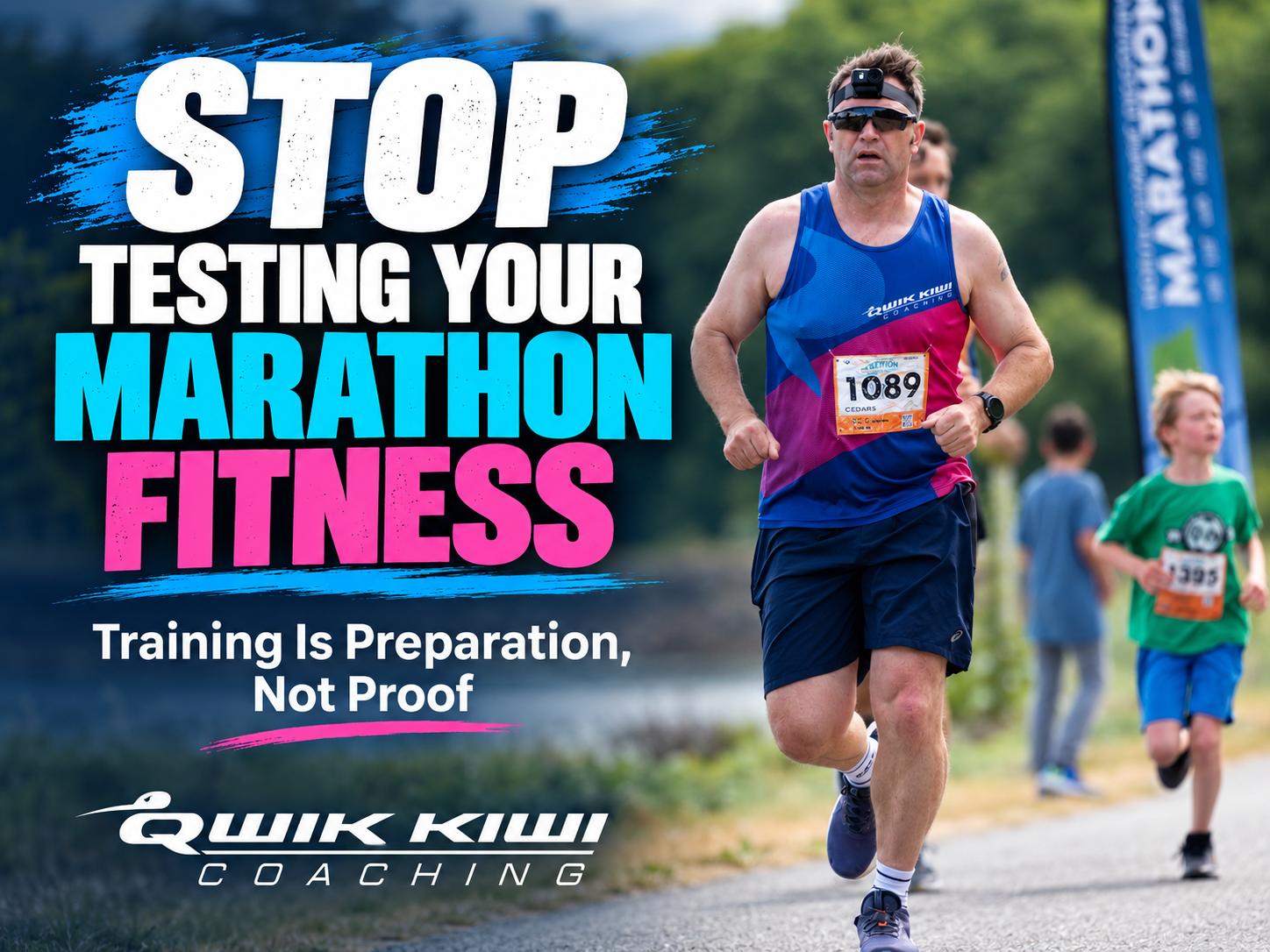
Marathon training can create a strange kind of uncertainty.
You’re putting in weeks and months of work for a race that covers 42.2 kilometres, yet you’re rarely going to reproduce the complete demands of that race during training.
So naturally, you want reassurance.
You want to know that your fitness is improving. You want confirmation that your goal pace is realistic. And as race day approaches, you may desperately want proof that you’re ready.
That’s when training can quietly turn into testing.
Your long run becomes a race. A planned workout becomes an opportunity to see how far you can hold marathon pace. You enter a half marathon and run it flat-out because you want to know what shape you’re in.
Occasional well-planned benchmark sessions can provide useful information. Race-pace workouts can also help develop pacing skills, confidence and race-day preparation. (Runner’s World)
But you don’t need to keep proving your marathon fitness.
Your marathon is the test. Your training is what prepares you for it.
Training and Testing Have Different Purposes
A training session should create a specific stimulus.
One workout might develop aerobic endurance. Another might improve threshold. Another could develop your ability to sustain marathon-specific effort when you’re carrying some fatigue.
Each has a purpose within the bigger programme.
Testing asks a different question:
“What can I do right now?”
That can be useful occasionally. But if you keep asking that question throughout your marathon build, you risk interfering with the training that is supposed to improve the answer.
You don’t become fitter simply by checking how fit you are.
You become fitter by applying appropriate training, recovering from it, adapting, and then repeating that process consistently.
The Long Run Is an Easy Place to Start Testing Yourself
You’re 90 minutes into a long run and feeling fantastic.
Instead of continuing at the prescribed Level II, you start thinking:
I wonder how long I could hold marathon pace from here?
Suddenly your aerobic long run has become a marathon fitness test.
The problem isn’t necessarily that marathon-pace running is inappropriate. Faster running can have an important place within a marathon programme, and selected long runs can deliberately incorporate goal-marathon-pace work. (Runner’s World)
The problem is that it wasn’t the session you were supposed to be doing.
If marathon-specific work is appropriate, I want it deliberately programmed into your training—not added because you happened to feel good halfway through Sunday’s run.
Don’t Race Every Opportunity You Get
Tune-up races can be useful during marathon preparation.
A 5km, 10km or half marathon can provide a different training stimulus, allow you to practise race routines and sometimes give us useful information about your fitness. Shorter races can also be strategically incorporated into a marathon programme. (Runner’s World)
But entering an event doesn’t automatically mean you need to race it flat-out.
The purpose matters.
A half marathon several weeks before your marathon could be a genuine race. It could be a controlled marathon-specific workout. It could form part of a longer training day.
Those are very different sessions.
What I don’t want is every event becoming another opportunity to prove your fitness simply because there’s a timing mat and a finish line.
Be Careful With Goal Marathon Pace
Goal marathon pace has a special attraction.
If you’re hoping to run your marathon at a particular pace, it seems logical that the more kilometres you can complete at that pace during training, the more confident you should become.
To a point, that’s true.
Marathon-pace training can teach you what your planned race effort feels like, improve pacing confidence and give you opportunities to rehearse race-day fuelling and equipment. (Runner’s World)
But that doesn’t mean you should continually ask:
“How long can I hold marathon pace today?”
There’s a significant difference between completing a prescribed marathon-pace workout and continuing until you discover your current limit.
One is training.
The other is testing.
Every Test Has a Cost
A hard workout doesn’t exist in isolation.
You have to recover from it.
If you turn a controlled workout into a maximal effort, you’ve increased the training stress. That can affect what you’re capable of doing tomorrow, the following day and potentially your next key session.
That matters because marathon fitness is built through consistent weeks of training, not occasional spectacular performances. Current coaching guidance similarly emphasises consistent weekly running and balanced training rather than relying on sporadic big efforts. (Runner’s World)
The question isn’t simply whether you can complete the extra hard work.
Ask whether doing it improves the overall programme.
Your Training Watch Can Encourage Testing
Modern running watches provide enormous amounts of information.
VO₂ max estimates. Race predictions. Training readiness. Performance condition. Recovery times. Personal records.
These can all be useful.
But they can also encourage you to turn normal training sessions into opportunities to generate better numbers.
Perhaps your watch predicts a marathon time you don’t like.
Your response shouldn’t be to head out tomorrow and try to prove it wrong.
Your watch is providing information.
It isn’t setting your workout.
Follow the purpose of your training session rather than chasing validation from an algorithm.
Strava Can Create the Same Problem
Social platforms add another layer.
A steady Level II run might not look particularly exciting when it appears alongside someone else’s fast workout.
That doesn’t make your run less valuable.
Marathon training contains plenty of sessions that won’t earn much attention online.
That’s okay.
The goal isn’t to produce the most impressive training feed.
The goal is to prepare yourself to run your best marathon.
Confidence Should Come From Patterns
So how do you know whether your marathon training is working if you aren’t constantly testing yourself?
Look at the bigger picture.
Perhaps your Level II pace is gradually improving at the same effort.
Maybe workouts that previously felt difficult are becoming more manageable.
Perhaps you’re recovering better from your long runs.
You might be completing more training consistently, tolerating your weekly volume better, or executing prescribed marathon-specific sessions with greater control.
No single one of those things guarantees a particular marathon result.
Together, however, they can tell us far more than repeatedly trying to prove your fitness.
There Is a Place for Benchmark Workouts
This isn’t an argument against testing altogether.
Strategically placed benchmark workouts can be extremely useful.
They can help assess progress, refine training intensities, provide information for race pacing and build confidence.
The key is that the test has been planned.
We know why we’re doing it.
We know where it sits within the programme.
And importantly, we allow for the recovery it requires.
A well-timed marathon-specific benchmark can provide useful information without repeatedly disrupting the training process. (Runner’s World)
That is very different from testing yourself every time you feel good.
Don’t Panic If a Test Goes Badly
There’s another danger with constantly testing your fitness.
Eventually, one of those tests won’t go well.
Perhaps you attempt a marathon-pace session and struggle.
Suddenly you’re questioning your goal.
But marathon training takes place under accumulated fatigue.
You might have trained hard earlier in the week. You may have slept poorly. The weather could be difficult. Your fuelling might have been off. You could simply be having an ordinary bad day.
One workout is information.
It isn’t a verdict on your marathon.
Look for patterns across your training rather than allowing one session to redefine what you believe you’re capable of.
Trust the Training Process
One of the hardest parts of marathon preparation is accepting that you won’t know exactly what you can do on race day until you get there.
You can prepare extremely well.
You can use your training to establish realistic expectations.
You can practise your pacing, fuelling and race-day strategy.
But eventually you have to trust the work you’ve completed.
Constantly seeking reassurance by testing yourself can undermine the very process that is supposed to create your fitness.
Sometimes the best thing you can do after a great workout is simply think:
“Good. The training is working.”
Then recover and get ready for the next one.
Save the Test for Race Day
Your marathon programme should contain challenges.
There will be demanding long runs, threshold sessions, marathon-specific workouts and periods when you’re training with tired legs.
But every session should have a purpose.
Don’t turn an ordinary training day into a fitness test simply because you’re feeling good.
Don’t race every long run.
Don’t turn every tune-up event into an all-out effort.
And don’t continually see how far you can hold goal marathon pace.
Training should build your fitness—not constantly ask you to prove that it exists.
When marathon morning finally arrives, you’ll get your opportunity to find out exactly what you can do.
Your marathon is the test. Your training is the preparation.
Ready to Run Your Best Marathon?
Knowing when to train hard, when to keep a session controlled and when a benchmark workout is actually useful can make a significant difference to your marathon preparation.
If you’d like help structuring your marathon training, establishing realistic training intensities or deciding whether your race goal matches the fitness you’re developing, book a free, no-obligation 40-minute coaching consultation.
We’ll discuss your current training, your upcoming marathon and how you can prepare effectively without feeling the need to prove your fitness every weekend.
Book your free marathon coaching consultation: