If you’re preparing for your first Sprint or Olympic-distance triathlon, you don’t need to begin your brick training with a huge bike ride followed by a long run.
You need to learn what happens when you finish riding, get off your bike and start running.
This week’s Monday’s Brick – USA Triathlon’s Beginner Sprint/Olympic Brick is a great introduction to exactly that.
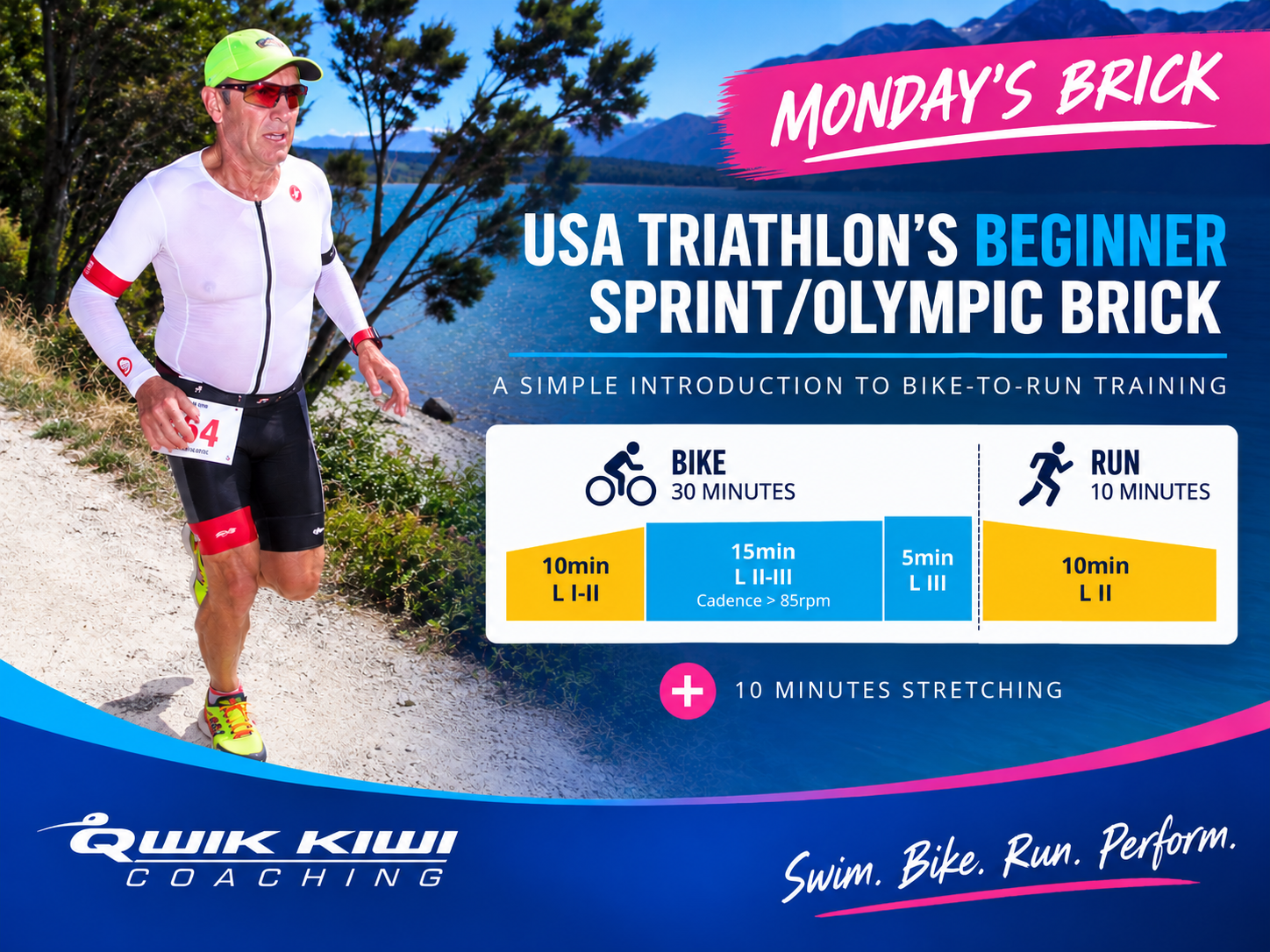
The workout lasts just 40 minutes, but there’s a deliberate progression built into the bike. You start easily, gradually increase your effort and finish the ride at Level III before transitioning directly into 10 minutes of controlled Level II running.
That means you’re not beginning the run with completely fresh legs.
And that’s the point.
The goal isn’t to discover how fast you can run after cycling. It’s to become familiar with the transition, learn how your legs respond and practise settling into a comfortable running rhythm.
Why You’re Doing This Session
For a beginner triathlete, the first few brick sessions are as much about learning as they are about developing fitness.
You can be perfectly comfortable cycling and perfectly comfortable running, yet putting the two together can feel surprisingly different.
Your legs have spent the previous 30 minutes moving through a cycling-specific range of motion. You then get off the bike, stand upright and ask those same muscles to immediately start running.
That’s something worth practising before race day.
This session gives you an opportunity to experience that change without making the workout unnecessarily complicated.
The progressive bike also introduces another important lesson.
You won’t simply cruise through the entire ride at one easy intensity. You’ll gradually move from Level I-II towards Level III before transitioning onto the run.
This session can help you:
- Become familiar with running immediately after cycling.
- Practise a simple bike-to-run transition.
- Learn how your running legs feel after progressively harder cycling.
- Develop better control of your cycling intensity.
- Practise maintaining a cadence above 85rpm during the main part of the ride.
- Learn to settle into Level II rather than chasing pace at the start of the run.
- Build confidence before your first Sprint or Olympic-distance triathlon.
For beginners, that final point is particularly important.
The more familiar the bike-to-run transition becomes in training, the less surprising it should feel on race day.
Session Inspiration
The inspiration for this workout comes from an article about using brick workouts in triathlon training published by USA Triathlon.
The session provides a straightforward introduction to bike-to-run training for athletes preparing for Sprint and Olympic-distance triathlons.
I’ve adapted the workout to my Levels intensity system so you have clear intensity targets throughout the bike and run.
For a full understanding of the system, you can read my guides to intensity for cycling and running.
What You Should Focus On
On the Bike
Your 30-minute ride gradually progresses through three stages.
Start with:
10 minutes at Level I-II.
Don’t rush this section.
Allow your legs to warm up, gradually establish your cycling rhythm and prepare yourself for the work ahead.
You’ll then ride:
15 minutes at Level II-III.
This is where the effort begins to build.
Aim to keep your cadence above 85rpm while maintaining a smooth, controlled pedal stroke.
Level II-III means you’re working around the transition between your endurance and tempo intensities. It shouldn’t suddenly feel like a hard interval.
Think of it as gradually applying more pressure while remaining in control.
Your final cycling block is:
5 minutes at Level III.
This is the strongest part of the ride.
Again, don’t turn it into a race.
You’re deliberately finishing the bike with some work in your legs because you want to experience what happens when you then ask them to run.
During the Transition
Once you’ve completed the five minutes at Level III, transition directly onto the run.
Have your running shoes and anything else you need organised before you start the workout.
As a beginner, there’s no need to sprint through transition.
Instead, focus on being calm, organised and efficient.
You want to avoid an unnecessarily long break, but you’re practising the process—not trying to win T2 in training.
The more often you practise it, the more automatic those simple actions become.
On the Run
Run for:
10 minutes at Level II.
This is where beginners can easily make a mistake.
You’ve just finished five minutes of Level III cycling, adrenaline can be high and your perception of running pace may feel slightly unusual.
Don’t respond by immediately trying to run fast.
Settle into Level II.
Your breathing should remain controlled and you should be able to maintain a conversational effort.
The first few minutes may feel awkward.
That’s normal.
Give your body time to transition from cycling mechanics to running mechanics. Concentrate on relaxing, finding your normal stride and allowing the run to come to you.
The objective isn’t to produce an impressive 10-minute run.
It’s to learn how to run well after cycling.
Common Mistakes to Avoid
Riding Too Hard Too Soon
The bike progresses for a reason.
Don’t turn the first 10 minutes into Level III because you feel fresh.
Start at Level I-II and allow the intensity to build throughout the ride.
Turning Level II-III Into a Hard Effort
Level II-III is controlled.
You should notice the increase in effort from your warm-up, but you shouldn’t be struggling.
Save Level III for the final five minutes.
Ignoring Your Cadence
During the 15-minute Level II-III portion, aim to keep your cadence above 85rpm.
Avoid grinding a large gear at a low cadence simply because it produces more speed.
Think smooth and controlled.
Taking Too Long in Transition
You don’t need a race-speed transition, but you also don’t want to sit around until your legs feel completely recovered.
The value comes from beginning the run while the cycling is still influencing how your legs feel.
Starting the Run Too Fast
This is probably the biggest mistake to avoid.
Your first instinct may be to force your legs into your usual running pace.
Instead, concentrate on Level II effort.
Your pace can look after itself.
Worrying About Heavy or Awkward Legs
If your legs feel strange when you begin running, the workout is doing exactly what you need it to do.
You’re experiencing the bike-to-run transition in training rather than discovering it for the first time during your race.
Don’t panic.
Relax and allow your running rhythm to develop.
Tips for Completing This Session Successfully
Set everything up before you begin.
Have your running shoes ready, know where you’ll leave your bike and make the transition as simple as possible.
During the bike, concentrate on progression rather than speed.
Each section should have a purpose:
Level I-II → Level II-III → Level III.
You should feel the effort gradually increasing rather than suddenly jumping from easy riding to hard riding.
Once you reach the run, change your mindset.
The progressive build is finished.
You’re no longer trying to increase the intensity.
Now the challenge is to bring it back under control.
Settle into Level II, relax your upper body and give your legs a few minutes to remember how to run.
For a beginner, that’s a valuable skill to practise repeatedly.
Today’s Workout
USA Triathlon’s Beginner Sprint/Olympic Brick
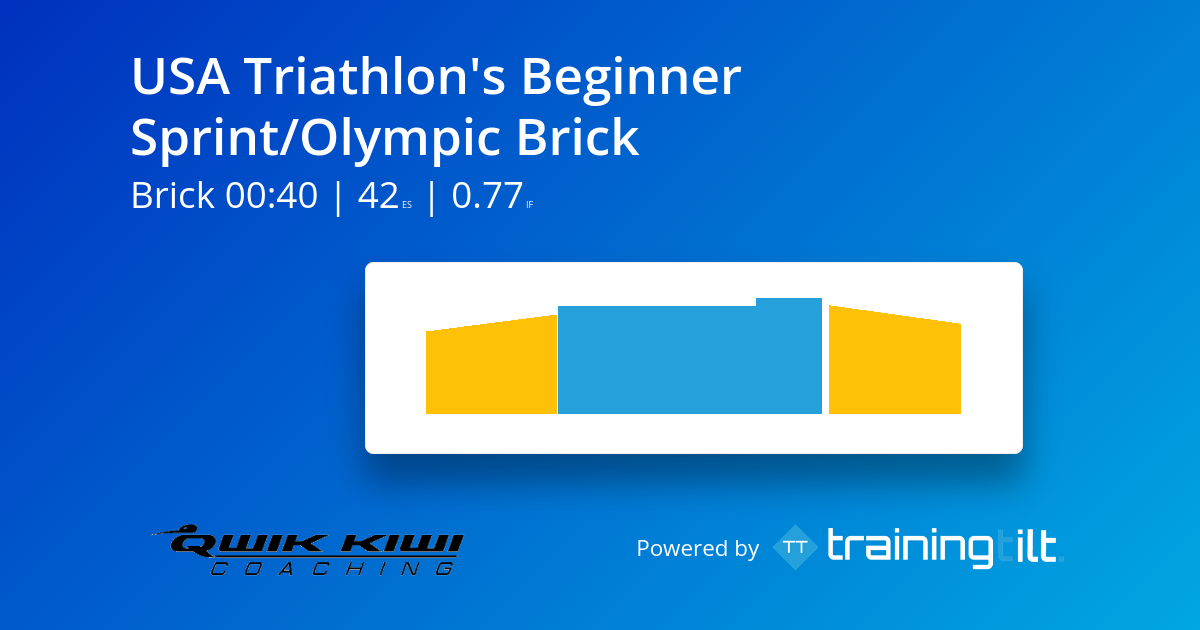
Workout Duration: 40min
Bike — 30min
Warm-Up
10min Level I-II
Build
15min Level II-III
Cadence above 85rpm
Finish
5min Level III
Transition
Transition directly from the bike onto the run.
Keep it calm, organised and reasonably prompt.
Run — 10min
10min Level II
Recovery
10min Stretching
How This Session Should Feel
The workout should feel like it has two distinct parts.
During the bike, the intensity gradually builds.
The first 10 minutes should feel easy and comfortable. During the next 15 minutes, you’ll notice the effort increasing while still remaining controlled. The final five minutes at Level III should feel purposeful and require more concentration.
Then you transition onto the run.
At first, your legs may feel heavy, quick, awkward or simply different.
Don’t judge the session by those opening steps.
Stay at Level II and give your body an opportunity to adjust.
As the 10-minute run progresses, you should begin to feel more natural and establish a comfortable running rhythm.
You shouldn’t finish this workout exhausted.
You should finish it with a better understanding of what happens when you get off your bike and start running—and with a little more confidence that you can handle that moment on race day.
For a beginner triathlete, that’s exactly what a brick session should teach you.
Want to Get More From Your Brick Sessions?
Want to run better off the bike and use brick workouts properly?
Get my FREE Brick Session Blueprint.
Inside you’ll discover:
- Smarter brick sessions.
- Better pacing.
- Stronger triathlon runs.
- Sessions suitable for Sprint through to Ironman-distance athletes.
Get your free Brick Session Blueprint and start making every brick session count.
Want to Complete This Brick on Velocity?
Both legs of this brick workout are now available as coach-led video sessions on Velocity, so you can follow the workout with me rather than managing the session yourself.
🚴 Bike Leg — 30min
Progress from Level I-II through Level II-III before finishing at Level III.
🏃 Run Leg — 10min
Transition from the bike and settle into a controlled Level II run.
Complete them back-to-back as the full brick, moving directly from the bike video into the run video. It’s an easy way to have the pacing and structure guided for you while you focus on executing the session well.
Not using Velocity yet? Join Qwik Kiwi athletes for coach-led training, including live sessions each Tuesday and Thursday at 6:00am NZT, plus an expanding library of on-demand workouts. Start with a 14-day free trial.