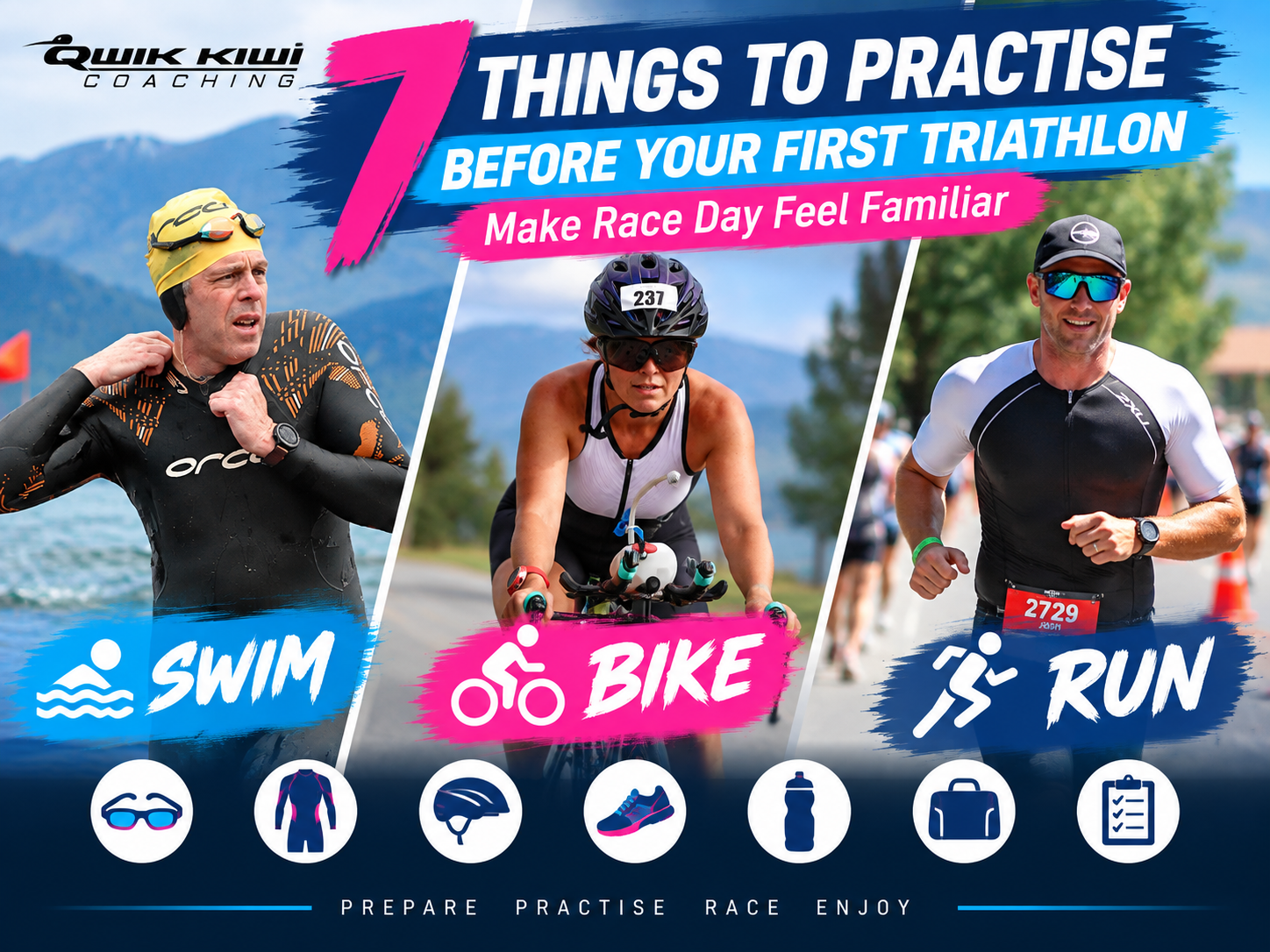
Training for your first sprint triathlon is about more than becoming fit enough to swim, cycle and run.
You can be perfectly capable of completing each discipline individually and still arrive on race morning facing several things you have never actually done before.
What does it feel like to swim in open water with other people around you? How quickly can you find your bike in transition? Can you put your shoes on when you’re wet and your heart rate is elevated? What does running feel like immediately after cycling?
These aren’t necessarily fitness problems.
They’re skills and familiarity problems — and the good news is that you can practise them.
Your first triathlon will probably contain plenty of new experiences. The goal of your training isn’t to remove every unknown, but you can make race day considerably less daunting by making the important things familiar beforehand.
Here are seven things I’d encourage you to practise before your first sprint triathlon.
1. Practise Swimming in Conditions Similar to Race Day
If your sprint triathlon has an open-water swim, your first experience of open-water swimming shouldn’t be when the starting signal goes.
Pool swimming and open-water swimming are different experiences.
In a pool, you’ve got a black line underneath you, a wall every 25 or 50 metres, lane ropes and usually relatively calm water.
In open water, those reference points disappear.
You may need to sight to stay on course, deal with waves or chop, swim alongside other people and manage the initial excitement of the start.
If you can safely access open water before your event, spend some time becoming comfortable in that environment.
You don’t necessarily need to turn every open-water swim into a hard training session. The objective can simply be familiarity.
Practise looking forward periodically to identify where you’re going. Learn how your wetsuit feels if you’re racing in one. Experiment with your goggles and make sure they remain comfortable and don’t leak.
Most importantly, learn to stay calm.
Always treat open-water safety seriously. Swim in an appropriate location, follow local safety guidance and avoid swimming alone.
If your race is pool-based, the same principle applies: understand how your particular event starts and how the swim will operate.
The more familiar the environment feels, the less mental energy you’ll need to spend dealing with it on race morning.
2. Practise Your Swim-to-Bike Transition
Transition isn’t just somewhere you store your bike.
It’s part of the race.
For your first triathlon, you don’t need an elaborate professional transition routine. You need something simple, organised and repeatable.
Before race day, lay out the equipment you’ll need and practise moving from swimming into cycling.
If you’re wearing a wetsuit, practise taking it off.
Work out the order in which you’ll put on your helmet, cycling shoes if you’re using them, race number and any other equipment required for your event.
One particularly important habit is putting your helmet on and fastening it before handling your bike. Check the rules for your specific event beforehand so you understand its transition requirements.
You can practise this at home without completing a full swim beforehand.
Wet yourself down if necessary, then go through the sequence.
It might initially feel awkward.
That’s exactly why you’re practising it.
You’re developing a routine so that when you enter transition on race day with an elevated heart rate and dozens of other athletes moving around you, you don’t need to invent the process.
3. Practise Cycling After Swimming
Most of your cycling training will probably begin with fresh legs.
Race day won’t.
The swim in a sprint triathlon might not leave your legs exhausted, but the experience of getting out of the water, moving through transition and immediately beginning to ride is different from starting a normal training ride.
You don’t need to perform a swim-bike session every week.
But completing some sessions where you swim and then ride gives you an opportunity to experience that changeover.
It also lets you practise some practical details.
How does your stomach feel when you start cycling after swimming? Where will you carry your drink? When will you begin drinking? Does your race clothing feel comfortable on the bike when it’s wet?
These small details are much easier to solve during training than during your race.
4. Practise Running Off the Bike
This is one of the most valuable race-specific experiences for a first-time triathlete.
You finish your bike ride, put on your running shoes and start running.
And your legs can feel decidedly strange.
Your stride may initially feel awkward, your cadence can feel different, and the pace you’re running may not feel anything like it normally does.
That’s one reason we use brick sessions in triathlon training.
A brick combines two disciplines, commonly cycling followed immediately by running.
For a first sprint triathlon, that run doesn’t always need to be long.
Even a short, controlled run straight after your bike can teach you a lot.
You’re learning what those first few minutes feel like and, importantly, learning not to panic when your legs don’t immediately feel normal.
This is also a chance to practise controlling your effort.
It’s very easy to leave transition excited and run the opening part of the run too hard. Learning to settle into your running rhythm after cycling can pay dividends later in the race.
5. Practise Your Bike-to-Run Transition
Transition two looks simple.
Rack your bike. Change your shoes if necessary. Start running.
But it’s still worth rehearsing.
Work out exactly what you need.
Where will your running shoes be? Do you need socks? Are you wearing the same shoes for cycling and running? Where will your hat or visor be? What happens to your helmet?
Again, you’re not trying to win the transition.
You’re trying to make it calm, simple and automatic.
Practise coming off the bike, going through your transition routine and beginning your run.
You’ll also need to understand the mount and dismount rules for your particular race. Don’t assume every event operates identically — read the athlete information supplied by your event organiser.
Saving a handful of seconds in transition isn’t particularly important for most first-time triathletes.
Avoiding several minutes of confusion because you don’t know what you’re doing is much more useful.
6. Practise Using Your Race-Day Equipment
Race day isn’t the time to discover that your goggles leak.
Or that your wetsuit rubs your neck.
Or that your cycling shoes are difficult to put on when you’re wet.
Or that the running top you love for a 30-minute training run becomes uncomfortable when it’s already wet from swimming and cycling.
Use the equipment you intend to race with during training.
That includes your swimwear or tri-suit, wetsuit where applicable, goggles, helmet, bike, cycling shoes, running shoes, socks, sunglasses, race belt and anything else you expect to use.
You don’t have to wear the complete race setup for every training session.
But everything should be tested.
The same applies to your bike.
Make sure you’re comfortable using your gears, drinking while riding and handling the bike confidently. As race day approaches, make sure the bike is mechanically ready too.
Your equipment should become boring.
That’s a good thing.
You want to know how everything works before you reach the start line.
7. Practise Your Race-Day Routine
Finally, practise more than the race itself.
Think about everything that happens before the starting signal.
What will you eat for breakfast?
When will you eat it?
What will you drink?
What time do you need to arrive?
What equipment needs to go into transition?
How will you organise it?
When will you warm up?
Where do you need to be before the swim starts?
You don’t need to create a full dress rehearsal every weekend, but you should test the important parts of your routine.
This is particularly important with fuelling and hydration.
Don’t introduce an unfamiliar breakfast, sports drink or nutritional product simply because somebody told you it’s good for triathlon. Practise what you intend to use so you know how your body responds.
As your event approaches, write yourself a simple race-day checklist.
The purpose isn’t to make race morning rigid.
It’s to reduce the number of decisions you need to make when you’re already excited, nervous and surrounded by hundreds of other people doing their own thing.
You Don’t Need to Practise the Entire Race
After reading all of this, you might be tempted to put everything together and complete an entire sprint triathlon in training.
You don’t need to.
You don’t have to prove that you can complete the race before you’re allowed to stand on the start line.
Instead, practise the components.
Do some open-water swimming where appropriate.
Practise transition.
Complete some bike-to-run bricks.
Test your equipment.
Practise your race-day breakfast.
Learn how you’ll manage your effort.
Over time, those individual experiences start connecting.
That’s race-specific preparation.
You’re not trying to recreate race day every weekend. You’re removing unnecessary surprises from the day that actually matters.
Fitness Gets You to the Race — Skills Help You Use That Fitness
There’s an important progression in preparing for your first triathlon.
Initially, much of your attention may simply be on developing enough swimming, cycling and running fitness.
As your event gets closer, the question begins to change.
It becomes less about:
“Can I swim, ride and run?”
And more about:
“Can I put swimming, cycling and running together?”
That’s why the final weeks before your first sprint triathlon aren’t necessarily the time to chase huge fitness gains.
They’re an opportunity to make your training increasingly specific to what you’re actually going to do.
Practise the environment.
Practise the transitions.
Practise running off the bike.
Practise your equipment.
Practise your routine.
Then when race morning arrives, you won’t be doing everything for the first time.
You’ll simply be putting together things you’ve already practised.
Consistency beats perfection.
Four Weeks Until Your First Sprint Triathlon?
If you’ve already built your basic swimming, cycling and running fitness and your first sprint triathlon is approaching, First Sprint: 4 Weeks to Your First Sprint Triathlon is designed to help you bring those three disciplines together.
This isn’t a couch-to-triathlon programme.
It’s a four-week, race-specific TrainingPeaks plan for athletes who can already complete approximately 1,500 metres within a structured swim workout — that doesn’t need to be continuous — ride continuously for approximately 90 minutes, and run continuously for approximately 45 minutes.
Those aren’t universal minimum requirements for starting triathlon training. If your race is several months away, you can begin from a considerably lower fitness level and progressively build towards those capabilities.
But if you’ve already got that foundation and your race is getting close, First Sprint gives you a structured programme for turning your existing swim, bike and run fitness into triathlon preparation.
The cycling workouts use power, the running workouts use pace, and you’ll also receive the First Sprint Athlete Guide to help you understand how to put the programme into practice.
You already know how to swim, ride and run.
Now practise putting them together.
Four weeks. Three sports. One finish line. 🏊🚴🏃