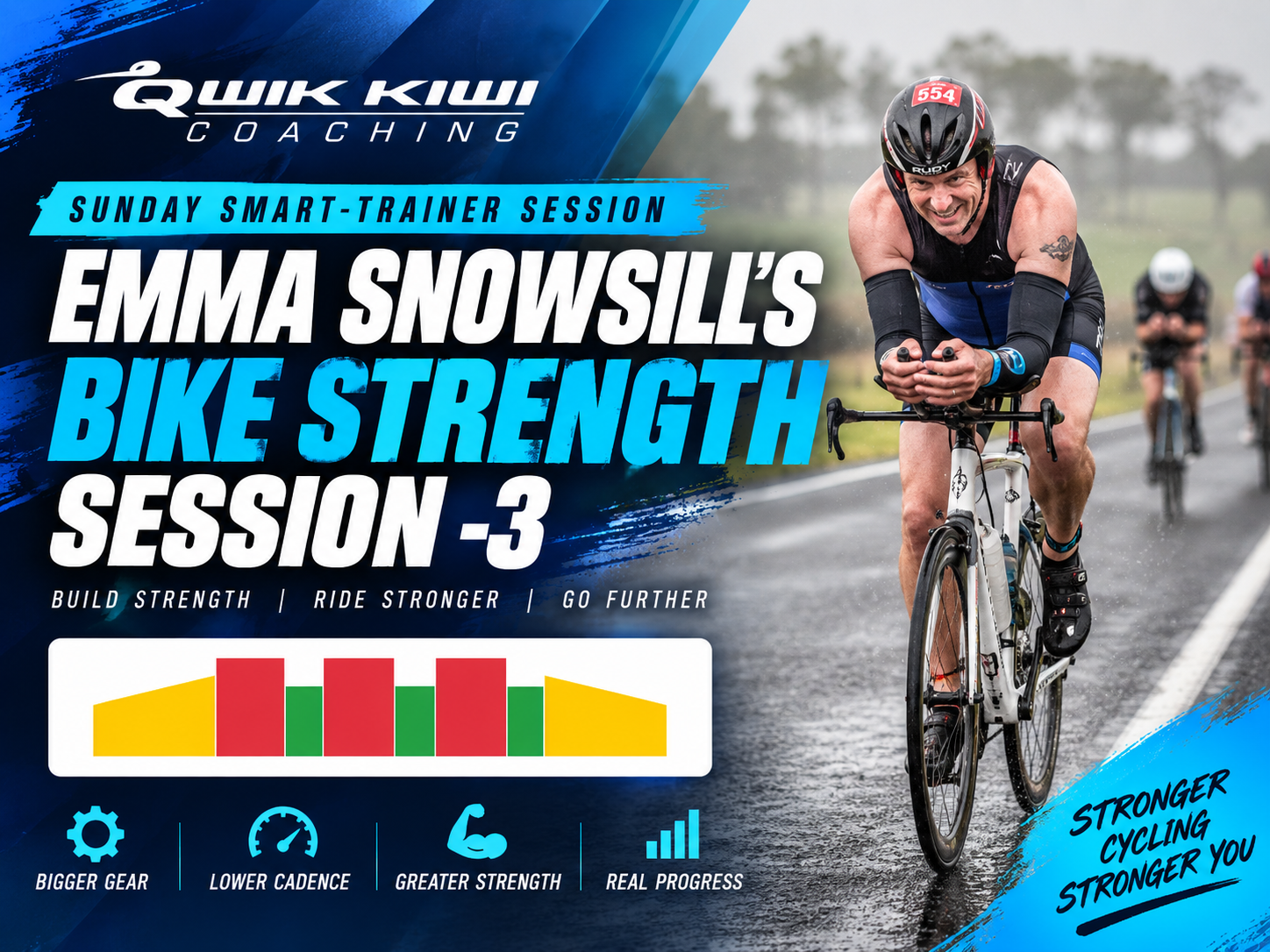
Strength on the bike isn’t only developed in the gym.
By deliberately combining a bigger gear, lower cadence and sustained Level IV intensity, you can create a very different muscular demand from your normal endurance riding.
That’s the focus of this week’s Emma Snowsill’s Bike Strength Session -3.
The main set consists of three five-minute efforts at Level IV while holding your cadence between 65 and 75rpm. Instead of spinning quickly, you’re deliberately asking your legs to produce greater force with each pedal stroke.
It’s a simple session on paper, but five minutes can feel considerably longer when you’re pushing a big gear at threshold intensity.
The challenge isn’t simply to survive all three efforts. It’s to maintain controlled power, good pedalling technique and the prescribed cadence as muscular fatigue builds.
Session Inspiration
The inspiration for this workout comes from a Beginner’s Guide to Triathlon published by Triathlon Plus, which was included with Issue 42 in the summer of 2012.
The guide featured training advice from Emma Snowsill, one of the outstanding triathletes of her generation.
Snowsill won three ITU World Championships and gold medals at both the 2008 Beijing Olympic Games and 2006 Melbourne Commonwealth Games.
I’ve subsequently adapted the concept into this particular -3 variation, using sustained big-gear Level IV efforts to target cycling-specific muscular strength.
Today’s Workout
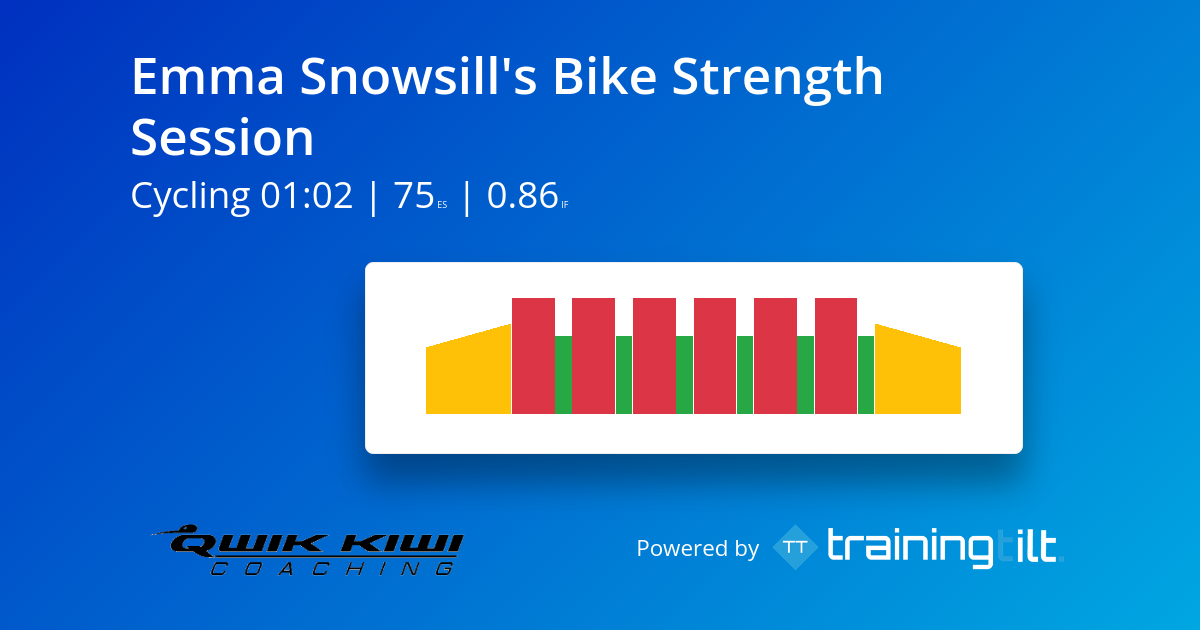
Emma Snowsill’s Bike Strength Session -3
Warm-Up
- 10min Level II
Main Set – 3x:
- 5min Big Gear (BG) at Level IV @ 65–75rpm
- 2min Level II Rest Interval (RI)
Cool-Down
- 10min Level II
Post-Ride
- 10min Stretching
Total Riding Time: 41 minutes
Why You’re Doing This Session
Most of the time, I encourage cyclists to ride at a cadence around 90–100rpm.
This workout deliberately takes you well below that.
During each five-minute Level IV effort, you’ll reduce your cadence to 65–75rpm and select a gear that allows you to maintain the prescribed intensity.
That changes the muscular demand.
Rather than relying on higher leg speed, you’re producing more force through each pedal stroke. Sustaining that for five minutes at Level IV provides a substantial challenge to the cycling-specific strength of your legs.
That can be particularly useful when preparing for situations where you’re required to produce sustained power against greater resistance—for example, climbing or riding into a strong headwind.
But there’s an important distinction:
Big gear doesn’t mean grinding as hard as possible.
This remains a controlled Level IV workout.
What You Should Focus On
Start with 10 minutes at Level II and use that time to properly prepare your legs for the work ahead.
Don’t spend the entire warm-up simply waiting for the first interval.
Gradually settle into your normal cadence and include some changes in resistance so your legs are ready when you move into the bigger gear.
When the first five-minute effort begins, select a gear that allows you to maintain 65–75rpm at Level IV.
Your cadence and intensity need to work together.
If the gear is so large that your cadence drops below 65rpm and you’re fighting to turn the pedals, you’ve gone too far.
Likewise, if your cadence continually creeps above 75rpm, you may not be creating the muscular-strength stimulus we’re looking for.
Aim for strong, controlled pedal strokes rather than stomping on the pedals.
During each two-minute Level II recovery, change back into an easier gear, bring your cadence towards your normal range and genuinely recover.
You’ll need that recovery before doing it again.
Common Mistakes To Avoid
Choosing too big a gear. Bigger isn’t automatically better. You need enough resistance to create the low-cadence strength stimulus while still maintaining Level IV appropriately.
Letting cadence fall too low. The target is 65–75rpm. This isn’t a competition to see how slowly you can turn the pedals.
Starting the first repetition too hard. Five minutes is long enough for an overenthusiastic start to come back and punish you.
Allowing your upper body to do the work. Stay controlled through your shoulders and torso. The additional force should be generated through your legs rather than by wrestling with the handlebars.
Ignoring the recovery intervals. Those two minutes are there for a reason. Bring the intensity back to Level II and prepare yourself to produce another quality effort.
Turning the third repetition into a maximal effort. The goal is three quality Level IV repetitions—not two controlled efforts followed by a five-minute test.
Coach Ray’s Tips
I’d judge this workout by consistency across the three repetitions.
Your first five-minute effort establishes the standard.
The second asks whether you can reproduce it.
The third asks whether you can maintain that same quality when your legs are carrying considerably more fatigue.
Ideally, your power, cadence and technique should remain relatively consistent across all three.
If your first repetition is substantially stronger than your third, consider whether you went too hard initially or selected too large a gear.
I’d also pay attention to how the effort feels compared with your normal Level IV riding.
At 65–75rpm, you may find that your cardiovascular system feels relatively controlled while your legs experience considerably greater muscular strain.
That’s part of the purpose of the session.
You’re changing how you produce the power.
Coach Ray Rode This Session
I’ve also completed Emma Snowsill’s Bike Strength Session -3, and this is a particularly interesting workout to review afterwards because the combination of power, heart rate and cadence can tell us much more than any one metric in isolation.
My Strava Activity
My Workout Data

When I review this session, the first thing I’d look for is whether the three five-minute work intervals are clearly identifiable in the data.
Then I’d compare power and cadence together.
Was I able to maintain Level IV while keeping cadence within 65–75rpm throughout all three repetitions?
Next I’d look at heart rate.
Did it progressively rise across each five-minute effort? Was heart rate higher during the second and third repetitions despite similar power? And how effectively did it fall during the Level II recoveries?
Finally, I’d compare the first and third repetitions.
If I produced similar power at a similar cadence while maintaining good technique, despite the accumulated fatigue, that’s a good indication that I executed the session as intended.
The objective isn’t to find the biggest number in the file.
It’s to determine whether I produced the right power, at the right cadence, consistently.
Ride Emma Snowsill’s Bike Strength Session -3 With Me
Want to experience the workout rather than just read about it?
Emma Snowsill’s Bike Strength Session -3 is available to ride on demand on Velocity, where you can complete the exact session with me coaching you through it.
I’ll guide you through the warm-up before taking you into the three five-minute big-gear Level IV efforts at 65–75rpm, along with the Level II recoveries and cool-down.
For a workout like this, having the session structured for you means you can concentrate on what really matters: selecting the appropriate gear, controlling your cadence, maintaining Level IV and keeping your technique together as muscular fatigue builds.
👉 Ride Emma Snowsill’s Bike Strength Session -3 on Velocity
New to Velocity? Get 14 Days FREE
If you’re not already riding with me on Velocity, you can get 14 days of Velocity FREE through Qwik Kiwi Coaching.
Your free trial gives you the opportunity to experience my coach-led indoor cycling workouts for yourself—and Emma Snowsill’s Bike Strength Session -3 is a great session to start with.
👉 Start your FREE 14-day Velocity trial
Once you’ve created your account, come back and ride the workout with me.
Choose the right gear. Control the cadence. Produce the power.