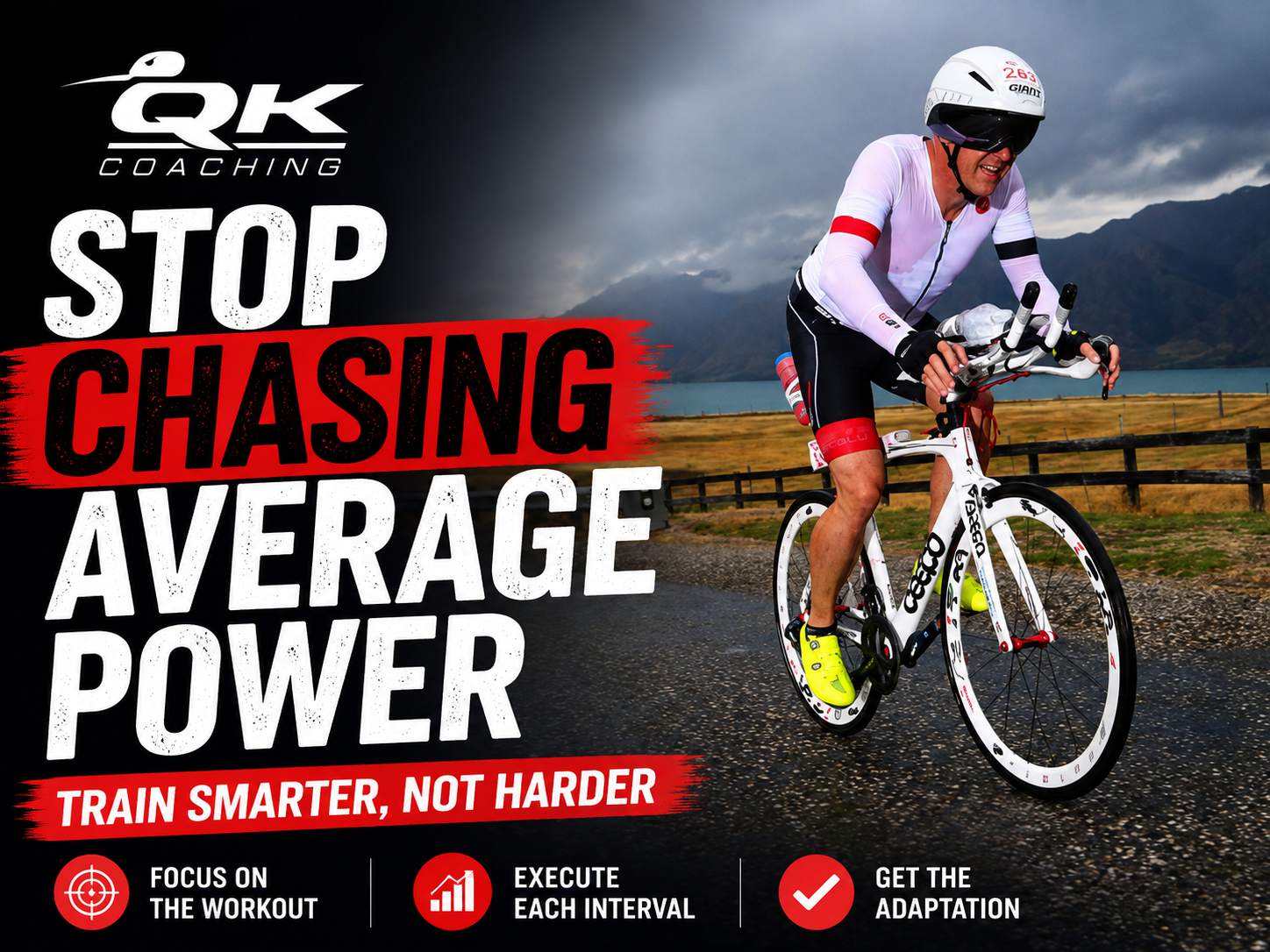
It’s tempting to finish an indoor cycling workout, look at your average power, and immediately decide whether you had a good ride.
Higher average watts?
Great session.
Lower average watts?
Maybe you weren’t riding well enough.
But there’s a problem with that approach:
Average power doesn’t tell you whether you completed the workout correctly.
In fact, chasing a higher average power can encourage you to ride too hard when you should be recovering, push unnecessarily between intervals, and completely miss the purpose of a structured training session.
Your goal isn’t to produce the highest average power possible.
Your goal is to execute the workout.
What Does Average Power Actually Tell You?
Average power is exactly what the name suggests: the average number of watts you produced across a particular period of time.
If you complete a steady endurance ride, that number can be useful.
But structured indoor cycling workouts aren’t always steady.
Imagine a session containing several hard VO₂ Max intervals separated by easy recovery periods.
During the intervals, your power might be well above your FTP.
During recovery, it might be deliberately very low.
Combine everything and your average power for the entire session could look relatively unimpressive.
That doesn’t mean it was a poor workout.
It may mean you executed it perfectly.
Average power can disguise how demanding a variable workout actually was, which is one reason metrics such as Normalized Power were developed.
Your Recovery Intervals Are Supposed to Be Easy
This is where chasing average power can become particularly counterproductive.
Let’s say you’ve just completed a hard Level V interval.
Your programme gives you three minutes of Level I recovery before the next repetition.
That recovery has a purpose.
It allows you to reduce the physiological stress sufficiently to produce another quality interval.
But if you’re watching your average power and thinking:
“I don’t want that number to drop…”
you may start riding your recovery harder than prescribed.
Now you’re not recovering properly.
The next interval suffers.
Then the next one.
You may finish with a higher average power but a worse training session.
Don’t Add Watts Where They Don’t Belong
The same problem occurs during warm-ups and cool-downs.
A warm-up isn’t an opportunity to improve your workout average.
It’s preparation for the work ahead.
Likewise, the cool-down isn’t the time to squeeze out a few more watts so your final number looks better.
If your programme prescribes Level I or Level II, ride at the prescribed intensity.
Every part of the workout should serve a purpose.
Adding unnecessary intensity doesn’t automatically make the workout more effective.
Judge the Important Parts of the Session
Instead of asking:
“What was my average power?”
Ask better questions.
Did I hit the prescribed power during my key intervals?
Did I maintain the required intensity throughout each repetition?
Was my final interval as strong as my first?
Did I keep the recovery genuinely easy?
Did I maintain good cadence and technique?
Did I complete the workout as it was designed?
Those questions tell you far more about the quality of your training than one average number at the end.
Two Rides Can Have the Same Average Power—and Be Completely Different
Consider two one-hour rides.
During the first, you ride continuously at 200 watts.
During the second, you repeatedly alternate between much harder efforts and easy recovery periods.
Both rides could finish with an average power of 200 watts.
But they aren’t the same workout.
The variable ride can create substantially greater physiological demands because the cost of harder efforts isn’t simply cancelled out by easier recovery periods. Normalised Power (NP) is used specifically to better represent this difference in variable rides.
This is why context matters.
A number without understanding what happened during the workout can be misleading.
Average Power Isn’t a Bad Metric
None of this means average power is useless.
There are situations where it’s extremely valuable.
For a sustained time trial, long climb, or steady interval, average power can be one of the most useful measures of performance. Average power can be more appropriate than Normalised Power when evaluating long climbs or time trials, especially if Variability Index (VI) is low (less than 1.05).
The problem isn’t average power itself.
The problem is chasing it when it isn’t the objective of the session.
Metrics should help you understand your training—not dictate how you ride regardless of the workout’s purpose.
Don’t Turn Structured Training Into a Competition With Yourself
Indoor cycling makes numbers incredibly visible.
Power.
Heart rate.
Cadence.
Average power.
Calories.
Training Stress Score.
FTP.
It’s easy to become obsessed with making every number bigger.
But successful training isn’t about setting a record every time you climb onto the bike.
Sometimes success means producing more power.
Sometimes success means holding back.
Sometimes success means recovering properly so you can absolutely nail the next interval.
The smartest athletes understand the difference.
Follow the Workout, Not Your Ego
When you start your next indoor cycling session, resist the temptation to judge it by the average watts displayed at the end.
Look at what the workout was designed to achieve.
If it’s a VO₂ Max session, execute your Level V efforts properly.
If it’s a Threshold workout, focus on your Level IV intervals.
If it’s an endurance session, stay controlled at Level II.
And when you’re supposed to recover, recover.
You don’t get bonus fitness because your average power looked impressive afterwards.
You get fitter by applying the right training stimulus at the right time—and then recovering sufficiently to adapt to it.
Stop chasing average power. Start chasing better execution.
Take Your Indoor Cycling to the Next Level
If you’re looking for structured indoor cycling workouts that build fitness, improve performance, and take the guesswork out of your training, check out Qwik Kiwi’s Velocity.
Velocity gives you access to hundreds of cycling workouts including VO₂ Max, Threshold, Tempo, Endurance, Technique, and Recovery sessions suitable for cyclists, triathletes, and endurance athletes of all abilities.
You can try Velocity completely FREE for 14 days with no long-term commitment.
Start your free trial today:
http://app.vqvelocity.com/join?a=rhs956
Train smarter. Ride stronger. Stay consistent.