You’ve completed months of training.
You’ve swum countless laps, spent hours on the bike, completed your long runs, practised your brick sessions, and hopefully worked out a nutrition strategy that works for you.
By the day before your Ironman 70.3, there’s very little you can do to become fitter.
But there’s plenty you can do to make race day harder than it needs to be.
Poor organisation, unfamiliar food, unnecessary time on your feet, forgotten equipment, and last-minute stress can all undermine the preparation you’ve spent months building.
That’s why I tell athletes:
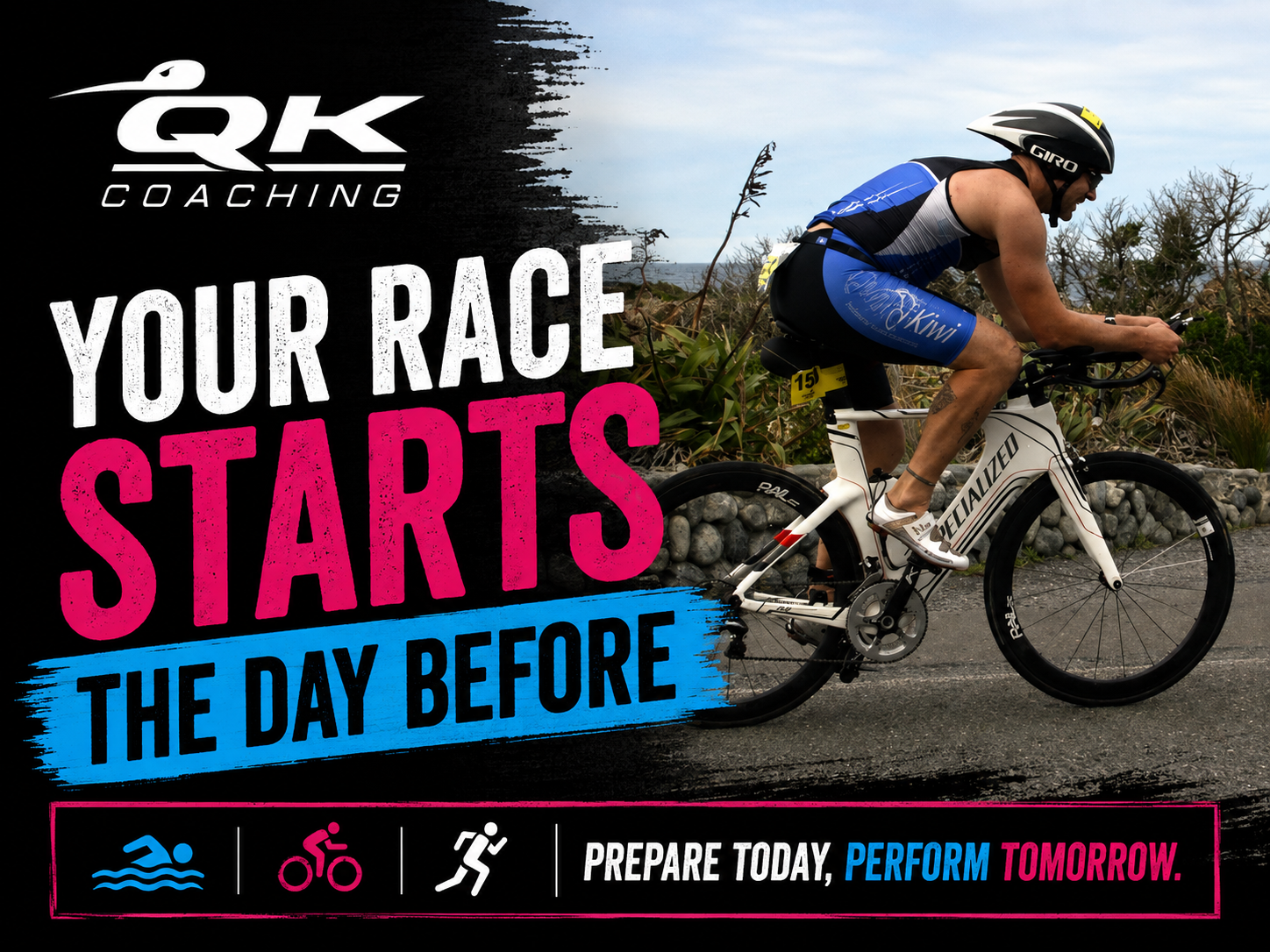
Your Ironman 70.3 doesn’t start when the gun goes off. It starts the day before.
The Training Is Done
The first thing to understand is that the day before your race isn’t another opportunity to gain fitness.
That work has already been done.
Your priority now is to arrive at the start line rested, fuelled, organised, and mentally ready to execute your race.
Some athletes struggle with this.
After weeks of tapering, they feel restless. They worry they’ve lost fitness. They want to squeeze in one more decent training session just to reassure themselves.
Don’t.
If your programme includes a short pre-race swim, ride, or run, complete it as prescribed. The objective is simply to keep the body moving and maintain familiarity—not create fatigue.
You can’t significantly improve your fitness the day before the race.
You can certainly make yourself tired.
Get Your Equipment Sorted Early
Triathlon requires a lot of equipment.
Wetsuit.
Goggles.
Helmet.
Bike shoes.
Running shoes.
Race belt.
Nutrition.
Bottles.
Timing chip.
And that’s before we start thinking about all the little extras you’ve decided work for you.
Don’t wait until late in the evening to organise everything.
Lay your equipment out and work systematically through your swim, bike, and run.
If your event requires you to rack your bike or drop transition bags the day before, make sure you know exactly what must be left in transition and what you’re allowed to bring on race morning.
The rules and procedures vary between events, so read the Athlete Guide for your specific race rather than relying on what happened at another event.
Check Your Bike—Then Leave It Alone
The day before your Ironman 70.3 isn’t the time for major mechanical changes.
Make sure your bike is functioning correctly.
Check your brakes.
Check your gears.
Make sure your tyres are in good condition.
Charge your electronic shifting, bike computer, power meter, and any other equipment that needs charging.
Then resist the temptation to start adjusting things.
Race week is not the time to experiment with a different saddle height, move your aero bars, fit unfamiliar equipment, or make changes simply because somebody in transition has a setup that looks faster than yours.
Race what you’ve trained on.
Know Where You’re Going
One of the easiest ways to create unnecessary race-morning stress is not knowing where you need to be.
The day before, make sure you understand:
- Where transition is.
- Where you’ll enter transition on race morning.
- Where the swim start is.
- How you’ll get there.
- Where your bike is positioned.
- Where Bike Out and Bike In are.
- Where Run Out is.
- What time transition opens and closes.
- When you need to be at the swim start.
If possible, walk through transition and identify landmarks that will help you find your bike.
Hundreds or thousands of bikes can look remarkably similar when you’ve just finished a 1.9km swim.
A few minutes familiarising yourself with the layout can make T1 considerably calmer.
Eat Familiar Food
The day before a race isn’t the time to explore the local cuisine.
You might be somewhere new with fantastic restaurants and foods you’ve never tried before.
Save them for after the race.
Stick with meals and snacks that you know your body tolerates.
Your goal is to arrive on race morning well fuelled without giving your digestive system any surprises.
Keep drinking regularly throughout the day as well. You don’t need to spend the day forcing enormous quantities of water into yourself. Simply maintain your normal hydration and follow the nutrition and hydration strategy you’ve practised.
Race-week nutrition should be boring.
That’s a good thing.
Prepare Your Race-Morning Breakfast
Don’t make breakfast decisions at 4:30 in the morning.
You should already know:
- What you’re eating.
- How much you’re eating.
- When you’re eating it.
- What you’re drinking.
- What nutrition you’re taking to the start.
Better still, this should be the same breakfast strategy you’ve practised before important training sessions.
Have everything ready the night before.
Race morning has enough moving parts without trying to find a missing banana in a hotel room before sunrise.
Get Off Your Feet
Race expos are exciting.
There are bikes to look at, products to browse, other athletes to talk to, course sections to inspect, and plenty happening around the event village.
But spending five hours wandering around isn’t ideal preparation for racing 113 kilometres the following day.
Do what you need to do.
Register.
Rack your bike.
Attend required briefings.
Complete your preparation.
Then get off your feet.
Relax.
You’ve got plenty of exercise scheduled for tomorrow.
Don’t Obsess Over Sleep
Athletes often put enormous pressure on themselves to get the “perfect” night’s sleep before a race.
Then they lie awake worrying because they’re not asleep.
Race nerves are normal.
You’re excited.
You’re thinking about the morning.
You might be in an unfamiliar bed.
Your alarm may be set ridiculously early.
Do what you can to create a relaxing evening and get to bed at a sensible time, but don’t panic if your sleep isn’t perfect.
Focus on resting rather than forcing yourself to sleep.
Charge Everything
Modern triathlon involves an impressive number of batteries.
Before you settle down for the evening, check:
- GPS watch.
- Bike computer.
- Electronic gears.
- Power meter.
- Heart-rate monitor, if required.
- Headphones for before the race, if you use them.
- Phone.
There’s nothing quite like discovering your bike computer has 8% battery remaining while you’re walking into transition.
Make charging part of your day-before checklist.
Visualise Your Race
Once the logistics are sorted, spend a few quiet minutes thinking through the race.
Picture yourself entering the water calmly.
Imagine settling into your swim rhythm.
Visualise moving smoothly through T1.
See yourself riding at your planned effort rather than chasing other athletes.
Picture yourself staying on top of your nutrition.
Imagine leaving T2 under control.
Then see yourself staying patient through the half marathon and finishing strongly.
You’re not trying to predict exactly what will happen.
You’re rehearsing how you want to respond.
Have a Plan for Problems
Something probably won’t go perfectly.
That’s endurance racing.
Your goggles might leak.
The weather might change.
You might drop some nutrition.
Your legs might feel terrible for 20 minutes.
An athlete might pass you when your ego desperately wants to follow.
Think about these situations beforehand.
Then decide how you’ll respond.
When you’ve already considered a problem calmly, you’re much more likely to make a good decision when it happens under race-day pressure.
Make Race Morning Boring
This is really what all your preparation is trying to achieve.
Race morning shouldn’t involve frantic searching.
It shouldn’t involve experimenting.
It shouldn’t involve trying to remember what you’re supposed to do next.
Wake up.
Eat the breakfast you’ve planned.
Get dressed.
Take the equipment you’ve already prepared.
Travel to transition using the route you’ve already worked out.
Complete your final checks.
Head to the swim start.
That’s it.
Save the excitement for the race.
Final Thoughts
Months of training create your fitness.
The final 24 hours protect it.
The day before your Ironman 70.3 isn’t about doing more.
It’s about eliminating unnecessary decisions, reducing stress, eating and drinking appropriately, organising your equipment, and arriving at the start line ready to execute.
Prepare your gear.
Know the logistics.
Eat familiar food.
Get off your feet.
Trust your training.
Then when race morning arrives, you don’t need to wonder whether you’re ready.
You simply follow the plan.
Because your Ironman 70.3 doesn’t start when you enter the water.
It starts the day before.
Need Help Preparing for Your Next Ironman 70.3?
Training for an Ironman 70.3 isn’t just about completing swim, bike, and run sessions. The right preparation also brings together pacing, nutrition, recovery, race strategy, and the countless small decisions that determine how well you perform on race day.
If you’re preparing for your first Ironman 70.3, chasing a personal best, or simply want more confidence in what you’re doing, I’d be happy to help.
Book a free, no-obligation coaching consultation and let’s talk about your goals, your current training, and how you can arrive at your next start line properly prepared.
You’ll leave the call with practical advice and a clearer understanding of your next steps, whether we end up working together or not.