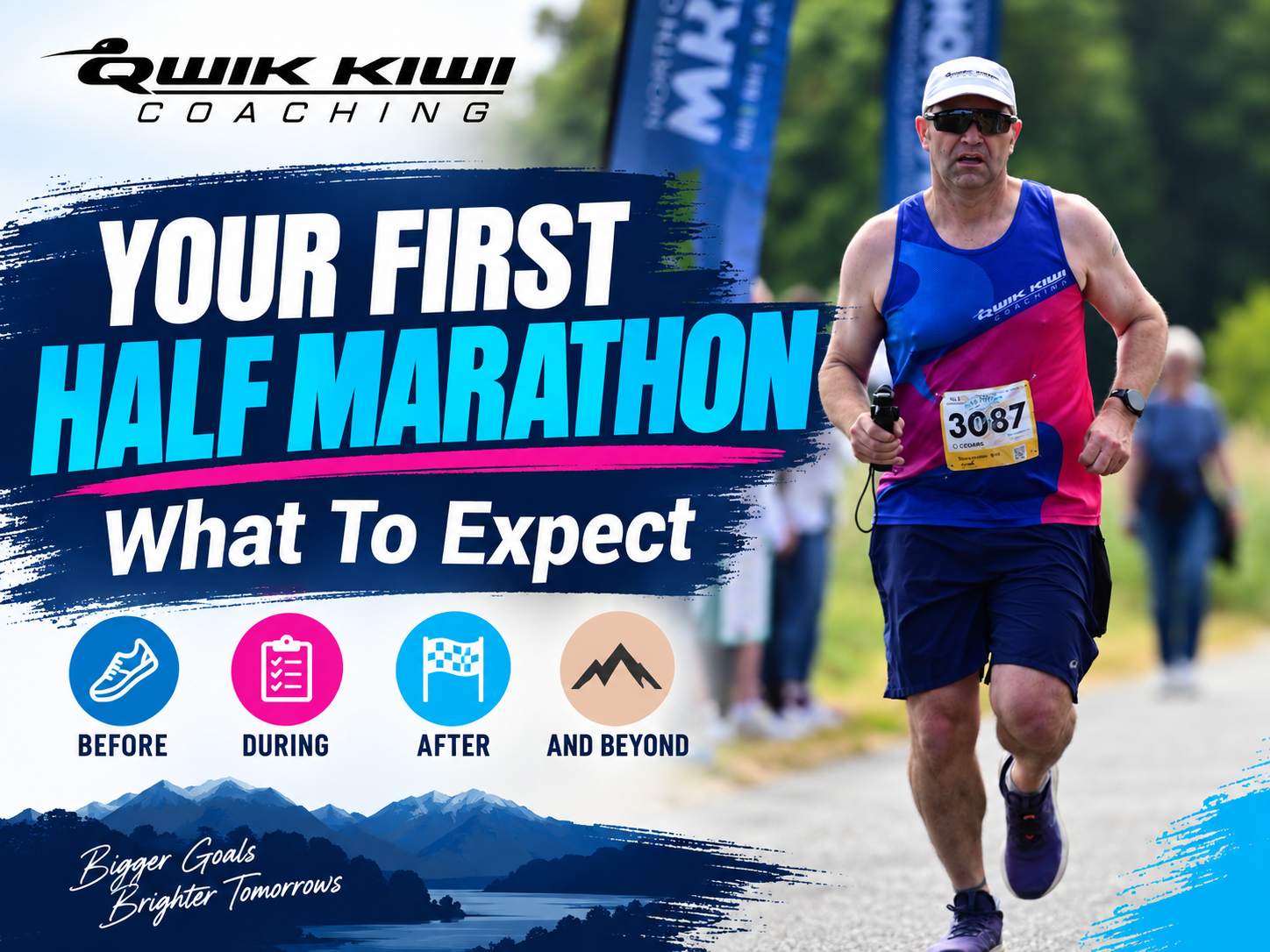
Your first half marathon is a significant step.
At 21.1 kilometres, it is long enough to demand patience, endurance and preparation, but achievable enough that thousands of runners make it their first serious endurance-running goal.
If you have entered your first half marathon, you might already be wondering what those 21.1 kilometres will actually feel like.
Will the opening kilometres feel easy? When will it start getting hard? How should you pace yourself? What should you eat and drink? And what happens when the excitement of the start line wears off and you realise there is still a long way to run?
Knowing what to expect won’t remove every challenge. It can, however, prevent many of the surprises that cause first-time half marathoners to make poor decisions.
Here is what you can expect as you prepare for—and run—your first half marathon.
The Half Marathon Is Longer Than It Looks
One of the traps with the half marathon is that it can appear relatively manageable.
If you are already comfortable running 5km or 10km, you may look at 21.1km and think it is simply a matter of continuing for longer.
It isn’t quite that simple.
As the distance increases, small mistakes become more significant.
Starting a little too fast matters more. Poor fuelling becomes more noticeable. Inadequate hydration can catch up with you. Running harder than planned during your training can leave you carrying unnecessary fatigue into subsequent sessions.
That is why successful half marathon preparation isn’t simply about increasing the distance of your runs.
You are developing the endurance, strength, pacing judgement and confidence required to keep running effectively as fatigue gradually builds.
Expect Your Training to Build Gradually
You don’t need to run 21.1km every weekend to prepare for a half marathon.
In fact, repeatedly trying to prove that you can cover the race distance is rarely the best way to train.
Your training should progressively prepare you for the demands of the event.
For many first-time half marathoners, this means gradually extending the long run while combining it with easier running, appropriate quality sessions, recovery and strength work.
Most of your endurance running should feel controlled. In my training system, much of this work is completed at Level II—a comfortable, conversational intensity.
You should finish many of these sessions feeling as though you have trained rather than raced.
As your fitness develops, more specific training can be introduced. The exact progression depends on your current ability, training history and how much time you have before race day.
The important thing is that your training progresses for a reason.
Some Training Weeks Will Feel Better Than Others
Don’t expect every week of your half marathon build-up to feel fantastic.
There will probably be runs where everything clicks. Your pace feels comfortable, your breathing is controlled and you finish wondering why running ever seemed difficult.
There will also be days when your legs feel heavy and a normally comfortable pace seems strangely demanding.
That’s normal.
Your fitness isn’t defined by one workout.
Work, sleep, weather, stress, previous training and countless other factors can influence how you feel on a particular day.
One of the skills you develop while preparing for your first half marathon is learning not to overreact to individual sessions.
Consistency over weeks and months matters far more than whether Tuesday’s run was brilliant.
Your Long Runs Will Teach You More Than Endurance
Long runs obviously help develop the aerobic endurance required to complete 21.1km, but they also give you an opportunity to practise being a half marathon runner.
What will you eat beforehand?
What clothing will you wear?
Which shoes work well over longer distances?
How much fluid do you need?
Will you use carbohydrate during the race?
How does your stomach respond when you eat or drink while running?
These aren’t details you want to discover for the first time on race morning.
Use your longer training sessions to develop a routine that you can trust.
The goal isn’t to create the perfect long run every weekend. It is to gradually remove uncertainty from race day.
Expect Race Week to Feel Strange
As your race approaches, your training workload should reduce so that you can arrive at the start line recovered and ready to perform.
For a first-time half marathoner, this can feel uncomfortable.
You’ve spent weeks building your training and suddenly you are doing less.
You might worry that you’re losing fitness.
You aren’t going to lose months of preparation because you’ve reduced your training before the race.
The purpose is to allow the fitness you’ve already developed to show itself.
You may also become unusually aware of every minor sensation in your body.
A tight calf that you would normally ignore suddenly feels significant. You might question whether your legs feel too heavy—or suspiciously fresh.
Try not to test your fitness during race week.
Your training has already done that work.
The Start Line Will Probably Feel More Exciting Than You Expected
Race morning is different from training.
There are other runners everywhere. Music may be playing. The announcer is talking. People are warming up. Your heart rate may already be higher than usual before you’ve taken a single running step.
Then the race starts.
Suddenly everyone around you is moving.
This is where one of the most important decisions of your first half marathon occurs.
Don’t allow everybody else’s excitement to determine your pace.
The opening kilometres should feel controlled.
If your goal pace feels almost too easy at the beginning, that is not necessarily a problem.
There is plenty of race left.
The First 5km Should Feel Comfortable
One of the most common first-half-marathon mistakes is trying to bank time early.
You feel fresh, so you run faster than planned.
Perhaps your target pace is 6:00 min/km, but 5:40 min/km feels surprisingly comfortable.
You convince yourself that you’ve suddenly become fitter and decide to keep going.
Unfortunately, the half marathon has a very effective way of collecting those borrowed seconds later.
The first few kilometres are not the time to demonstrate how fit you are.
Settle into your planned effort. Relax your shoulders. Find your rhythm and let the race come to you.
You want to reach 5km feeling as though you’ve been holding yourself back slightly.
Between 5km and 10km, Settle Into the Race
By now, the initial excitement should have started to fade.
Your breathing should be controlled and your pace should feel sustainable.
This section of the race can feel deceptively uneventful—and that’s a good thing.
Keep doing the basics well.
Hold your effort. Take your planned nutrition and fluids. Stay relaxed and avoid chasing every runner who passes you.
You still have more than half the race remaining.
Patience is a performance skill.
Around Halfway, the Race Starts Becoming More Honest
Passing the halfway point can provide a psychological boost.
You’ve completed more than 10km.
But you also still have approximately another 10km to run.
This is where you begin to find out whether your early pacing decisions were sensible.
If you started conservatively, you may still feel controlled.
If you raced the opening kilometres, you may notice the effort beginning to climb earlier than expected.
Don’t panic if running starts to feel harder.
A half marathon is supposed to become challenging.
Your goal isn’t to prevent fatigue entirely. It is to delay unnecessary fatigue and manage it when it arrives.
From 15km, Expect to Work
For many first-time runners, somewhere around 15–18km is where the half marathon changes character.
Your legs may become heavier.
Maintaining your pace requires more concentration.
The distance markers can suddenly seem further apart.
This is where your training matters.
You’ve practised running when you are tired. You’ve completed long runs. You’ve developed aerobic endurance. You’ve learned what controlled effort feels like.
Instead of thinking about the entire remaining distance, focus on manageable targets.
Run to the next kilometre marker.
Maintain your form.
Take the next drink station.
Stay present.
You don’t need to feel good. You need to keep making sensible decisions.
The Final Few Kilometres Are Where You Can Start Racing
If you’ve paced the race appropriately, the final kilometres are your opportunity to use what remains.
That doesn’t necessarily mean launching a huge surge at 18km.
Start by asking whether you can gradually increase your effort while maintaining good running form.
If you can, begin working.
At 20km, you have just over a kilometre remaining.
Now the calculations become much simpler.
If you still have something left, use it.
Your first half marathon finish line is getting very close.
Expect the Finish to Be Emotional
Crossing the finish line of your first half marathon can produce a surprisingly powerful reaction.
You might be delighted.
You might be exhausted.
You might immediately start analysing your splits.
You might promise never to run another half marathon—and begin searching for your next one later that afternoon.
Give yourself a moment to appreciate what you’ve achieved.
The race itself lasted a few hours.
Getting to that finish line probably required months of preparation.
That is the real achievement.
What Happens After Your First Half Marathon?
Your job isn’t finished when you stop your watch.
Keep moving for a little while rather than immediately sitting down. Start replacing fluids and energy, get into warm or dry clothing if conditions require it, and give your body time to settle.
Expect some muscle soreness over the following couple of days, particularly if this is the furthest or hardest you’ve ever run.
Don’t rush back into hard training simply because the soreness disappears.
Recovery from a half marathon is more than waiting until your legs stop hurting.
Give yourself some easier days and allow your body to absorb what you’ve just done.
Then review the experience.
What worked?
What would you change?
Did your pacing plan work?
Was your nutrition appropriate?
Did your shoes and clothing perform as expected?
Where did the race become difficult?
Your first half marathon gives you valuable information for your second.
Your First Half Marathon Doesn’t Need to Be Perfect
You will probably make mistakes.
Almost everybody does.
You may start slightly too fast, miss a drink station, forget something in your race bag or discover that the gel you loved in training suddenly seems far less appealing at kilometre 17.
That’s okay.
Your first half marathon is both a race and a learning experience.
The aim isn’t to execute every detail perfectly.
It’s to arrive prepared enough that you can manage the challenges when they occur.
And preparation doesn’t begin on race morning.
It begins with the weeks of consistent training that come beforehand.
Ready for Your First Half Marathon? Step into Strides
If you can already run continuously for around 30 minutes and your next goal is to complete your first half marathon, Step into Strides is designed specifically for you.
It is a structured beginner half marathon training plan that progressively takes you from that 30-minute starting point through to being prepared to successfully complete 21.1km.
Rather than simply trying to run further each week, you’ll build your endurance gradually and develop the consistency, confidence and fitness you need for your first half marathon.
The goal isn’t just to get you to the start line.
It’s to help you arrive there knowing that the training you’ve completed has prepared you for what lies ahead—and give you the confidence to work your way through those 21.1km to your first half marathon finish.
If you can run for 30 minutes, you’re ready to take the next step.
Build consistently. Arrive prepared. Become a half marathoner.