It’s Sunday morning.
You’ve got a long ride scheduled, the weather is good, and you’re heading out with a few training partners.
The plan says endurance.
Then someone attacks the first hill.
Someone else chases.
Before you know it, your carefully planned long ride has turned into an unofficial bike race.
It can be great fun.
But if it happens every weekend, it may not be helping your triathlon training nearly as much as you think.
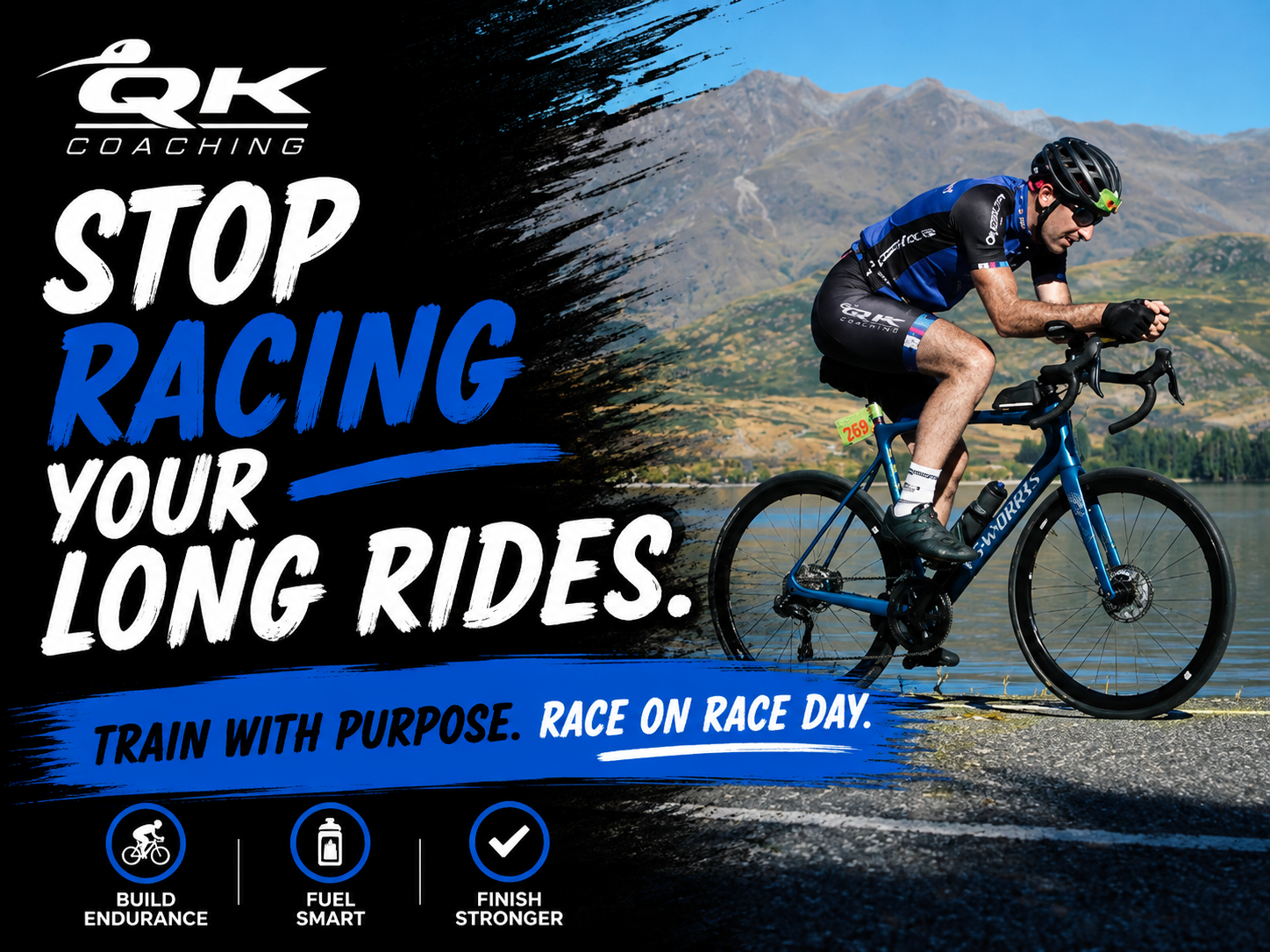
Your long ride has a purpose.
Make sure you actually train for it.
What Is the Purpose of Your Long Ride?
For most triathletes, the long ride is predominantly about developing endurance.
You’re building your ability to ride for an extended period while maintaining good technique, producing sustainable power, staying comfortable on the bike, and managing your fuelling and hydration.
Depending on where you are in your programme, your long ride might also contain specific work such as hills, tempo efforts, race-pace blocks, or periods in your aero position.
That’s completely different from turning the entire session into an uncontrolled race.
Hard work should be there because the programme calls for it—not because somebody attacked a hill.
The Group Ride Trap
Training with other people can be fantastic.
It makes long rides social, provides motivation, and can help the hours pass quickly.
But it can also make controlling your intensity difficult.
Someone rides off the front.
Your competitive instinct kicks in.
You close the gap.
The group accelerates after a corner.
You accelerate harder.
You reach a hill and suddenly everyone wants to know who’s the strongest climber.
None of those efforts may have been part of your planned session.
Individually, they might not seem significant.
Repeat them for three or four hours and you’ve completed a very different workout from the one you were supposed to do.
Don’t Turn Every Hill Into an Interval
Hills are one of the easiest places for endurance rides to become unnecessarily hard.
Your speed falls, someone comes past you, and suddenly you’re pushing well above your intended effort.
You don’t need to crawl uphill.
But you also don’t need to race every climb.
Use your gears, control your effort, and remember what the session is designed to achieve.
If your programme specifically calls for hard hill efforts, that’s different.
Attack them.
Make them count.
Then return to the prescribed endurance intensity afterwards.
There’s a big difference between structured intensity and random intensity.
Save Your Hard Efforts for the Sessions That Matter
A good triathlon programme contains different types of training for different reasons.
Some sessions should challenge your threshold.
Others should develop VO₂ max.
Some may target race-specific power.
And some should predominantly develop aerobic endurance.
If every workout becomes moderately hard or harder, you start blurring those distinctions.
Your long ride becomes too hard to be a good endurance session, yet often isn’t structured enough to provide the same benefit as a dedicated quality workout.
Worse, the fatigue can follow you into the sessions that actually are supposed to be hard.
Train hard when it’s time to train hard.
Train endurance when it’s time to develop endurance.
You Don’t Need to Finish Destroyed
One of the biggest misconceptions in endurance sport is that the quality of a workout can be measured by how exhausted you are afterwards.
A successful long ride doesn’t require you to crawl through the front door and spend the rest of the afternoon lying on the couch.
You should certainly know you’ve trained, particularly as your rides become longer and more race-specific.
But being completely destroyed isn’t the objective.
The question isn’t:
“How tired did that make me?”
A much better question is:
“Did I achieve the purpose of today’s session?”
Those are two very different measures of training quality.
Long Rides Are Perfect for Practising Fuelling
Your long ride is also one of your best opportunities to practise race-day fuelling.
What will you drink?
How frequently will you eat?
How much carbohydrate can you comfortably tolerate?
Can you access your nutrition while riding?
Does your planned race nutrition still work after several hours?
These are things you want to discover in training—not during your goal race.
An uncontrolled smash-fest can make it harder to practise this properly because you’re concentrating on hanging onto wheels rather than executing your own plan.
Use your long rides as race preparation as well as fitness training.
Learn to Ride Your Own Effort
This is particularly important if you train with stronger cyclists.
You don’t have to prove anything by staying with them.
If they ride above the intensity prescribed for your session, let them go.
That’s not weakness.
That’s discipline.
Likewise, if you’re one of the stronger riders in the group, you don’t need to turn every climb into an opportunity to demonstrate it.
Sometimes being the smartest athlete in the group means being willing to ride your own session.
Remember, you’re not training to win Sunday’s coffee ride.
You’re training to perform at your goal event.
What About Race-Pace Work?
As your triathlon approaches, portions of your long ride may become increasingly race-specific.
That’s valuable.
For example, your coach might prescribe sustained blocks at your target race intensity within an otherwise controlled long ride.
Now you’re developing endurance while also rehearsing the demands of race day.
The important distinction is that the intensity is planned.
You know when it starts.
You know how hard you’re supposed to ride.
You know when it finishes.
And you know why you’re doing it.
That’s purposeful training.
Randomly chasing every wheel for three hours isn’t.
Think About Tomorrow’s Training Too
Your training week doesn’t end when you finish your long ride.
You may have a run later that day.
You may have another important session tomorrow.
And you’ll almost certainly have more training in the days ahead.
If you turn today’s endurance ride into an all-out race, the additional fatigue can compromise everything that follows.
One epic Saturday isn’t particularly useful if you’re too tired to train properly for the next three days.
Triathlon fitness is built through consistent weeks and months of training.
Not by winning one weekend workout.
When Racing Your Mates Is Absolutely Fine
None of this means you can never have fun on a group ride.
There are times when chasing your mates, attacking hills, or having a hard group ride can be an excellent training stimulus.
Just recognise what you’re doing.
If you’ve deliberately chosen that ride as your quality cycling session, enjoy it.
But don’t pretend it’s an easy endurance ride and then wonder why you’re exhausted afterwards.
Every session doesn’t need to be perfectly controlled.
It does need to make sense within the bigger picture of your training.
Final Thoughts
Your long ride shouldn’t automatically become a race every weekend.
Give the session a purpose before you leave home.
If it’s an endurance ride, develop endurance.
If it includes race-pace work, execute that work properly.
If it’s deliberately a hard group ride, recognise it as a hard session and plan the rest of your training accordingly.
You don’t need to prove your fitness every Saturday.
You need to build it.
Because the athlete who consistently trains with purpose will usually get more from their programme than the athlete who tries to win every workout.
Save racing for race day.
Are You Training Hard—or Training With Purpose?
If you’re unsure how hard your long rides should be, how to balance endurance and intensity, or how your bike training should fit around your swimming and running, I’d be happy to help.
Book a free, no-obligation 40-minute coaching call and we can discuss your goals, your current training, and how to structure a programme that prepares you for your next triathlon.
Train with purpose today so you can race with confidence when it counts.