When most cyclists think about performance equipment, they think about their bike, smart trainer, power meter, shoes, or perhaps an aerodynamic helmet.
A fan probably doesn’t make the list.
But when you’re training indoors, it should.
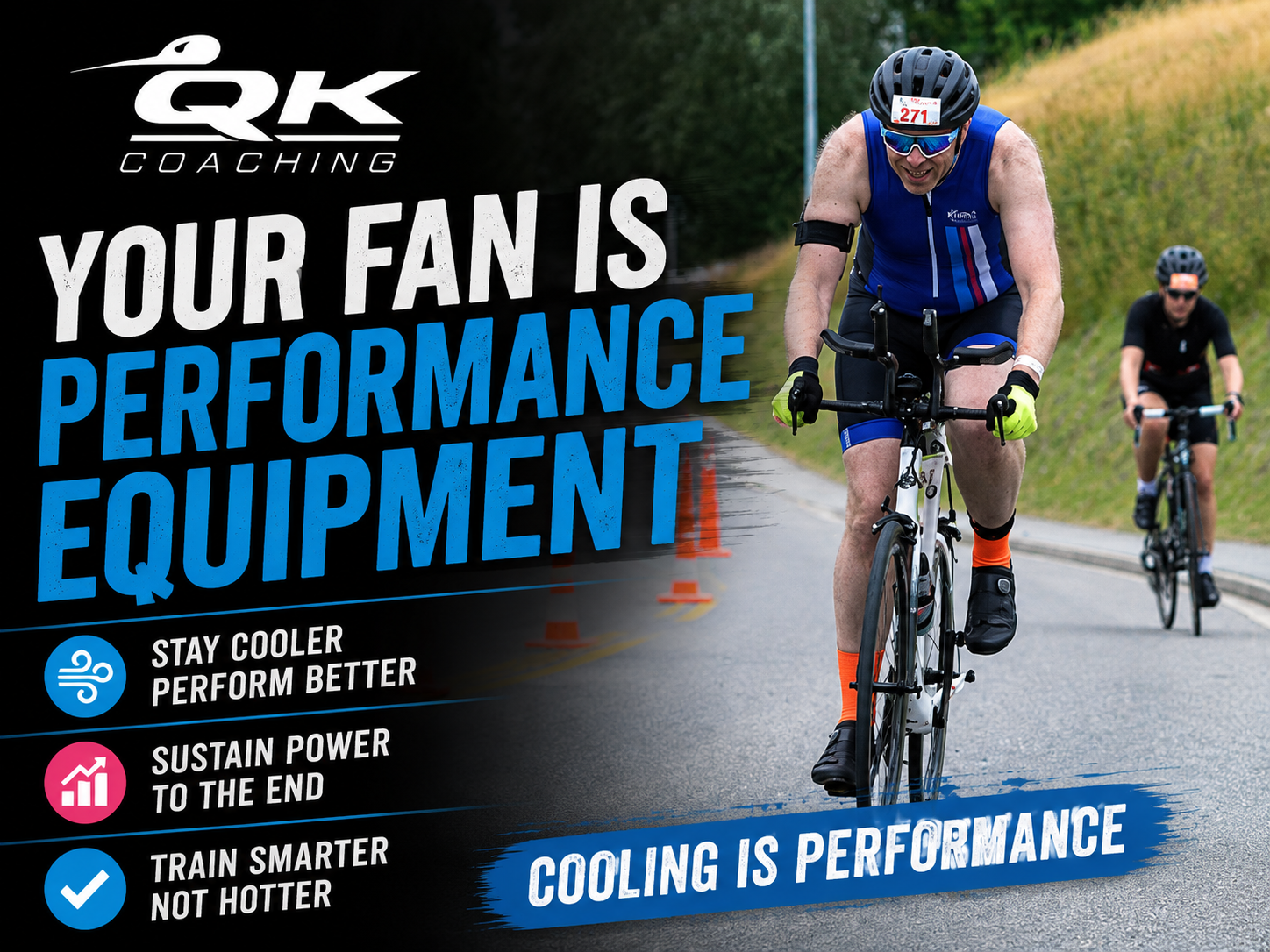
Your fan isn’t just there to make your pain cave more comfortable. It’s performance equipment.
Without the natural airflow you experience outdoors, heat can accumulate quickly during indoor cycling. As your body works harder to keep itself cool, the same power output can become increasingly difficult to sustain.
If you want to get the most from your indoor workouts, cooling deserves far more attention than many cyclists give it.
Why Indoor Cycling Gets So Hot
When you ride outside, you’re constantly moving through the air.
Even on a relatively calm day, your forward movement creates substantial airflow across your body.
That moving air helps sweat evaporate from your skin, which is one of your body’s primary mechanisms for dissipating heat.
Move indoors and that airflow disappears.
You’re sitting almost completely stationary while continuing to generate substantial metabolic heat.
Your body is still sweating, but without enough airflow, evaporative cooling becomes less effective.
That’s why you can find yourself dripping with sweat during an indoor session even when the room itself doesn’t seem particularly warm.
Heat Can Become a Performance Limiter
As your body temperature rises, your cardiovascular system has more work to do.
More blood needs to be directed towards the skin to assist with cooling while your working muscles are simultaneously demanding oxygenated blood.
Over time, you may notice your heart rate gradually increasing even though your power remains unchanged.
The workout starts feeling harder.
Holding your target watts becomes more difficult.
Eventually, you may need to reduce your power.
This isn’t necessarily because your cycling fitness suddenly disappeared.
You may simply be overheating.
Research examining prolonged cycling has shown that heat stress can reduce power output, while airflow plays an important role in determining how strongly environmental heat affects cycling performance.
A Fan Can Help You Produce More Work
This isn’t simply about comfort.
A controlled study compared 40 minutes of indoor cycling with and without fan cooling. Participants exercised at the same relative heart-rate intensity in both conditions.
With fan cooling, they were able to produce approximately 15% greater workload, while also reporting a lower thermal sensation. Body-mass loss through sweating was also reduced.
In other words, cooling allowed them to do more work without a corresponding increase in perceived effort.
That’s why I consider a good fan part of your indoor cycling equipment.
If heat is limiting your ability to execute the prescribed workout, you’re not getting the training session you intended.
Don’t Confuse Sweating With Training Quality
There’s a strange badge of honour associated with indoor cycling.
A massive puddle of sweat underneath the bike can make a workout feel successful.
“Look how hard I worked!”
But sweat isn’t a measure of training quality.
The goal of your Threshold workout isn’t to produce as much sweat as possible.
It’s to accumulate quality work at Level IV.
The goal of your VO₂ Max session isn’t to turn your training room into a sauna.
It’s to execute your Level V intervals at the appropriate intensity.
If overheating prevents you from achieving those targets, excessive heat has become an unnecessary obstacle.
Train for the adaptation you’re chasing—not the size of the puddle underneath your bike.
Use a Proper Fan
A small desk fan pointed vaguely in your direction may be better than nothing, but serious indoor cycling deserves serious airflow.
Ideally, you want enough air moving across a large portion of your body to replicate some of the cooling effect you’d naturally experience outdoors.
Aim the airflow towards areas such as your:
- Face
- Chest
- Shoulders
- Upper body
Depending on your training environment and how much you sweat, you may even benefit from using more than one fan.
One can provide strong airflow from the front, while another provides additional cooling from the side.
The important factor isn’t how expensive the fan is.
It’s whether it moves enough air to keep you effectively cooled.
Start the Fan Before You’re Overheating
Don’t wait until you’re drenched in sweat before switching your fan on.
Cooling works best when you’re preventing excessive heat accumulation rather than trying to deal with it after it has already occurred.
You might begin your warm-up with the fan on a lower setting and increase the airflow as the workout intensity rises.
A remote control or easily accessible fan controller can be particularly useful because it allows you to adjust airflow without interrupting your session.
The harder the workout becomes, the more cooling you’ll generally appreciate.
Hard Sessions Need Good Cooling
Cooling becomes particularly important during demanding indoor workouts.
Think about a Level V VO₂ Max session.
You’re deliberately trying to push your aerobic system close to its limits.
The intervals are already difficult enough without adding unnecessary thermal stress.
The same applies to Level IV Threshold sessions, longer Tempo workouts, and indoor race simulations.
When the objective is producing quality power, you want your cardiovascular system supporting that effort—not spending unnecessary resources dealing with preventable heat accumulation.
Don’t Forget Hydration
A powerful fan doesn’t mean you can forget about drinking.
You’re still producing heat.
You’re still sweating.
And you’re still losing fluid.
Have your drink bottles ready before you begin the session and drink appropriately throughout your ride.
For longer or particularly demanding workouts, your hydration and fuelling strategy becomes increasingly important.
Cooling and hydration work together to help you maintain the quality of your training.
What About Heat Training?
There are situations where deliberately training with additional heat stress can be useful.
Heat acclimation is a legitimate training strategy, particularly when preparing to race in hot conditions.
But that’s a specific training intervention.
It shouldn’t happen accidentally because you forgot to turn your fan on.
If the goal of today’s workout is a quality VO₂ Max, Threshold, Tempo, or endurance session, then create an environment that allows you to execute that session properly.
If you’re deliberately completing a heat-acclimation session, that’s different.
As always, understand the purpose of the workout.
Upgrade Your Cooling Before You Upgrade Your Bike
Cyclists love equipment.
It’s easy to spend hundreds—or thousands—of dollars looking for marginal improvements.
But if you’re training indoors without adequate airflow, one of the most useful upgrades to your setup could be remarkably simple.
Get a better fan.
Position it properly.
Turn it on.
And give your body the cooling it needs to perform.
You might discover that the reason those final intervals have been falling apart isn’t your fitness after all.
Sometimes you don’t need a new smart trainer.
You don’t need a new bike.
You don’t need another FTP test.
You just need more airflow.
Take Your Indoor Cycling to the Next Level
If you’re looking for structured indoor cycling workouts that build fitness, improve performance, and take the guesswork out of your training, check out Qwik Kiwi’s Velocity.
Velocity gives you access to hundreds of cycling workouts including VO₂ Max, Threshold, Tempo, Endurance, Technique, and Recovery sessions suitable for cyclists, triathletes, and endurance athletes of all abilities.
You can try Velocity completely FREE for 14 days with no long-term commitment.
Start your free trial today:
http://app.vqvelocity.com/join?a=rhs956
Train smarter. Ride stronger. Stay consistent.