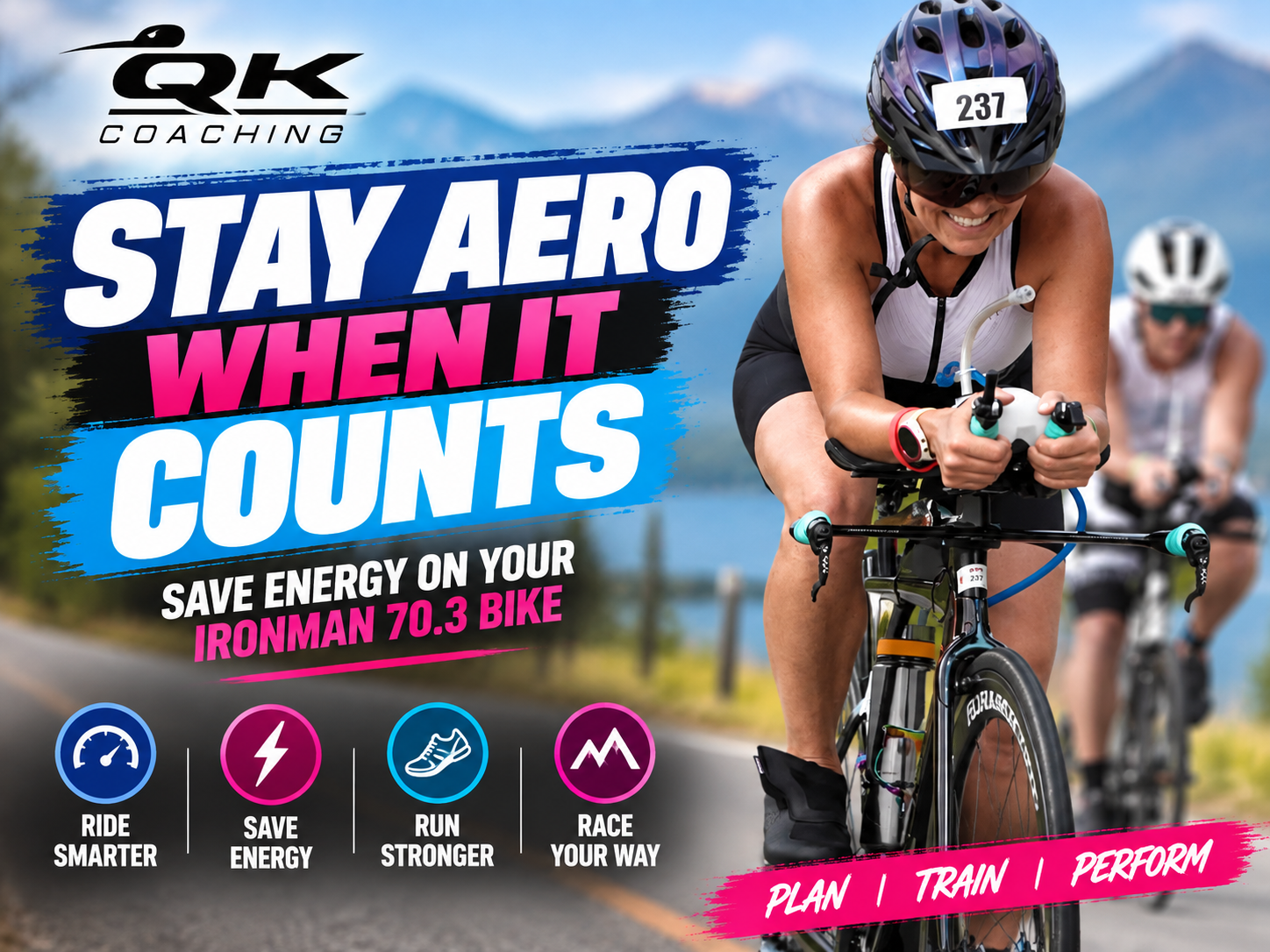
You’ve invested in a triathlon bike.
You’ve got aero bars.
You’ve spent time getting your position comfortable.
Then race day arrives—and every time the road gets a little uncomfortable, the wind picks up, or your concentration wanders, you sit upright.
There’s nothing wrong with coming out of the aero position when you need to brake, corner, climb, descend safely, take nutrition, or manage the bike.
But on the sections where it is safe, comfortable and appropriate to stay aero, repeatedly sitting up can mean giving away one of the biggest advantages your bike provides.
You don’t necessarily need more power to ride faster.
Sometimes you simply need to make better use of the power you’re already producing.
Aerodynamics Matter Over 90km
Your Ironman 70.3 bike leg is 90 kilometres.
Over that distance, relatively small decisions repeated hundreds of times can add up.
Aerodynamic drag is a major source of resistance when cycling, and your body position is an important contributor to your overall drag. Research consistently shows that changing a cyclist’s position can materially alter frontal area and aerodynamic drag. (PubMed)
That’s why aero bars exist.
They allow you to reduce your frontal profile and present a smaller, more aerodynamic shape to the air.
But there’s an obvious catch.
They only help when you actually use them.
Your Body Is a Big Part of the Equation
Athletes understandably get excited about equipment.
Deep-section wheels.
Aero helmets.
Fast tyres.
Race suits.
Disc wheels.
All of those details can matter.
But don’t overlook the large object sitting on top of the bike:
you.
Your position can have a substantial effect on aerodynamic performance. Research examining different aero-bar positions, for example, found meaningful changes in frontal area and drag as position changed. (PubMed)
So before becoming obsessed with buying another aerodynamic upgrade, ask yourself a simpler question:
Can I comfortably hold my aero position when it matters?
Aero Isn’t About Getting as Low as Possible
This is important.
A good aero position isn’t simply the lowest position you can physically achieve.
There is a trade-off between reducing aerodynamic drag and maintaining your ability to produce power, breathe comfortably and sustain the position. Research examining different torso angles has demonstrated exactly this interaction: lower isn’t automatically better if the position compromises physiological function or power production. (PubMed)
For an Ironman 70.3 athlete, the fastest position on paper isn’t particularly useful if you can only tolerate it for five minutes.
You need a position that is:
Aerodynamic enough to reduce drag.
Comfortable enough to sustain.
Powerful enough to ride effectively.
Stable enough to control the bike safely.
And you need to be able to run after 90km of using it.
Stay Aero When It Counts
The title of this article is deliberately Stay Aero When It Counts, rather than Never Leave Your Aero Bars.
There are plenty of legitimate reasons to sit up.
You may need to brake.
You may be approaching a technical corner.
You may be descending somewhere where greater control is required.
You may be climbing slowly enough that aerodynamics matter considerably less.
You may need to stretch briefly or safely access nutrition.
Safety comes first.
But think about the long, open sections of road where you’re travelling at a decent speed and have a clear line ahead of you.
Those are the kilometres where I want you asking:
“Why am I sitting up?”
If there isn’t a good answer, get comfortably back into your aero position.
The Faster You Go, the More Aerodynamics Matter
Aerodynamic resistance increases rapidly as speed increases.
That means your position becomes increasingly important on faster sections of the course.
This creates an interesting mistake.
Athletes sometimes sit up when they’re riding quickly because they’re already moving fast.
But those faster sections can be exactly where reducing drag is particularly valuable.
You don’t need to attack them.
You don’t necessarily need to increase your power.
Instead, settle into your position, stay smooth and let your aerodynamics help turn your existing power into speed.
A Headwind Is Not the Time to Become a Sail
A headwind can be frustrating.
You look at your speed and it seems disappointingly low despite producing the appropriate power.
The natural response can be to fight the wind.
Push harder.
Sit up.
Become tense.
That’s rarely the response I want.
When you’re riding into a headwind, aerodynamic drag becomes especially relevant.
Stay patient.
Stay within your race plan.
Make yourself appropriately aerodynamic.
And accept that your speed will be lower.
Race your effort, not the number on the speed display.
Trying to force your usual speed into a headwind can cost considerably more energy than simply accepting the conditions.
Free Speed Isn’t Actually Free
You’ll often hear aerodynamics described as free speed.
I understand why.
If two positions allow you to produce the same sustainable power but one creates less drag, you can potentially travel faster without producing additional power.
But there is still a cost.
You need to develop the mobility, stability and muscular endurance to hold that position.
Your neck needs to tolerate it.
Your shoulders need to tolerate it.
Your hips need to tolerate it.
And you need to remain comfortable enough to fuel, hydrate and concentrate.
So aero speed isn’t really free.
You earn it in training.
Train in the Position You Want to Race In
If you intend to spend large portions of your Ironman 70.3 in the aero bars, you need to practise doing exactly that.
Not only during easy rides.
Not only for a few minutes at a time.
During appropriate race-specific sessions, spend meaningful periods riding in your intended race position.
That is particularly important when you’re completing sustained Level II and race-specific work.
You want your body to become accustomed to producing your race-day power in your race-day position.
If all your indoor training is completed sitting upright with your hands on the base bar, don’t be surprised when holding the aero position for 90km feels difficult on race day.
Practise Fuelling While Aero
Your position also needs to work with your nutrition strategy.
Can you drink without completely disrupting your rhythm?
Can you access your nutrition safely?
Can you return smoothly to your aero position afterwards?
These sound like tiny details.
Across 90km, they’re repeated again and again.
Practise them.
The objective isn’t to refuse to move out of aero under any circumstances.
It’s to become efficient enough that necessary interruptions are brief and controlled.
Don’t Sacrifice Safety for Aerodynamics
No bike split is worth crashing for.
Come out of the aero bars when you need greater control.
Brake appropriately.
Look ahead.
Respect technical sections.
Follow the event rules and instructions.
Aero when appropriate. Control when necessary.
Those ideas aren’t in conflict.
They’re smart racing.
Save Energy for the Run
The objective of your Ironman 70.3 bike leg isn’t simply to record the fastest bike split you can possibly produce.
You’ve still got 21.1km to run.
That’s where good aerodynamics become especially useful.
If you can maintain your desired bike speed at a slightly lower physiological cost—or achieve a little more speed from the same sustainable effort—you potentially preserve resources for later in the race.
That’s much more valuable than using every aerodynamic gain as an excuse to push harder.
Think of your aero position as a tool for efficiency, not permission to abandon your pacing strategy.
Don’t Chase the Perfect Position on Race Week
If your current aero position is uncomfortable, race week isn’t the time to make a dramatic change.
A substantially different position can alter how your body interacts with the bike, and research shows that aerodynamic gains can come with physiological and biomechanical trade-offs. (PubMed)
Make meaningful position changes well before your event.
Then train in them.
Test them on long rides.
Run off the bike afterwards.
Make sure the position works for the whole race—not just for a photograph from the side.
If necessary, work with a competent bike fitter who understands triathlon and the demands of your event.
Ask Yourself One Question
During your next race-specific ride, pay attention to how often you leave your aero bars.
Every time you sit up, ask:
“Why?”
Sometimes there will be an excellent answer.
Corner.
Traffic.
Climb.
Nutrition.
Safety.
Comfort adjustment.
Good.
But if the answer is simply:
“Habit.”
That’s something you can work on.
The goal isn’t to become obsessed with staying aero every second.
It’s to stop unnecessarily giving away efficiency.
Final Thoughts
You don’t need to spend your entire Ironman 70.3 bike leg folded into the smallest possible position.
And you shouldn’t compromise safety, control, sustainable power or your ability to fuel simply to look aerodynamic.
Instead, develop an aero position that works for you.
Practise it.
Become comfortable in it.
Learn to fuel from it.
Then use it intelligently on race day.
When the road is safe, your speed makes aerodynamics important and there is no good reason to be sitting upright:
Stay aero when it counts.
Not because you’re trying to win the bike leg.
Because every bit of energy you use wisely on the bike is energy you may appreciate when you’re running the final kilometres of your Ironman 70.3.
Want to Make Your Ironman 70.3 Bike Work for Your Run?
Your aero position is only one part of a successful 90km bike leg. Pacing, fuelling, cadence, training and race-day decision-making all contribute to whether you arrive at T2 ready to run.
If you’re preparing for an Ironman 70.3 and would like some personalised guidance, book a free, no-obligation 40-minute coaching consultation with me.
We can discuss your goals, current training and where you might be able to improve your race execution.
Book your free 40-minute coaching consultation
You’ll leave with practical advice and a clearer understanding of your next steps, whether we end up working together or not.