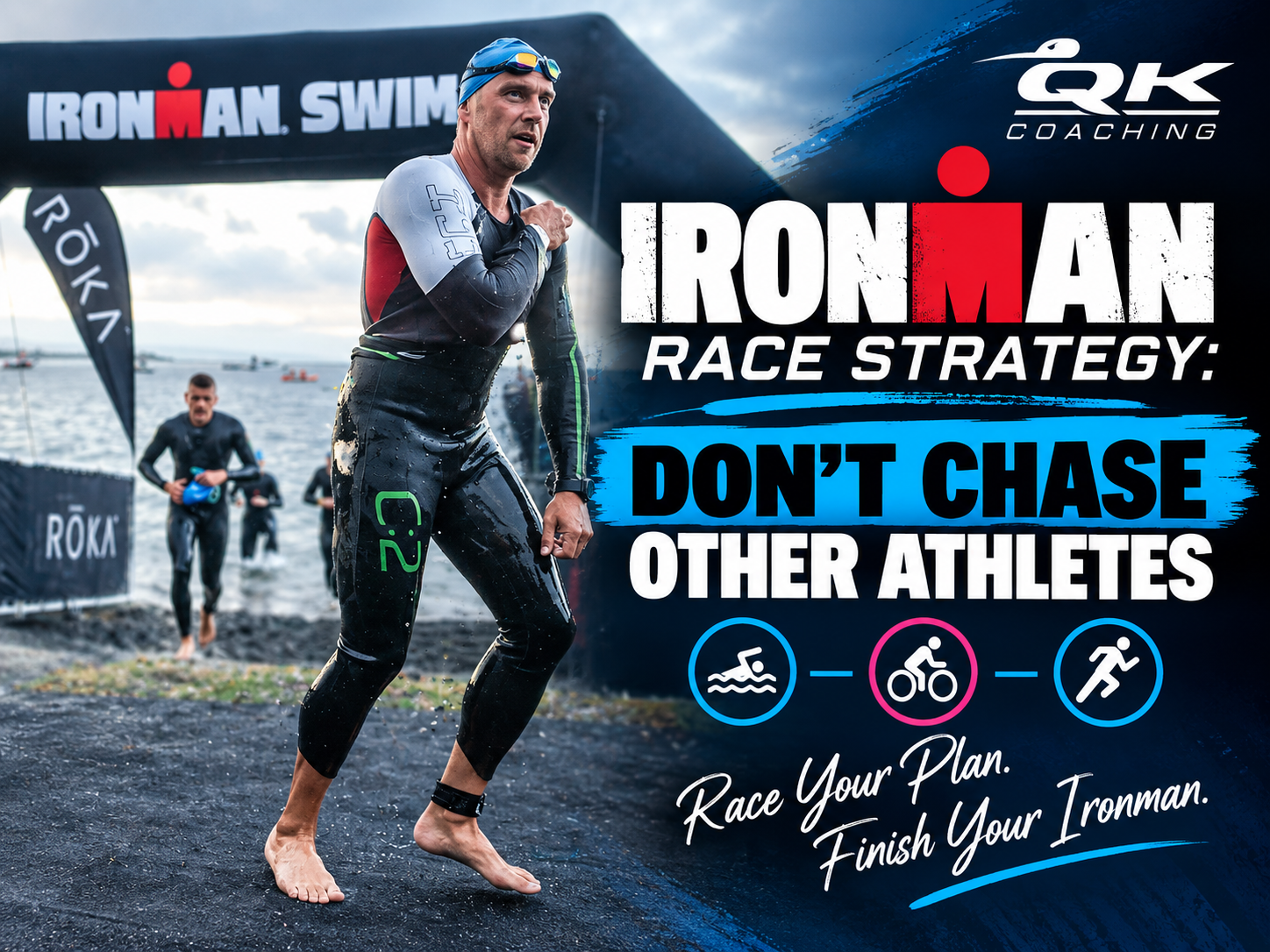
Someone swims past you.
Someone powers past you on the bike.
Someone flies out of T2 and disappears up the road.
What do you do?
For many Ironman athletes, the instinct is immediate:
Chase them.
They look like someone you should be able to stay with. Maybe they’re in your age group. Maybe you’ve raced them before. Perhaps you’ve convinced yourself that if they’re going that fast, you should be too.
But an Ironman isn’t about responding to every athlete who passes you.
It’s about executing your race.
IRONMAN’s own race-day guidance encourages athletes to follow the plan they’ve developed in training and to know their pace rather than changing their routine simply because it’s race day. (Ironman)
That means sometimes the smartest thing you can do is watch another athlete disappear up the road.
Their Race Isn’t Your Race
You know your training.
You know your fitness.
You know your planned intensity.
You know your fuelling strategy.
What do you know about the athlete who just passed you?
Probably very little.
You don’t know whether they’re a stronger cyclist.
You don’t know whether they’re an exceptional runner.
You don’t know whether they’ve paced the opening kilometres perfectly.
And you certainly don’t know whether they’re making a mistake they’ll pay for later.
Yet it’s incredibly easy to throw your own race plan away simply because someone else comes past.
Don’t let another athlete make your pacing decisions for you.
Ironman Rewards Patience
Ironman is a long race.
A 3.8km swim is followed by 180km on the bike and then a 42.2km marathon.
There is an enormous amount of racing still to come when someone passes you early in the day.
That’s why reacting emotionally can be so costly.
You increase your effort to stay with someone on the bike.
You push harder up a climb because you don’t want them getting away.
You surge after being passed.
Or you run noticeably faster than planned because another athlete leaves T2 just ahead of you.
Each decision might seem insignificant at the time.
But Ironman has a habit of collecting payment for those decisions later.
Don’t Turn the Bike Into a Series of Surges
The bike leg is perhaps the easiest place to get drawn into someone else’s race.
You’re feeling good. Another athlete passes you. Your competitive instinct kicks in.
Suddenly you’re riding harder.
Maybe you eventually pass them back.
They pass you again.
Now you’re racing each other rather than racing the Ironman.
For most age-group athletes, that’s unnecessary energy expenditure.
Your goal should be to ride at an intensity appropriate for your fitness and your race plan, keeping your effort as controlled as the terrain and conditions allow.
There’s also a practical rules consideration. IRONMAN races are non-drafting events, and athletes need to understand the passing and draft-zone requirements applying to their event. The current 2026 rules are in effect for races after 2 March 2026, and IRONMAN recommends checking your event-specific Athlete Information Guide because requirements can vary. (Ironman)
So don’t turn another athlete into an unofficial pacemaker.
Ride your numbers. Ride your effort. Ride your race.
Your Watch Is More Useful Than Their Back Wheel
You’ve spent months learning what sustainable Ironman intensity feels like.
Use that information.
Depending on how you race, you may be monitoring power, heart rate, pace, perceived exertion—or a combination of them.
Those metrics provide information about your performance.
The athlete 20 metres ahead doesn’t.
If chasing someone causes your power to jump well above your planned intensity or your heart rate to climb unnecessarily, they’re not helping you race faster.
They’re encouraging you to spend energy earlier than planned.
Let them go.
Don’t Chase on the Run Either
The same mistake can happen when you reach the marathon.
Someone runs past you looking fantastic.
Your legs feel reasonable.
You think:
“I’ll just stay with them.”
Five kilometres later, you’ve been running noticeably harder than planned.
Remember the lesson from respecting the first 10km of your Ironman marathon: early pace can feel deceptively comfortable.
IRONMAN’s Run Smart guidance recommends developing and practising your desired race pace in training, while recognising signs such as unusually high heart rate or muscular strain that may mean you need to adjust. (Ironman)
Another athlete passing you isn’t one of those signs.
Don’t Race Someone You Can’t See
There’s another trap.
Age-group racing can make athletes obsessed with where their competitors are.
You might know someone started in a different swim wave.
You might believe a rival is several minutes ahead.
Perhaps a friend tells you someone is just up the road.
Now you’re trying to close a gap.
Be careful.
Unless you’re genuinely racing for position and have reliable information, chasing an imagined race situation can quickly undermine a well-executed Ironman.
For most athletes, the best route to the fastest possible finish is to concentrate on the things they can control.
Pacing. Fuelling. Hydration. Technique. Decision-making.
Let Them Make Their Mistake
One of the hardest skills in endurance racing is allowing someone else to do something you believe is wrong without following them.
They attack the hill.
Let them.
They hammer the first hour of the bike.
Let them.
They charge out of T2.
Let them.
Maybe they’re fitter than you and you’ll never see them again.
That’s fine.
Or perhaps you’ll see them again at kilometre 32 of the marathon.
The important thing is that you haven’t compromised your own race trying to find out.
There Is a Difference Between Racing and Chasing
I’m not suggesting you should ignore competition completely.
Racing other athletes is part of sport.
There may come a point late in your Ironman when you’ve executed your plan well, you’re still feeling strong, and it makes sense to begin competing more aggressively.
That’s very different from reacting impulsively every time someone passes you.
Chasing is reactive.
Racing is deliberate.
If you’re going to increase your effort, make it a conscious decision based on where you are in the race, how you’re feeling, and what you know you can sustain.
Don’t do it simply because someone else’s race has triggered your ego.
Practise Racing Your Own Race
This skill needs practising too.
Training isn’t only about improving your physiology.
Group rides, training partners and local events can all create opportunities to practise discipline.
Someone surges ahead during a session that is supposed to be Level II?
You don’t have to follow.
Someone attacks a hill?
Stay at your prescribed intensity.
Your training partner turns a steady run into a race?
Let them go.
Every time you make the decision to stick to the purpose of your session rather than responding to someone else, you’re practising a skill you’ll need on Ironman race day.
Have a Plan Before the Cannon Goes
The easier your race plan is to understand, the easier it becomes to recognise when you’re departing from it.
Know your intended swim effort.
Know how you’ll control the early bike.
Know the intensity you want to sustain through the main part of the ride.
Know your fuelling and hydration strategy.
Know how you want the opening kilometres of your marathon to feel.
IRONMAN’s guidance emphasises the value of following your race plan, while its broader preparation advice stresses having a clear roadmap rather than improvising your way through the event. (Ironman)
When someone passes you, you can then ask yourself one simple question:
Has anything about my race plan changed?
If the answer is no, why would your effort change?
Focus on the Athlete You Can Control
There may be hundreds or thousands of athletes around you during an Ironman.
You can control precisely one of them.
You.
You can’t stop someone passing you.
You can’t control how hard they ride.
You can’t control how quickly they run.
You can’t control whether they’re having the race of their life or making a mistake.
But you can control your response.
Stay patient.
Stay disciplined.
Keep fuelling.
Keep monitoring your effort.
And keep executing the race you’ve trained for.
Final Thoughts
Ironman isn’t won by responding to every athlete who comes past you.
For most age-group athletes, their best race comes from executing their own strategy as consistently as possible.
Some athletes will pass you.
Let them.
Some may disappear up the road and never come back.
That’s okay too.
Your job isn’t to prove you’re faster than the person beside you at kilometre 40 of the bike.
Your job is to get the best possible performance out of your body over the entire Ironman.
And if you’ve paced intelligently, fuelled consistently and stayed patient, you might be surprised how many of those athletes come back to you later.
Don’t chase other athletes.
Race your plan.
And when the time genuinely comes to race?
You’ll still have something left to do it with.
Ready to Build Your Best Ironman Yet?
Whether you’re training for your first Ironman, chasing a personal best, or simply trying to avoid the common mistakes that derail so many race days, having the right plan can make all the difference.
If you’d like to discuss your training, race goals, nutrition, pacing, or race-day strategy, I’d love to help.
Book a free, no-obligation 40-minute coaching consultation and let’s chat about how we can get you to the start line feeling confident and prepared.
👉 Book your free 40-minute coaching consultation
Train smart. Race strong.