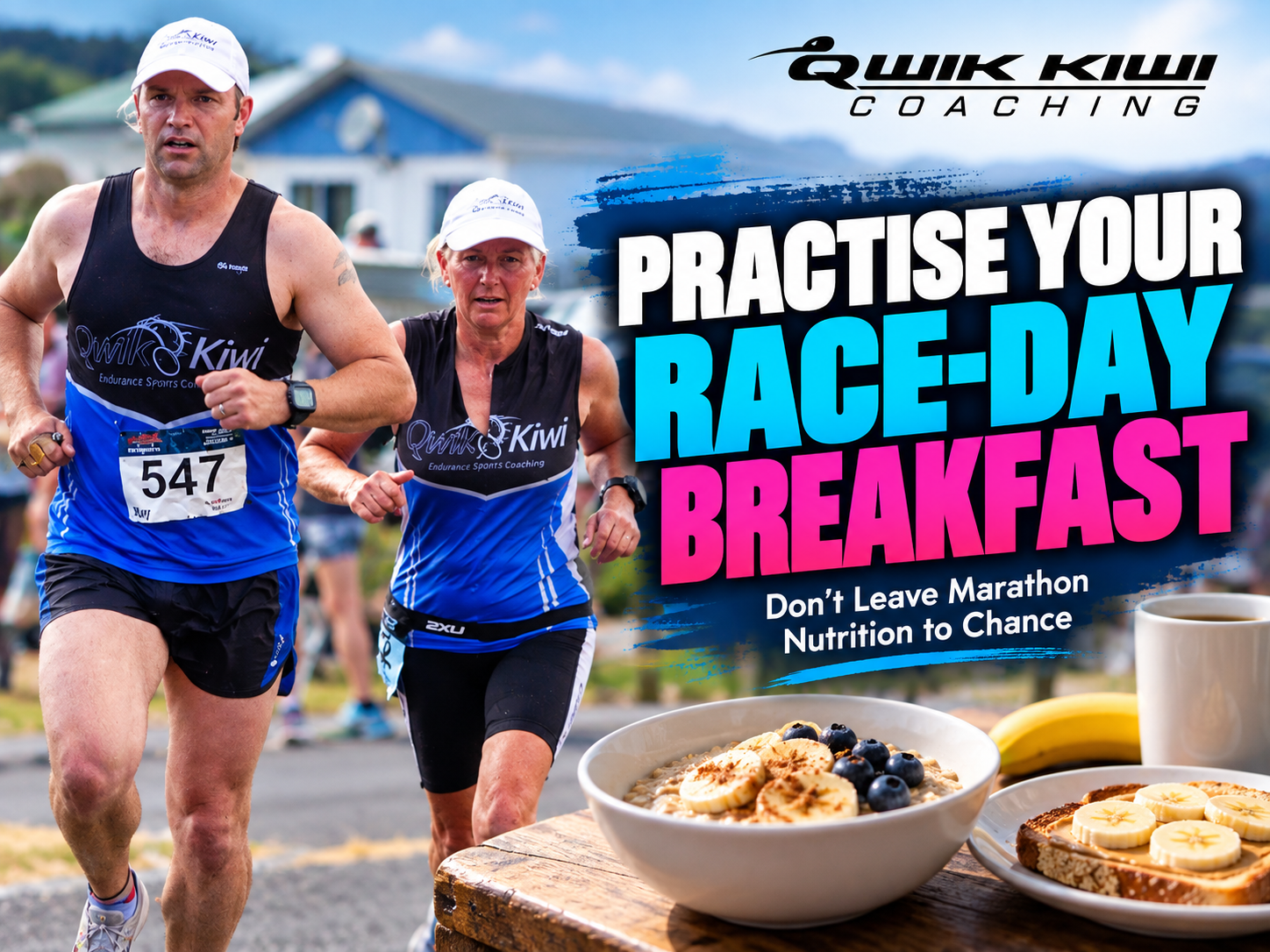
You’ve trained for months. You’ve completed your long runs, practised your pacing and worked out which gels and drinks you’ll use during the marathon.
Then race morning arrives, and you eat something completely different.
Perhaps the hotel has a buffet. Maybe your race starts earlier than you’re used to. You’re travelling and can’t find your normal breakfast. Or someone tells you that their pre-marathon breakfast is perfect, so you decide to try it too.
That’s an unnecessary gamble.
Your race-day breakfast should be part of your marathon preparation, just like your pacing, shoes, clothing and nutrition during the race.
Use your long runs to practise what you’ll eat, how much you’ll eat and when you’ll eat it. By race morning, breakfast shouldn’t require much thought at all.
Your Marathon Fuelling Starts Before the Starting Gun
During a marathon, carbohydrate is an important fuel source, and your pre-race nutrition contributes to making carbohydrate available when you start running. Contemporary endurance-sport recommendations suggest approximately 1–4 g of carbohydrate per kilogram of body mass during the 1–4 hours before prolonged exercise, with the exact amount and timing depending on the individual and how much time there is before the start. GSSI
That’s deliberately a wide range.
A runner eating four hours before the race has very different opportunities from someone eating much closer to the start. Body size, appetite, previous meals and gastrointestinal tolerance also matter.
Rather than assuming there’s one perfect breakfast for every marathon runner, you need to discover what works for you.
And you want to discover that during training—not on marathon morning.
Practise Your Breakfast Before Your Long Runs
Your long runs provide an ideal opportunity to rehearse your race-day routine.
If you’re planning to eat breakfast three hours before your marathon, try doing the same before some of your important long runs.
Practise:
- what you eat;
- how much you eat;
- when you eat it;
- what you drink alongside it; and
- how your stomach feels once you start running.
You’re not simply testing whether you like the food.
You’re learning whether you can comfortably digest it before running and whether you feel appropriately fuelled once you get underway.
ACSM experts specifically recommend practising race-day fuelling during training because major dietary changes can contribute to gastrointestinal problems. ACSM
Don’t Turn Race Morning Into a Hotel Buffet Experiment
Destination marathons can make breakfast particularly challenging.
You walk into the hotel dining room and suddenly there are cereals, pastries, eggs, bacon, fruit, yoghurt, toast and several foods you wouldn’t normally eat before running.
It can be tempting to think:
“I’ve got a marathon ahead of me. I should eat plenty.”
More isn’t automatically better.
A huge breakfast that leaves you feeling full, bloated or uncomfortable isn’t going to help simply because you’ve consumed more energy.
Likewise, race morning isn’t the ideal time to discover whether three croissants, bacon, scrambled eggs and a giant coffee agree with you while running 42.2 kilometres.
If you’ve practised your breakfast beforehand, you already know what you’re looking for.
Familiar Beats Fancy
Your race-day breakfast doesn’t need to be complicated.
Depending on the runner, it might include foods such as toast, cereal, porridge, bananas or other familiar carbohydrate-rich options. The important point isn’t finding a magical “marathon breakfast”.
It’s finding something that provides the carbohydrate you need and that you know you can tolerate before running.
Foods higher in fat, fibre or protein can take longer to digest, so many athletes favour relatively carbohydrate-rich, easily digested foods as competition approaches. Individual tolerance remains important. ACSM
What works brilliantly for one athlete might leave another searching desperately for a toilet.
That’s exactly why you practise.
Don’t Copy Someone Else’s Breakfast
Marathon runners love sharing what works for them.
Someone might swear by porridge and banana. Another might eat toast and honey. Someone else might tell you that you have to eat a particular cereal, drink a particular sports drink or use a particular supplement.
Their breakfast might be excellent.
For them.
Your job isn’t to copy another runner’s breakfast. It’s to develop a routine that works with your body, your preferences and your race schedule.
Take useful ideas from other athletes, but test them yourself before deciding whether they belong in your marathon plan.
Practise the Timing as Well as the Food
Knowing what you’re going to eat is only part of the equation.
You also need to know when you’re going to eat it.
If you normally train at 8:00 am but your marathon starts at 6:00 am, your normal weekend breakfast routine may not transfer neatly to race day.
Work backwards from your race start.
When will you need to wake up?
When will you eat?
How much time does that give you to digest your breakfast?
When will you leave your accommodation?
Will you need an additional small snack closer to the start?
These are practical details, but getting them sorted beforehand removes another source of race-morning stress.
Think About What Will Actually Be Available
If you’re travelling to your marathon, don’t assume your usual breakfast will magically appear.
Check what your accommodation provides.
If necessary, bring suitable foods with you or buy them before race morning. Make sure you have somewhere to store or prepare them if required.
If you’ve spent months discovering that a particular breakfast works perfectly before your long runs, you don’t want to discover at 5:00 am on race morning that you can’t get it.
Sometimes the best marathon nutrition strategy involves nothing more sophisticated than good organisation.
Breakfast and During-Race Fuelling Need to Work Together
Your breakfast isn’t separate from your marathon nutrition plan.
It’s the beginning of it.
You should also be practising the carbohydrate and fluids you’ll consume once you’re running. Your breakfast, pre-start nutrition and during-race fuelling should form one rehearsed strategy rather than three unrelated decisions.
That means some of your long runs can become full race-nutrition rehearsals.
Eat your planned breakfast at your planned time. Start running at approximately the equivalent interval afterwards. Carry the products you intend to race with and practise your planned fuelling schedule.
Pay attention to how you feel.
If something doesn’t work, that’s useful information.
You still have time to change it.
Don’t Wait Until Your Final Long Run
Start experimenting early enough in your marathon build that you have time to make adjustments.
Perhaps your breakfast is too large.
Maybe you need to eat slightly earlier.
Perhaps a particular food leaves you hungry again too quickly, while another makes you feel too full.
You might discover that something you’ve happily eaten before shorter runs doesn’t work as well before a long run combined with regular carbohydrate intake during the session.
Test, adjust and repeat.
Over time, you’re trying to remove uncertainty.
Don’t Suddenly Change the Plan Because You’re Nervous
Race-day nerves can make athletes second-guess decisions they’ve already tested successfully.
You wake up and don’t feel particularly hungry, so you consider skipping breakfast.
Or you worry that you haven’t eaten enough and add another large serving.
Perhaps another runner at breakfast tells you what they’re eating and suddenly you wonder whether you should be doing the same.
Trust the routine you’ve rehearsed.
You did those practice runs for a reason.
Race Morning Should Feel Familiar
By the time marathon morning arrives, you should have answered the important questions.
You know what you’re eating.
You know approximately how much you’re eating.
You know when you’re eating it.
You know what you’re drinking.
You know how your stomach normally responds.
And you know how that breakfast fits with the fuelling you’ll use once the race begins.
There will already be enough excitement and uncertainty on marathon morning.
Breakfast doesn’t need to be one of them.
Ready to Run Your Best Marathon?
Whether you’re training for your first marathon or chasing a new PB, getting your race-day nutrition right can make a significant difference.
If you’d like help developing your marathon training, pacing and fuelling strategy, book a free, no-obligation 40-minute coaching consultation.
We’ll talk about your goals, your experience, your upcoming race and how you can prepare your race-day routine before you reach the start line.
👉 Book your free marathon consultation here:
Book your free 40-minute coaching consultation
Practise your breakfast just like you practise your pacing. Nothing important on marathon morning should be left to chance.