There is something satisfying about finishing a huge training session.
The monster ride.
The epic brick.
The run that goes far longer than planned.
You upload it, look at the numbers and think:
“Now that was proper Ironman training.”
But one enormous workout doesn’t make you an Ironman athlete.
And if that session leaves you so exhausted that the next three or four days of training fall apart, it may have done considerably less for your preparation than you think.
Ironman fitness is built differently.
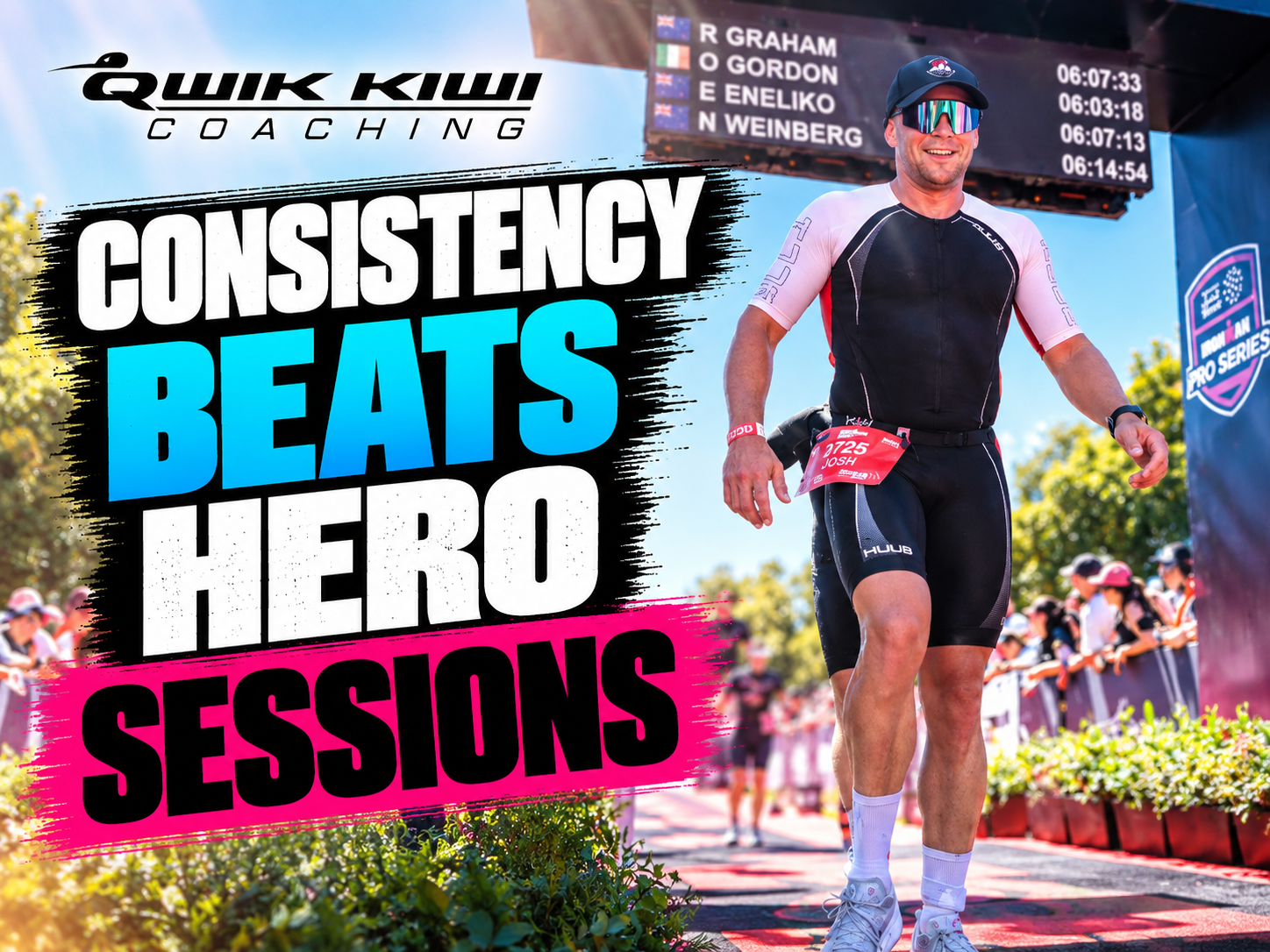
Consistency beats hero sessions.
The Session Everyone Remembers
Most endurance athletes have completed one of these at some point.
You feel good, the weather is perfect and you have some extra time available.
Your planned three-hour ride becomes four.
Then five.
Perhaps you add a run afterwards because you’re feeling strong.
By the end, you’re exhausted—but satisfied.
It feels like you’ve achieved something significant.
And you have.
The problem comes when one big session becomes more important than the training surrounding it.
You wake up the following morning shattered.
The recovery swim gets skipped.
Tuesday’s run becomes a shuffle.
Wednesday’s quality session is poor.
By Thursday you’re finally starting to feel normal again.
That spectacular Saturday session has now affected half your training week.
A workout shouldn’t be judged only by what you accomplished during it.
It should also be judged by what it allows you to do afterwards.
Ironman Fitness Is Built Over Months
An Ironman is a 3.8km swim, 180km bike and 42.2km run.
Preparing your body for that challenge takes time.
There is no single training session capable of creating the fitness required.
Instead, fitness develops through repeated training and recovery over weeks and months.
That means:
Swim after swim.
Ride after ride.
Run after run.
Easy sessions.
Quality sessions.
Long sessions.
Recovery.
None of those individual workouts needs to be extraordinary.
What matters is your ability to keep stacking them together.
That principle is particularly important in Ironman preparation because you are simultaneously developing endurance across three disciplines while also managing strength, mobility, nutrition, sleep, work and the rest of your life.
The real achievement isn’t completing one massive week.
It’s being able to complete another productive week afterwards.
Don’t Confuse Exhaustion With Progress
One of the easiest mistakes in endurance training is using fatigue as evidence that a session worked.
If you finish absolutely destroyed, it can feel as though you must have achieved something.
But exhaustion isn’t the goal.
Adaptation is the goal.
Training provides a stimulus. Recovery gives your body the opportunity to adapt to that stimulus. If you repeatedly create more fatigue than you can recover from, the quality and consistency of your subsequent training can suffer.
Research examining training load and fatigue across sports has also found periods of intensified or accumulated training load can be associated with greater injury and illness risk, reinforcing the importance of managing the stress you apply rather than simply trying to accumulate as much as possible. PubMed Central (PMC)
You don’t get bonus fitness points for crawling through your front door after every long ride.
Sometimes the better session is the one you finish knowing:
“I could have done more.”
Because tomorrow you get to train again.
The Boom-and-Bust Trap
This is something I see regularly with motivated endurance athletes.
They have a big weekend available, so they train enormously hard.
Then fatigue hits.
Training becomes inconsistent.
A few sessions are missed.
Eventually they feel recovered—and because they’re worried about the training they missed, they try to compensate with another huge session.
The cycle repeats.
Boom. Recover. Boom. Recover.
What’s missing is consistency.
There is some evidence linking abrupt changes in training load with injury risk, although the research does not support a universal rule such as never increasing training by more than exactly 10% per week. PubMed Central (PMC)
The practical coaching message is simpler:
Avoid repeatedly asking your body to cope with training it hasn’t been progressively prepared to handle.
You Can’t Bank Ironman Training
Another version of the hero-session mentality appears when life gets busy.
You know next week will be difficult.
Work is hectic.
You’re travelling.
Family commitments are coming up.
So you decide:
“I’ll do extra this weekend to make up for it.”
Unfortunately, endurance training doesn’t work like depositing money into a bank account.
You can’t complete next Thursday’s run today.
Nor should you try to cram missed training into the following week.
When life interrupts your programme, adapt.
Complete what you reasonably can.
Then return to your normal training rhythm.
A missed workout is rarely important.
Turning one missed workout into several days of inappropriate catch-up training can be.
The Best Training Plan Is the One You Can Repeat
A training programme can look incredible on paper.
Three swims.
Four rides.
Four runs.
Two strength sessions.
A huge weekend.
Perfect.
Except you have a full-time job, children, a partner, community commitments and need to sleep occasionally.
If you can only sustain that programme for two weeks, it isn’t a good programme for you.
The best Ironman training programme isn’t necessarily the programme containing the most training.
It is the programme containing the appropriate training that you can consistently complete and recover from.
Your training needs to fit your life—not compete with it.
That may mean your programme looks less impressive than someone else’s on Strava.
That doesn’t matter.
You’re not training to win Strava.
You’re training for your Ironman.
Ordinary Sessions Are Doing More Than You Think
Many of the sessions that build an Ironman athlete aren’t particularly exciting.
An easy aerobic run.
A steady Level II ride.
Technique work in the pool.
A recovery session.
Another routine endurance workout.
There may be nothing about them worth posting on social media.
But repeated consistently, these ordinary sessions accumulate into something extremely valuable.
Your aerobic endurance improves.
Your movement becomes more economical.
Your ability to tolerate training develops.
Your technique becomes more automatic.
Your confidence grows.
And gradually you become capable of handling more race-specific training.
I’ve written previously about the same principle when discussing Ironman foundations: the aim early in preparation isn’t to produce your biggest weeks; it’s to develop the athlete capable of consistently handling the training that will be required later.
That’s how sustainable progression works.
Your Easy Sessions Matter Too
Hero-session thinking can also make athletes undervalue easier training.
If Saturday’s five-hour ride feels important, Monday’s gentle recovery session can feel almost pointless.
It isn’t.
Your easier sessions help create the structure that allows harder training to work.
That’s particularly relevant when training for an Ironman because your programme contains multiple disciplines.
If every ride is hard, your running suffers.
If every run is hard, your cycling suffers.
If every session becomes an opportunity to prove your fitness, eventually something gives.
Your programme needs contrast.
Some sessions should challenge you.
Others should build aerobic endurance.
Some should develop technique.
And some should leave you feeling better at the end than you did at the beginning.
Easy training isn’t wasted training.
It is part of the system.
Quality Sessions Still Matter
“Consistency beats hero sessions” doesn’t mean you should never train hard.
Quite the opposite.
Appropriately programmed quality sessions are important.
There will also be long rides, long runs and substantial brick sessions during Ironman preparation.
Some workouts should be challenging.
The distinction is purpose.
A well-designed long session exists because it contributes to your progression.
A hero session often happens because you feel good, someone else is doing more, your ego takes over, or you decide that harder and longer must automatically be better.
One is training.
The other can become testing.
You don’t need to prove every weekend that you’re capable of completing an Ironman.
You need to train so that when race day arrives, you are.
Stop Chasing Missed Training
If you train consistently for months, something will eventually go wrong.
You’ll get sick.
Work will explode.
The weather will be terrible.
Your children will need you.
Travel will interfere.
You’ll simply have a bad day.
That is normal.
What matters is what happens next.
Don’t panic.
Don’t double tomorrow’s training.
Don’t turn the following weekend into a monster training camp.
Return to the programme.
One missed session has very little influence on months of consistent preparation.
Consistency doesn’t mean perfection.
It means repeatedly returning to the process.
Judge Training by Weeks, Not Workouts
Instead of asking:
“How impressive was today’s workout?”
Try asking:
“How good was my training this month?”
Did you train regularly?
Did you complete the important sessions?
Did you recover appropriately?
Did your long sessions progress gradually?
Did your swimming improve?
Did your cycling become stronger?
Did your running become more durable?
Did you remain healthy?
Are you still motivated?
Can you continue?
Those questions tell you far more about the direction of your Ironman preparation than the statistics from one enormous Saturday ride.
The Athlete Who Keeps Showing Up Wins
You will occasionally have brilliant sessions.
Enjoy them.
There will be days when everything clicks and you feel almost unstoppable.
There will also be ordinary sessions.
And difficult sessions.
And sessions where you simply complete what was prescribed and go home.
Those workouts count too.
In fact, they may tell me more about an athlete than the spectacular ones.
Because successful Ironman preparation isn’t about waiting until motivation, weather, energy and life align perfectly.
It is about developing a sustainable routine that allows you to keep moving forward.
Week after week.
Month after month.
Final Thoughts
Your biggest workout won’t determine your Ironman.
Your training history will.
One heroic ride cannot replace months of consistent cycling.
One monster brick cannot compensate for weeks of missed sessions.
One enormous training weekend cannot manufacture endurance overnight.
Instead, focus on stacking good training together.
Complete the session that is appropriate today.
Recover.
Come back tomorrow.
Then do it again.
Don’t chase hero sessions. Chase consistent weeks.
Because when you stand on the start line of your Ironman, the fitness you rely on won’t have come from one extraordinary workout.
It will have come from hundreds of ordinary ones.
Consistency beats hero sessions.
Ready to Build Your Best Ironman Yet?
Whether you’re training for your first Ironman, chasing a personal best, or simply trying to avoid the common mistakes that derail so many race days, having the right plan can make all the difference.
If you’d like to discuss your training, race goals, nutrition, pacing or race-day strategy, I’d love to help.
Book a free, no-obligation 40-minute coaching consultation and let’s chat about how we can get you to the start line feeling confident and prepared.
And if you’d like a practical Ironman training tip delivered each week:
Sign up for the FREE Weekly Ironman Tips
“ ”Train smart. Race strong.