If your first kilometre feels fantastic and your fourth kilometre feels like survival, there’s a good chance fitness isn’t your problem.
Pacing is.
A well-paced 5K should get progressively harder, not progressively slower. Whether you’re chasing a parkrun PB, racing a standalone 5K, or simply trying to get more from the fitness you already have, how you distribute your effort across those five kilometres can make an enormous difference.
The basic strategy is surprisingly simple:
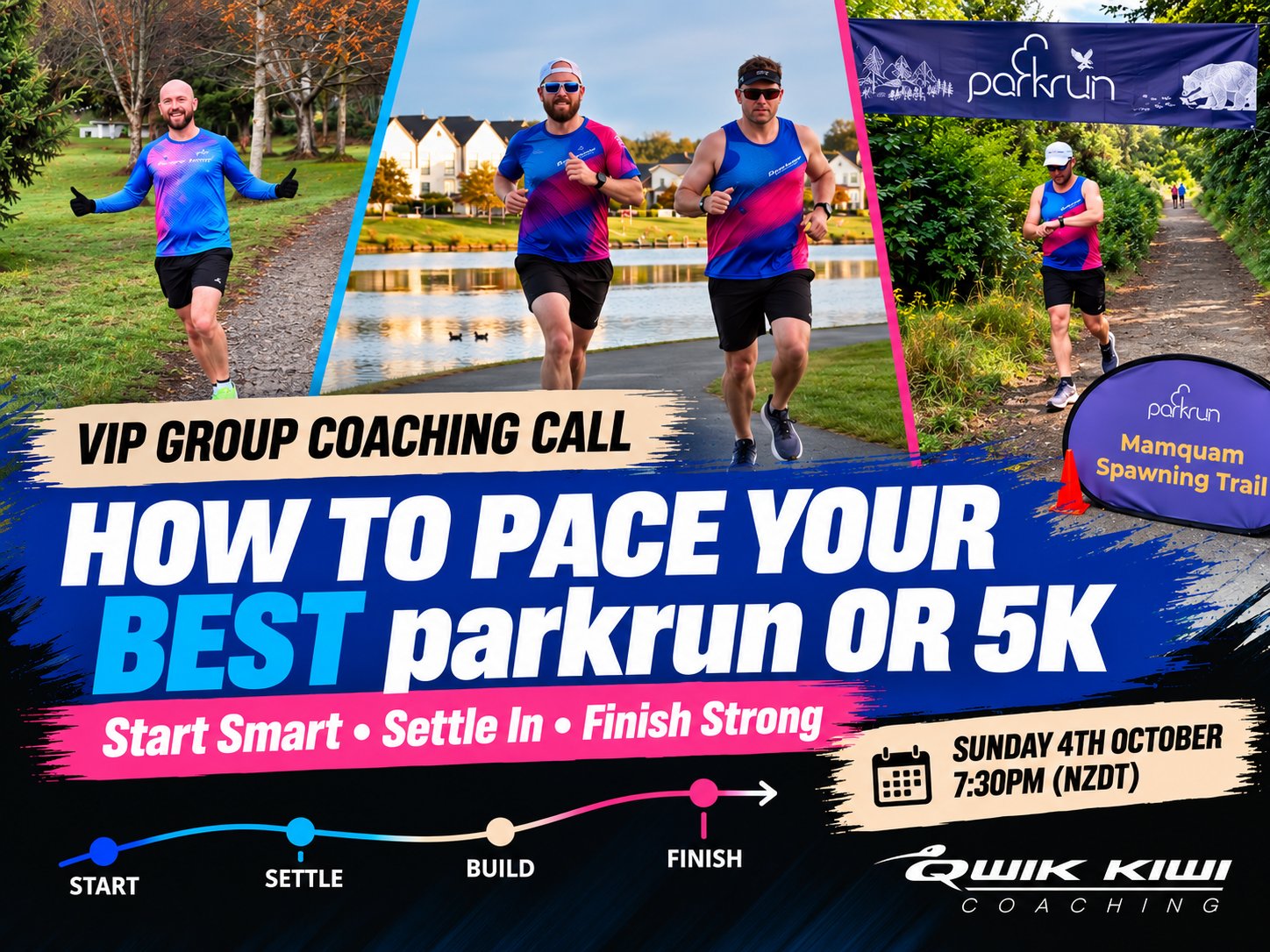
Start Smart. Settle In. Finish Strong.
The execution, however, takes practice.
Fitness Sets Your Potential — Pacing Lets You Use It
Think of your fitness as the size of the engine you have available. Pacing determines how effectively you use that engine.
Two runners with similar fitness can produce very different 5K performances simply because one distributes their effort better.
The classic mistake is starting too quickly. You’re fresh, perhaps you’ve had an easier day beforehand, adrenaline is flowing and you’re surrounded by other runners. A pace that should be difficult suddenly feels surprisingly comfortable.
But there is no free speed.
If you work significantly harder than you should during the first kilometre, you’re effectively borrowing energy from kilometres three, four and five.
The opposite extreme isn’t ideal either. Starting so cautiously that you have an enormous amount left at the finish means you probably left time on the course.
The objective is to distribute your effort effectively across the entire 5 km.
Set a Realistic 5K Target
Good pacing starts before the gun goes.
One of the easiest ways to pace a 5K badly is to decide that today is the day you’re going to run a time that your recent training doesn’t suggest you’re ready for.
Be ambitious, but give that ambition some evidence.
Look at your:
- recent parkrun and 5K results
- recent time trials
- quality training sessions
- current training consistency
- recent fitness rather than an old PB
Once you have a realistic target, know approximately what that means in min/km.
A 25-minute 5K requires an average of 5:00 min/km.
A 30-minute 5K requires an average of 6:00 min/km.
But remember that average pace is only a starting point. Courses and conditions vary, which is why I also like athletes to have an A goal and a fallback goal. If conditions or your body aren’t cooperating with Plan A, adjusting your target and executing Plan B well isn’t failure.
Start Smart: Control the First Kilometre
The opening kilometre is probably where more 5Ks are ruined than anywhere else.
You have adrenaline, fresh legs and runners disappearing up the road around you.
There’s also an important psychological trap:
Your 5K pace should feel reasonably manageable at the beginning.
If you expect target pace to feel as difficult during the first 500 metres as it will at 4 km, you’re very likely to start too quickly.
Don’t panic when people pass you. They might genuinely be faster runners. Or they might be making exactly the mistake you’re trying to avoid.
Get yourself up to speed, settle into your running and establish your intended effort.
You don’t need to deliberately sacrifice time. This is about control, not running slowly.
Instead of asking yourself:
Could I go faster?
Ask:
Can I sustain this effort for another four kilometres?
Settle In: Find Your 5K Rhythm
Once the opening kilometre is behind you, settle into your rhythm.
Your breathing should be working. You should be concentrating. You are definitely racing.
But you shouldn’t feel as though you’re already desperately hanging on.
Somewhere through kilometres two and three, the effort that initially felt relatively comfortable will begin to become uncomfortable.
That’s normal.
One of the important skills in 5K racing is learning to distinguish between:
“This is getting hard.”
and
“I’ve gone too hard.”
Instead of obsessively staring at your watch, concentrate on what you can control:
Posture. Cadence. Breathing. Relaxed shoulders. Forward momentum.
You aren’t trying to win the race with one heroic surge. You’re accumulating good running, one kilometre at a time.
Even Pace or Even Effort?
There’s an important distinction between even pacing and even effort.
On a perfectly flat course in ideal conditions, even pacing can work beautifully.
That’s not the reality of many parkruns.
Run uphill and your pace will probably decrease. Don’t automatically force yourself back to target pace. Maintain the appropriate effort and accept the slower split.
A downhill section may allow you to regain some of that time without increasing your effort.
Wind, heat, trail surfaces, grass, tight corners, congestion and even puddles can all affect your pace.
This is where becoming too attached to the watch can hurt your race.
If your target is 5:00 min/km but you’re climbing into a headwind, forcing yourself to maintain 5:00 min/km could turn that section into a substantially harder effort than intended.
Race the course that’s underneath your feet — not the perfect 5K that exists on your spreadsheet.
Kilometres Three and Four: Where the Race Gets Tough
This may be the most important part of your 5K.
Everyone is enthusiastic during the first kilometre.
Once you can see the finish, it’s also relatively easy to convince yourself to suffer for another couple of minutes.
It’s kilometres three and four where races often drift away.
You’ve been working hard for a while, but the finish isn’t particularly close. Your brain begins suggesting that easing off slightly would be a very sensible idea.
This is where your controlled opening kilometres start paying you back.
Instead of thinking:
I’ve still got two kilometres to go.
Shrink the race.
Get to that corner.
Catch the runner ahead.
Maintain this effort for another 200 metres.
Get yourself to 4 km.
Be particularly careful of the small, unconscious reduction in effort. Often you don’t deliberately decide to slow down. You simply stop pushing quite as hard.
Stay engaged with the race.
Finish Strong: Start Spending What’s Left
Once you have approximately one kilometre remaining, the equation changes.
You’ve spent four kilometres protecting yourself from doing something stupid too early.
Now you can start spending what’s left.
That doesn’t necessarily mean launching an enormous surge at 4 km.
Instead, start squeezing.
Lift the effort slightly. Hold it. Then ask for a little more.
Use runners ahead of you as targets. Pick someone out and gradually close the gap. Once you reach them, find your next target.
As the finish gets closer, the consequences of going too hard diminish because there is less distance remaining for that increased effort to punish you.
With a few hundred metres remaining, you aren’t protecting the final kilometre anymore.
There isn’t another kilometre.
That’s when you commit.
If you’ve paced the race well, your final kilometre will probably be your hardest in terms of effort, even if hills, wind or terrain mean it isn’t necessarily your fastest split.
Practise Pacing at parkrun
One of the advantages of parkrun is that you don’t need to race for a PB every Saturday.
In fact, I discourage athletes from trying to race all-out every week. Continually racing hard creates fatigue that needs to be recovered from and can interfere with the rest of your training.
Instead, use some parkruns as pacing practice.
For example, you could deliberately run a progressive 5K where each kilometre is faster than the previous one.
If we use a runner capable of approximately 25 minutes as an example, one pacing challenge could look like this:
| Kilometre | Target Pace |
|---|---|
| 1 km | 5:20 min/km |
| 2 km | 5:10 min/km |
| 3 km | 5:00 min/km |
| 4 km | 4:50 min/km |
| 5 km | 4:40 min/km |
That still totals 25 minutes, but you’ve turned the event into a pacing challenge rather than simply trying to run as hard as possible from the gun.
See how closely you can hit each target.
Another week, run your parkrun at a predetermined tempo pace and try to produce remarkably consistent kilometre splits.
Learning to accurately judge pace at submaximal intensities can be just as valuable as racing flat-out.
Can You Change Your Goal During a 5K?
Absolutely.
Most mid-race adjustments involve moving to a fallback goal because the weather, course, legs or circumstances aren’t cooperating.
But occasionally the opposite happens.
You arrive expecting an ordinary run, start conservatively and suddenly realise you’re having an exceptional day.
There’s nothing wrong with changing the plan.
One of the advantages of starting under control is that you retain the ability to make that decision later. You can progressively increase the effort when the evidence from your body tells you there’s more available.
Don’t Forget Your Warm-Up
If you’re genuinely racing your parkrun or 5K, don’t expect your body to go from standing around at the start line straight into race pace.
I typically recommend approximately 10–15 minutes of warm-up before a parkrun.
You’re not trying to complete another workout before the event or fatigue yourself. You’re preparing the body so that when the 5K starts you can settle into your rhythm quickly.
A good warm-up gets the muscles warm, increases blood flow, elevates heart rate and breathing, and prepares you for the demands that are about to come.
Start Smart • Settle In • Finish Strong
If you want something simple to remember next Saturday morning, make it this:
Start Smart — control the opening kilometre rather than allowing adrenaline or the runners around you to dictate your pace.
Settle In — find a sustainable 5K rhythm and accept that the effort will become progressively more uncomfortable.
Stay Strong — concentrate through kilometres three and four when it’s easiest to unconsciously let the pace slip.
Finish Strong — with approximately one kilometre remaining, progressively start spending whatever you’ve got left.
Good pacing isn’t designed to make racing a 5K easy.
If you’re genuinely racing it, it’s still going to hurt.
The goal is to ensure that the discomfort is producing the best performance you’re capable of rather than simply being the consequence of running the first kilometre too quickly.
Fitness gives you the potential. Pacing lets you use it.
Ready to Improve Your 5K?
Whether you’re chasing your next parkrun PB, preparing for a 5K race or simply want to become a stronger and more consistent runner, having the right training and pacing strategy can make a substantial difference.
If you’d like help putting that strategy together, book a FREE 40-minute consultation with Coach Ray and let’s talk about your running, your goals and what you need to do next.
Book your FREE 40-minute consultation
Train hard. Train smart.
Coach Ray