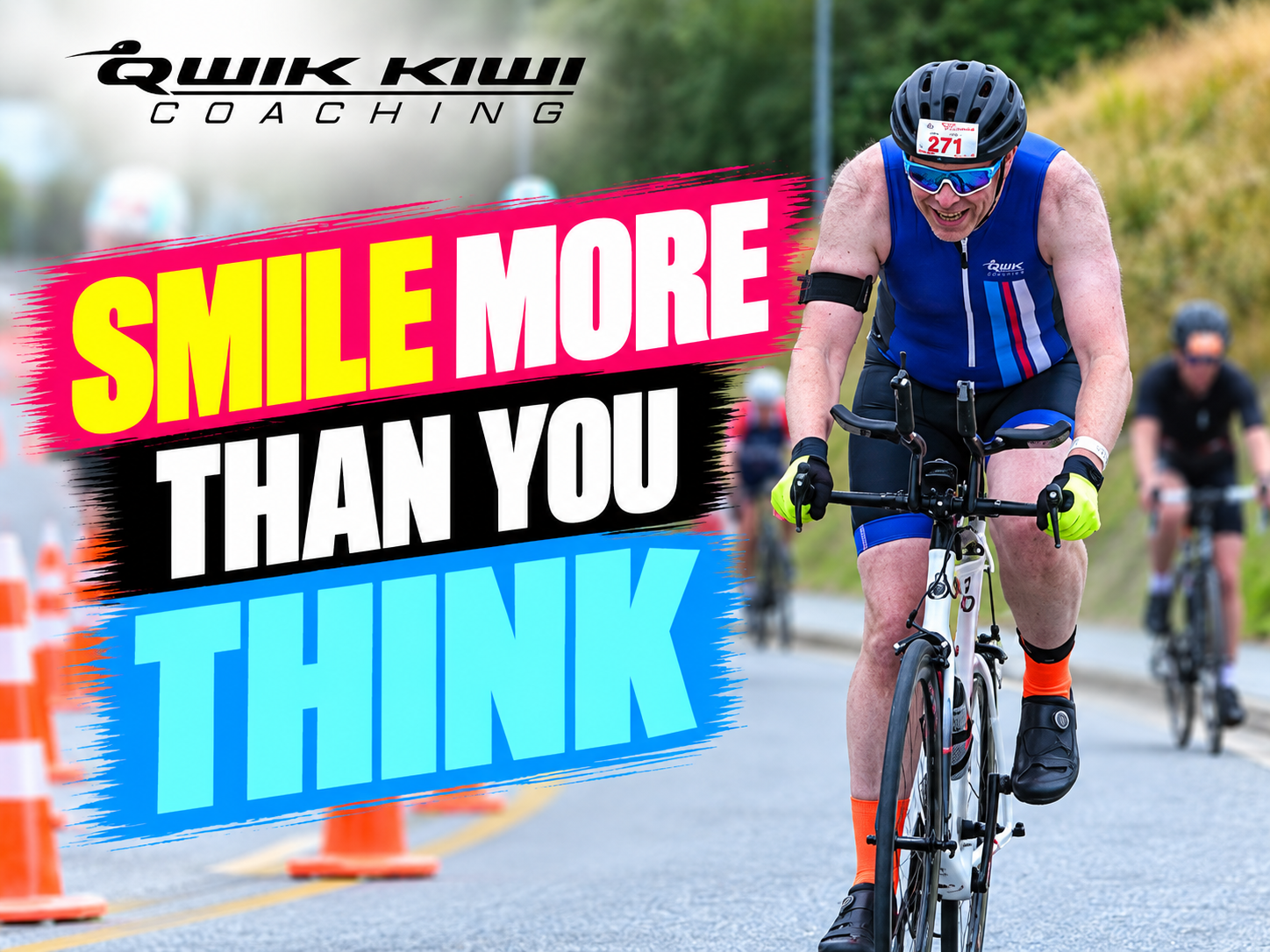
At some point during your Ironman 70.3, things are probably going to get uncomfortable.
Maybe the swim is rougher than expected.
Perhaps you’re riding into a headwind and your average speed isn’t where you hoped it would be.
Or you’re 15km into the run, your legs are hurting and the finish line still feels a long way away.
When that happens, I want you to try something incredibly simple:
Smile.
It might sound like strange advice in the middle of an endurance race, but deliberately smiling can be a useful cue to relax, reset your thinking and stop a difficult moment from spiralling into a negative one.
Your Ironman 70.3 doesn’t have to feel easy for you to smile.
Sometimes you smile precisely because it isn’t easy.
Your Mindset Changes as the Race Gets Harder
Most athletes start an Ironman 70.3 in a reasonably positive frame of mind.
You’ve tapered.
You’re excited.
The atmosphere is fantastic.
You’ve got months of training behind you.
Then fatigue starts accumulating.
The internal conversation can gradually change:
“This headwind is killing me.”
“My legs feel terrible.”
“I’m slowing down.”
“Everyone is passing me.”
“I don’t know if I can keep doing this.”
One negative thought leads to another, and suddenly you’re not simply dealing with physical fatigue. You’re adding frustration, anxiety and tension to it.
That’s where something as simple as a smile can become useful.
A Smile Can Be Your Reset Button
I’m not suggesting that smiling magically removes fatigue.
It doesn’t replenish glycogen.
It won’t fix dehydration.
It won’t suddenly give you another 20 watts on the bike.
And it certainly isn’t a substitute for sensible pacing, appropriate fuelling and good preparation.
Think of it instead as a mental reset button.
When you notice yourself getting tense or negative, smile.
Then use that moment to check in:
Relax your shoulders.
Release your grip.
Take a controlled breath.
Check your pacing.
Take your nutrition.
Focus on the next job.
Now the smile isn’t simply an expression.
It has become a cue for a process.
Why Your Internal Conversation Matters
There is good evidence that psychological strategies can influence endurance performance.
A systematic review examining psychological interventions found consistent support for strategies including self-talk, imagery and goal setting in endurance performance. PubMed
In one controlled study, athletes who received motivational self-talk training improved cycling time-to-exhaustion and reported lower perceived exertion at an equivalent point in the exercise compared with their earlier test. PubMed
That doesn’t prove that smiling itself will make your Ironman 70.3 faster.
But it does reinforce an important coaching principle:
How you respond mentally to discomfort matters.
Your thoughts don’t have to be passengers during your race.
You can influence them.
Watch What Happens to Your Body When Things Get Tough
Think about how you physically respond when you’re struggling.
Your jaw tightens.
Your shoulders creep upwards.
You grip the handlebars harder.
Your breathing becomes less controlled.
Your running posture starts looking forced.
Sometimes your face tells the entire story.
Try smiling.
Then consciously relax.
On the bike, soften your hands and shoulders while maintaining control.
On the run, release unnecessary tension from your face, hands and upper body.
You aren’t pretending that the race doesn’t hurt.
You’re reminding yourself:
I can be uncomfortable without becoming tense.
Don’t Save Your Smile for the Finish Line
Watch athletes approaching an Ironman 70.3 finish chute.
Suddenly they’re smiling.
They’re waving.
Their posture changes.
They start interacting with spectators.
Somehow, despite being exhausted a few minutes earlier, they look completely different.
Of course the finish line has something to do with that.
But why wait until the final 200 metres?
Use the crowd.
Smile at volunteers.
Thank the person handing you a drink.
Acknowledge your supporters.
Smile when you see another athlete having a great race.
And occasionally smile simply because you get to be out there doing something you’ve spent months preparing for.
That can help pull your attention away from the endless internal discussion about how tired you are.
Smile When Something Goes Wrong
This might be the most valuable time to use it.
Dropped a bottle?
Smile. Solve the problem. Move on.
Had a terrible swim?
Smile. The swim is finished. Start riding your bike.
Lost time at an aid station?
Smile. Get back into your rhythm.
Headwind stronger than expected?
Smile. Everyone else has the same wind.
Your race rarely unfolds perfectly.
You can’t always control what happens.
You can control what you do next.
That little smile can become your signal that the previous problem is finished and you’re moving forward.
Use It Before You Need It
Like most race-day skills, this is better if you practise it.
Don’t wait until you’re deep into your Ironman 70.3 to experiment with mental strategies for the first time.
During your harder training sessions, notice what happens to your thoughts as fatigue increases.
When you catch yourself becoming negative, try:
Smile → relax → breathe → assess → act.
You could practise it during a long ride when the weather turns unpleasant.
Use it late in a brick run.
Try it during a tough interval session.
You are creating an association between the physical action of smiling and a deliberate mental reset.
Research on self-talk suggests that psychological skills benefit from being deliberately trained rather than merely hoped for on competition day. A meta-analysis of self-talk interventions found an overall positive effect on sports performance, with trained interventions tending to be more effective. PubMed
Don’t Confuse Positivity With Ignoring Problems
There is an important distinction here.
I’m not asking you to blindly tell yourself:
“Everything is fantastic!”
when it clearly isn’t.
If you’re overheating, address it.
If you’re running too hard, slow down.
If you’ve fallen behind with your nutrition, make sensible adjustments.
If something hurts in a way that suggests injury rather than normal racing discomfort, take it seriously.
Positive thinking isn’t about ignoring useful information.
It’s about avoiding the additional damage caused by turning a manageable problem into a mental catastrophe.
Acknowledge the problem. Make a decision. Then move forward.
Develop Your Own Reset Routine
Your smile can be the first part of a short routine you use whenever the race starts becoming mentally difficult.
For example:
Smile.
Relax your shoulders.
Take one controlled breath.
Ask: What do I need right now?
Then deal with the answer.
Maybe you need to slow down.
Maybe you need a gel.
Maybe you need water.
Maybe everything is actually fine and you simply need to keep moving.
Breaking difficult moments into something you can act upon prevents your mind from jumping ahead to the remaining kilometres.
You don’t need to solve the rest of your race.
You need to deal with what is happening now.
Your Ironman 70.3 Is Supposed to Be Challenging
There will probably be moments when you’re tired.
There may be moments when you’re frustrated.
And there will almost certainly be a point when the finish line feels much further away than you’d like.
That doesn’t mean your race is going badly.
It means you’re doing an endurance event.
So when things get hard, remember:
Smile more than you think.
Not because everything is easy.
Not because discomfort isn’t real.
But because that smile can remind you to relax, reset and focus on the things you can control.
Then keep moving forward.
You might even remember why you wanted to do this in the first place.
Want Help Preparing for Your Ironman 70.3?
If you’re preparing for an Ironman 70.3 and want personalised help with your training, pacing, race strategy or mental preparation, you can book a free, no-obligation 40-minute coaching consultation with me.
We can talk through your goals, where your training is currently at and what you can do to arrive on the start line confident and prepared.
Book your free 40-minute coaching consultation with Coach Ray
Train smart. Stay positive. And remember to smile.