Indoor Cycling Tips #015 | Qwik Kiwi Coaching
Have you ever watched a really good cyclist riding at a challenging intensity?
Their legs are working hard.
They’re producing plenty of power.
Their breathing is elevated.
But there’s something interesting about their upper body.
It often looks remarkably quiet.
Their shoulders aren’t constantly rocking from side to side. Their head isn’t bobbing up and down with every pedal stroke. They’re not pulling aggressively on the handlebars every time one leg pushes down.
Instead, their upper body looks controlled and relatively relaxed.
Now compare that with someone who is struggling to maintain their power.
Their shoulders start rocking.
Their elbows lock.
Their grip tightens.
Their whole body seems to be fighting the bike.
Some movement is natural, particularly during very hard efforts. But unnecessary upper-body movement can be a sign that technique is deteriorating.
Good cycling isn’t just about how much power you produce. It’s also about how well you control your body while producing it.
And that’s why one of my favourite indoor cycling technique cues is simple:
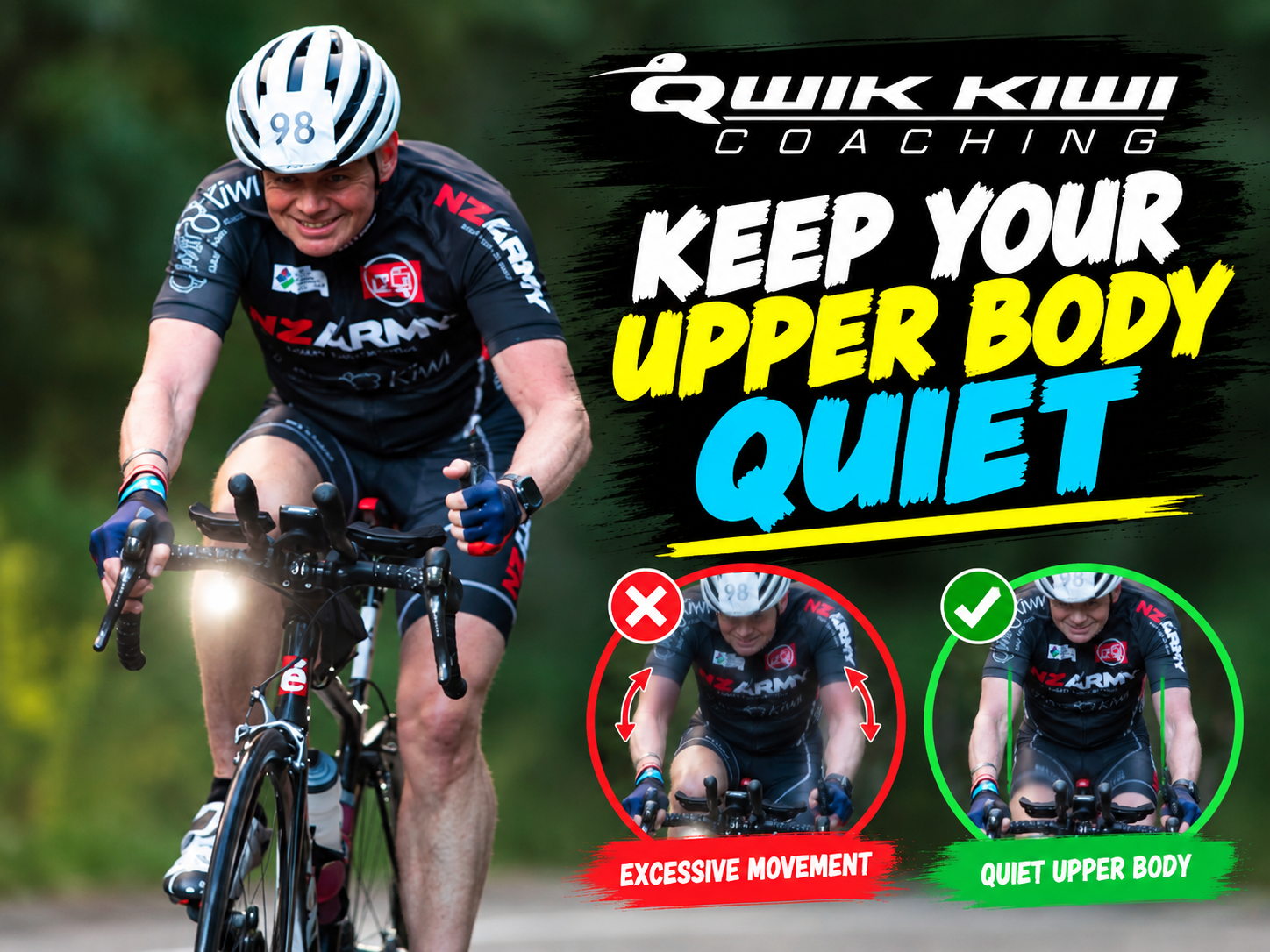
Keep your upper body quiet.
What Does Keeping Your Upper Body Quiet Actually Mean?
First, it doesn’t mean becoming completely rigid.
Your upper body needs to move naturally as you pedal, breathe, steer and respond to the demands of cycling.
Even experienced cyclists demonstrate some movement through their shoulders, arms and torso.
The goal isn’t to eliminate all movement.
The goal is to avoid unnecessary movement and excessive tension.
When I tell an athlete to keep their upper body quiet, I’m looking for several things:
- Relaxed shoulders rather than shoulders hunched towards the ears.
- A comfortable grip on the handlebars rather than a death grip.
- Elbows that remain slightly bent rather than completely locked.
- A stable torso without excessive side-to-side rocking.
- Hips that remain relatively stable on the saddle.
- Smooth pedalling without the whole body bouncing with each pedal stroke.
These are all useful signs of controlled cycling technique.
And while they’re particularly easy to observe indoors, they matter outdoors too.
Your Legs Should Be Doing Most of the Work
When you’re cycling in a seated position, your legs are responsible for producing most of the power that drives the bike forward.
Your upper body has an important supporting role.
It helps stabilise your position, supports your contact with the handlebars and allows you to maintain control of the bike.
But during normal seated cycling, you shouldn’t need to throw your shoulders from side to side to produce every pedal stroke.
Think about a steady Level II Endurance ride.
Your legs are turning the pedals at a comfortable cadence.
Your breathing is controlled.
Your hands rest comfortably on the handlebars.
Your upper body should be relatively relaxed.
Now imagine the same athlete unnecessarily rocking their shoulders through every pedal stroke.
They’re creating additional movement that isn’t directly contributing to driving the pedals.
Not every movement represents a meaningful loss of energy, and a perfectly motionless torso isn’t necessarily the most efficient technique.
However, excessive movement and tension can make it harder to maintain a comfortable, controlled riding position.
That’s what we’re trying to address.
Why Upper-Body Movement Often Increases as You Get Tired
One of the first things I notice when athletes become fatigued is that their technique starts to change.
At the beginning of an interval, everything looks controlled.
Cadence is steady.
The shoulders are relaxed.
The torso is stable.
But as the effort continues, little changes begin appearing.
The athlete starts gripping the handlebars more tightly.
Their elbows become rigid.
Their shoulders begin moving.
Their hips may start rocking.
Sometimes their cadence falls and they begin forcing each pedal stroke.
Fatigue doesn’t just affect how much power you can produce. It can also affect how you produce that power.
This is one reason I encourage athletes to concentrate on technique throughout their workouts rather than only during the warm-up.
It’s relatively easy to ride smoothly when you’re fresh.
The real challenge is maintaining appropriate technique as the workout becomes demanding.
A Quiet Upper Body Doesn’t Mean You Can’t Ride Hard
This is an important distinction.
I don’t expect athletes to look exactly the same during a Level II Endurance ride and a maximal sprint.
Different intensities create different demands.
During Level II Endurance, I generally expect relaxed, controlled upper-body movement.
During Level III Tempo and Level IV Threshold efforts, there may be more tension as athletes work harder to maintain their prescribed power.
During Level V VO₂ Max efforts, breathing becomes much more demanding and some additional upper-body movement may occur.
During maximal sprints, cyclists may deliberately use their arms and upper bodies to help stabilise the bike and produce high power.
That’s normal.
The objective isn’t to remain perfectly still regardless of intensity.
It’s to maintain as much control as is appropriate for the effort you’re completing.
If you’re rocking aggressively from side to side during a moderate Level II ride, that’s worth investigating.
If you’re moving more during an all-out sprint, that’s an entirely different situation.
Context matters.
Your Handlebars Aren’t Something to Fight
One of the simplest things you can do to improve your upper-body technique is to check your grip.
Are you holding the handlebars comfortably?
Or are you gripping them as though someone is trying to take the bike away from you?
During steady seated cycling, you generally don’t need excessive hand pressure.
A firm, secure grip is important for control, particularly outdoors.
But excessive gripping can create unnecessary tension through your hands, forearms, shoulders and neck.
Try this during your next Level II ride.
Without compromising control, briefly check how tightly you’re holding the handlebars.
Relax your fingers slightly.
Allow your elbows to remain comfortably bent.
Drop your shoulders away from your ears.
Then concentrate on pedalling smoothly.
You may be surprised how much unnecessary tension you’ve been carrying.
Relax Your Shoulders
Shoulder tension is another common problem.
As an interval becomes more difficult, athletes sometimes start lifting their shoulders towards their ears.
This can create additional tension through the neck and upper back.
It may also make the riding position less comfortable over time.
During your next workout, periodically ask yourself:
Are my shoulders relaxed?
If not, consciously release some of that tension.
Keep your head in a comfortable position.
Maintain a natural bend through the elbows.
Allow your upper body to support your riding position without becoming unnecessarily rigid.
You don’t need to slump forward or compromise your posture.
You’re simply removing tension that isn’t helping you ride.
Keep Your Hips Stable
Although we’re talking about the upper body, the hips are an important part of this discussion.
Your pelvis provides the foundation for your seated cycling position.
If your hips are rocking excessively from side to side, that movement can influence what happens through your torso and shoulders.
Hip rocking can occur for several reasons.
Your saddle may be too high.
Your cadence may be beyond what you can currently control smoothly.
You may be struggling to maintain the prescribed power.
Or fatigue may be affecting your pedalling technique.
This is why I don’t automatically assume every technique problem is simply a matter of concentrating harder.
Sometimes the athlete needs better technique.
Sometimes they need to develop more strength or coordination.
And sometimes their bike position needs attention.
If you’re repeatedly struggling to maintain a stable position, consider whether your bike fit is contributing to the problem.
What Does the Research Say About Upper-Body Stability?
The relationship between upper-body movement and cycling performance is more complicated than simply saying that less movement always means better efficiency.
Research confirms that the upper body plays an active role in stabilising the cyclist and supporting power production.
A study published in the Journal of Sports Sciences investigated upper-limb and trunk muscle activity during seated and standing cycling at different power outputs.
The researchers identified muscle activity associated with torso stabilisation, trunk movement and supporting body weight. Upper-body muscle activity increased substantially at very high power outputs.
This reinforces an important point: your upper body isn’t supposed to be inactive. It has a functional role in cycling. PubMed
A more recent study published in August 2026 examined upper-body postural stability during maximal cycling. It reported that maximal intensity compromised upper-body stability, reinforcing why some additional movement during very demanding efforts is unsurprising. International Journal of Exercise Science
Meanwhile, a systematic review of cycling position optimisation found that changes in trunk angle and riding position can influence both biomechanical and physiological demands. It also highlighted limitations in the available evidence. PubMed
The practical coaching message is straightforward.
We shouldn’t claim that keeping your shoulders perfectly still will automatically produce more watts or a measurable improvement in efficiency.
However, learning to maintain a controlled, comfortable position, without unnecessary movement or tension, is a valuable cycling skill.
Indoor Cycling Is the Perfect Place to Practise
One of the advantages of indoor cycling is that you can concentrate on technique without the distractions of riding outdoors.
You don’t have to negotiate corners.
You don’t have traffic to contend with.
You don’t need to react to changing road surfaces.
You can simply concentrate on how you’re riding.
And because your bike remains in a relatively fixed position on a conventional indoor trainer, unnecessary body movement can become particularly noticeable.
This creates an excellent opportunity to practise upper-body control.
Try This Simple Technique Exercise
During your next Level II Endurance ride, spend five minutes concentrating specifically on your upper body.
Five-Minute Upper-Body Technique Check
Level II
Maintain your normal comfortable endurance cadence and power throughout.
| 0–1 min | Relax your shoulders and release unnecessary tension. |
| 1–2 min | Check your grip and maintain a comfortable bend in your elbows. |
| 2–3 min | Keep your torso controlled without deliberately stiffening it. |
| 3–4 min | Concentrate on stable hips and smooth pedalling. |
| 4–5 min | Bring everything together and maintain the same comfortable power. |
Notice whether you can improve your control without changing the intensity of the workout.
If you can, you’ve just made your easy ride a little more productive without making it harder.
What Happens When You Increase Your Cadence?
Cadence training provides another excellent opportunity to assess upper-body control.
For most cycling situations, I encourage athletes to become comfortable riding at approximately 90–100rpm.
But I also deliberately prescribe lower- and higher-cadence training to develop a wider range of cycling skills.
When athletes begin practising higher cadences, I sometimes see them bouncing in the saddle or moving excessively through their shoulders.
They might achieve the prescribed cadence, but their technique deteriorates.
That’s not what I’m looking for.
A high cadence is only useful as a technique exercise if you can maintain appropriate control.
If you’re comfortable at 95rpm but start bouncing at 105rpm, don’t simply force the higher number.
Reduce your cadence slightly.
Find a speed where you can pedal smoothly.
Then gradually build your ability to maintain that control at higher cadences.
For example, you might progress through:
- 90–95rpm
- 95–100rpm
- 100–105rpm
- 105–110rpm
Only increase cadence when you can maintain good technique.
And remember, these are technique-training ranges, not a requirement to ride at a high cadence during every workout.
Your Core Helps Support Your Riding Position
When discussing upper-body stability, it’s tempting to immediately recommend more core training.
Core strength and endurance can certainly contribute to maintaining a comfortable riding position.
Your trunk muscles help support your torso and control movement between your pelvis and upper body.
However, developing stronger abdominal muscles doesn’t automatically guarantee improved cycling technique.
You also need to practise controlling your position while actually riding.
This is an example of the difference between general strength and sport-specific skill.
A cyclist might be capable of completing challenging abdominal exercises but still struggle to maintain a relaxed upper body during high-cadence cycling.
Conversely, an experienced cyclist may demonstrate excellent control on the bike without performing particularly impressive gym exercises.
Develop your strength, but also practise using that strength appropriately on the bike.
Don’t Confuse Relaxed With Collapsed
When I encourage athletes to relax their shoulders, I’m not telling them to abandon their riding position.
There’s a difference between being relaxed and allowing your posture to collapse.
You still need to support your upper body.
You still need to maintain control of the handlebars.
And you still need a position that allows you to breathe comfortably and produce power.
The goal is controlled relaxation.
Think of it as maintaining enough muscular activity to support your position without creating unnecessary tension.
Stable, not stiff. Relaxed, not collapsed.
Your Bike Fit Can Influence Upper-Body Control
Sometimes an athlete struggles to keep their upper body quiet because their position on the bike makes it difficult.
If the handlebars are too far away, they may be forced to reach excessively.
If they’re too low for the athlete’s current mobility or positional tolerance, maintaining a comfortable posture may become challenging.
Saddle height, saddle position and other aspects of bike fit can also influence pelvic stability.
A clinical commentary on cycling and hip pain identifies several potential contributors to pelvic rocking, including saddle position, handlebar position, crank length and poor torso control. PMC
This is why I don’t recommend automatically correcting every movement problem by telling an athlete to sit still.
If you’re consistently uncomfortable, experiencing pain or struggling to maintain your position, a professional bike fit may be worthwhile.
Technique matters.
But so does having a bike that fits you appropriately.
Can Better Upper-Body Control Improve Your Aerodynamics?
Potentially, although the relationship isn’t as simple as eliminating movement.
A stable position may make it easier to maintain your intended riding posture, particularly when you’re fatigued.
For road cyclists and triathletes, maintaining an appropriate aerodynamic position can be important.
However, an aggressive aerodynamic position isn’t automatically the most effective choice for every athlete.
Research has shown that changing hand position and trunk angle can affect cycling biomechanics and physiological demands, while lower positions can provide aerodynamic advantages. PLOS One
The objective is to find a position you can maintain comfortably and effectively for the demands of your event.
A theoretically aerodynamic position is of limited practical value if you cannot sustain it.
The best position is one that balances aerodynamics, power production, comfort and control.
Common Upper-Body Technique Mistakes
Here are some of the things I regularly encourage athletes to look out for.
| Common mistake | Coaching correction |
|---|---|
| Shoulders hunched towards the ears | Relax your shoulders and neck |
| Excessively tight grip | Maintain a secure but comfortable grip |
| Locked elbows | Keep a comfortable bend in your arms |
| Excessive torso rocking | Concentrate on controlled, smooth pedalling |
| Bouncing at high cadence | Reduce cadence until you regain control |
| Pelvic rocking | Check cadence, fatigue and bike fit |
| Becoming rigid while trying to stay still | Aim for stability without unnecessary tension |
You don’t need to correct everything at once.
Choose one thing to work on.
Practise it during easier riding.
Then gradually apply that skill to more demanding efforts.
Good Technique Should Survive Fatigue
This is where upper-body control becomes particularly useful.
It’s one thing to look smooth during the first five minutes of a workout.
It’s another to maintain appropriate technique during the final minutes of a challenging Level IV Threshold interval.
As fatigue develops, pay attention to the signs that your technique may be deteriorating.
Are you gripping the handlebars more tightly?
Are your shoulders rising?
Is your torso rocking more?
Are you beginning to bounce in the saddle?
If so, try making a small correction.
Relax your shoulders.
Re-establish your cadence.
Concentrate on smooth pedalling.
But don’t become so obsessed with keeping still that you compromise the actual purpose of the workout.
The goal is to maintain good technique while producing the prescribed power—not to sacrifice the workout simply to look perfectly motionless.
Frequently Asked Questions
Should my upper body be completely still when cycling?
No. Some upper-body movement is natural and necessary. The objective is to avoid excessive movement and tension, particularly during steady seated cycling.
Does rocking my shoulders waste energy?
Excessive movement may indicate poor control or unnecessary muscular activity, but the amount of energy involved isn’t easily quantified. It’s more useful to concentrate on maintaining a comfortable, controlled riding position than to assume every movement represents wasted power.
Why do I bounce in the saddle at high cadence?
You may be pedalling faster than you can currently control smoothly. Saddle position and other bike-fit factors may also contribute. Reduce your cadence until you regain control, then develop higher-cadence skills progressively.
Should I keep my upper body quiet during sprints?
Not in the same way as during steady endurance riding. Maximal sprinting can involve substantial upper-body muscle activity and deliberate movement to support power production.
Can core training improve my cycling technique?
It may help develop the strength and endurance required to support your riding position, but you should also practise technique while cycling. General strength and cycling-specific coordination are not identical.
Keep Your Upper Body Quiet. Let Your Legs Do the Work.
The next time you’re riding indoors, take a moment to assess your upper body.
Are your shoulders relaxed?
Are your elbows comfortably bent?
Are you gripping the handlebars unnecessarily tightly?
Is your torso controlled?
Are your hips stable?
And can you maintain that control as the workout becomes more demanding?
You don’t need to ride like a statue.
You don’t need to eliminate every movement.
You simply want to become more aware of how you’re using your body and develop the ability to maintain good technique across different intensities.
Because becoming a better cyclist isn’t just about producing more power.
It’s also about becoming better at producing that power.
Keep your upper body quiet.
Keep your pedalling smooth.
And concentrate on riding well.
Improve Your Cycling Technique With Velocity
If you’d like to develop smoother pedalling, better cadence control and more consistent indoor cycling technique, come and join us on Qwik Kiwi Velocity.
Velocity includes hundreds of coach-led video cycling workouts covering Level II Endurance, Level III Tempo, Level IV Threshold, Level V VO₂ Max, cadence, technique and recovery.
You’ll also find dedicated Coach Ray’s Cadence Session workouts designed to help develop smooth pedalling and control across different cadence ranges.
And you can join our squad-based live cycling sessions twice each week at 6:00 a.m. New Zealand time.
Tuesday: 45 minutes or less.
Thursday: Approximately one hour, sometimes a little more or less depending on the workout.
During these sessions, I’ll coach you through the prescribed efforts and provide practical reminders about cadence, power, pacing and technique.
Can’t make the live sessions? You can access the workout library on demand.
Try Velocity FREE for 14 days
Train smarter. Ride smoother. Ride stronger.