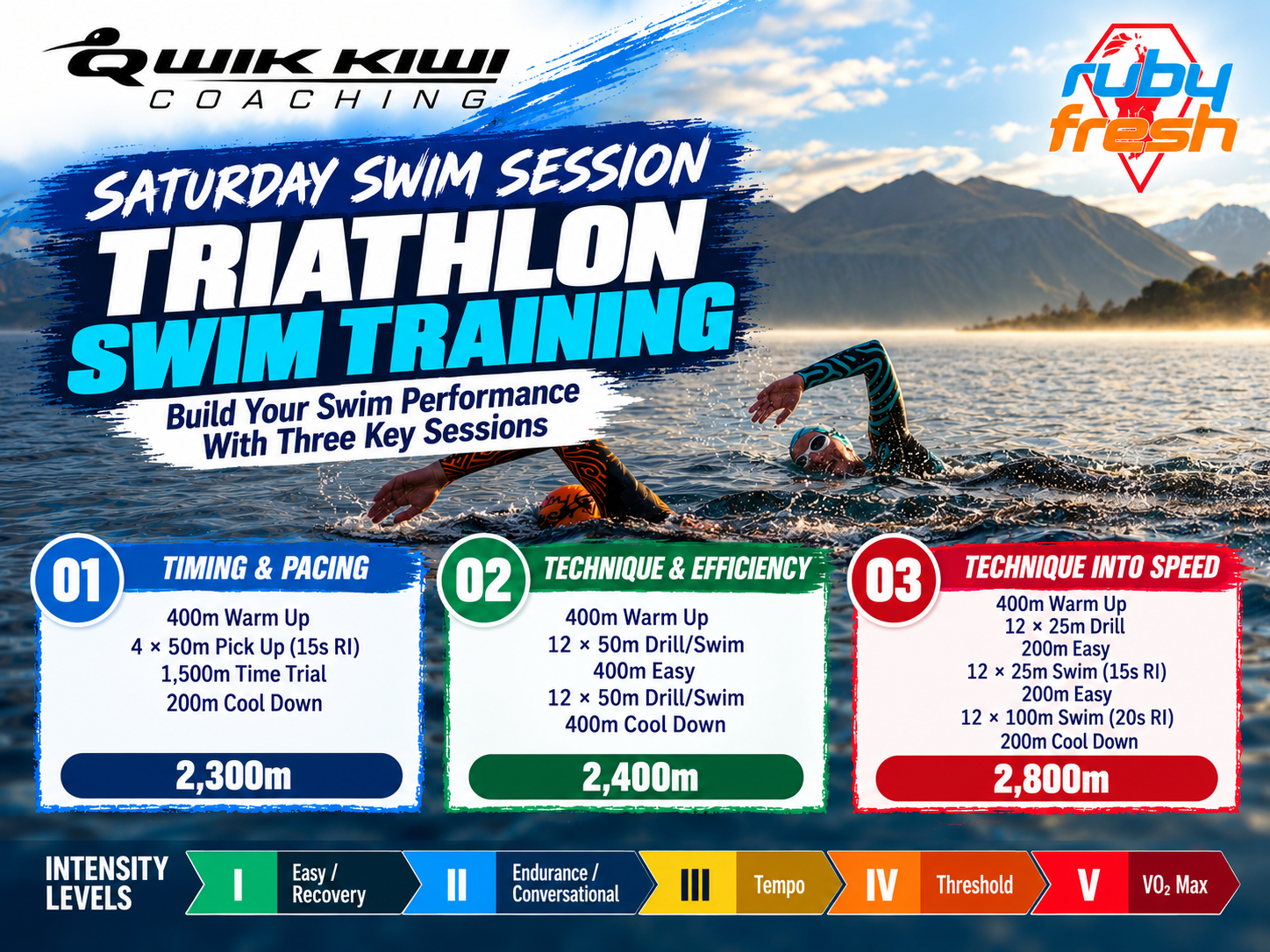
Improving your swimming for a triathlon takes more than simply covering distance in the pool. You need to develop the ability to sustain a strong pace, swim efficiently and maintain good technique as fatigue accumulates.
This week’s Saturday Swim Session brings together three complementary workouts designed to develop these qualities. You’ll establish a benchmark for your current swimming fitness, work on improving your freestyle technique and challenge yourself to produce repeatable swimming speed.
Whether you’re preparing for an Olympic-distance triathlon, Ironman 70.3 or T100 event, these sessions provide a structured approach to developing your swim performance.
Rather than choosing between three different distances of the same workout, you’ll complete three separate sessions during the week, each with a different training emphasis.
- Qwik Kiwi Performance Swim Session 01: Establish your current swimming fitness with a 1,500m Time Trial.
- Qwik Kiwi Performance Swim Session 02: Develop freestyle technique, coordination and efficiency through repeated Drill/Swim combinations.
- Qwik Kiwi Performance Swim Session 03: Combine technique development with progressively longer swimming efforts, challenging your ability to sustain speed.
You can learn more about the swimming intensity levels I use in my coaching in my article Intensity for Swimming.
This Week’s Goal
The overall goal is to establish a foundation for improving your swimming performance by combining fitness assessment, technical development and controlled high-quality swimming.
Each session has a specific purpose.
The 1,500m Time Trial provides a useful indication of your current swimming ability. It gives you a benchmark against which future improvements can be measured and helps you better understand your sustainable swimming pace.
The technique-focused session provides an opportunity to concentrate on your freestyle stroke without the pressure of swimming fast. By alternating drills with normal swimming, you’ll work on transferring technical improvements into your regular freestyle.
The third session brings these qualities together. You’ll begin with technique work before progressing into short repetitions and then sustained 100m efforts. The challenge is to swim at the fastest pace you can consistently maintain for the prescribed distance and Rest Intervals, without allowing your technique to deteriorate.
Why You’re Doing These Sessions
A successful triathlon swim depends on several interconnected qualities.
Aerobic endurance allows you to maintain your swimming effort over the distance required by your event.
Freestyle efficiency helps you move through the water effectively without wasting unnecessary energy.
Sustainable swimming speed allows you to maintain a strong pace rather than starting too quickly and slowing significantly as fatigue develops.
Pacing awareness helps you recognise how different swimming intensities feel and how long you can sustain them.
These three workouts address those qualities from different directions.
The Time Trial establishes where you are now. The technique session develops how you move through the water. The third session challenges you to apply that technique while swimming progressively longer repetitions at a sustainable pace.
Together, they provide a balanced combination of assessment, technique and performance development.
This Week’s Workouts
Qwik Kiwi Performance Swim Session 01 – 1,500m Time Trial
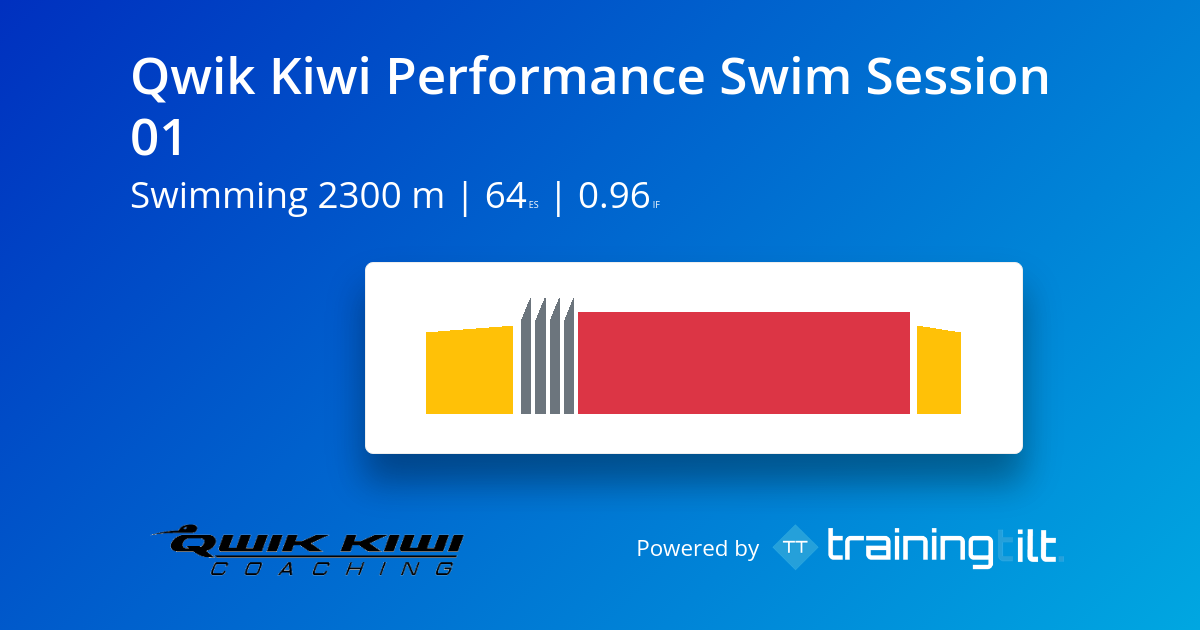
This session is designed to establish a benchmark for your current swimming fitness.
The 1,500m Time Trial is the main focus. Your objective is to cover the distance as quickly as you can while distributing your effort appropriately so that you maintain a strong pace throughout.
Workout
- 400m Warm Up (WU)
- 4 × 50m Pick Up – 15 sec Rest Interval (RI)
- 1,500m Time Trial
- 200m Cool Down (CD)
Warm Up – 400m
Begin with 400m of comfortable swimming. Use a mixture of strokes if you wish, gradually settling into a smooth freestyle rhythm.
The purpose is to increase your body temperature, loosen your shoulders and prepare yourself for the more demanding work ahead.
4 × 50m Pick Up – 15 sec RI
Use these repetitions to progressively increase your swimming intensity.
Start each 50m under control and gradually build your speed towards the finish. Avoid sprinting from the beginning.
Concentrate on maintaining good technique as your swimming speed increases.
1,500m Time Trial
This is the key component of the session.
Swim 1,500m as quickly as you can sustain across the entire distance.
The challenge is not simply to swim the opening 100m or 200m quickly. It is to distribute your effort so that you produce the fastest possible overall time.
Start with a controlled effort, establish a sustainable rhythm and aim to maintain consistent pacing throughout.
If you’ve judged your effort well, you may be able to increase your speed over the final few hundred metres.
Record your total time and, if possible, your 100m splits.
These results will provide useful information for assessing your current swimming fitness and tracking improvements.
Cool Down – 200m
Finish with 200m of easy swimming, allowing your breathing and heart rate to gradually settle.
Qwik Kiwi Performance Swim Session 02 – Freestyle Technique & Efficiency
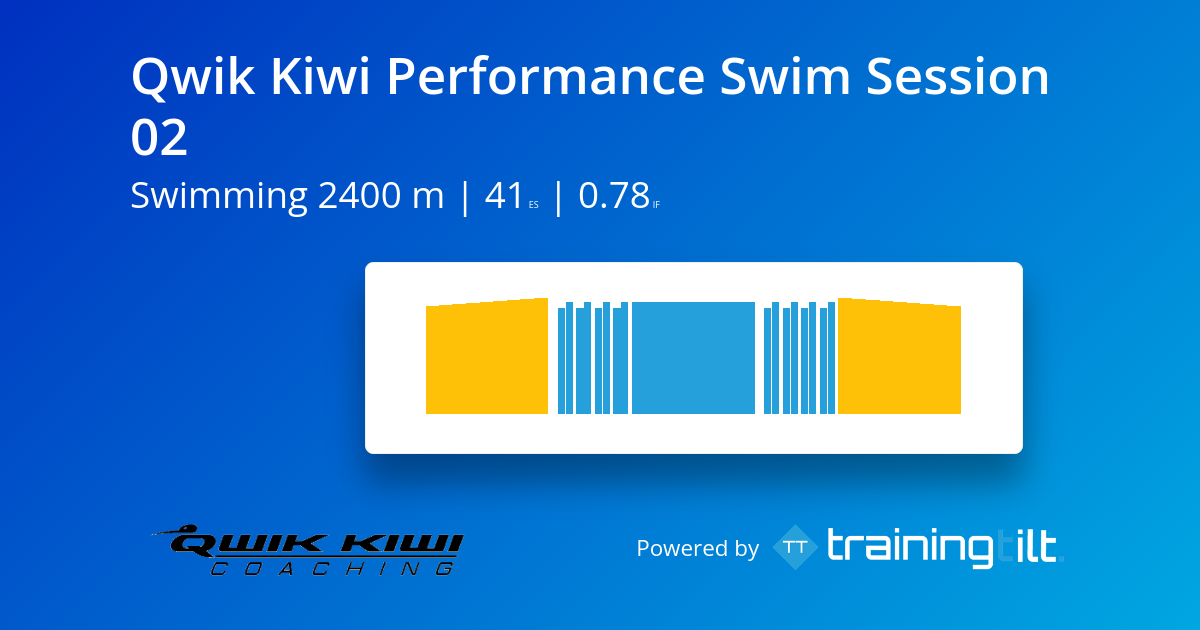
This session places the emphasis on improving freestyle technique and transferring technical improvements into your normal swimming.
Rather than simply completing drills for the sake of doing drills, concentrate on what each drill is teaching you and how that movement can improve your freestyle.
Workout
- 400m Warm Up
- 12 × 50m Drill/Swim
- 400m Easy
- 12 × 50m Drill/Swim
- 400m Cool Down
Warm Up – 400m
Begin with relaxed swimming, gradually settling into your normal freestyle stroke.
Pay attention to your body position, breathing, rotation and the rhythm of your arms.
12 × 50m Drill/Swim
Complete each 50m as:
25m Drill / 25m Normal Freestyle
Choose drills that address an aspect of your technique that you want to improve.
For example, you might use:
- Kick On Side (KOS) to develop body position and rotation.
- 6/1/6 to improve coordination between kicking, rotation and arm movement.
- 6/3/6 to develop rhythm and timing.
- Popov to improve stroke coordination and rotation.
- Broken Arrow to develop recovery mechanics and rotation.
You don’t need to use every drill during the session. Selecting a few that address your particular technical needs is often more productive.
The important part is the transition from the drill into normal freestyle.
During the 25m Swim, concentrate on incorporating the particular focus of the drill into your normal swimming stroke.
400m Easy
Return to continuous, relaxed freestyle swimming.
This provides an opportunity to consolidate the technical work from the first drill set.
Concentrate on maintaining good body position, a smooth catch and an efficient rhythm.
12 × 50m Drill/Swim
Repeat the Drill/Swim structure.
You can continue with the same drills if you feel they’re helping, or select different drills to address another technical aspect.
As you become more comfortable with the movements, concentrate on making the transition between drill and normal swimming increasingly natural.
Cool Down – 400m
Finish with 400m of comfortable swimming.
Use this final section to reinforce the technical improvements you’ve been working on rather than simply swimming to complete the distance.
Qwik Kiwi Performance Swim Session 03 – Technique Into Sustainable Speed
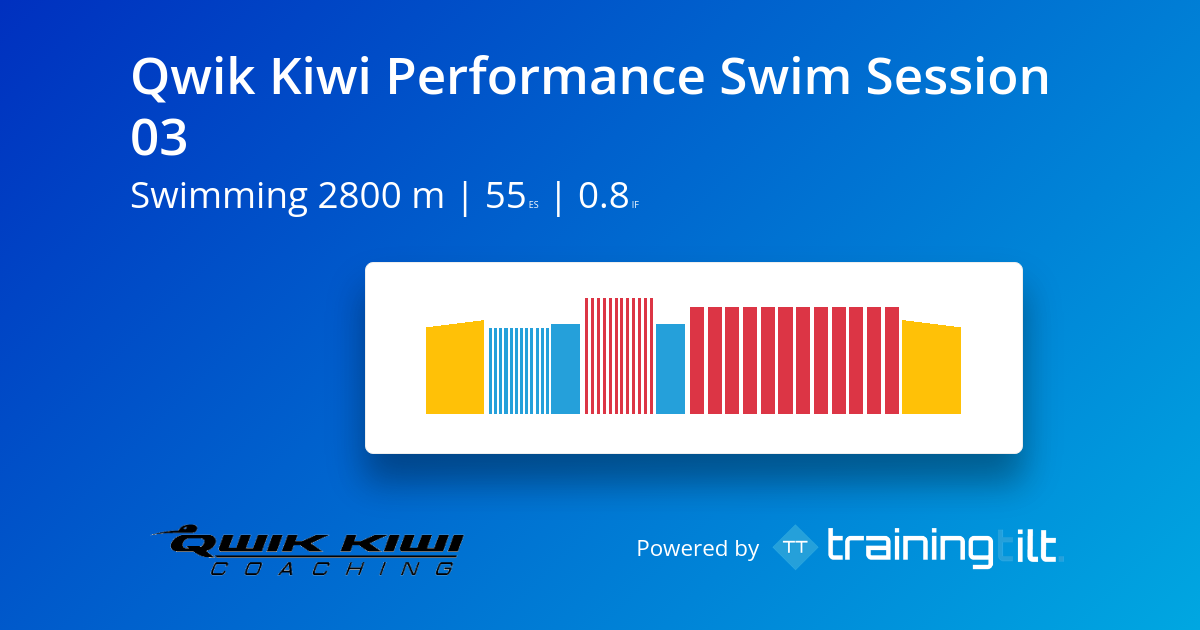
This workout combines technique development with progressively longer swimming efforts.
You’ll begin by concentrating on individual technical movements before moving into short swimming repetitions and then a substantial set of 100m efforts.
The main challenge is to maintain the fastest pace you can consistently sustain for each repetition distance and its prescribed Rest Interval.
Workout
- 400m Warm Up
- 12 × 25m Drill
- 200m Easy
- 12 × 25m Swim – 15 sec RI
- 200m Easy
- 12 × 100m Swim – 20 sec RI
- 400m Cool Down
Warm Up – 400m
Begin with comfortable swimming, gradually increasing your movement quality and preparing for the work ahead.
12 × 25m Drill
Use these repetitions to concentrate on specific aspects of your freestyle technique.
You might choose drills that improve rotation, body position, coordination or the catch.
Keep the movements controlled and purposeful.
200m Easy
Return to normal freestyle swimming.
Concentrate on incorporating the technical improvements from the drills into your full stroke.
12 × 25m Swim – 15 sec RI
These short repetitions introduce the speed component of the workout.
Swim each 25m at the fastest pace you can consistently sustain across all 12 repetitions with the available 15 seconds of recovery.
The objective is not to produce one exceptionally fast repetition followed by progressively slower efforts.
Instead, aim to maintain a strong, repeatable pace while continuing to swim with good technique.
Your final repetition should be as fast as your first.
200m Easy
Use this section to recover and prepare for the longer repetitions.
Allow your breathing to settle while maintaining a smooth, relaxed freestyle stroke.
12 × 100m Swim – 20 sec RI
This is the main endurance and performance component of the workout.
Swim each 100m at the fastest pace you can sustain consistently across all 12 repetitions, using the prescribed 20-second Rest Intervals.
Because these repetitions are longer than the preceding 25m efforts, your sustainable pace will naturally be different.
Start at a pace that challenges you but allows you to maintain consistency throughout the set.
Concentrate on maintaining a strong catch, good body position and an effective swimming rhythm.
If your pace deteriorates significantly during the later repetitions, you may have started too quickly.
The goal is to finish the set knowing you’ve worked hard while maintaining repeatable swimming performance.
Cool Down – 400m
Finish with comfortable swimming, gradually allowing your body to recover.
Concentrate on relaxed movements and good technique.
What You Should Focus On
Although these sessions have different objectives, several principles apply throughout the week.
1. Consistency Before Speed
Whether you’re completing a Time Trial or repeated 25m and 100m efforts, pacing matters.
Swimming quickly at the beginning of a session is of little benefit if you cannot maintain your performance.
Aim to distribute your effort appropriately and develop the ability to produce repeatable swimming speeds.
2. Technique Under Fatigue
It’s relatively easy to concentrate on technique when you’re fresh and swimming slowly.
The greater challenge comes when fatigue accumulates.
Pay attention to whether your body position, catch, rotation or stroke rhythm changes as you become tired.
3. Make Your Drills Purposeful
Every drill should have a specific technical objective.
Don’t simply complete the prescribed distance and move on.
Think about the movement you’re practising and how it should improve your normal freestyle.
The most important part of a Drill/Swim repetition is often what happens when you return to swimming.
4. Record Useful Information
Your 1,500m Time Trial provides an important benchmark.
Record your overall time and, where possible, your splits.
For Session 03, recording your 25m and 100m repetition times can help you understand whether your pacing was consistent.
This information becomes increasingly valuable as your swimming develops.
Common Mistakes to Avoid
Starting the Time Trial too quickly. An excessively fast opening can lead to significant slowing later. Aim for the fastest sustainable overall pace rather than the fastest opening split.
Treating drills as recovery swimming. Drills are opportunities to improve specific movements. Complete them deliberately, with a clear technical objective.
Forgetting the drill focus during normal swimming. The goal is to improve your freestyle, not simply become better at performing drills.
Swimming the first few repetitions too quickly. In Session 03, choose a pace that you can sustain across the complete set rather than producing a few impressive early repetitions.
Allowing technique to deteriorate. As fatigue increases, concentrate on maintaining effective movements rather than simply working harder.
Ignoring the prescribed Rest Intervals. The recovery periods are part of the workout design. Keep them consistent so you can evaluate your swimming performance accurately.
Tips for Completing the Workouts Successfully
Spread the three sessions across the week where possible, allowing adequate recovery between the more demanding workouts.
Approach Session 01 when you’re reasonably fresh so that your 1,500m Time Trial provides a meaningful assessment of your swimming fitness.
Use Session 02 to concentrate on technical quality. Resist the temptation to turn the easy swimming into another demanding endurance session.
During Session 03, establish a repeatable pace early in each set. The fastest sustainable pace for 25m repetitions with 15 seconds of recovery will be different from the fastest sustainable pace for 100m repetitions with 20 seconds of recovery.
Most importantly, don’t sacrifice good technique simply to produce a faster split.
Workout Breakdown
| Session | Distance | Primary focus |
|---|---|---|
| Qwik Kiwi Performance Swim Session 01 | 2,300m | 1,500m Time Trial and pacing assessment |
| Qwik Kiwi Performance Swim Session 02 | 2,400m | Freestyle technique and efficiency |
| Qwik Kiwi Performance Swim Session 03 | 2,800m | Technique and repeatable swimming speed |
| Weekly total | 7,500m | Assessment, technique and performance |
After Your Swim
Take a few minutes after each workout to consider what you learned.
After Session 01:
- What was your overall 1,500m Time Trial result?
- Did you maintain a consistent pace throughout?
- Did you start too quickly, too slowly or at approximately the right intensity?
- Were you able to increase your effort towards the finish?
After Session 02:
- Which drills were most beneficial?
- Could you transfer the technical focus of each drill into normal freestyle?
- Did your stroke feel more efficient during the easy swimming?
- Which aspects of your technique still require attention?
After Session 03:
- Were your 25m repetitions consistent?
- Did you maintain your pace across the 12 × 100m set?
- How did your technique change as fatigue accumulated?
- Could you have started at a slightly faster pace and maintained it, or did you begin too quickly?
Recording these observations alongside your workout results will help you identify improvements and areas that require further attention.
Build Your Swimming Performance With a Structured Training Plan
Completing individual workouts can help improve your swimming, but following a structured training programme provides a more systematic approach to developing your fitness, technique and performance.
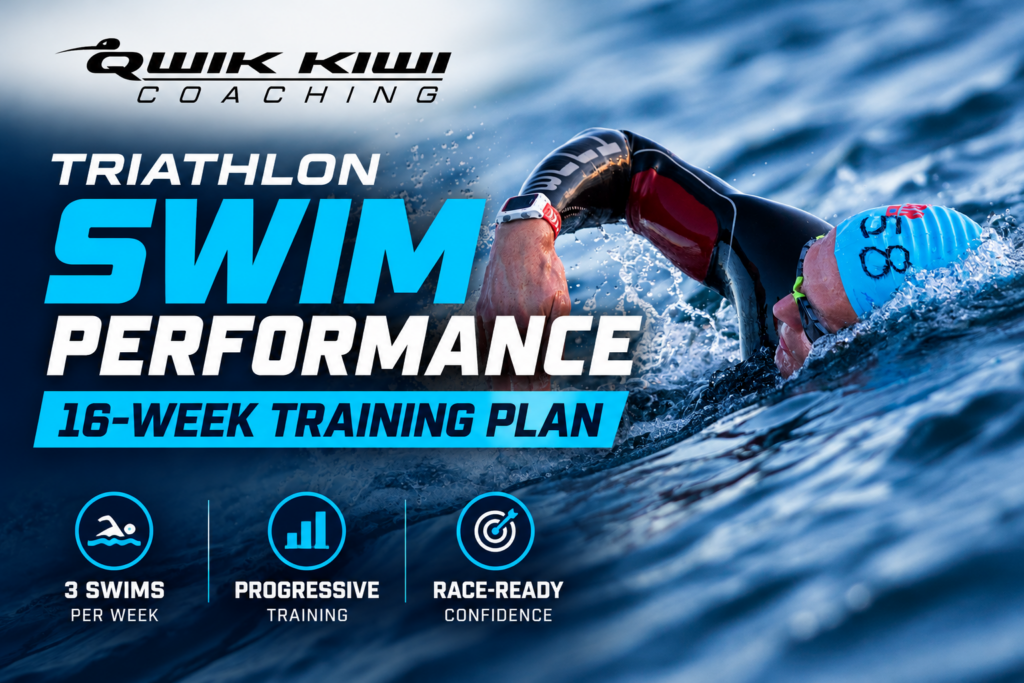
The Triathlon Swim Performance Plan – 16 Weeks from Qwik Kiwi Coaching brings together three swimming sessions each week, designed for triathletes preparing for Olympic-distance, Ironman 70.3 and T100 events.
Rather than wondering what to swim each time you visit the pool, you’ll have a structured programme to follow, with sessions designed to develop your swimming progressively.
The plan is particularly suitable for triathletes already comfortable swimming approximately 2,000–3,000m per session who want to take their swimming to the next level.
16 Weeks of Structured Swim Training
NZ$59
Three swimming sessions per week, with the complete 16-week programme available when you purchase.View the 16-Week Swim Performance Plan
Whether you’re aiming to swim faster, become more efficient or arrive at the first transition of your next triathlon feeling stronger and better prepared, structured and consistent training can make a meaningful difference.
Train consistently, swim purposefully and build your performance one session at a time.