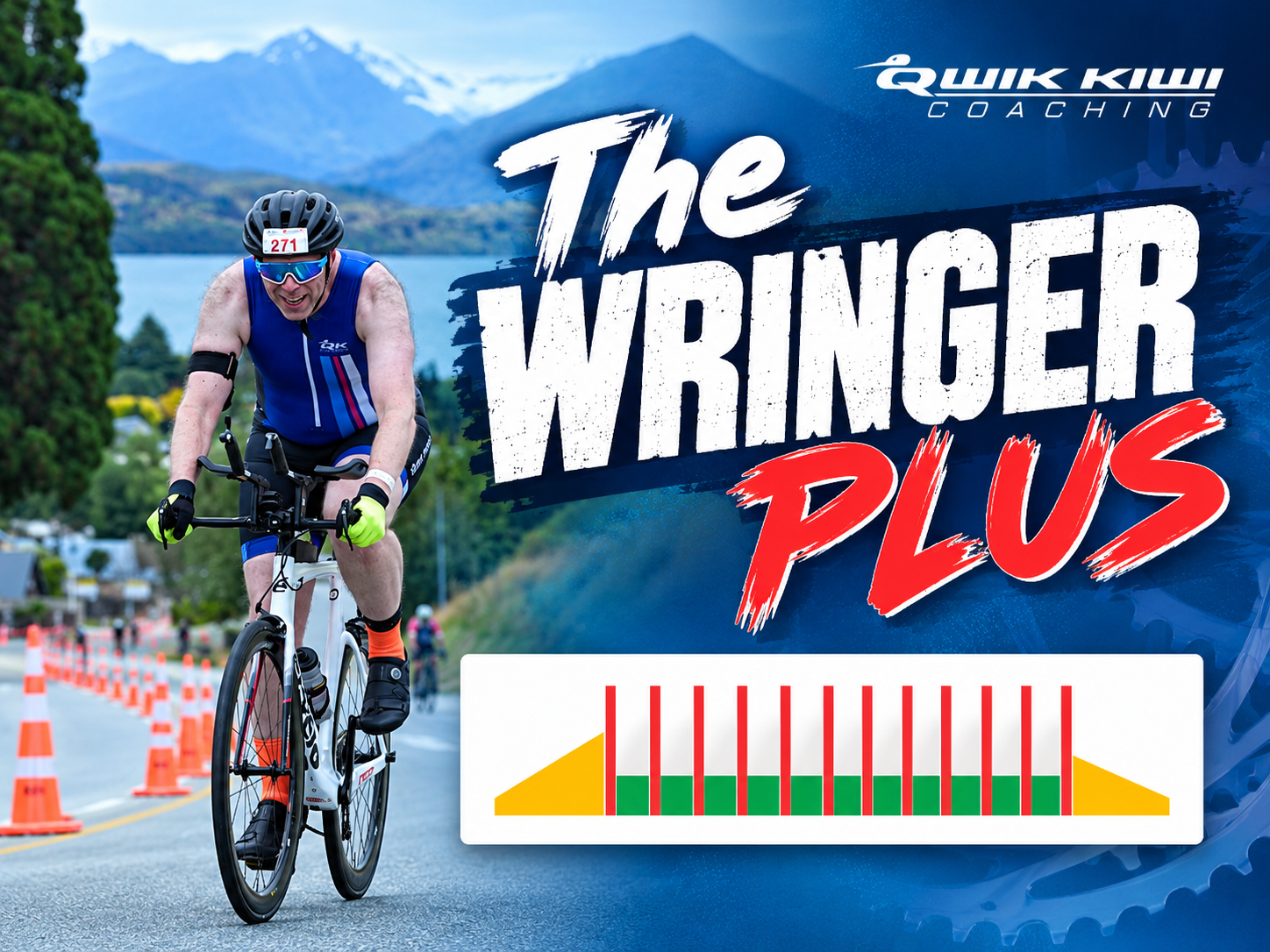
Twelve brutal 45-second efforts. Eleven progressively shorter recoveries. One seriously challenging cycling workout.
What happens when you repeatedly push well above your threshold, but your recovery time gets shorter with every interval?
That’s the challenge behind The Wringer Plus, a demanding indoor cycling workout designed to develop your ability to produce high power repeatedly while managing increasing fatigue.
Each hard effort lasts just 45 seconds, but don’t let that fool you. These are Level V++ efforts, demanding very high power and commitment.
The real challenge comes from the recovery intervals. After the first repetition, you get two minutes and 30 seconds to recover. That recovery gets five seconds shorter after every subsequent effort, leaving you with just one minute and 40 seconds before the final repetition.
By the time you reach the last few intervals, your legs will be feeling the accumulated work, and your ability to repeat those powerful efforts will be under serious pressure.
The goal isn’t simply to survive all twelve repetitions. It’s to produce consistent, high-quality efforts despite progressively less recovery.
Session Inspiration: Where The Wringer Plus Came From
The Wringer Plus is my modification of Zwift’s original workout, The Wringer.
I first became aware of the original session through an Instagram post by Mark Kenna, an Ironman triathlete who had incorporated The Wringer into his training.
In his November 2017 post, Mark described fitting the workout into a busy day and seeing improvements compared with an earlier attempt. His average power had increased from 163W to 174W, while his average heart rate had risen only slightly, from 143bpm to 145bpm.
That was an interesting example of how repeating a demanding workout can provide an opportunity to assess changes in performance.
My version, The Wringer Plus, retains the progressively shortening recovery structure and delivers twelve very demanding 45-second efforts.
It’s a session that rewards controlled execution, consistent pacing and the ability to keep producing power as fatigue builds.
Today’s Workout: The Wringer Plus
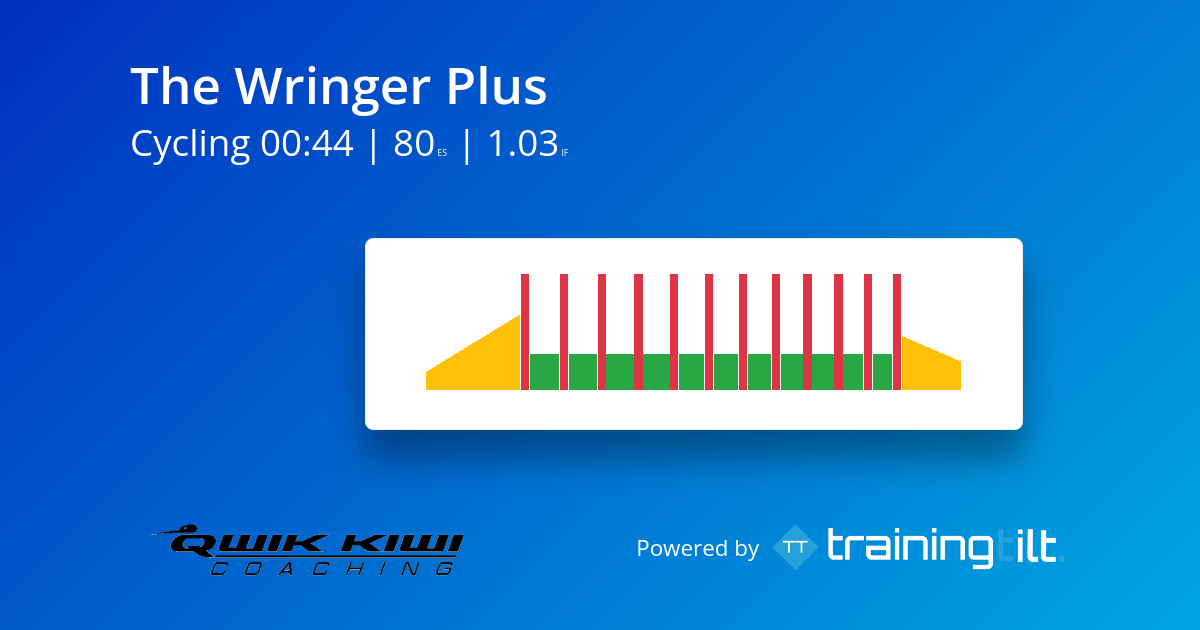
44 min 55 sec cycling
12 × 45 sec Level V++
9 min hard efforts
Warm-Up (8 minutes)
– 8 minutes gradually building from Level I through to Level IV.
The warm-up is relatively short for such a demanding workout, so make every minute count. Gradually increase the intensity, preparing your cardiovascular system and legs for the high-power efforts ahead.
If you need more time to feel properly prepared, extend the warm-up before beginning the main set.
Main Set — 12 × 45 Seconds at Level V++
| Repetition | Hard Effort | Level I Recovery |
|---|---|---|
| 1 | 45 sec Level V++ | 2:30 |
| 2 | 45 sec Level V++ | 2:25 |
| 3 | 45 sec Level V++ | 2:20 |
| 4 | 45 sec Level V++ | 2:15 |
| 5 | 45 sec Level V++ | 2:10 |
| 6 | 45 sec Level V++ | 2:05 |
| 7 | 45 sec Level V++ | 2:00 |
| 8 | 45 sec Level V++ | 1:55 |
| 9 | 45 sec Level V++ | 1:50 |
| 10 | 45 sec Level V++ | 1:45 |
| 11 | 45 sec Level V++ | 1:40 |
| 12 | 45 sec Level V++ | Straight into cool-down |
Every hard repetition is the same duration and intensity. The only thing that changes is the amount of recovery available.
That five-second reduction might seem insignificant at first, but across eleven recovery intervals, you lose 50 seconds of recovery time.
Cool-Down (5 minutes)
- 5 minutes gradually easing from Level II towards Level I.
- 10 minutes stretching.
Total cycling duration: 44 minutes 55 seconds.
Why You’re Doing This Session
The Wringer Plus is designed to challenge your ability to repeatedly produce very high power, particularly as recovery becomes progressively more restricted.
There are several important training benefits.
1. Developing High-Intensity Cycling Power
The twelve 45-second efforts demand substantial power output, challenging your ability to produce hard efforts repeatedly.
These short, intense repetitions provide a strong stimulus to your anaerobic energy systems while also placing significant demands on aerobic recovery between efforts.
2. Improving Your Ability to Repeat Hard Efforts
It’s one thing to produce a powerful 45-second interval when you’re fresh.
It’s another to repeat that effort after several demanding intervals, especially when your recovery time is getting shorter.
This is relevant to cycling and triathlon situations where you need to respond to changes in terrain, short climbs or surges in effort.
3. Learning to Manage Accumulating Fatigue
The progressively shorter recoveries make this session particularly challenging.
You don’t get to decide when you’ve recovered sufficiently. The next interval arrives according to the workout schedule.
That makes your pacing, concentration and recovery discipline increasingly important.
4. Developing Mental Resilience
The first few repetitions may feel manageable.
The middle repetitions require commitment.
The final few test your ability to stay focused and execute the workout properly when you’re uncomfortable.
The objective is to maintain quality rather than simply push harder and harder until your power collapses.
What You Should Focus On
Keep Your Power Consistent
The temptation with 45-second intervals is to attack the first few efforts at an unsustainable intensity.
Resist that temptation.
Although Level V++ is extremely demanding, you still want to produce reasonably consistent efforts throughout the session.
The twelfth repetition should be recognisably comparable with the first, rather than a desperate attempt to keep the pedals turning.
Make Every Recovery Count
Your recovery intervals are all at Level I.
Use them properly.
Don’t continue pushing moderate power simply because you feel strong early in the session. Doing so adds unnecessary fatigue and compromises the later repetitions.
As the recoveries shorten, disciplined easy riding becomes even more important.
Avoid Starting Each Interval With a Huge Sprint
You need to get up to your prescribed intensity quickly, but that doesn’t mean an uncontrolled acceleration.
A massive opening surge can leave you struggling to sustain the required power for the remainder of the 45 seconds.
Aim to establish your effort promptly and maintain it.
Focus on the Next Repetition
Twelve repetitions can seem intimidating.
Rather than worrying about the entire workout, concentrate on executing the interval immediately in front of you.
Complete the effort, recover properly, then prepare for the next one.
Common Mistakes to Avoid
Going too hard in the first three repetitions. The early intervals can feel deceptively manageable because your recovery periods are relatively generous. Save enough to complete the entire session.
Riding too hard during recovery. Level I means genuinely easy riding. The recoveries are there to help you prepare for another demanding effort.
Allowing power to collapse late in the session. Some decline may occur, but a substantial drop suggests the opening efforts were too aggressive or the prescribed intensity was beyond your current capacity.
Ignoring your technique when fatigued. Keep your upper body reasonably relaxed and your pedalling controlled, even when the efforts become uncomfortable.
Treating the final interval as an all-out sprint. The goal is to complete another quality Level V++ repetition, not produce a wildly inconsistent final effort.
Coach Ray’s Tips for The Wringer Plus
- Prepare properly. The prescribed eight-minute warm-up is short for this intensity. If you aren’t ready to produce high power, extend it.
- Establish a sustainable high-intensity target. Level V++ is demanding, but don’t confuse it with producing the highest possible five-second sprint power.
- Watch the trend across all twelve repetitions. Consistency matters more than setting a personal best in one interval.
- Recover deliberately. Let your breathing settle and your legs recover as much as possible during each Level I interval.
- Expect the final four repetitions to be tough. The decreasing recovery time is a deliberate part of the challenge.
- Prioritise quality over completion at any cost. If you can no longer produce controlled efforts at the intended intensity, it’s better to stop the main set than continue with severely deteriorating technique.
Who Is This Workout For?
The Wringer Plus is particularly suitable for experienced cyclists and triathletes who already have a solid aerobic training base and are accustomed to structured high-intensity interval training.
It may be useful for athletes looking to develop repeated high-power efforts, improve their ability to tolerate demanding interval sessions or introduce a challenging workout during an appropriate quality-training phase.
However, this isn’t a beginner session or a recovery ride.
Athletes new to structured interval training should build their fitness and experience with less demanding sessions before attempting The Wringer Plus.
Similarly, this is not a workout I’d recommend when you’re already carrying substantial fatigue from recent training.
Place it carefully within your training week and allow sufficient recovery afterwards.
Coach Ray Rode This Session
The Wringer Plus is a particularly useful workout to review afterwards because it provides twelve opportunities to compare your power output under progressively greater fatigue.
When analysing the completed session, I’ll be looking at the consistency of the 45-second efforts, how effectively power drops during the Level I recoveries, and whether there is a noticeable deterioration across the final repetitions.
A particularly interesting comparison is the average power produced during the first four repetitions versus the final four.
The objective isn’t necessarily to produce more power at the end. It’s to see how well you can maintain the prescribed intensity as the recovery intervals become shorter.

Ride The Wringer Plus on Velocity
Want to tackle The Wringer Plus without constantly watching the clock or calculating how much recovery you have left?
You can ride the complete workout with me on Qwik Kiwi Velocity.
The workout is available as a coach-led OnDemand session, taking you through all twelve high-intensity efforts and their progressively shorter recovery intervals.
With the workout structure handled for you, you can concentrate on producing quality efforts, recovering effectively and maintaining your technique as fatigue builds.
If you’re not already a Velocity member, you can explore the growing library of coach-led indoor cycling workouts, along with our twice-weekly live squad sessions.
Final Thoughts
The Wringer Plus is a demanding session that rewards discipline as much as determination.
The individual efforts are short, but twelve repetitions at Level V++, combined with progressively shorter recoveries, make this a serious high-intensity workout.
Don’t waste your energy trying to win the first interval.
Concentrate on delivering controlled, repeatable efforts, making the most of every recovery and maintaining quality right through to the final repetition.
Start controlled. Recover properly. Keep the power consistent.
If you know another cyclist or triathlete who enjoys a challenging indoor cycling session, share this workout with them.