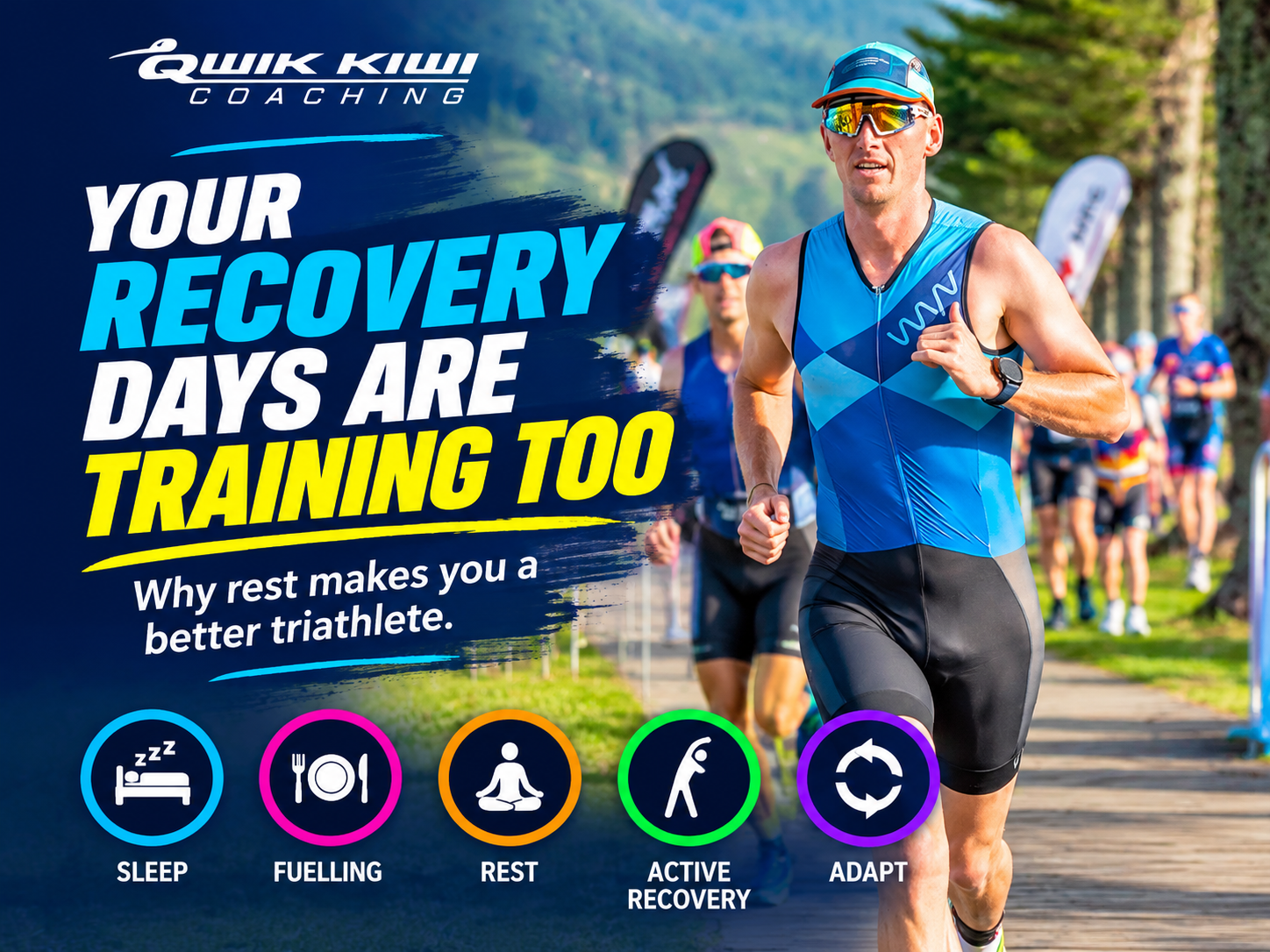
One of the most important sessions in your training programme might be the one where you slow down.
Triathletes are generally pretty good at training.
We’ll get up early to swim before work, squeeze a bike session into our lunch break, head out for a run in the evening and somehow find time for strength training, stretching and mobility work.
We like being active. We enjoy the challenge. And there’s something satisfying about ticking another completed workout off the training plan.
But there’s a problem with always wanting to do more.
Your body doesn’t get fitter simply because you keep adding training stress. It gets fitter when it has the opportunity to adapt to that stress.
And that adaptation requires recovery.
If you’re constantly tired, struggling to hit your training targets or feeling guilty whenever you take a day off, there’s a good chance you’re overlooking one of the most important parts of your training programme.
Your recovery days aren’t interruptions to your training.
They’re part of the training itself.
Training Creates the Stimulus. Recovery Allows the Adaptation.
When you complete a challenging swim, bike or run session, you’re placing stress on your body.
That stress is deliberate.
You’re asking your cardiovascular system, muscles and nervous system to cope with demands that encourage them to become more capable.
But the workout itself is only one part of the process.
Afterwards, your body needs time and resources to repair, replenish and adapt.
With appropriate recovery, that training stimulus can lead to improvements in endurance, strength, efficiency and performance.
Without sufficient recovery, fatigue can accumulate faster than your body can adapt.
That’s when training becomes less productive.
You might still be completing workouts, but you’re no longer getting the benefits you should be getting from them.
The goal isn’t to accumulate as much fatigue as possible. It’s to accumulate adaptations that make you a better athlete.
Why Triathletes Are Particularly Vulnerable to Poor Recovery
Triathlon presents an interesting challenge.
Unlike runners or cyclists who primarily focus on one discipline, triathletes are trying to develop fitness across three different sports.
And that creates plenty of opportunities to do too much.
Consider a fairly typical training week:
- Swimming sessions to develop technique, endurance and speed.
- Cycling sessions targeting aerobic fitness, threshold and race-specific power.
- Running sessions developing endurance, economy and speed.
- Brick sessions to practise running after cycling.
- Strength and conditioning to support performance and resilience.
Add work, family commitments, disrupted sleep and everything else that life throws at you, and it’s easy to see how recovery can become an afterthought.
There’s also a common trap.
Because swimming, cycling and running use the body differently, athletes sometimes assume they can keep adding sessions without significantly increasing fatigue.
But your body doesn’t experience each discipline in complete isolation.
Even if your legs aren’t sore after swimming, the session still contributes to your overall training and recovery demands.
Three sports don’t give you three separate recovery systems.
Easy Days Need to Be Easy
One of the simplest ways to improve your recovery is to stop turning easy sessions into moderately hard ones.
This is something I regularly emphasise with athletes.
If I’ve prescribed a Level I recovery session, there’s a reason for it.
It’s not an invitation to see how quickly you can complete the distance.
It’s not an opportunity to chase a Strava segment.
And it’s certainly not a session where you should feel obliged to keep up with someone who’s training harder.
The purpose is to encourage gentle movement and circulation while keeping the additional training stress low.
Likewise, a Level II endurance session should generally remain controlled and conversational rather than gradually becoming a Level III tempo effort simply because you’re feeling good.
There’s a place for harder training.
Level III tempo, Level IV threshold and Level V VO₂ max sessions can all contribute to developing your fitness when appropriately programmed.
But those sessions are most productive when you’re sufficiently recovered to execute them properly.
If every day becomes a moderately hard day, your easy sessions stop supporting recovery and your hard sessions become harder to perform well.
That’s not an effective way to train.
A Rest Day Isn’t a Lost Training Opportunity
Some athletes struggle with taking a complete day off.
They worry about losing fitness.
They feel like they’re falling behind.
Or they see someone else’s training on Strava and wonder whether they should be doing more.
But one appropriately scheduled rest day isn’t going to undo months of consistent training.
In fact, it may be exactly what allows you to train well over the following days.
There are times when complete rest is more appropriate than an easy session.
You might be carrying significant fatigue from a demanding training block.
You might have had several nights of poor sleep.
Work or family commitments might be creating additional stress.
Or your body might simply need a break from structured exercise.
That’s not a failure of discipline.
It’s an intelligent response to the demands you’re placing on yourself.
Remember, consistency isn’t about training every single day. It’s about being able to train effectively week after week, month after month.
Recovery Doesn’t Always Mean Doing Nothing
There’s an important distinction between complete rest and active recovery.
Both have a place in a well-designed triathlon training programme.
A complete rest day might involve no structured exercise at all.
An active recovery day could include a short Level I swim, an easy spin on the bike or a gentle walk.
The important consideration is the purpose of the activity.
An active recovery session should leave you feeling the same or better afterwards, not significantly more fatigued.
If you’re so tired that even an easy session feels demanding, taking the day off may be the better option.
You don’t earn extra fitness points for forcing yourself through a recovery workout.
Sleep: One of Your Most Valuable Recovery Tools
If you’re looking for ways to improve recovery, sleep is an excellent place to start.
It’s also one of the first things athletes sacrifice when life gets busy.
You might get up at 5:00 am to squeeze in a swim before work.
Then stay up late finishing jobs, watching television or catching up on emails.
Do that repeatedly and you can gradually accumulate a significant sleep deficit.
Sleep supports many of the processes involved in physical recovery, including tissue repair, hormonal regulation, immune function and cognitive performance.
For most adults, regularly achieving approximately seven to nine hours of sleep is a useful starting point, although individual needs vary and athletes undergoing demanding training may require more.
Rather than immediately looking for another recovery gadget, consider whether you could improve your sleep habits.
A consistent bedtime, a suitable sleeping environment and enough time allocated for sleep can make a meaningful difference.
You can’t continually sacrifice sleep to fit in more training and expect your body to recover optimally.
Fuelling Your Recovery
Recovery isn’t just about sitting on the couch.
What you eat and drink after training can influence how effectively you replenish energy stores and prepare for your next session.
Carbohydrates help replenish the glycogen you’ve used during training.
Protein supports muscle repair and adaptation.
Fluids and electrolytes help replace what you’ve lost through sweating.
And eating enough overall is particularly important when you’re training across three disciplines.
One mistake I see athletes make is concentrating heavily on their nutrition during long sessions while overlooking what happens afterwards.
They finish a demanding workout, get busy with the rest of their day and don’t eat enough to support their recovery.
Then they wonder why tomorrow’s session feels so difficult.
You don’t necessarily need expensive recovery products.
For many athletes, normal meals and snacks containing appropriate carbohydrates, protein and fluids will do the job.
The important thing is to fuel the training you’ve completed and prepare for the training that’s coming next.
Recovery Weeks Are Part of a Good Training Plan
A well-structured training programme shouldn’t involve increasing the workload indefinitely.
That’s where periodisation becomes important.
During a training block, the workload may progressively increase as your body develops the ability to tolerate greater demands.
But at appropriate intervals, the programme needs to provide an opportunity for fatigue to reduce.
This is one reason I incorporate recovery into the progression through Foundation & Injury Prevention (FI), Early Quality (EQ), Transition Quality (TQ) and Final Quality (FQ) phases.
The training emphasis changes as the athlete progresses towards their goal event, but recovery remains important throughout.
A recovery week might involve reducing total training volume, adjusting the frequency or intensity of sessions, or removing some of the more demanding work.
It doesn’t necessarily mean doing nothing for seven days.
And the timing shouldn’t be identical for every athlete.
An experienced triathlete with a substantial training history may tolerate a different pattern of training and recovery from someone preparing for their first Olympic-distance triathlon.
The key is recognising that progressive overload only works when your body has enough opportunity to adapt.
Research on athlete recovery supports balancing training demands with recovery and considering the athlete’s individual response, rather than treating training load as something that should always increase. PubMed PubMed
Don’t Forget About Life Stress
Here’s something that’s easy to overlook.
Your body doesn’t distinguish neatly between training stress and everything else happening in your life.
A demanding week at work, disrupted sleep, family responsibilities, travel or emotional stress can all affect how well you’re recovering.
Imagine two athletes completing exactly the same training programme.
One is sleeping well, eating consistently and has a relatively manageable workload outside training.
The other is working long hours, sleeping poorly and dealing with considerable family stress.
It would be unrealistic to expect both athletes to respond identically.
That’s why I don’t believe a training plan should be treated as something that must be followed regardless of circumstances.
Sometimes the smartest coaching decision is to reduce a session, move it to another day or replace it with rest.
Your training needs to fit the life you’re actually living, not the life your training plan assumes you’re living.
How Do You Know When You Need More Recovery?
Some fatigue is a normal part of endurance training.
You shouldn’t expect to feel completely fresh every day, particularly during a demanding training block.
However, there is a difference between manageable training fatigue and fatigue that continues to accumulate without adequate recovery.
Some signs worth paying attention to include:
- Your usual training paces or power outputs feel unusually difficult.
- You’re repeatedly struggling to complete sessions that would normally be manageable.
- Your motivation to train has dropped noticeably.
- You’re more irritable or struggling to concentrate.
- Your sleep quality has deteriorated.
- Muscle soreness persists longer than normal.
- You’re feeling unusually tired throughout the day.
- You seem to be getting sick more frequently.
None of these signs alone proves that you’re overtraining.
But a persistent combination of declining performance, fatigue and changes in wellbeing deserves attention. PubMed BMJ
If that sounds familiar, don’t automatically respond by training harder.
Review your recent workload, sleep, nutrition and other life demands.
And if fatigue is persistent, unexplained or accompanied by concerning symptoms, seek appropriate medical advice rather than assuming training is the only cause.
Stop Chasing Recovery Gadgets Before Getting the Basics Right
There’s no shortage of products promising better recovery.
Massage guns.
Compression boots.
Ice baths.
Recovery supplements.
Sleep trackers.
And an ever-growing range of technologies designed to tell you how ready you are to train.
Some of these tools may be useful in particular circumstances.
But before spending money on the latest recovery technology, I’d ask a few simpler questions.
Are you sleeping enough?
Are you eating enough to support your training?
Are you keeping your recovery sessions genuinely easy?
Are you scheduling appropriate rest?
Are you adjusting training when life becomes particularly stressful?
If those fundamentals aren’t in place, I’d address them before worrying about the latest gadget.
The basics might not be exciting, but they’re the foundation of effective recovery.
Recovery Is What Makes Consistent Training Possible
One of the biggest advantages of appropriate recovery isn’t necessarily how you feel tomorrow.
It’s what it allows you to achieve over the next several months.
Consider two athletes.
The first athlete constantly pushes to do more.
They turn recovery sessions into tempo sessions, add extra kilometres whenever they feel good and rarely take a proper rest day.
Occasionally, they complete an enormous training week.
But they’re also frequently exhausted, missing sessions, struggling with niggles or needing unplanned breaks.
The second athlete follows a more sustainable programme.
They complete their quality sessions properly.
They keep their easy sessions easy.
They take recovery seriously.
And they repeat that process consistently.
Over time, the second athlete may accumulate substantially more productive training.
Not because they trained harder every day.
But because they recovered well enough to keep training.
That’s what we’re trying to achieve.
Not the biggest possible training week. The greatest sustainable improvement over time.
Five Ways to Make Your Recovery Days More Effective
If you want to improve how you recover from triathlon training, start with these five practical habits.
1. Respect the prescribed intensity. When your programme calls for Level I recovery, keep it at Level I rather than allowing the session to become another workout.
2. Protect your sleep. Give yourself sufficient opportunity to sleep, particularly during demanding training blocks.
3. Eat and drink appropriately. Replenish energy, consume adequate protein and replace fluids after training.
4. Be flexible when life gets busy. Sometimes reducing your workload is more productive than forcing yourself through another demanding session.
5. Take complete rest when you need it. You don’t have to earn a rest day by exhausting yourself first.
These habits might seem simple.
But applying them consistently can make a considerable difference to the quality of your training.
The Session That Makes You Faster Might Be the One Where You Slow Down
As triathletes, we often measure progress by what we’ve completed.
The kilometres we’ve swum.
The hours we’ve ridden.
The pace we’ve maintained.
The intervals we’ve finished.
But sometimes the most valuable thing you can do for your next training session is to recover from the previous one.
Rest isn’t a reward for working hard.
It’s one of the things that allows hard work to produce results.
So the next time your training programme includes a recovery day, don’t look at it as a missed opportunity to improve.
Look at it as part of the process that makes improvement possible.
Stress. Recover. Adapt. Repeat.
That’s how you build sustainable endurance performance.
And remember:
Your recovery days are training too.
Want to Get More From Your Triathlon Training?
If you’re constantly feeling tired, struggling to balance swimming, cycling and running, or wondering whether you’re doing too much or too little, having a properly structured training programme can make a significant difference.
Effective triathlon coaching isn’t simply about prescribing harder workouts. It’s about balancing the right training stimulus with enough recovery to help you improve consistently.
I offer a free, no-obligation 40-minute coaching consultation where we can discuss your current training, recovery, goals and how to make your programme work better for you.
👉 Book your free 40-minute coaching consultation
Train with purpose. Recover with purpose. Race with confidence.