You get out of the swim.
You run through T1.
You jump onto your bike.
And suddenly you feel fantastic.
That’s exactly when you need to hold back.
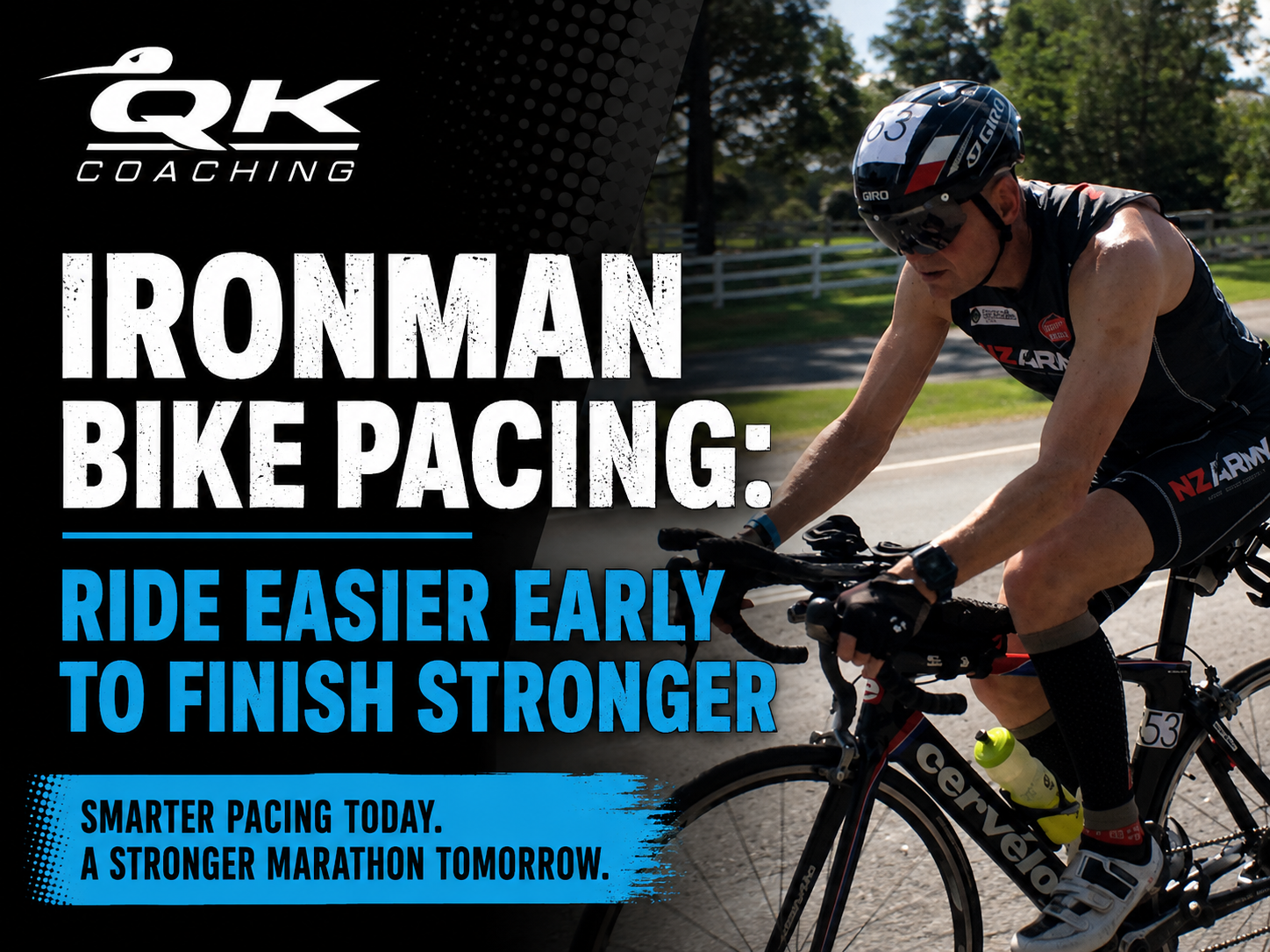
One of the simplest pieces of advice I can give an Ironman athlete is to deliberately ride easier during the opening stages of the bike.
Not because you’re lacking fitness.
Not because you’re afraid to race.
But because you’ve got 180km of cycling ahead of you—and then you’ve still got to run a marathon.
Ironman rewards patience.
The First Part of the Bike Should Feel Easy
This can be difficult to accept on race day.
You’ve tapered.
You’re rested.
You’ve got adrenaline flowing.
Your legs feel strong.
Other athletes are flying past you.
And your planned Ironman effort can feel ridiculously easy.
Good.
Let it feel easy.
The mistake is interpreting that feeling as permission to ride harder.
Your body doesn’t know that you’ve got a pacing target written down somewhere. It simply responds to the work you’re asking it to do.
Spend too much energy now and you don’t get it back later.
Remember: You’ve Just Finished a 3.8km Swim
The bike doesn’t begin with a completely fresh body.
You’ve already completed the swim.
Your heart rate may still be elevated from exiting the water and moving through transition. Your body is changing from swimming horizontally to riding your bike, and you’ve got nutrition and hydration to organise.
Give yourself time to settle.
Rather than immediately trying to hit an aggressive power number or average speed, use those opening kilometres to get yourself organised.
Find your rhythm.
Get comfortable.
Start your fuelling.
Let your breathing settle.
Then allow yourself to gradually move into your planned Ironman bike effort.
Don’t Chase the Athletes Around You
This is probably one of the hardest parts.
Someone comes flying past.
Then another athlete.
Then another.
Your competitive instincts kick in.
You know you can ride with them.
And you probably can.
But should you?
You have no idea what their race plan is.
They may be a stronger cyclist.
They may be planning to ride aggressively.
They may be making a terrible pacing decision.
None of that changes what you should be doing.
Let them go.
Ironman gives you plenty of time to see them again.
Your Bike Split Isn’t the Goal
It’s easy to become obsessed with your bike split.
But you’re not competing in a 180km cycling time trial.
You’re completing an Ironman.
Your objective isn’t:
“How quickly can I get to T2?”
It’s:
“How quickly can I get to the finish line?”
Those are very different questions.
A brilliant bike split followed by a long, slow marathon isn’t necessarily good race execution.
Sometimes riding a few minutes slower creates the opportunity to run considerably faster.
Your marathon legs are being created while you’re still on the bike.
Establish Your Fuelling Early
The opening part of the bike is also where you begin establishing your race-day fuelling rhythm.
Don’t become so obsessed with speed that nutrition becomes an afterthought.
Settle onto the bike and start following the nutrition strategy you’ve practised during training.
Know when you’re going to eat.
Know when you’re going to drink.
Know what you’re going to consume.
Then keep doing it.
A controlled opening makes it much easier to establish that routine than spending the first hour attacking hills and chasing riders.
You’re not simply fuelling the bike.
You’re fuelling the marathon that follows it.
Speed Can Lie to You
Avoid judging your early bike leg purely by speed.
Wind direction, road surface, gradient, and course conditions can all influence how quickly you’re travelling.
You can be riding at exactly the correct effort and still see a speed on your computer that disappoints you.
Don’t chase the number.
If you’re riding into a headwind, let yourself go slower.
If you’re climbing, let your speed drop.
If you’ve got a tailwind, take the free speed.
Control the effort, not the conditions.
Smooth Is Fast
A well-executed Ironman bike leg can look remarkably boring.
That’s a compliment.
No huge surges.
No attacking every climb.
No desperately chasing riders.
No repeatedly pushing hard and then recovering.
Instead:
Smooth power.
Controlled effort.
Consistent fuelling.
Good aerodynamic positioning.
Patient decision-making.
That’s how you build a bike leg that leaves you ready to run.
Use Your Training to Find the Right Effort
Race day shouldn’t be the first time you discover what appropriate Ironman bike pacing feels like.
Your long rides and race-specific brick sessions are where you learn it.
Practise starting those rides conservatively.
Settle into your target effort.
Follow your planned nutrition.
Then run afterwards.
Pay close attention to what happens when you begin the run.
If you can settle comfortably into your planned running intensity, that’s useful information.
If every race-specific brick ends with you struggling badly on the run, don’t automatically assume you need more running fitness.
You may simply be riding too hard.
The Bike Should Get Harder Because the Race Gets Harder
Your opening Ironman bike effort shouldn’t feel heroic.
It should feel sustainable.
As the hours pass, maintaining that same appropriate effort will naturally become more challenging.
That’s normal.
You don’t need to artificially create difficulty during the first hour.
Let the race come to you.
If you’ve paced intelligently, the effort that felt easy early will require concentration later.
And that’s exactly when the athletes who rode too aggressively early often begin paying for their decisions.
Arrive at T2 Wanting to Run
Think about how you want to feel when you approach T2.
You don’t want to be counting down the kilometres because your legs are destroyed and you desperately need to get off the bike.
You want to arrive thinking:
“I’m ready to run.”
Of course you’ll be tired.
You’ve just swum 3.8km and ridden 180km.
But there should still be something left.
Because the race isn’t over.
You’ve got 42.2km to go.
Final Thoughts
Riding easier early doesn’t mean riding slowly.
It means riding intelligently.
Give your body time to settle after the swim.
Control your enthusiasm.
Let other athletes go.
Establish your fuelling routine.
Ignore speed when conditions make it meaningless.
Then gradually settle into the sustainable effort you’ve practised in training.
If the opening stages of your Ironman bike leg feel easier than you expected, don’t panic.
That’s probably a sign you’re doing it right.
The time to prove how strong you are isn’t during the first hour of the bike.
It’s when you’re still moving strongly towards the finish line many hours later.
Ride easier early. Finish stronger.
Want to Get Your Ironman Pacing Right?
Knowing you’re fit enough for an Ironman is one thing.
Knowing exactly how to use that fitness across the swim, bike, and marathon is another.
If you’re preparing for an Ironman and aren’t sure how hard you should ride, how to pace the different stages of your race, or how your pacing and fuelling strategies should work together, let’s have a chat.
Book a free, no-obligation 40-minute coaching consultation and we can discuss your upcoming event, current training, and where smarter race execution could help you perform better.
Train smart. Race strong.