You’ve spent months preparing for your marathon.
You’ve completed your long runs, practised your pacing, tested your fuelling strategy and hopefully arrived at race week feeling confident about your preparation.
Then you visit the marathon expo.
There’s a fantastic pair of running shoes on special. A new singlet that looks perfect for race day. Perhaps some lightweight racing socks that promise to make you more comfortable over 42.2 kilometres.
It’s tempting.
After all, wouldn’t some new equipment help you perform at your best?
Not necessarily. In fact, introducing something new on marathon race day could turn a small problem into a very uncomfortable 42.2 kilometres.
Your marathon isn’t the time to experiment with shoes, socks, clothing or accessories you’ve never used before.
A tiny irritation at five kilometres can become a painful problem by 35 kilometres.
The rule is simple:
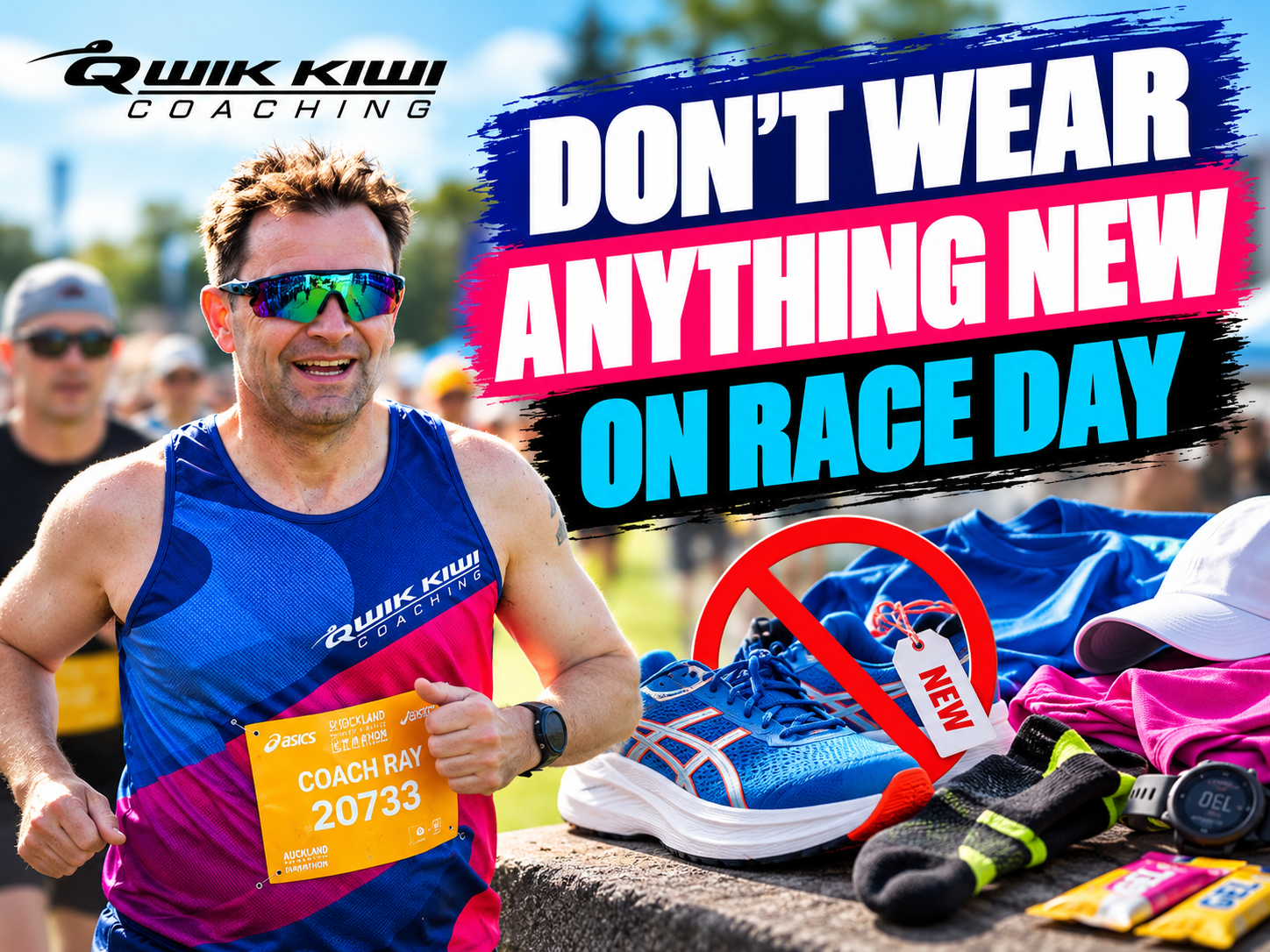
Nothing new on race day.
Race Day Is for Execution, Not Experimentation
One of the most important principles of marathon preparation is reducing unnecessary uncertainty.
You can’t control everything that happens during a marathon.
The weather might change. You might encounter unexpected hills or headwinds. Your legs might feel better or worse than anticipated.
However, there are plenty of things you can control.
What you wear is one of them.
Your running shoes, socks, shorts, singlet, sports bra, running belt and other equipment should all have been tested during training.
You want to know that everything fits comfortably, stays in place and doesn’t cause problems when you’re running for an extended period.
Race day is about putting your preparation into practice.
It’s not the time to discover whether your new shorts start chafing after 20 kilometres.
Your Running Shoes Need to Be Tested
Perhaps the most obvious piece of equipment to consider is your running shoes.
You might have trained for months in one pair, then decide to purchase a new pair shortly before your marathon.
Maybe they’re the latest carbon-plated racing shoes.
Perhaps they’re an updated version of your favourite model.
Or you’ve simply decided your current shoes are looking a little tired.
Whatever the reason, don’t wear completely untested shoes for your marathon.
Even when two pairs of shoes are supposedly the same size and model, there can be differences in how they fit and feel.
A new model might have a different heel shape, toe box, upper material or cushioning system.
Those differences might seem insignificant during a short walk around the shop.
But what happens after 30 kilometres?
You could develop blisters, pressure points, toenail problems or discomfort that you’ve never experienced in training.
Do Marathon Racing Shoes Need Hundreds of Kilometres Before Race Day?
Not necessarily.
Modern racing shoes, particularly some carbon-plated models, don’t always require the same amount of use as traditional training shoes.
However, that doesn’t mean you should take them straight out of the box on race morning.
You should have enough experience running in them to be confident about their fit, comfort and performance.
That might include a shorter easy run, a race-pace session and a longer run containing some faster running.
The important thing isn’t reaching an arbitrary number of kilometres.
It’s knowing that the shoes work for you.
And if you’ve been using a particular pair successfully throughout your training, there’s no requirement to change them simply because you’re racing a marathon.
Don’t Underestimate Your Socks
Running socks might seem like a minor detail.
After all, how much difference can a pair of socks make?
Potentially quite a lot.
Different socks have different thicknesses, seams, materials and levels of compression.
They can also change how your shoes fit.
A pair of socks that’s slightly thicker than your usual pair might increase pressure around your toes.
A different seam could create friction.
Socks that retain moisture or bunch up might increase the likelihood of blisters.
None of these problems might be noticeable during the first few kilometres.
But over the course of a marathon, repeated friction can become increasingly uncomfortable.
Choose socks you’ve already worn successfully during longer runs.
And make sure you’ve tested those socks with the shoes you intend to race in.
Your shoes and socks work together. Test them together.
Your Race-Day Clothing Matters Too
Shoes receive plenty of attention, but clothing can create just as many problems.
Your singlet might rub under your arms.
Your shorts might ride up.
A seam could irritate your skin.
A sports bra might cause chafing around the band or straps.
Your running belt could bounce or rub against your waist.
And clothing that feels comfortable during a 20-minute run might become irritating after several hours.
That’s why your long runs are such valuable opportunities to rehearse your marathon clothing.
Wear the outfit you’re planning to race in.
Notice how it behaves as you become warmer and sweatier.
Does anything move, bounce, bunch up or rub?
If you’re planning to carry gels in your shorts or running belt, test that arrangement too.
A pair of shorts might feel fantastic until you’ve loaded the pockets with six gels.
Your race-day clothing should be chosen because you’ve tested it, not simply because it looks good.
Chafing Can Turn a Good Marathon Into a Miserable Experience
Chafing is one of those problems that can start small and become increasingly unpleasant.
A little rubbing at five kilometres might barely register.
By 15 kilometres, you notice it.
At 25 kilometres, it’s uncomfortable.
By 35 kilometres, every step could be painful.
Common areas include the inner thighs, underarms, nipples, waistband, sports bra contact points and anywhere equipment rubs against the skin.
The best approach is prevention.
Use your long runs to identify potential problem areas.
Test clothing combinations and any anti-chafing products you intend to use.
If you’ve discovered that a particular seam or piece of equipment consistently causes irritation, change it during training rather than hoping it will somehow behave differently on race day.
Remember that rain, sweat and changing temperatures can also affect how clothing interacts with your skin.
An outfit that’s comfortable in cool, dry conditions might behave differently in warm or wet weather.
Don’t Forget About Your Running Belt and Accessories
Your race-day equipment isn’t limited to shoes and clothing.
Think about everything you intend to carry or wear.
That might include:
- A running belt or hydration vest
- A GPS watch and heart-rate monitor
- Sunglasses and a cap or visor
- Headphones, if permitted by the event
- Gel holders and race-number attachments
- Compression sleeves or other accessories
Every item introduces another potential source of irritation, inconvenience or distraction.
Does your running belt bounce when it’s fully loaded?
Can you remove your gels easily while running?
Do your sunglasses stay in place when you’re sweating?
Does your hydration vest rub when its bottles are full?
These might seem like small details, but your marathon is made up of thousands of steps.
The fewer equipment problems you need to think about, the more attention you can give to your pacing, fuelling and running.
The Marathon Expo Is for Shopping, Not Testing
Marathon expos can be fantastic.
There’s often a wide selection of running equipment, clothing, nutrition products and accessories.
You might discover a new brand or find something you’ve been considering purchasing for months.
There’s nothing wrong with taking advantage of a good deal.
However, just because you’ve purchased something at the expo doesn’t mean you need to wear it the following morning.
Buy the shoes.
Buy the singlet.
Buy the socks.
Then take them home and test them during your next training block.
Your marathon expo purchases can wait until after race day.
Your Race-Day Dress Rehearsal
One of the best ways to avoid equipment problems is to complete a race-day dress rehearsal during training.
Choose a suitable long run several weeks before your marathon and wear everything you’re planning to use on race day.
Ideally, choose a session that resembles your race conditions as closely as practical.
Wear your intended shoes and socks.
Use your race-day shorts and singlet.
Carry your planned nutrition in the same pockets or belt.
Wear your watch, sunglasses and other accessories.
Then pay attention to how everything performs.
Don’t just ask whether you were comfortable during the first 20 minutes.
Think about how you felt towards the end of the run.
Were there any areas of irritation?
Did anything start bouncing?
Were your shoes comfortable as your feet became warmer?
Could you access your nutrition easily?
Did your clothing remain comfortable as you became sweatier?
If something doesn’t work, you’ve still got time to make adjustments.
That’s exactly what training is for. Testing your full kit during long runs is also recommended in marathon preparation guidance from ASICS and The Running Channel. ASICS NZ The Running Channel
What If the Weather Is Different on Race Day?
Of course, your marathon conditions might not match what you’ve experienced during training.
Perhaps you’ve completed most of your preparation in cool weather, but race day is forecast to be unusually warm.
Or you’ve trained in sunshine and now the forecast suggests rain.
You may need to adjust your clothing.
The principle remains the same: choose familiar, tested options wherever possible.
If you have several running singlets, choose one you’ve previously worn comfortably in warm conditions.
If rain is forecast, consider clothing combinations you’ve used successfully during wet training runs.
You don’t need to wear exactly the same outfit in every possible condition.
You need to understand how your equipment performs and make informed decisions rather than introducing unnecessary surprises.
Nothing New on Race Day Applies to Nutrition Too
Although this article focuses on what you wear, the same principle applies to your marathon nutrition.
Don’t suddenly change your breakfast.
Don’t introduce an unfamiliar gel.
Don’t rely on a sports drink you’ve never tried.
Your race-day fuelling should have been rehearsed during training, particularly during your longer runs.
I’ve covered the importance of practising your breakfast and fuelling strategy in other Marathon Tips, but the underlying principle is identical.
Practise during training. Execute on race day.
Familiar Doesn’t Mean Worn Out
There’s one important distinction worth making.
Avoiding new equipment doesn’t mean you should race in shoes that are excessively worn or clothing that’s falling apart.
If your running shoes are approaching the end of their useful life, plan ahead.
Purchase replacements early enough to test them properly.
If your favourite running shorts are becoming uncomfortable or losing their shape, replace them during training rather than waiting until race week.
The goal is to arrive at the start line with equipment that’s both suitable and familiar.
Not necessarily old.
Not necessarily new.
Tested and trusted.
Prepare Your Race-Day Kit Before the Morning
Once you’ve decided what you’ll wear, get everything organised before race morning.
Lay out your running shoes, socks, shorts, singlet and accessories.
Attach your race number.
Make sure your watch is charged.
Check that you’ve packed your gels and other planned nutrition.
If you’re travelling to your marathon, consider preparing your essential race-day equipment in your carry-on luggage where practical.
The fewer decisions you need to make on race morning, the better.
You’ll already have plenty to think about.
Your clothing and equipment shouldn’t be another source of uncertainty.
Don’t Let a Small Equipment Problem Become a Big Marathon Problem
Marathon preparation involves months of training.
You’ve invested time and energy into developing the endurance, strength and confidence needed to cover 42.2 kilometres.
It would be frustrating to have that preparation undermined by something as avoidable as an untested pair of socks or a singlet that starts rubbing after 10 kilometres.
Not every equipment problem can be prevented.
But many can.
Your long runs are opportunities to discover what works, what doesn’t and what needs changing.
Use them.
When race day arrives, wear the equipment you’ve already trusted through training.
Nothing new on race day isn’t about being afraid to try new things. It’s about choosing the right time to experiment.
And that time is during training, not during your marathon.
Ready to Run Your Best Marathon?
Whether you’re preparing for your first marathon or chasing a new PB, having the right preparation can make all the difference.
Your marathon training should develop more than endurance. It should also prepare you for the practical demands of race day, including pacing, fuelling, equipment choices and managing fatigue.
If you’d like personalised help preparing for your next marathon, book a free, no-obligation 40-minute coaching consultation.
We’ll discuss your goals, your current training and how to develop a plan that helps you arrive at the start line confident and prepared.
👉 Book your free marathon coaching consultation
Remember: Race day isn’t a fashion experiment. Wear the gear you’ve already trusted through training.