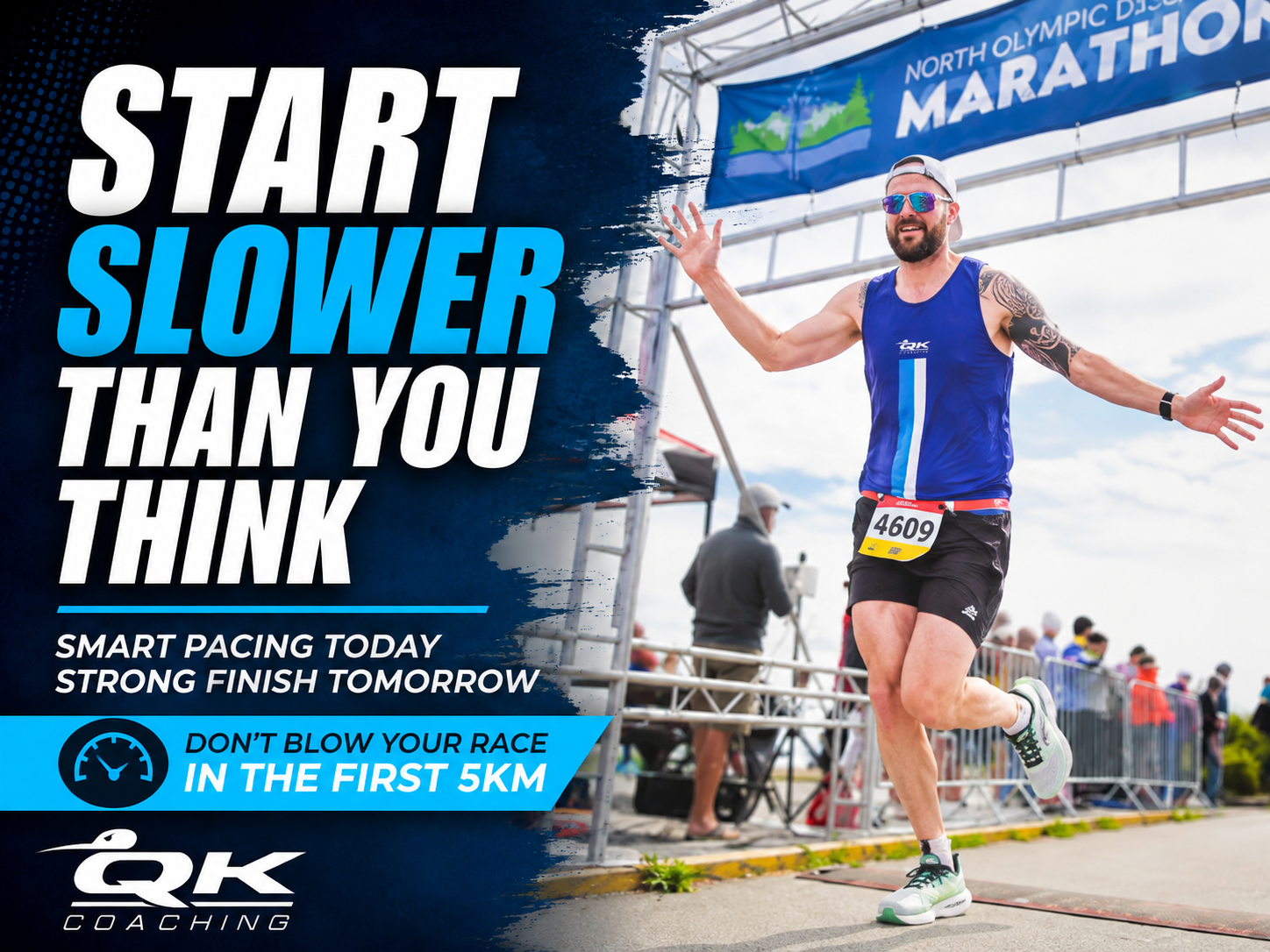
The first five kilometres of your marathon should probably feel too easy.
That’s not a mistake.
That’s good pacing.
One of the most common mistakes marathon runners make happens before they’ve even settled properly into the race. The gun goes, adrenaline takes over, everyone around them starts moving quickly, and suddenly they’re running faster than planned.
It feels fantastic.
The problem is that the marathon doesn’t care how good you felt at five kilometres.
What matters is how you feel at 35.
Why Starting Too Fast Feels So Easy
Race morning is completely different from an ordinary training day.
You’ve tapered.
Your legs are fresh.
You’ve hopefully had a good breakfast.
You’re surrounded by hundreds or thousands of excited runners.
Spectators are cheering.
Adrenaline is flowing.
After weeks of marathon training, your planned marathon pace can suddenly feel ridiculously comfortable.
That’s where discipline becomes important.
If your goal pace is 5:30 per kilometre and you find yourself comfortably ticking along at 5:15/km, it’s tempting to think:
“Maybe I’m having a great day.”
Perhaps you are.
But kilometre three is not the time to find out.
Small Mistakes Become Expensive
Running slightly too fast doesn’t necessarily feel difficult early in a marathon.
That’s what makes it dangerous.
Ten or fifteen seconds per kilometre faster than planned may seem insignificant.
Over the opening kilometres, however, you’re asking your body to work harder than necessary.
You’re using more energy.
You’re burning through carbohydrate faster.
You’re generating more muscular fatigue.
And you’re doing all of this during the easiest part of the race.
The bill often doesn’t arrive until much later.
At 10 kilometres, everything might still feel great.
At halfway, you may still be confident.
Then somewhere beyond 30 kilometres, those early pacing decisions can start catching up with you.
You Can’t Bank Marathon Time
One of the most dangerous marathon strategies is trying to “bank time.”
The idea sounds logical.
Run faster than goal pace while you’re fresh, build yourself a buffer, and then use that extra time when you slow down later.
Unfortunately, marathon physiology doesn’t work like a savings account.
Running faster early increases the physiological cost of the race.
Instead of banking time, you may simply be borrowing it—with interest.
A better strategy is to conserve your resources early so they’re available when you actually need them.
Let Other Runners Go
This can be one of the hardest things to do on race morning.
People will pass you.
Some will be running your goal time.
Some may look like runners you should be able to beat.
Let them go.
You aren’t racing them at kilometre three.
You’re racing 42.2 kilometres.
If they’re running the right pace for them, fantastic.
If they’re running too quickly, there’s a good chance you’ll see them again later.
Run your own race.
Settle Into Your Marathon
I like athletes to think of the opening kilometres as an opportunity to settle rather than race.
Find your rhythm.
Relax your shoulders.
Control your breathing.
Check your pace.
Allow the congestion around the start to clear naturally.
Don’t waste energy weaving between runners simply because the opening kilometre is slightly slower than planned.
You’ve got a long way to go.
Once you’re settled, gradually move towards your planned marathon pace.
There is no prize for being exactly on your average goal pace after the first kilometre.
Your Marathon Should Get Hard Later
A well-paced marathon shouldn’t feel particularly difficult during the opening stages.
In fact, if you’re wondering whether you’re running too slowly, you’re probably much closer to the correct effort than the runner beside you who is breathing heavily at kilometre five.
The challenge will come.
You don’t need to manufacture it early.
By the time you reach 30 kilometres, maintaining marathon pace will require significantly more concentration and effort.
That’s when you want the energy you saved earlier.
Practise Patience in Training
Good marathon pacing doesn’t begin on race morning.
Practise it during training.
Marathon-pace sessions give you an opportunity to learn what your intended effort feels like.
Long runs teach you to stay controlled when you’re feeling good.
Progressive sessions can teach you the difference between starting conservatively and finishing strongly.
The more familiar controlled pacing becomes, the easier it is to ignore the excitement around you on race day.
What About a Negative Split?
For many recreational marathon runners, aiming to run the second half slightly faster than the first can be a useful mindset.
It encourages patience early.
That doesn’t mean deliberately jogging the first half before suddenly accelerating.
The difference can be relatively small.
The principle is more important than the exact numbers:
Don’t spend energy early that you’ll desperately want back later.
If you’ve paced well, fuelled properly, and prepared appropriately, you can assess how you’re feeling later in the race.
It’s much more enjoyable to be passing runners during the final kilometres than watching them disappear ahead of you in the first five.
Patience Is a Marathon Skill
Marathon running rewards patience.
That’s one of the things that makes the event so challenging.
You need to control yourself when you feel fantastic so you can keep performing when you don’t.
Anyone can run aggressively when they’re fresh.
The smarter runner understands that the opening kilometres are about restraint.
Save the bravery for later.
Final Thoughts
When the starting gun goes, don’t race.
Settle.
Let other runners surge ahead.
Relax.
Find your rhythm.
Allow the first few kilometres to feel almost ridiculously easy.
Your marathon won’t be decided by how impressive your opening 5km looks on Strava.
It will be decided by how effectively you manage your energy across the entire 42.2 kilometres.
Start conservatively.
Be patient.
Then, when everyone else starts slowing down, you’ll have the opportunity to finish strongly.
Start slower than you think. Your final 10 kilometres may thank you for it.
Ready to Run Your Best Marathon?
Whether you’re preparing for your first marathon or chasing a new PB, getting your pacing right can be the difference between a strong final 10km and simply trying to survive it.
If you’d like help developing your marathon training, choosing an appropriate race pace, planning your nutrition, or putting together a race-day strategy that suits you, book a free, no-obligation coaching consultation.
We’ll talk about your goal, your current training, your upcoming marathon, and what you can do to arrive at the start line ready to race intelligently.
Book your free marathon coaching consultation: