If you’re serious about becoming a better triathlete, there’s something you need to understand:
You don’t get better simply by doing more training.
Swimming, cycling and running provide your body with a training stimulus.
But continually adding more sessions, more kilometres and more intensity doesn’t automatically produce more fitness.
Your body needs an opportunity to recover from the training you’ve completed.
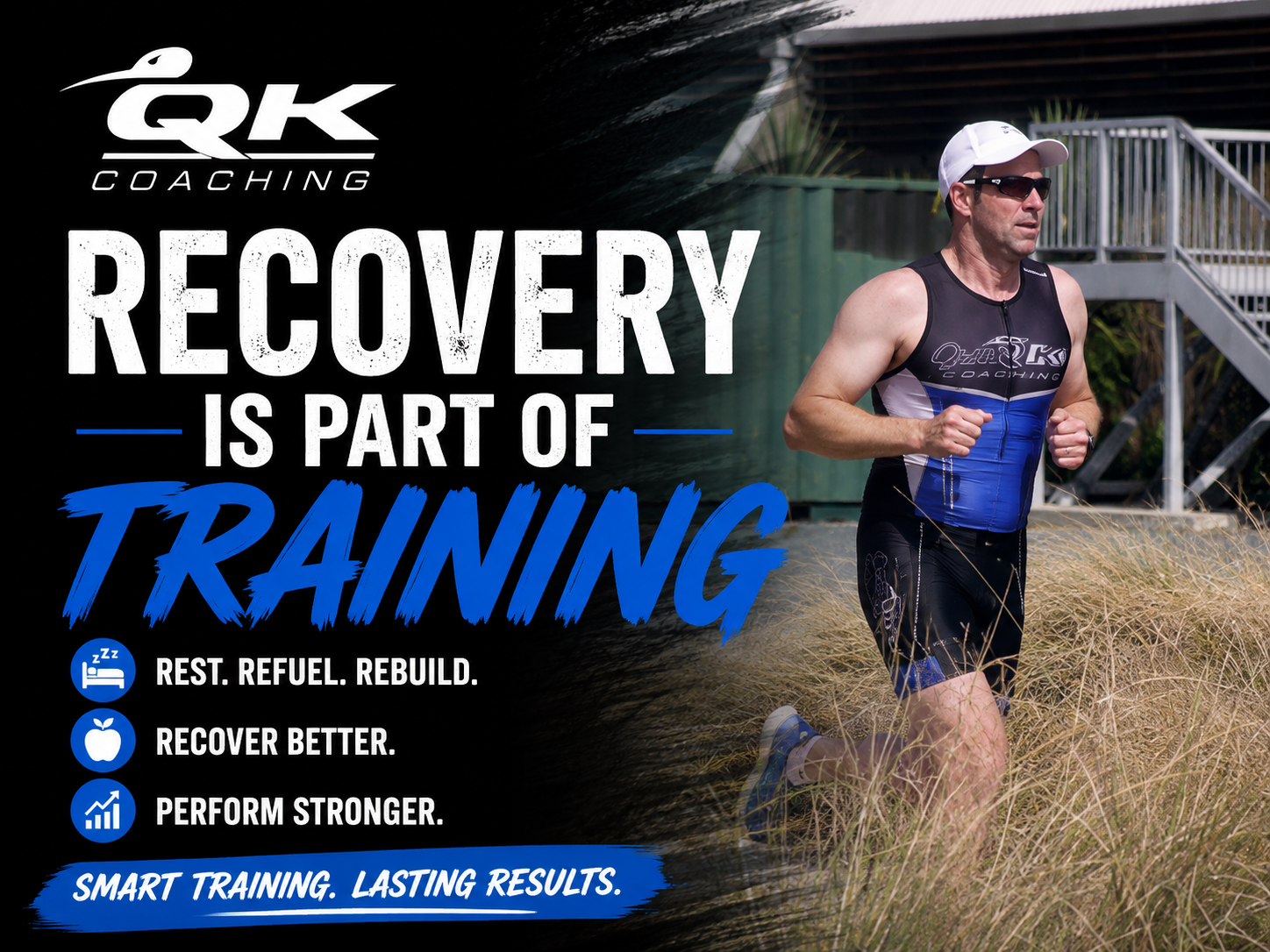
That’s why recovery isn’t time away from training.
Recovery is part of training.
Training Creates Fatigue
Every training session places stress on your body.
That’s the point.
A hard interval session challenges your cardiovascular system and muscles.
A long ride creates fatigue.
A long run places stress on your musculoskeletal system.
Even an easy session contributes something to your overall training load.
Complete the appropriate amount of training, recover from it, and your body adapts.
But if you continually add more stress without enough recovery, fatigue begins accumulating faster than your body can manage it.
Eventually, the quality of your training suffers.
Training Doesn’t Work in Isolation
It’s tempting to think that the workout itself is where all the improvement happens.
Complete a great threshold session and you’ve become fitter.
Finish your biggest long ride and you’ve become stronger.
Run further than you’ve ever run before and you’ve improved your endurance.
But training is only part of the process.
The workout provides the stimulus.
Your body then needs time and resources to respond to that stimulus.
That’s one reason appropriate sleep, nutrition, hydration, easy training and rest all matter.
You need both sides of the equation.
Training + Recovery = Adaptation
Take recovery away and you’re eventually left with plenty of training—but an athlete who’s too fatigued to benefit properly from it.
Triathletes Are Particularly Good at Doing More
Triathlon creates a unique problem.
There are three sports to train for.
If your swimming isn’t improving, you can add another swim.
If your cycling isn’t where you want it, you can ride more.
If you’re worried about your run, perhaps you can squeeze another run into the week.
Then there’s strength training.
Mobility.
Brick sessions.
Open-water practice.
Before long, you’ve filled every available space in your week.
But just because you can fit another session into your schedule doesn’t mean you should.
Sometimes the best thing you can add to your programme is nothing.
Easy Days Need to Be Easy
Recovery doesn’t always mean sitting on the couch.
Easy swimming, cycling or other appropriate low-intensity activity can sometimes fit perfectly into a recovery day.
The important word is easy.
One of the most common mistakes endurance athletes make is turning easy sessions into moderate sessions.
The programme says recovery ride.
The legs feel good.
So you push a little harder.
Someone passes you.
You chase.
A hill appears.
You attack it.
Now your recovery session isn’t really recovery anymore.
If today’s purpose is recovery, respect that purpose.
You’ll have plenty of opportunities to train hard.
Rest Days Aren’t Lost Fitness
Some athletes struggle psychologically with complete rest days.
Doing nothing feels lazy.
Your training platform shows zero kilometres.
Your friends are uploading workouts to Strava.
And you start wondering whether you’re falling behind.
You’re not.
A well-placed rest day can help you arrive at your next important session ready to train properly.
That’s much more valuable than squeezing in another mediocre workout simply because you felt guilty about doing nothing.
Rest when the programme calls for rest.
Sleep Is One of Your Best Recovery Tools
You can spend a fortune on recovery gadgets.
But don’t overlook something much simpler:
Sleep.
Good sleep supports the physical and mental processes involved in recovery.
And importantly, sleep needs to be considered when planning your training.
If you’re repeatedly sacrificing sleep so you can squeeze in early-morning workouts, you may eventually reach a point where adding more training is counterproductive.
Sometimes an extra hour in bed will contribute more to your next quality session than another hour of tired training.
Prioritise the basics before worrying about the latest recovery gadget.
You Need to Refuel Too
Recovery also requires energy.
You’ve just asked your body to swim, ride or run.
Now you need to give it the resources required to recover.
That means paying attention to your everyday nutrition as well as your training nutrition.
Carbohydrate helps replenish the fuel you’ve used.
Protein contributes to muscle repair and rebuilding.
Fluids and electrolytes help replace what you’ve lost through sweat.
Your recovery strategy doesn’t need to be complicated.
But consistently under-fuelling your training while expecting your body to recover effectively isn’t a great combination.
Training and fuelling need to support each other.
Recovery Happens Between Hard Sessions Too
Good programme design isn’t simply about inserting the occasional recovery week.
The placement of individual sessions matters.
If you complete a demanding bike workout in the morning, a hard run that evening may not always be the smartest choice.
Likewise, stacking several demanding sessions together can leave you too fatigued to execute any of them particularly well.
This is where the structure of your training week becomes important.
Hard sessions need enough recovery around them that you can complete them with the quality they deserve.
Otherwise, you risk turning a carefully designed programme into one long sequence of tired training.
Recovery Weeks Have a Purpose
Recovery also needs to occur on a larger scale.
As training builds over several weeks, fatigue accumulates.
That’s normal.
Periodically reducing training load gives your body an opportunity to absorb that work before beginning the next block.
A recovery week doesn’t mean all training necessarily stops.
Instead, volume and/or intensity may be reduced depending on the athlete and where they are within their programme.
The objective is simple:
Finish the recovery period ready to train well again.
If you reach the end of every recovery week still exhausted, something probably needs adjusting.
Learn to Listen to Your Body
A training plan is a plan.
It can’t always predict what happens in the rest of your life.
You might have slept poorly.
Work may have been particularly stressful.
You might have spent the weekend travelling.
Your children may have kept you awake.
All of those stresses contribute to the total load you’re carrying.
That’s why athletes need to develop the ability to recognise when something isn’t right.
Persistent fatigue, declining training quality, unusual irritability, poor sleep, or continually feeling flat shouldn’t automatically be treated as signs that you need to train harder.
Sometimes they’re signs that you need to recover.
Recovery Helps You Train Harder
There’s an important distinction here.
Prioritising recovery doesn’t mean avoiding hard training.
Quite the opposite.
Good recovery allows you to train hard when hard training actually matters.
If you’ve recovered properly, you can attack your quality sessions with purpose.
You can produce better power on the bike.
You can hit the appropriate pace during your running intervals.
You can maintain better technique in the pool.
Then, when the session is finished, you recover again.
That creates a useful rhythm:
Stress. Recover. Adapt. Repeat.
Not:
Stress. Stress. Stress. Break down.
Don’t Try to Win Recovery Either
Endurance athletes have an impressive ability to turn almost anything into a competition.
Recovery can become another one.
The latest massage gun.
Compression boots.
Ice baths.
Supplements.
Expensive sleep trackers.
Some recovery tools may be useful in the right circumstances.
But don’t let the extras distract you from the fundamentals.
Before worrying about sophisticated recovery strategies, ask yourself:
Am I sleeping enough?
Am I eating appropriately?
Am I hydrating?
Are my easy sessions actually easy?
Do I have appropriate rest within my programme?
Is my overall training load sustainable?
Get those things right first.
Final Thoughts
Triathlon rewards consistency.
And consistency isn’t created by seeing how much training you can survive.
It’s created by balancing enough training to stimulate improvement with enough recovery to keep doing it week after week.
Train hard when it’s time to train hard.
Keep your easy sessions easy.
Fuel your body.
Prioritise sleep.
Take your rest days.
Respect your recovery periods.
And remember:
Recovery isn’t what you do instead of training.
Recovery is part of training.
Are You Training Enough—or Recovering Enough?
If you’re constantly tired, struggling to balance swimming, cycling and running, or unsure how much recovery you should have within your training week, I’d be happy to help.
Book a free, no-obligation 40-minute coaching call and we can discuss your goals, current training, available time, and how to structure a programme that balances training stress with appropriate recovery.
You don’t need to fit in every possible workout.
You need to consistently complete the training you can recover from, adapt to, and repeat.