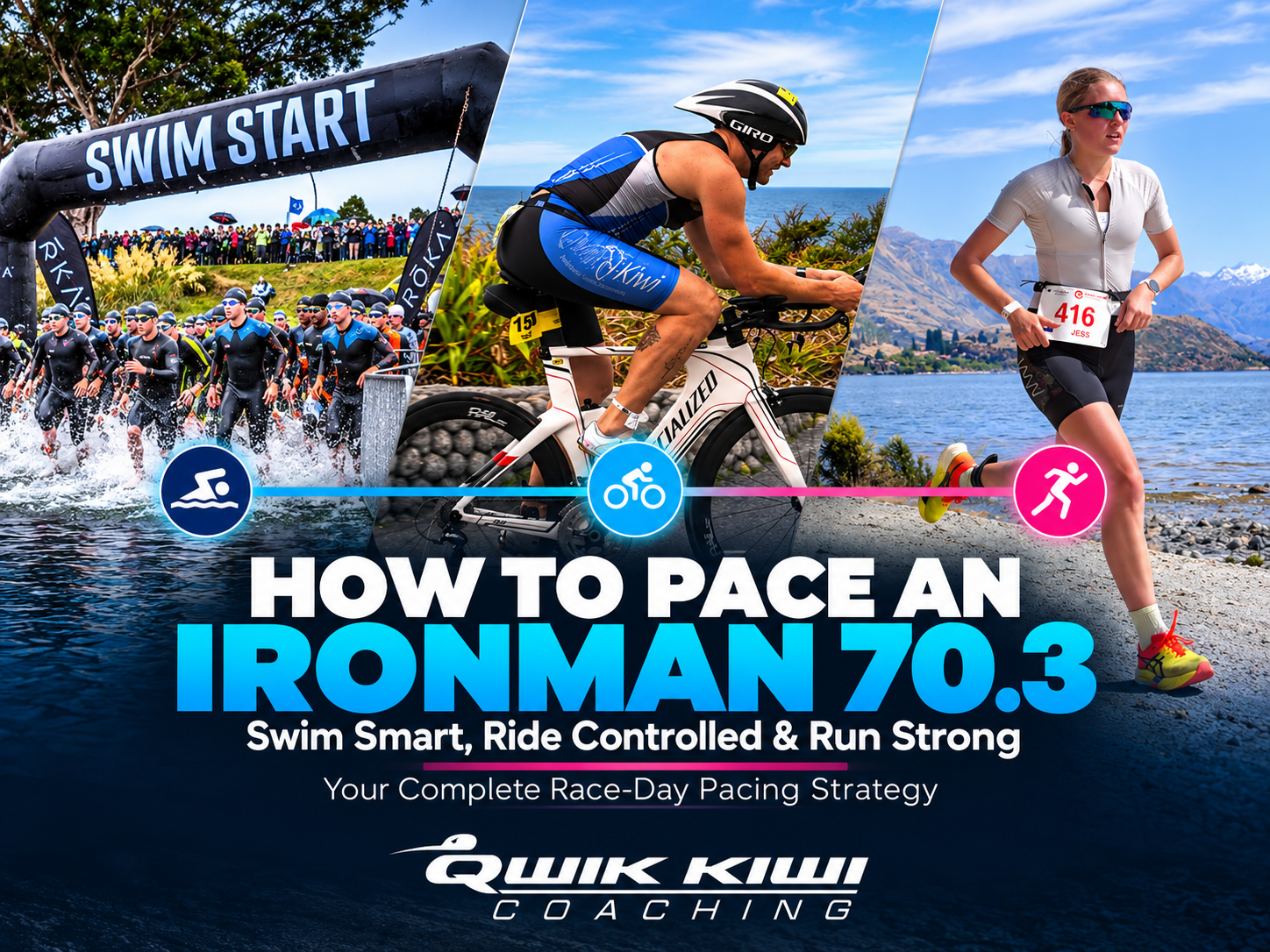
Your Complete Race-Day Pacing Strategy
You can have the best training preparation of your life, arrive at an Ironman 70.3 fitter than you’ve ever been, and still completely ruin your race by getting your pacing wrong.
Push too hard in the swim, burn too many matches on the bike, and that half marathon can quickly turn into a very long, painful walk.
But here’s the thing: your fastest Ironman 70.3 isn’t necessarily achieved by swimming, cycling or running as fast as you can. It’s achieved by managing your effort across all three disciplines to produce your best overall result.
An Ironman 70.3 consists of a 1.9 km swim, a 90 km bike ride and a 21.1 km run. Every decision you make during one discipline influences your performance in the next.
In this guide, we’ll explore how to pace each discipline, manage hills and headwinds, integrate your fuelling strategy and avoid the mistakes that can undermine months of preparation.
We’ll also answer some practical questions raised during a recent Qwik Kiwi Coaching group coaching call.
Watch: How to Pace an Ironman 70.3 — Coach Ray’s Complete Race-Day Strategy.
1. Pace the Whole Race, Not Each Discipline
One of the biggest mistakes I see athletes make is treating an Ironman 70.3 as three separate races.
They want to swim a personal best, ride their fastest-ever 90 km and somehow expect to run a fantastic half marathon afterwards.
Unfortunately, that’s not how endurance racing works.
Every decision you make during the swim influences what happens on the bike. Every decision you make on the bike influences what happens during the run.
And the consequences of getting your pacing wrong tend to become increasingly expensive as the race progresses.
A faster bike split doesn’t always mean a faster race
Consider two athletes with similar fitness but different pacing strategies.
| Discipline | Athlete A | Athlete B |
|---|---|---|
| Swim | 38 minutes | 40 minutes |
| Bike | 2:35 | 2:42 |
| Run | 2:10 | 1:50 |
| Overall time | 5:23 | 5:12 |
Times exclude transitions. This is a hypothetical illustration rather than a prediction of individual performance.
Athlete A completes the swim and bike nine minutes faster than Athlete B.
However, Athlete A struggles through the half marathon, taking 20 minutes longer to complete the run.
Despite being slower through the first two disciplines, Athlete B finishes 11 minutes faster overall.
This doesn’t mean that riding seven minutes slower will automatically improve your running performance by 20 minutes.
What it demonstrates is the importance of distributing your effort appropriately.
The goal isn’t to be conservative for the sake of being conservative. It’s to manage your effort in a way that produces the fastest overall finish.
Coach Ray’s Tip: Every time you’re tempted to push harder, ask yourself: “Will this help my overall race, or am I simply trying to produce a faster split right now?”
2. Swim Smart: Find Your Rhythm, Don’t Fight the Water
The Ironman 70.3 swim is only 1.9 km, but it sets the tone for everything that follows.
For many athletes, the opening few hundred metres are among the most stressful moments of the entire event.
There are swimmers around you, people kicking and splashing, competitors changing direction and the adrenaline of race morning.
It’s very easy to start much harder than planned.
Start controlled
An overly aggressive swim start can elevate your breathing rate, increase your perceived effort and make it difficult to establish a comfortable rhythm.
My recommendation is to start controlled.
That doesn’t mean deliberately swimming slowly. It means getting yourself into a sustainable rhythm as quickly as possible.
If you’re a less confident swimmer, consider positioning yourself towards the side or rear of your expected pace group rather than getting caught up in the busiest part of the field.
Once you’re underway, concentrate on your breathing, maintaining good technique and swimming efficiently.
Swim the shortest practical route
Sighting is another important consideration.
There’s little benefit in swimming quickly if you’re travelling an additional couple of hundred metres because you’re continually drifting off course.
Practise sighting during your open-water training so you can maintain your direction without unnecessarily disrupting your swimming technique.
Draft without overexerting yourself
Where practical, drafting behind or alongside another swimmer travelling at a suitable pace can reduce the energy cost of swimming.
However, don’t chase a faster swimmer simply to remain in their draft.
If you’re constantly working above your sustainable effort, the potential energy savings may not justify the additional intensity.
Exit the water ready to ride
You don’t want to reach T1 completely exhausted.
Ideally, you should feel that you’ve swum purposefully, maintained control and still have plenty of energy available for the remainder of the race.
Coach Ray’s Tip: The swim isn’t necessarily where you’ll produce your biggest advantage, but it’s certainly somewhere you can make the rest of your day unnecessarily difficult.
3. Ride Controlled: The 90 km That Makes or Breaks Your Run
For most athletes, the bike leg represents the largest proportion of their Ironman 70.3 race time.
It’s also where you have the greatest opportunity to control your effort.
If you’re using a power meter, you have an objective measure of the workload you’re producing.
Heart rate and perceived effort are also valuable, particularly when considered alongside power.
The important thing is establishing an intensity you can sustain for the expected duration of your ride while leaving enough capacity to run effectively.
How hard should you ride?
Athletes familiar with Functional Threshold Power (FTP) may have seen Ironman 70.3 pacing recommendations expressed as a percentage of FTP.
These can provide useful starting points, but they aren’t universal prescriptions.
An athlete completing the bike in two hours and twenty minutes may tolerate a different relative intensity from someone taking three and a half hours.
Similarly, two athletes with identical FTP values may have very different abilities to sustain prolonged efforts or run effectively afterwards.
Your appropriate bike intensity depends on several factors:
- Your current cycling fitness and endurance preparation.
- Your expected bike duration.
- Your ability to sustain prolonged efforts.
- Your experience running after cycling.
- The terrain and environmental conditions.
- Your planned nutrition and hydration strategy.
Rather than relying solely on a percentage of FTP, I recommend validating your race intensity during long rides and brick sessions.
You should have a reasonable idea of how your intended bike effort affects your ability to run.
Riding quickly versus riding aggressively
You don’t have to ride as hard as possible to produce a good bike split.
Aerodynamics, positioning, consistent power output and sensible decisions around terrain all contribute to cycling performance.
There’s a significant difference between riding quickly and riding aggressively.
If you finish the bike feeling like you’ve completed a cycling time trial, there’s a reasonable chance you’ve gone too hard.
Ideally, when you reach T2, you should feel that you’ve worked consistently but still have the ability to run.
Coach Ray’s Tip: The real test of your bike pacing isn’t just your bike split. It’s what happens after you get off the bike.
4. Master the Hills, Headwinds and Temptation to Go Too Hard
One of the most important distinctions in endurance racing is understanding the difference between speed and effort.
On a flat road with little wind, speed can be reasonably consistent.
Introduce hills, headwinds, technical sections or changing road surfaces, and speed becomes a much less useful indicator of how hard you’re working.
Don’t chase speed uphill
Imagine you’re riding at 30 km/h on the flat before encountering a long climb.
If you attempt to maintain 30 km/h up that climb, your power output could increase dramatically.
That additional effort has a physiological cost.
The same applies when riding into a headwind.
You might be travelling considerably slower than expected, but that doesn’t necessarily mean you’re performing poorly.
It simply means the conditions have changed.
Allow controlled variations in power
I don’t recommend trying to maintain precisely the same power output every second.
On rolling terrain, some variation is inevitable and appropriate.
You may allow a modest increase in power on shorter climbs, then reduce your effort on descents where additional pedalling produces little speed benefit.
The important thing is avoiding excessive surges.
Repeatedly attacking hills, recovering on descents and repeating that pattern over 90 km can create considerably more fatigue than a smoother pacing strategy.
Your average power might look reasonable, but it doesn’t necessarily reveal how aggressively you’ve ridden.
A practical example from Challenge Wānaka
During our group coaching call, one athlete asked how to manage effort on the descents of a rolling or hilly course such as Challenge Wānaka.
My recommendation was to allow the intensity to rise modestly on climbs and then back off on descents.
Using my Qwik Kiwi Coaching intensity system, the general approach discussed was:
- Level III: The predominant race effort.
- Level IV: Controlled increases in intensity on steeper climbs where necessary.
- Level II: Reduced effort on descents, allowing some recovery.
- Level V: Avoid repeated VO₂ max surges that unnecessarily increase fatigue.
For example, during a Challenge Wānaka-specific hill session on Velocity, we practised climbing efforts capped at approximately 105% FTP.
That was a training-session example rather than a universal Ironman 70.3 race-power prescription.
The principle is to allow some variation while avoiding unnecessary time at very high intensities.
On descents, recovery doesn’t always mean completely stopping pedalling. It may simply mean riding at a lower intensity.
The appropriate choice depends on your speed, terrain, safety and how much additional pedalling would contribute.
Let other athletes go
Another temptation comes from competitors passing you.
Someone overtakes you on a climb, and suddenly you find yourself increasing your effort to stay with them.
But you don’t know their fitness, their pacing strategy or whether they’re about to make a mistake themselves.
Let them go.
Race according to your own capabilities.
Coach Ray’s Tip: Don’t confuse slowing down with losing control of your race. Sometimes slowing down is exactly what good pacing requires.
5. Run Strong: Why the First 5 km Can Decide Your Half Marathon
The opening kilometres of the Ironman 70.3 run are particularly important.
After spending several hours cycling, you’re asking your legs to perform a very different movement pattern.
For some athletes, the opening kilometres feel heavy and awkward.
For others, particularly well-trained athletes, running immediately after cycling can feel surprisingly easy.
That can be dangerous.
Your perception of running pace may not be particularly reliable immediately after changing disciplines.
You might find yourself running 20–30 seconds per kilometre faster than intended without realising it.
While that might feel manageable initially, it can become expensive later.
Control the opening 5 km
My recommendation is to treat the first five kilometres as a period of controlled adjustment.
Settle into your running rhythm, monitor your breathing, check your heart rate if you use it and avoid getting carried away.
Your planned Ironman 70.3 running pace should be based on your demonstrated ability to run after cycling, not simply your standalone half marathon personal best.
For example, running a 1:30 half marathon when fresh doesn’t automatically mean that a 1:35 half marathon is realistic during an Ironman 70.3.
Your appropriate pace depends on your cycling intensity, endurance preparation, nutrition, weather conditions and course profile.
A practical run pacing strategy
I generally encourage athletes to approach the half marathon patiently.
First 5 km — Establish control
Settle into a sustainable pace and allow your body to adjust to running.
Middle 10–11 km — Maintain your rhythm
Concentrate on consistent effort, controlled breathing and maintaining your nutrition and hydration strategy.
Final 5 km — Build your effort
If you’re feeling strong, gradually increase your effort towards the finish.
Notice that I said increase your effort, not necessarily your pace.
As fatigue accumulates, maintaining the same pace may require more effort.
On hot or hilly courses, your running speed may also vary considerably.
Can you use a 7–7–7 pacing strategy?
During the Q&A, an athlete asked whether the one-third pacing strategy commonly used for half marathons could also work during an Ironman 70.3.
Absolutely.
The 7–7–7 strategy divides the half marathon into approximately three sections:
- First 7 km: Start conservatively and establish your running rhythm.
- Second 7 km: Settle into your sustainable race effort.
- Final 7.1 km: Gradually increase your effort if you’re capable of doing so.
The important difference is that your target running pace needs to reflect the fatigue accumulated during the swim and bike.
You won’t be starting the half marathon fresh.
This strategy can work particularly well on relatively flat courses, such as Tauranga, where maintaining a consistent running rhythm is more straightforward.
On more undulating courses, such as Challenge Wānaka, you may need to place greater emphasis on managing effort rather than maintaining an exact pace.
Coach Ray’s Tip: You can’t win back the energy you’ve wasted in the first five kilometres, but you can use the energy you’ve conserved during the final five.
6. Fuel Your Pacing: Energy, Hydration and Staying Ahead of Fatigue
Pacing and nutrition are closely connected.
You can execute your pacing strategy almost perfectly, but if your carbohydrate intake is inadequate, your ability to maintain that effort may deteriorate significantly as the race progresses.
Equally, you can have an excellent nutrition strategy and still struggle badly if you’ve ridden beyond your sustainable intensity.
The two need to work together.
Start the race properly fuelled
Arrive at the start line with adequate carbohydrate availability and a familiar pre-race breakfast.
Race morning isn’t the time to experiment with unfamiliar foods or completely change your normal routine.
Establish consistent carbohydrate intake
The bike provides your best opportunity to establish a consistent fuelling pattern.
You have relatively easy access to bottles and nutrition, and most athletes find it easier to consume carbohydrates while cycling than running.
For many Ironman 70.3 athletes, 60–90 grams of carbohydrate per hour can be an appropriate target, depending on individual tolerance, training and race duration.
Some athletes will need less, while others can tolerate more.
The important thing is practising the amount you intend to consume.
You don’t want to discover on race day that your stomach cannot tolerate your planned carbohydrate intake.
Hydration and sodium are individual
Sweat rates vary considerably between athletes and conditions.
A cool race in New Zealand may require a very different fluid strategy from a hot, humid race overseas.
Sodium intake should be considered alongside fluid consumption, sweat losses and the sodium already present in sports drinks and other nutrition.
More isn’t automatically better.
Why excessive intensity can undermine nutrition
Nutrition often becomes more difficult when intensity is excessive.
Riding too hard, particularly in hot conditions, can increase the likelihood of gastrointestinal problems.
That’s another reason why sensible pacing is so important.
Your long rides and brick sessions aren’t simply opportunities to build fitness.
They’re also opportunities to rehearse exactly how you’ll fuel your race.
Coach Ray’s Tip: Never rely on race-day nutrition to rescue an unsustainable pacing strategy.
7. What If You’ve Already Overcooked the Bike?
During our coaching call, an athlete described an experience at Challenge Wānaka where repeated climbs, difficult gearing and insufficient recovery on descents contributed to significant fatigue.
By the time he reached the run, it became apparent that he’d pushed too hard during the bike leg.
His question was simple: what can you do when you realise you’ve made that mistake?
First, reduce your intensity
If you’ve overcooked the bike, continuing to push aggressively on the run is unlikely to improve the situation.
Back off.
That might mean reducing your running pace considerably or temporarily adopting a walk–run approach.
The immediate objective is to return to a manageable level of effort.
Check your fuelling and hydration
If inadequate carbohydrate availability is contributing to your difficulties, consuming an appropriate amount of easily digested carbohydrate may help.
Depending on what’s available at aid stations, this might include:
- Sports drinks.
- Energy gels.
- Cola or another carbohydrate-containing drink.
However, don’t suddenly consume excessive quantities in an attempt to recover lost energy.
Taking on more carbohydrate than your gastrointestinal system can tolerate may make the situation worse.
Understand the difference between energy depletion and muscular fatigue
One important point from our discussion is that not every poor run after an aggressive bike leg is caused by glycogen depletion.
Glycogen is stored carbohydrate found primarily in the muscles and liver. It provides an important energy source during endurance exercise.
When carbohydrate availability becomes inadequate, sustaining higher exercise intensities becomes increasingly difficult.
Consuming carbohydrate can help maintain blood glucose availability, but it cannot instantly restore depleted muscle glycogen.
Similarly, carbohydrate intake cannot immediately reverse muscular fatigue or muscle damage caused by prolonged, excessive workloads.
If your legs are simply unable to produce the force required to maintain your intended pace, reducing your effort may be necessary even when you’ve consumed adequate nutrition.
Re-establish a sustainable rhythm
Once you’ve reduced your effort, assess how you’re feeling.
If your symptoms improve, gradually return to a manageable running rhythm.
However, severe dizziness, confusion, collapse, persistent vomiting or symptoms of heat illness require medical attention rather than simply attempting to continue.
The lesson is that recovery strategies have limitations.
The best approach is to avoid creating the problem through excessive bike intensity in the first place.
Coach Ray’s Tip: If your race starts going wrong, don’t compound the problem by trying to force your original pace. Adapt, manage your effort and make the best decisions you can from that point onwards.
8. The Pacing Mistakes That Cost Athletes Their Best Race
Most Ironman 70.3 pacing mistakes aren’t caused by athletes lacking knowledge.
They’re often caused by athletes failing to follow what they already know.
Mistake 1: Going too hard too early
This might involve sprinting the opening few hundred metres of the swim, pushing too hard during the first kilometres of the bike or running well ahead of your planned pace out of T2.
Often, it happens because everything feels easy.
You’re rested, you’ve tapered, your adrenaline is flowing and you’re excited.
But feeling good doesn’t automatically mean you should increase your intensity.
Mistake 2: Racing other athletes
Someone in your age group passes you.
You catch an athlete you know.
Or you find yourself riding alongside competitors who are maintaining an intensity slightly higher than you’ve planned.
It’s easy to convince yourself that you should stay with them.
But you don’t know how they’re going to perform during the run.
Your responsibility is to execute your own race.
Mistake 3: Failing to adapt
Imagine you’ve planned to ride at a particular power output, but race day is considerably hotter than the conditions you’ve trained in.
Your heart rate is higher than expected, you’re struggling with hydration and your perceived effort is increasing.
Rigidly maintaining your original power target may not be the smartest decision.
A good pacing strategy needs flexibility.
Your race plan should guide your decisions, but it shouldn’t prevent you from responding intelligently to what’s happening.
Mistake 4: Trying to recover lost time
If your swim takes three minutes longer than expected, don’t immediately try to recover those three minutes during the opening ten kilometres of the bike.
You’ve still got a long way to go.
The athletes who execute the best races are often those who remain calm, make sensible decisions and resist the temptation to react emotionally.
9. Does This Pacing Strategy Work for Other Triathlon Distances?
Another question raised during our coaching call was whether the same principles apply to sprint, Olympic-distance, T100 and full-distance Ironman events.
The answer depends on the event duration.
For longer races such as T100 and full-distance Ironman, the principles of sustainable effort, controlled pacing and consistent nutrition remain particularly important.
However, sprint and Olympic-distance triathlons generally involve higher relative intensities.
During shorter events, athletes can operate closer to their physiological limits, and the balance between pacing and nutrition changes.
For example, a well-prepared athlete completing a sprint triathlon in approximately one hour may have less need for substantial carbohydrate intake during the race than someone competing over several hours.
However, avoiding unnecessary surges and distributing effort effectively remain important at every distance.
The shorter the race, the higher the relative intensity you may be able to sustain — but pacing still matters.
10. Your Ironman 70.3 Race-Day Pacing Blueprint
Let’s bring everything together into a practical strategy.
Swim Smart
Start controlled, establish your rhythm and avoid unnecessary effort.
You don’t need to prove how fast you can swim during the first 200 metres.
Ride Controlled
Establish a sustainable workload, monitor your power or perceived effort and avoid getting carried away on hills or when other competitors pass you.
Your cycling performance should support your running performance.
Respect the Terrain
Your speed will change throughout the race.
That’s normal.
Don’t chase a particular speed when the terrain or weather makes it inappropriate.
Fuel Consistently
Follow a carbohydrate and hydration strategy you’ve practised during training.
Don’t wait until you’re already struggling before thinking about nutrition.
Run With Patience
Control the opening kilometres, settle into your rhythm and give yourself the opportunity to maintain or increase your effort towards the finish.
Finish Strong
Finishing strong doesn’t necessarily mean sprinting the final kilometre.
It means reaching the later stages of the race still capable of executing your strategy rather than simply trying to survive.
One of the most satisfying experiences in endurance racing is reaching the final kilometres and realising you’ve managed your effort well enough to continue running strongly.
That’s the outcome we’re trying to create.
Not necessarily your fastest swim split.
Not necessarily your fastest bike split.
But the best overall Ironman 70.3 performance you’re capable of producing on that particular day.
Frequently Asked Questions
What is the best way to pace an Ironman 70.3?
Aim for sustainable effort across all three disciplines rather than maximising individual splits. Swim efficiently, ride at an intensity that preserves your ability to run, and begin the half marathon conservatively before increasing your effort if conditions allow.
Should I use power or heart rate to pace the Ironman 70.3 bike?
Power provides an objective measure of cycling workload, while heart rate and perceived effort help you understand your physiological response. Using these measures together can provide a more complete picture than relying on speed alone.
Should I maintain the same power on hills?
Not necessarily. Some variation is appropriate on rolling terrain. A modest increase on climbs and reduced effort on descents can be sensible, provided you avoid repeated excessive power surges.
How fast should I run the first 5 km?
Your opening pace should be based on your demonstrated ability to run after cycling, not your standalone half marathon personal best. Begin at a controlled effort and allow yourself time to establish a sustainable rhythm.
Can I use the 7–7–7 strategy during an Ironman 70.3?
Yes. Dividing the half marathon into three approximately seven-kilometre sections can work well. Begin conservatively, maintain your rhythm through the middle section and increase your effort towards the finish if you’re capable.
How much carbohydrate should I consume during an Ironman 70.3?
For many athletes, approximately 60–90 grams per hour may be appropriate, although individual requirements and gastrointestinal tolerance vary. Practise your strategy during long training sessions rather than introducing it for the first time on race day.
What should I do if I’ve pushed too hard on the bike?
Reduce your running intensity, assess your fuelling and hydration, and establish a sustainable effort. Remember that nutrition cannot immediately reverse all forms of fatigue caused by excessive cycling intensity.
Final Thoughts: Race the Whole Event
An Ironman 70.3 rewards athletes who can balance fitness with disciplined execution.
You can be exceptionally well prepared physically, but if you spend too much energy during the opening stages, you may never get the opportunity to demonstrate your true running ability.
The goal isn’t simply to swim quickly, ride quickly or run quickly.
It’s to combine all three disciplines into the best overall performance you’re capable of producing.
Swim smart. Ride controlled. Run strong.
Want Help Developing Your Ironman 70.3 Race Strategy?
Knowing how to pace an Ironman 70.3 is one thing. Developing the right targets for your individual fitness, strengths, weaknesses and race course is another.
At Qwik Kiwi Coaching, I help triathletes develop structured training programmes and practical race-day strategies that bring together swimming, cycling, running and nutrition.
Whether you’re preparing for your first Ironman 70.3 or looking to improve your personal best, we can discuss your current preparation, pacing targets and what you need to work on before race day.
Book a FREE 40-minute coaching consultation with Coach Ray:
Let’s develop a strategy that gives you the best opportunity to perform on race day.