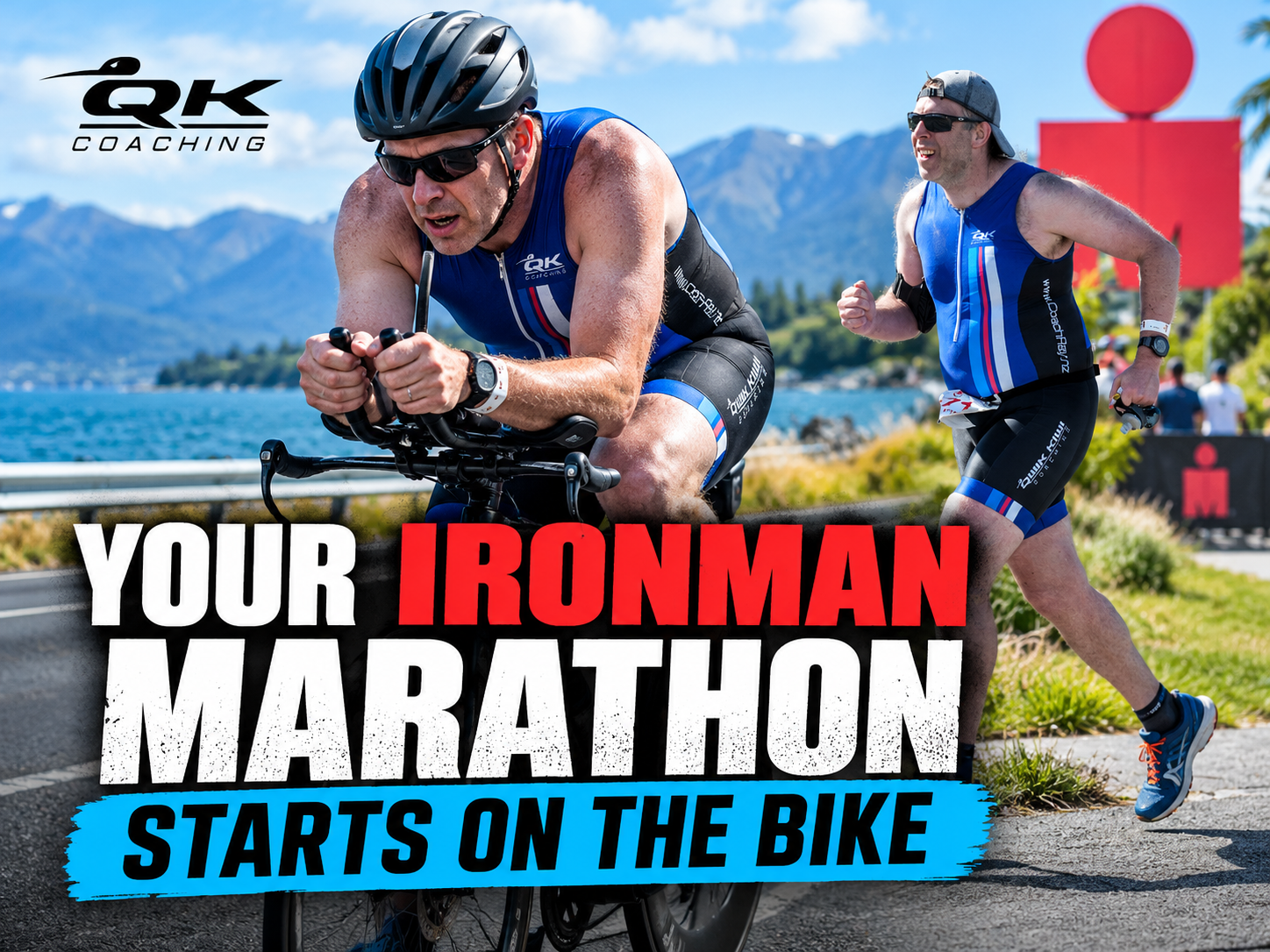
Want to run a better Ironman marathon? Stop thinking your marathon starts at T2.
By the time you put your running shoes on, you’ve already completed a 3.8km swim and a 180km bike ride.
That’s a lot of racing before you’ve even taken your first running stride.
Yet many Ironman athletes approach the bike leg as though it’s a separate race. They focus on producing the fastest possible bike split, chasing other competitors or maintaining an ambitious power target without giving enough consideration to what happens afterwards.
Then they reach T2, start running and discover that their marathon legs aren’t quite as fresh as they’d hoped.
The problem isn’t necessarily their running fitness.
It might be the decisions they made during the previous 180 kilometres.
If you want to run a strong Ironman marathon, you need to start preparing for it long before you arrive in T2.
Your Ironman marathon starts on the bike.
The Bike Leg Sets Up Your Marathon
An Ironman isn’t three independent races.
It’s one continuous endurance event involving swimming, cycling and running.
Each discipline influences what you’re capable of doing in the next.
The swim affects your bike.
The bike affects your run.
And the cumulative demands of the entire event influence your ability to maintain performance towards the finish.
This is particularly important when considering the relationship between cycling and running.
An athlete might be capable of running an excellent standalone marathon.
They might also have the cycling fitness to produce a very impressive 180km bike split.
But combining those two performances successfully requires more than simply adding them together.
The athlete needs to manage their energy expenditure, muscular fatigue, nutrition, hydration and overall physiological stress throughout the bike leg.
The fastest bike split you can produce isn’t necessarily the bike split that gives you your fastest overall Ironman finish time.
That’s a distinction every Ironman athlete needs to understand.
1. Riding Too Hard Can Destroy Your Marathon
One of the most common mistakes in Ironman racing is pushing harder than planned during the bike leg.
Sometimes it’s deliberate.
An athlete feels strong and decides to increase their power.
Other times it’s reactive.
Someone passes them, so they chase.
A hill appears, so they attack it.
A headwind develops, so they push harder to maintain their speed.
Individually, these decisions might not seem particularly significant.
But over 180km, repeated periods of excessive intensity can accumulate considerable fatigue.
By the time the athlete reaches T2, they’ve already spent energy they were counting on having available during the marathon.
And unfortunately, you can’t simply recover that energy by changing your shoes.
Your bike pacing should protect your run
The objective of Ironman bike pacing isn’t to ride slowly.
It’s to ride at the fastest sustainable effort that remains compatible with your overall race strategy.
That means considering more than your cycling fitness.
You also need to consider your running ability, training history, nutritional strategy, expected race duration and environmental conditions.
Power, heart rate and perceived effort can all help guide your pacing.
But the numbers must be appropriate for you.
An intensity that works for a highly experienced athlete may be completely unsuitable for someone completing their first Ironman.
Your Ironman bike intensity needs to be based on what you can sustain while still leaving enough capacity to run afterwards.
2. The First Hour of the Bike Matters More Than You Think
The opening stages of the bike leg can be particularly dangerous.
You’ve just finished swimming.
You’re excited to be on the bike.
Your legs feel fresh.
Athletes are passing you, and there’s a temptation to settle immediately into an ambitious pace.
But the first hour of an Ironman bike leg is not the time to prove how strong you are.
It’s the time to establish control.
Settle into your intended effort.
Allow your breathing and heart rate to stabilise.
Begin executing your nutrition and hydration plan.
Avoid unnecessary surges.
And resist the temptation to chase athletes whose race strategies may be completely different from yours.
A controlled opening hour can help establish the rhythm you’ll need for the remainder of the bike leg.
You don’t need to win the first hour of the bike. You need to arrive at T2 ready to run.
3. Stop Chasing Speed on Every Hill
Hilly Ironman courses introduce another challenge.
Many athletes naturally increase their effort whenever the road starts climbing.
They want to maintain momentum, avoid losing speed or stay with another rider.
But hills are precisely where pacing discipline becomes important.
You don’t need to maintain the same speed uphill.
You need to manage the effort required to climb.
Use your gears appropriately.
Allow your speed to decrease when necessary.
Avoid repeatedly riding well above your intended race intensity.
On descents, ride safely and efficiently rather than trying to compensate for every second lost on the climb.
The goal is to distribute your effort intelligently across the course.
That doesn’t necessarily mean holding identical power every second. Terrain, safety and riding conditions may require sensible variation.
But repeatedly attacking climbs and recovering on descents can create a very different physiological demand from a controlled, well-paced ride.
Race the hills with discipline, not ego.
4. Your Marathon Nutrition Starts on the Bike
Bike pacing is only part of the equation.
Your fuelling strategy can have an equally important influence on what happens during the marathon.
An Ironman requires a substantial amount of energy.
Although your body has stored carbohydrate available, those stores are limited.
If you fail to consume sufficient carbohydrate during the bike leg, you may begin the marathon with reduced carbohydrate availability.
That can make maintaining your planned running intensity increasingly difficult.
The bike leg is generally an important opportunity to consume carbohydrate because eating and drinking can be more manageable while cycling than while running.
However, that doesn’t mean consuming as much as possible.
Your intake needs to be appropriate for your race demands and gastrointestinal tolerance.
Practise your race-day fuelling
During long rides and selected brick sessions, practise:
- The carbohydrate intake you intend to use on race day.
- The products you’ll carry and consume.
- The timing and frequency of your intake.
- Your fluid and sodium strategy, based on individual needs and conditions.
- How your stomach responds when you transition from cycling to running.
Don’t assume a nutrition strategy that works during a two-hour ride will automatically work after five or six hours of racing.
And don’t assume you can simply make up for several hours of inadequate fuelling once you’ve started running.
Your marathon nutrition strategy needs to begin well before your marathon does.
5. Hydration Mistakes Can Follow You Into T2
Hydration is another important part of the bike-to-run relationship.
During the bike leg, athletes can experience substantial fluid losses, particularly in hot or humid conditions.
If those losses become excessive, they can contribute to cardiovascular strain, increased perceived effort and reduced performance.
But drinking too much is not the answer either.
Excessive fluid consumption can increase the risk of exercise-associated hyponatraemia, a potentially serious condition involving low blood sodium.
Your hydration strategy should be individualised and practised during training.
Consider your expected sweat losses, race conditions, drinking opportunities and gastrointestinal comfort.
And remember that hydration and fuelling are related but separate considerations.
You need an appropriate strategy for both.
A good bike split means very little if you arrive in T2 with significant hydration or nutrition problems that compromise your ability to run.
6. Your Aero Position Needs to Leave You Able to Run
Another factor athletes sometimes overlook is bike position.
An aerodynamic position can reduce drag and help improve cycling efficiency.
But the most aggressive position isn’t necessarily the most appropriate for an Ironman.
If you struggle to maintain your position comfortably for several hours, you may spend significant periods sitting upright or continually shifting around on the saddle.
You may also experience discomfort that affects your ability to produce power or run comfortably afterwards.
A sustainable bike position should balance aerodynamics, comfort, power production and your ability to transition into running.
That means your position needs to be tested over long rides—not just during a short session on the indoor trainer.
A professional bike fit can be valuable, particularly if you’re experiencing persistent discomfort.
The best Ironman bike position isn’t simply the one that looks fastest. It’s the one that works across your entire race.
7. Brick Sessions Teach You Whether Your Bike Pacing Works
One of the most useful ways to evaluate your intended Ironman bike intensity is through brick training.
A brick session combines cycling and running, allowing you to experience the transition between the two disciplines.
This is particularly valuable because a bike intensity that feels manageable while cycling may leave your legs feeling very different when you begin running.
A well-designed brick can help you assess whether your intended bike effort is realistic.
For example, you might complete a long aerobic ride incorporating sustained periods at your planned Ironman intensity, followed by a controlled run.
During the run, pay attention to how quickly you settle into your intended pace.
Monitor your breathing, heart rate and perceived effort.
Notice whether your legs begin to feel more comfortable as you establish your running rhythm.
And consider whether the nutrition you’ve consumed during the ride supports your ability to run.
What should you be looking for?
The question isn’t simply:
“Can I ride at this power?”
It’s:
“Can I ride at this power, fuel appropriately and still run effectively afterwards?”
That’s a much more useful question for Ironman preparation.
Not every brick needs to be long or demanding.
Shorter transition runs can help develop familiarity, while selected longer race-specific sessions can provide more substantial information about your pacing and nutrition.
The key is to use brick sessions purposefully rather than turning every weekend into an Ironman simulation.
8. Practise Running at the Correct Effort After Cycling
There’s another important skill to develop during brick training.
You need to learn how to control your running effort immediately after getting off the bike.
The opening kilometres of an Ironman marathon can feel surprisingly comfortable.
You’ve changed position, you’re finally running, and the excitement of reaching T2 can encourage you to run faster than planned.
But feeling good during the first kilometre doesn’t mean you should abandon your pacing strategy.
Practise starting your brick runs at an appropriately controlled effort.
Allow your breathing to settle.
Find your running rhythm.
Pay attention to how your legs respond.
And avoid immediately chasing your standalone marathon pace.
Your Ironman marathon pace is likely to be considerably slower than the pace you could sustain during a standalone marathon.
That’s normal.
The first few kilometres should establish your marathon, not compromise the final 20km.
9. Don’t Sacrifice Your Run Training to Become a Faster Cyclist
There’s an important training consideration here too.
Some athletes become so focused on improving their cycling that their running suffers.
They add more cycling intensity.
They increase their long rides.
They push harder during group rides.
Then they struggle to complete their scheduled running sessions.
Their cycling fitness may improve, but their overall Ironman preparation becomes less balanced.
Remember that Ironman performance depends on all three disciplines working together.
Your cycling programme needs to complement your running programme.
That means considering the accumulated fatigue from your weekly training.
A particularly demanding bike session immediately before an important running workout may compromise its quality.
Likewise, excessive cycling volume can leave you carrying fatigue into your long run.
This doesn’t mean avoiding challenging cycling sessions.
It means placing them appropriately within your training week.
For example, if your programme includes a key long run and a demanding bike session, consider separating them sufficiently to support recovery and session quality.
Your cycling training should make you a better Ironman athlete, not simply a better cyclist.
10. Use Your Training to Develop a Complete Race Strategy
Rather than treating bike pacing, running pace, nutrition and hydration as independent decisions, use your race-specific training to bring them together.
Your long rides can help establish sustainable cycling intensity.
Your brick sessions can help you understand how that effort affects your running.
Your nutrition rehearsals can help you determine what you can comfortably consume.
And your training across different conditions can teach you when adjustments might be necessary.
This approach is consistent with the race-specific preparation
By the time race day arrives, you should have a reasonable understanding of how the different parts of your strategy work together.
You won’t be able to predict every challenge.
But you can reduce the number of things you’re discovering for the first time during the race.
What Does a Well-Executed Ironman Bike Leg Look Like?
A successful bike leg doesn’t necessarily produce a spectacular average speed.
In fact, from the outside, it might look relatively uneventful.
You’re riding at a controlled intensity.
You’re managing hills sensibly.
You’re allowing other athletes to pass without reacting.
You’re following your planned fuelling and hydration strategy.
You’re maintaining a sustainable position.
And you’re making adjustments when the terrain, weather or your physiological responses require them.
As the kilometres accumulate, maintaining your effort will naturally become more challenging.
That’s normal.
The objective isn’t to reach T2 feeling completely fresh.
After 3.8km of swimming and 180km of cycling, you’re going to be tired.
But there’s an enormous difference between arriving at T2 carrying manageable fatigue and arriving completely exhausted because you’ve ridden beyond your capabilities.
The best Ironman bike leg is the one that helps you produce your best possible overall race—not simply your fastest cycling split.
A Practical Race-Day Checklist
Before your next Ironman, make sure you can answer these questions:
- Do I know my intended bike intensity, and have I practised it during long rides?
- Have I developed a strategy for controlling my effort on hills and during the opening stages?
- Have I tested my race-day carbohydrate and hydration strategy?
- Can I comfortably maintain my bike position for extended periods?
- Have I completed brick sessions that allow me to assess how my bike effort affects my running?
- Do I know how I want the first 5–10km of my marathon to feel?
- Have I considered how heat, wind and other conditions might influence my pacing?
- Am I prepared to adjust my strategy if the race unfolds differently from expected?
If you’re unsure about several of these questions, there’s an opportunity to improve your race preparation.
And importantly, you may be able to make those improvements without increasing your overall training volume.
Sometimes better Ironman performance comes from executing your existing fitness more effectively.
Final Thoughts: Your Marathon Starts Long Before T2
It’s tempting to think that the Ironman marathon begins when you leave transition and start running.
But the quality of your marathon is influenced by everything you’ve done beforehand.
How hard you swam.
How aggressively you rode.
Whether you controlled your effort on the hills.
How consistently you fuelled.
How well you managed hydration.
And whether you arrived at T2 with enough physical and mental capacity to keep executing your plan.
You cannot separate your Ironman marathon from the bike leg that precedes it.
So next time you’re planning a long ride or race-specific brick session, don’t just ask yourself how fast you can cycle.
Ask yourself:
“Will this bike effort leave me capable of running the marathon I want to run?”
That’s the question that matters.
Because a fast bike split might look impressive.
But a well-paced bike leg followed by a strong marathon is far more satisfying.
Your Ironman marathon doesn’t start at T2. It starts on the bike.
Ready to Run a Stronger Ironman Marathon?
If you’re preparing for an Ironman, getting your bike pacing and marathon strategy right can make an enormous difference to your race-day experience.
Whether you’re tackling your first Ironman, chasing a personal best or trying to avoid another difficult marathon after the bike, I’d love to help.
We can look at your current training, intended bike intensity, running preparation, nutrition and race-day strategy to identify where you might improve.
Book a free, no-obligation 40-minute coaching consultation and let’s discuss how to prepare you for your strongest possible Ironman.
Get Weekly Ironman Training Tips
Want practical advice on Ironman swimming, cycling, running, pacing, nutrition and race-day execution delivered directly to your inbox?
Sign up for my FREE Weekly Ironman Tips and learn how to train smarter and race stronger.
Train smart. Race strong.
Coach Ray Qwik Kiwi Coaching