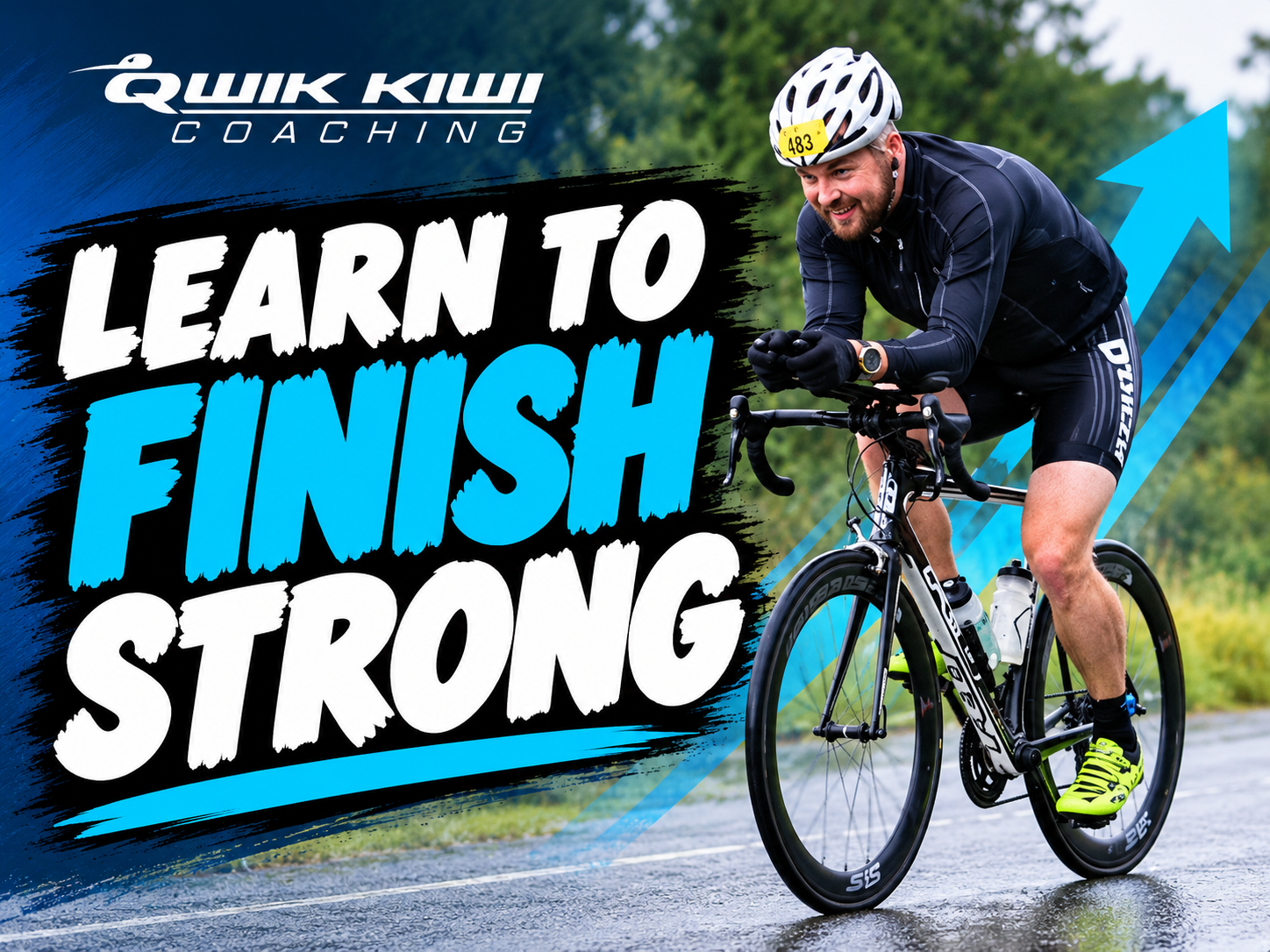
Have you ever started an indoor cycling workout feeling fantastic, only to find yourself struggling to maintain your power during the final interval?
The first effort feels comfortable.
The second is manageable.
By the third, you’re beginning to feel the fatigue.
And when the final interval arrives, your legs are heavy, your cadence is dropping, and you’re simply hoping to survive until the cool-down.
Sound familiar?
There’s an important difference between starting a workout strongly and finishing a workout strongly.
A strong start is relatively easy when you’re fresh.
The real challenge is maintaining your prescribed intensity, technique and concentration when fatigue begins to build.
And that’s a skill worth developing.
Learning to finish strong isn’t about saving everything for one spectacular final effort. It’s about pacing yourself so you can execute the entire workout properly.
What Does Finishing Strong Actually Mean?
When I encourage athletes to finish strong, I’m not necessarily asking them to produce their highest power of the session during the final minute.
Sometimes that’s appropriate.
Often it isn’t.
Imagine you’re completing a workout containing four five-minute Level IV Threshold intervals, each separated by a recovery interval.
Your target power is the same for all four repetitions.
If you produce significantly more power than prescribed during the first interval, struggle through the second and third, then fail to maintain the target during the fourth, you’ve probably paced the workout poorly.
Now consider another athlete who completes all four intervals at the prescribed intensity.
Their cadence remains controlled.
Their technique stays smooth.
And despite the accumulating fatigue, they’re still producing the required power during the final repetition.
That’s what I mean by finishing strong.
It’s not necessarily about producing more power.
It’s about maintaining the quality of your training as fatigue develops.
The Biggest Mistake: Starting Too Hard
One of the most common reasons cyclists fade towards the end of their workouts is that they begin too aggressively.
You start the first interval feeling fresh.
Your legs are responding well.
The prescribed power feels manageable.
So you add another 10 watts.
Then perhaps another 10.
After all, if you’re capable of producing more power, surely that’s better training?
Not necessarily.
The workout was designed around a particular intensity, duration and recovery structure.
When you increase the intensity unnecessarily, you’re changing the training stimulus.
You may also be increasing fatigue beyond what was intended.
That additional fatigue can compromise your ability to complete the later intervals.
The goal isn’t to see how much power you can produce during the first interval. It’s to execute every interval as prescribed.
This is also why I encourage athletes to stop judging their workouts by average power alone. Chasing higher average watts can lead to unnecessarily hard opening intervals and compromised recovery periods.
As I explain in my article, Stop Chasing Average Power: Focus on What Your Cycling Workout Is Actually Trying to Achieve, successful training is about executing the prescribed session, not making the final numbers look impressive.
Your First Interval Sets Up Your Last
Think of an interval session as a complete workout rather than a collection of unrelated efforts.
What you do during the opening repetitions influences what you’re capable of doing later.
If you repeatedly exceed your prescribed intensity early in the session, you may create fatigue that makes the remaining work considerably more difficult.
This is particularly important during workouts involving Level III Tempo, Level IV Threshold and Level V VO₂ Max efforts.
The intensity and recovery structure have been selected for a reason.
If the prescription calls for four repetitions at the same power, the objective is generally to maintain that power across the complete set.
Not to start well above the target and gradually fade.
A well-executed workout should look controlled from beginning to end, even when it becomes increasingly difficult.
Finish Strong Doesn’t Mean Finish Faster
This distinction is worth reinforcing.
There are workouts where I deliberately prescribe a progression.
For example, the intensity may gradually increase throughout the session.
In that situation, finishing at a higher power is part of the workout design.
But if you’re completing a steady Level II Endurance ride, there’s no requirement to turn the final ten minutes into a Level IV Threshold effort simply because you’re feeling good.
Likewise, if you’re completing a set of equal-power Threshold intervals, there’s no need to sprint through the final thirty seconds unless that’s specifically prescribed.
Finishing strong means finishing according to the purpose of the workout.
Sometimes that means increasing power.
Sometimes it means maintaining power.
And sometimes it means resisting the temptation to increase power.
Good training requires knowing the difference.
Learn to Manage Fatigue, Not Just Produce Power
Cycling performance isn’t determined solely by the highest power you can produce when you’re fresh.
Your ability to sustain appropriate power as fatigue accumulates is also important.
Consider two cyclists with similar Functional Threshold Power (FTP).
Both might be capable of producing 250 watts during a fresh Threshold effort.
But after several hours of riding, one athlete may still be able to produce a substantial proportion of that power, while the other experiences a much larger decline.
Their FTP values may be similar, but their ability to maintain performance after prolonged exercise differs.
This characteristic is often discussed in endurance sport as durability.
Durability describes how well an athlete maintains physiological and performance characteristics as exercise duration and accumulated work increase.
It’s particularly relevant for road cyclists, triathletes and endurance athletes competing over longer distances.
And it’s one reason I want athletes to become comfortable producing quality work when they’re no longer completely fresh.
The Science of Finishing Strong: Cycling Durability
Research increasingly recognises durability as an important component of endurance cycling performance.
A 2025 study involving 14 trained amateur cyclists compared their power output when fresh with their power output after completing 1,000 kJ of cycling work.
The more successful cyclists experienced an average reduction of just 6.5% in their 20-minute power output.
The less successful cyclists experienced a considerably larger reduction of 12.5%.
Although this was a relatively small observational study, it highlights an important distinction: athletes with similar fresh capabilities can respond quite differently after accumulating fatigue. PMC
A separate systematic review examining 21 studies found that the intensity of previous cycling work significantly influenced subsequent performance deterioration.
Higher-intensity exercise generally produced larger reductions in power output with less accumulated work than lower-intensity exercise. Springer Nature
These findings help explain why pacing, endurance development and fatigue management are important.
They also reinforce something I regularly discuss with my athletes.
It’s not just about how much power you can produce when you’re fresh. It’s about how much of that performance you can maintain when you’re tired.
Importantly, durability is usually assessed after substantial accumulated work. Completing the final repetition of a short interval session is not itself a validated measure of durability, but learning to execute later efforts well is a useful coaching objective.
Your Cadence Can Reveal When You’re Fading
Power isn’t the only thing I look at when assessing how an athlete finishes a workout.
Cadence can provide useful information too.
Imagine you’re completing four eight-minute Level IV Threshold intervals.
During the first interval, you’re comfortably maintaining 95rpm.
During the second, you’re riding at 92rpm.
By the third, you’re down to 85rpm.
And during the final interval, you’re grinding away at 70rpm, struggling to keep the pedals turning.
The prescribed power may still be achievable, but the way you’re producing it has changed considerably.
Sometimes a lower cadence is appropriate.
But if the workout was designed around maintaining a relatively consistent cadence, that progressive decline is worth examining.
It might indicate that you’ve started too hard.
Your selected gear may be inappropriate.
You may be accumulating fatigue beyond what you’re currently capable of managing.
Or your cadence technique may need development.
Finishing strong means maintaining control of your pedalling, not simply forcing the pedals around until the timer reaches zero.
Your Upper-Body Technique Matters Too
As fatigue builds, cyclists sometimes begin using more upper-body movement to help maintain their power.
Their shoulders start rocking.
Their grip tightens.
Their elbows become rigid.
They may begin pulling unnecessarily on the handlebars.
Some additional movement is normal during demanding efforts, particularly maximal sprinting.
But during steady seated cycling, I generally want athletes to maintain a relatively stable, relaxed upper body.
When the final interval arrives, ask yourself:
Are my shoulders still relaxed?
Am I maintaining a comfortable grip?
Are my hips stable?
Can I still pedal smoothly?
Good technique isn’t something you practise only during the warm-up.
It’s something you should aim to maintain throughout the workout, particularly when fatigue makes it more challenging.
Maintaining good technique as fatigue develops is an important cycling skill. It’s not simply about holding your target watts, but also about maintaining smooth pedalling, appropriate cadence and upper-body control.
I’ve explored this further in Ride Smooth, Not Just Hard: Why Better Pedalling Makes You a Better Cyclist, including practical ways to develop better technique during indoor cycling workouts.
Recovery Intervals Help You Finish Strong
Here’s something that many motivated cyclists overlook.
The recovery periods between intervals are part of the workout prescription.
They’re not wasted time.
Suppose you’re completing five three-minute Level V VO₂ Max intervals with three minutes of Level I recovery between repetitions.
The purpose of those recovery intervals is to allow sufficient recovery to complete the subsequent efforts at the intended intensity.
But some cyclists make the recovery intervals unnecessarily hard.
They feel guilty about reducing their power.
They want to keep their average watts high.
Or they simply find easy riding boring.
The problem is that harder recovery can compromise the quality of the next important effort.
If you’re supposed to recover at Level I, ride at Level I.
Don’t sacrifice the quality of your final intervals because you were trying to make your recovery intervals look impressive.
Fuelling Can Determine How Well You Finish
Not every late-workout fade is caused by poor pacing.
Sometimes the problem is inadequate fuelling.
This is particularly relevant during longer indoor cycling sessions.
Because indoor cycling can involve continuous pedalling without the natural breaks that often occur outdoors, athletes may accumulate substantial work.
If you’re underfuelled, maintaining your prescribed intensity can become increasingly difficult.
Your power may decline.
Your perceived exertion may rise.
And the final part of your workout can become much harder than intended.
For longer or demanding sessions, plan your carbohydrate intake appropriately.
Don’t wait until you’re struggling before considering whether you need fuel.
The exact amount depends on the duration, intensity, individual tolerance and purpose of the session.
For many sessions lasting approximately 60–150 minutes, carbohydrate intake of around 30–60g per hour may be appropriate, while longer demanding sessions can warrant greater amounts if the athlete has trained their gut to tolerate them.
Short, easy rides may not require carbohydrate intake during the session.
Match your fuelling to the demands of your workout.
And remember that fuelling is only one part of the equation.
Hydration, cooling, sleep and accumulated training fatigue can all influence how well you perform towards the end of a session.
How to Practise Finishing Strong on Your Indoor Trainer
Your indoor trainer provides an excellent environment for developing consistent pacing and execution.
You can control the workout structure.
You can monitor your power.
You can practise maintaining cadence.
And you can review whether your performance changes as fatigue builds.
Here are three practical approaches I use when coaching cyclists.
1. Consistent Threshold Intervals
The objective is to complete every repetition at the prescribed intensity.
Example Workout: 4x 5min Level IV Threshold
Total duration: 45 minutes
| Warm-up | 10min Level II |
| Main set | 4x 5min Level IV, 2min Level I recovery after the first three repetitions |
| Cool-down | 9min Level II |
The goal isn’t to increase power during each repetition.
It’s to maintain the prescribed Level IV intensity across all four intervals.
Concentrate on consistent power, smooth cadence and controlled technique.
The final repetition should be challenging, but still achievable.
2. Progressive Tempo Riding
This workout develops the ability to maintain controlled riding as intensity gradually increases.
Example Workout: Progressive Tempo
Total duration: 50 minutes
| Warm-up | 10min Level II |
| Progression | 10min lower Level III, 10min middle Level III, 10min upper Level III |
| Cool-down | 10min Level II |
The objective is to increase power progressively while remaining within Level III.
Avoid beginning at the upper end of the zone.
Give yourself room to progress.
Finish at the strongest prescribed intensity, not at the strongest intensity you can possibly produce.
3. Endurance With a Strong Final Section
This session develops controlled endurance riding and encourages athletes to maintain their prescribed intensity towards the end of a longer workout.
Example Workout: 90-Minute Endurance Ride
Total duration: 1 hour 30 minutes
| Warm-up | 10min Level II |
| Endurance | 60min Level II at a comfortable, sustainable intensity |
| Strong finish | 10min upper Level II, maintaining smooth cadence and control |
| Cool-down | 10min Level I–II |
Notice that the final section remains at Level II.
There’s no requirement to turn the workout into a Threshold session.
The goal is to maintain controlled endurance power despite the accumulated duration.
For athletes who are not yet comfortable with 90-minute rides, this workout should be shortened to suit their current training capacity.
How to Know Whether You’re Improving
One of the advantages of structured indoor cycling is that you can compare your execution over time.
Rather than simply looking at average power, examine the individual intervals.
Consider the following questions:
- Did I maintain the prescribed power throughout the workout?
- Did my final interval match the intended intensity?
- Was my cadence reasonably consistent?
- Did my technique deteriorate noticeably?
- Did I complete the recovery intervals at the prescribed intensity?
- Was the final repetition appropriately challenging without becoming an uncontrolled struggle?
You can also compare how the same workout feels across different training blocks.
Perhaps four five-minute Threshold intervals previously felt extremely difficult.
Several weeks later, you’re completing the same workout with better cadence control and a lower perceived exertion.
That can be a useful indication of improved training tolerance.
However, avoid interpreting every poor final interval as evidence that your fitness has declined.
Sleep, fuelling, environmental conditions, accumulated fatigue and normal day-to-day variation all influence performance.
Look for trends rather than judging yourself on one session.
Finishing Strong Requires Appropriate Recovery
There’s another side to developing the ability to finish strong.
You can’t continually train hard and expect every session to improve.
Adaptation requires an appropriate balance between training stress and recovery.
If you’re consistently arriving at workouts fatigued, your ability to maintain power during the final intervals may suffer.
Sometimes that’s because your training load is too high.
Sometimes your recovery between sessions is insufficient.
And sometimes the issue is that you’re turning too many easy rides into additional hard workouts.
Your Level II Endurance and recovery sessions have a purpose.
So do your complete rest days.
Don’t compromise tomorrow’s important workout by making today’s easy ride unnecessarily hard.
Finishing strong is partly about what happens during the workout.
But it’s also influenced by how well you’ve prepared for it.
One of the most common mistakes motivated cyclists make is turning recovery sessions into additional hard workouts. But accumulating unnecessary fatigue can compromise your ability to execute the important sessions later in the week.
In Recovery Days Are Training Too: Why Easy Days Help You Become a Better Cyclist, I explain why easier riding, and sometimes complete rest, is an essential part of developing long-term cycling performance.
When Finishing Strong Isn’t the Goal
Not every workout is designed to finish with your best performance.
Some sessions deliberately prescribe decreasing intensity.
Others involve maximal efforts where a degree of performance decline is expected.
And during very demanding Level V VO₂ Max workouts, the final repetitions may be extremely challenging even when you’ve paced the session appropriately.
The objective is always to execute the intended training stimulus.
If a workout prescribes descending power, follow the prescription.
If it prescribes maximal efforts, the execution will differ from steady Threshold intervals.
And if illness, pain, dizziness or unusual symptoms develop, don’t push through simply because you want to finish strong.
The training prescription determines what a successful finish looks like.
Frequently Asked Questions
Should my final cycling interval always be my hardest?
No. If the workout prescribes equal-power intervals, the goal is generally to maintain the same intensity across the set. A harder final interval is appropriate when the workout specifically calls for it.
Why does my power drop during the final interval?
Possible reasons include starting too aggressively, insufficient recovery between efforts, inadequate fuelling, accumulated fatigue, inappropriate workout intensity or environmental factors such as poor cooling.
Can indoor cycling improve my ability to finish races strongly?
Structured indoor cycling can help develop pacing, aerobic fitness, fatigue tolerance and the ability to execute efforts consistently. However, race-specific durability also requires appropriate endurance training and preparation for the demands of your event.
Should I increase my power if the final interval feels easy?
Not automatically. Consider the purpose of the workout. If the prescribed intensity is correct, completing the session comfortably may be exactly what was intended.
Is finishing strong the same as negative splitting?
Not necessarily. Negative splitting means completing the second portion of an effort faster or at a higher output than the first. Finishing strong can simply mean maintaining the prescribed performance without fading.
Learn to Finish Strong
The next time you start an indoor cycling workout, resist the temptation to prove how strong you are during the opening interval.
Settle into the prescribed intensity.
Find your cadence.
Control your breathing.
Maintain your technique.
Use your recovery intervals properly.
And concentrate on executing the entire workout rather than chasing impressive numbers during the first few minutes.
As fatigue develops, stay focused.
Don’t allow your cadence to collapse unnecessarily.
Don’t let your technique deteriorate without noticing.
And don’t abandon the prescribed power simply because the effort has become uncomfortable.
The first interval shows what you can do when you’re fresh. The final interval shows how well you’ve managed the workout.
You don’t need to finish every session faster.
You don’t need to sprint through the final thirty seconds.
And you certainly don’t need to turn every workout into a race.
You simply need to learn how to maintain quality as fatigue develops.
Start controlled. Ride with purpose. Finish strong.
Learn to Finish Strong With Qwik Kiwi Velocity
If you’d like to develop better pacing, stronger endurance and the ability to maintain quality throughout your indoor cycling workouts, come and join us on Qwik Kiwi Velocity.
Velocity provides hundreds of coach-led video cycling workouts covering:
- Level II Endurance and Recovery
- Level III Tempo
- Level IV Threshold
- Level V VO₂ Max
- Cadence and technique
- Cycling-specific strength and controlled pacing
You’ll also find structured interval sessions that challenge you to maintain prescribed power and technique as fatigue builds.
And you can join our squad-based live indoor cycling sessions twice each week at 6:00 a.m. New Zealand time.
Tuesday: 45 minutes or less.
Thursday: Approximately one hour, sometimes a little more or less depending on the workout.
During our live sessions, I’ll coach you through the efforts, helping you concentrate on pacing, power, cadence and executing the workout correctly.
Can’t make the live sessions? The complete workout library is available on demand.
Train smarter. Build endurance. Finish stronger.