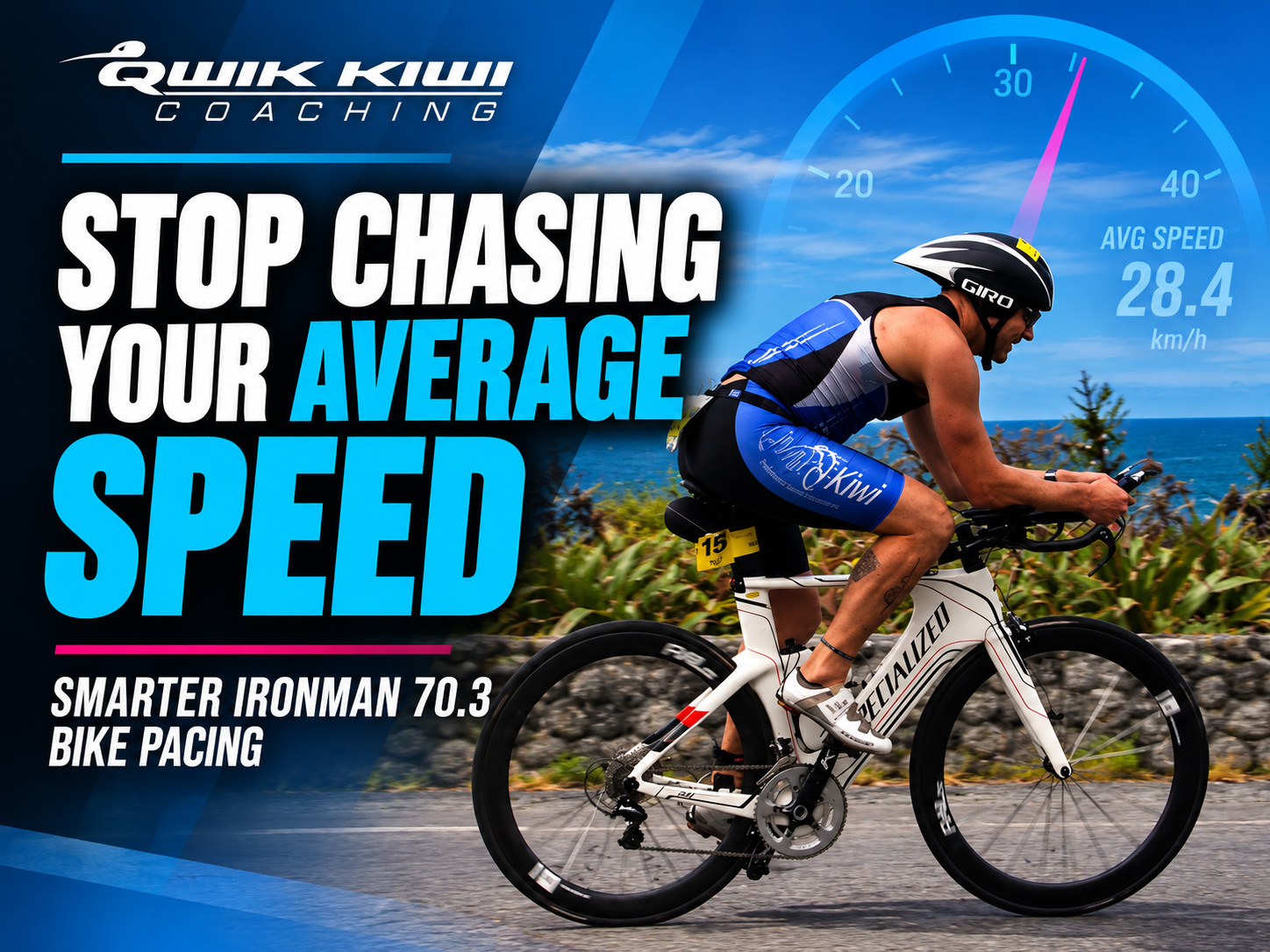
You’re 30km into the bike leg of your Ironman 70.3.
You’ve been riding well, your legs feel good and you’ve settled into what you believe is a sustainable effort.
Then you glance down at your bike computer.
Your average speed is lower than you expected.
Perhaps there’s been a headwind. Maybe the course has been hillier than you anticipated. Or the road surface simply isn’t as fast as you’d hoped.
Whatever the reason, you’re now behind your target average speed.
So what do you do?
For many triathletes, the temptation is to push harder.
And that’s where a perfectly good Ironman 70.3 bike leg can start going wrong.
Your average speed tells you how quickly you’ve covered the distance. It doesn’t necessarily tell you whether you’re riding at an appropriate intensity.
If you start chasing a speed target without considering the conditions, you risk spending energy that you’ll desperately want later.
Remember, your Ironman 70.3 doesn’t finish when you rack your bike.
You’ve still got 21.1km to run.
https://youtube.com/shorts/r-_E1q0Ur5A?feature=share
Average Speed Is an Outcome, Not a Pacing Strategy
There’s nothing inherently wrong with monitoring average speed.
It’s useful information.
It tells you how quickly you’ve travelled over a particular distance and can help you review your performance afterwards.
But average speed is influenced by several factors that have little to do with your current physiological effort.
These include:
- Wind direction and strength
- Course elevation and gradient
- Road surface and rolling resistance
- Aerodynamic positioning
- Corners, turns and technical sections
- Weather conditions
- Stops and sections requiring reduced speed
You could ride at exactly the same power output on two different courses and record substantially different average speeds.
You could even ride the same course on two different days, producing similar power, and finish with different bike splits because of the weather.
Your average speed doesn’t know how hard you’re working.
That’s why using it as your primary pacing target can be problematic.
The Headwind Trap
Imagine you’re riding along a flat road during your Ironman 70.3.
You’ve been averaging 32km/h, but suddenly you turn into a headwind.
Your speed drops to 26km/h.
Your first reaction might be frustration.
You start thinking about your target bike split.
You calculate how much time you’re losing.
Then you increase your power to try to maintain 32km/h.
The problem?
Overcoming aerodynamic resistance becomes increasingly demanding as your speed relative to the air increases.
Trying to force your original speed into a strong headwind can require a substantial increase in power.
That additional effort might seem manageable for a few minutes.
But over a 90km bike leg, repeatedly riding above your sustainable race intensity can accumulate fatigue.
And that fatigue doesn’t disappear when you reach T2.
The smarter approach is to accept that your speed will change while keeping your effort appropriately controlled.
Stay aerodynamic where it’s safe.
Maintain your planned race intensity.
Let the headwind affect your speed rather than allowing it to dictate an unsustainable effort.
Don’t Make the Opposite Mistake With a Tailwind
The same principle applies when the wind is behind you.
A tailwind can make you feel fantastic.
Your speed increases, your average starts climbing and suddenly you feel as though you’re having the ride of your life.
But that doesn’t automatically mean you should push harder.
In fact, on a fast section with a strong tailwind, increasing your power may provide relatively little additional time saving compared with the extra energy you’re spending.
Depending on the course and conditions, there may be opportunities to distribute your effort intelligently.
However, that is very different from chasing a particular speed.
Your objective is to use your available energy efficiently across the entire bike leg, not maximise the speed displayed on your computer at every moment.
Hills Can Make Average Speed Even More Misleading
Hilly courses create another challenge.
As the gradient increases, your speed naturally decreases.
If you’re fixated on maintaining a particular average speed, you might find yourself attacking every climb.
You push above your planned race intensity.
Your breathing becomes harder.
Your legs start accumulating fatigue.
Then you reach the descent and discover that gravity is doing much of the work anyway.
You may have spent a considerable amount of energy trying to save relatively little time.
That doesn’t mean you should ride every hill at exactly the same power as the flat sections.
Some variation in power is normal, and a carefully planned pacing strategy may allow modest increases on climbs.
But there’s a big difference between controlled, purposeful effort variation and repeatedly surging because your average speed is falling.
Avoid turning every hill into an opportunity to prove how strong you are.
You’re not racing to the top of the climb.
You’re racing to the finish line.
Use Power, Heart Rate and Perceived Exertion
So if average speed isn’t the best way to control your Ironman 70.3 bike leg, what should you use instead?
I recommend combining the information available to you rather than relying on a single number.
Power: What Are You Producing?
If you have a reliable power meter, power is one of the most useful tools for controlling bike intensity.
Unlike speed, power tells you about the mechanical work you’re producing.
If you’re riding into a headwind, your speed might decrease substantially while your power remains unchanged.
That helps you avoid the temptation to chase speed.
Power is particularly useful for preventing unnecessary surges on climbs or when overtaking.
However, your target power still needs to be appropriate for your fitness, expected race duration and ability to run afterwards.
A power target isn’t useful if it’s unrealistic.
Heart Rate: How Is Your Body Responding?
Heart rate provides another perspective.
It can help you understand how your body is responding to the workload.
However, heart rate is affected by factors such as heat, hydration, fatigue, caffeine and accumulated exercise stress.
It also responds more slowly than power to sudden changes in effort.
For those reasons, I wouldn’t recommend using heart rate in isolation either.
Instead, look at how it relates to your planned power and perceived exertion.
If you’re producing your normal race power but your heart rate is unusually elevated and the effort feels harder than expected, that’s information worth paying attention to.
Perceived Exertion: How Hard Does It Feel?
Your perception of effort is another valuable tool.
Ask yourself:
Can I sustain this effort for the remainder of the bike leg?
Is my breathing controlled?
Am I working harder than planned simply because the terrain or wind has changed?
Am I still riding at an intensity that will allow me to run well?
A well-developed sense of effort can help you make sensible adjustments when the numbers don’t tell the whole story.
Power, heart rate and perceived exertion work best when you understand how they relate to one another.
Your Bike Split Is Only Part of the Race
One of the biggest mistakes I see athletes make is treating the 90km bike leg as a standalone time trial.
They want to ride their fastest possible 90km.
But that’s not necessarily the same as producing their fastest possible Ironman 70.3.
Imagine two athletes with similar fitness.
The first athlete aggressively chases a target average speed, repeatedly surging into headwinds and over hills.
They arrive at T2 with an impressive bike split, but their legs are heavily fatigued.
The second athlete rides with greater discipline.
They accept changes in speed, control their intensity and arrive at T2 ready to run.
The second athlete might have a slightly slower bike split.
But if they run considerably better, they can finish the entire event faster.
The fastest bike split isn’t always part of the fastest overall race.
Your pacing decisions need to account for the swim you’ve already completed and the half marathon still ahead.
The Science Behind Consistent Bike Pacing
Research supports the importance of managing how you distribute your cycling effort before running.
In one study, 12 well-trained male triathletes completed two cycling trials at the same average power, followed by a 9.3km run.
One ride involved relatively constant power, while the other involved substantial variations in power output.
The athletes ran approximately 42 seconds slower, on average, after the variable-power ride.
The researchers concluded that highly variable cycling power could impair subsequent running performance. PubMed
Another study found greater physiological strain during variable-power cycling, including higher ventilation, blood lactate and perceived exertion, compared with a constant-power ride at the same average power. PubMed
These were relatively small studies, and their protocols weren’t identical to racing an Ironman 70.3.
They also don’t mean that you must maintain exactly the same power on every hill, descent or section of road.
In fact, research into triathlon pacing recognises that modest, planned variations in power can sometimes be beneficial when external resistance changes. PMC
The important distinction is between strategic pacing and uncontrolled surging.
You want to distribute your effort intelligently rather than repeatedly reacting to the speed displayed on your bike computer.
Practise Riding by Effort During Training
If you’ve developed a habit of chasing average speed, start changing it during your training.
1. Hide Average Speed Occasionally
During some training rides, remove average speed from your main bike-computer screen.
Instead, display the information that helps you execute the session properly.
For example, you might prioritise:
- Current or short-interval average power
- Heart rate
- Elapsed time
- Lap power
- Cadence
- Distance
You can still review average speed afterwards.
The aim is to stop allowing it to influence every decision during the ride.
2. Practise Riding in Different Conditions
Use your longer rides to experience different terrain and weather.
Notice how much your speed changes when you ride at a similar effort into a headwind compared with a tailwind.
Pay attention to what happens on climbs.
Learn to accept a slower speed without automatically increasing your effort.
The more familiar you become with these situations, the less likely you are to panic when they occur during your race.
3. Include Race-Specific Brick Sessions
A brick session provides valuable feedback about your bike pacing.
Complete a bike session at your planned Ironman 70.3 race intensity, then transition into a controlled run.
Ask yourself:
How did my legs feel during the opening kilometres?
Was my breathing controlled?
Could I settle into my planned running intensity?
Did the bike effort feel sustainable?
If you’re consistently struggling to run well after your race-specific bike sessions, review whether your bike intensity is appropriate.
You may need to adjust your pacing, fuelling or training preparation.
4. Review the Right Numbers Afterwards
Once your ride is finished, average speed can become useful again.
Compare it with your power, heart rate, elevation, weather conditions and perceived exertion.
Look at where you produced unnecessary surges.
Identify whether your effort became less controlled as the ride progressed.
Over time, this gives you a better understanding of how your cycling fitness translates into actual race performance.
A Better Race-Day Question
Instead of looking at your bike computer and asking:
“Am I riding fast enough?”
Ask:
“Am I riding at the right effort to finish this race strongly?”
That’s a much more useful question.
If you’re riding into a headwind and your speed drops, don’t automatically increase your power.
If you’re climbing a hill, avoid chasing a speed you could comfortably maintain on flat ground.
If you’re travelling quickly with a tailwind, don’t assume you need to work harder simply because you’re feeling good.
And if another athlete overtakes you, don’t abandon your pacing strategy to follow them.
Keep your attention on the things you can control.
Your effort.
Your position.
Your fuelling.
Your hydration.
Your race execution.
The speed will be whatever those decisions, your fitness and the conditions allow it to be.
Stop Racing Your Bike Computer
Your Ironman 70.3 bike computer is there to provide information.
It isn’t there to dictate every decision.
Average speed can be a useful measure of what you’ve achieved, but it’s a poor substitute for a properly developed pacing strategy.
If you become obsessed with defending a particular number, you risk turning headwinds, hills and other normal race conditions into reasons to push harder than planned.
Instead, trust your preparation.
Use your power, heart rate and perceived exertion intelligently.
Allow your speed to vary with the conditions.
And remember what happens when you reach T2.
You don’t get a medal for the fastest average speed displayed on your bike computer.
You’re trying to produce the best possible performance across the entire Ironman 70.3.
Stop chasing your average speed. Start managing your effort. Save your legs for the run.
Want Help Developing Your Ironman 70.3 Pacing Strategy?
Getting your pacing right can make an enormous difference to how you experience race day.
Whether you’re preparing for your first Ironman 70.3 or trying to improve your personal best, your bike pacing needs to reflect your fitness, the demands of the course and your ability to run afterwards.
If you’d like help developing a personalised training and race-execution strategy, I offer a free, no-obligation 40-minute coaching consultation.
We can discuss your goals, current training, bike pacing, fuelling and how to put together a stronger overall race.
Book your free 40-minute coaching consultation with Coach Ray.
Train smart. Race your effort. Finish strong.