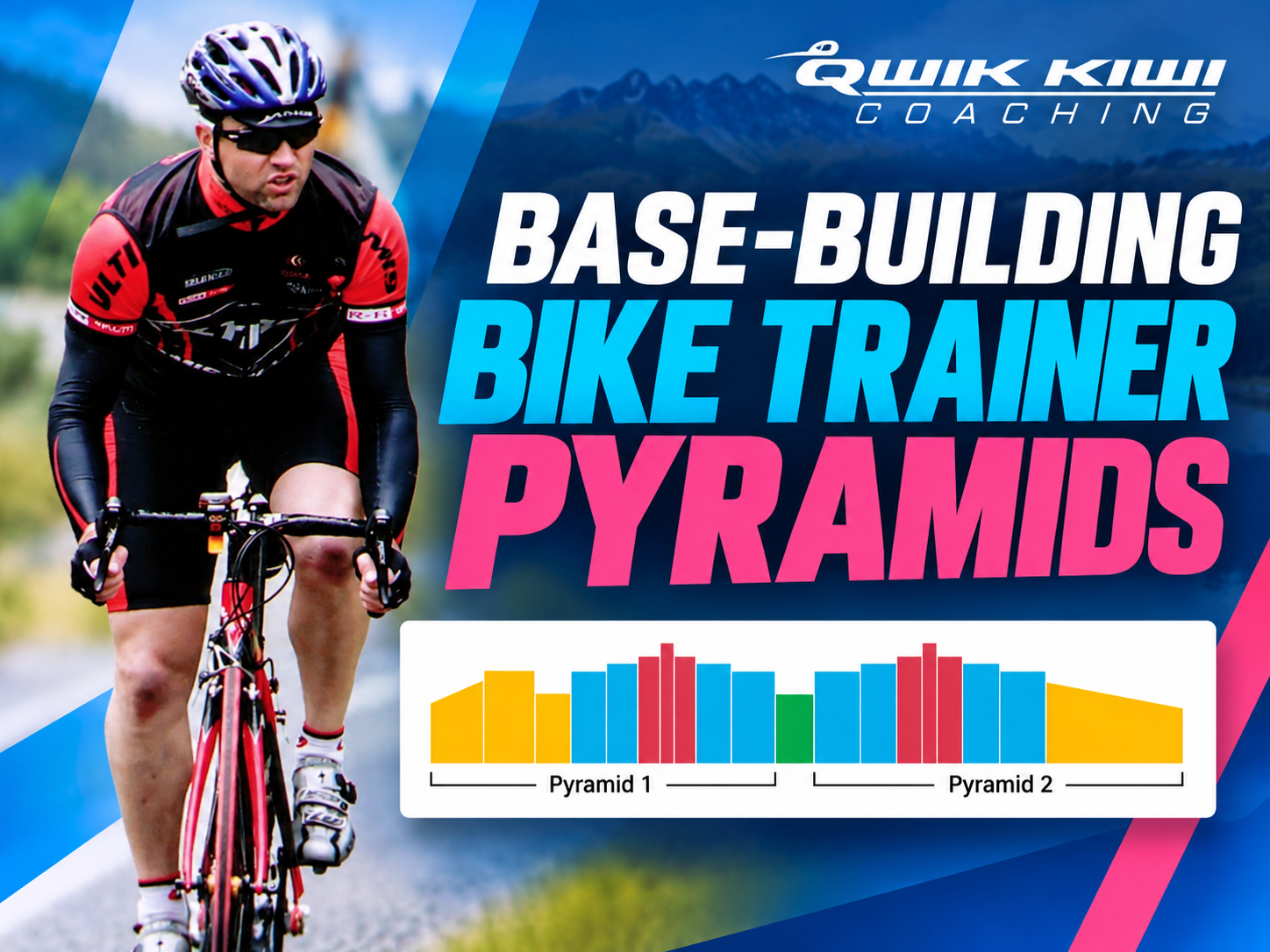
Want to build a stronger aerobic foundation while improving your ability to sustain power close to your cycling threshold?
The Base-Building Bike Trainer Pyramids workout combines controlled aerobic riding with progressively harder efforts, challenging you to increase your power output before gradually bringing it back down.
Unlike traditional interval workouts that repeat the same intensity, this session uses two structured pyramids. Each pyramid begins at 85% of Functional Threshold Power (FTP), climbs through 90% and 95%, briefly reaches 105%, and then descends through the same intensities.
The result is a demanding but controlled workout that develops muscular endurance, threshold tolerance, pacing discipline and your ability to manage changes in cycling intensity.
It’s a particularly useful session for road cyclists, triathletes and mountain bikers who want to become stronger, more consistent riders.
Originally inspired by a workout from the team at TriBy3 Multisport, published on Triathlete.com, this session provides a structured way to challenge your cycling fitness without relying on repeated maximal efforts.
Today’s Workout at a Glance
| Workout Detail | Prescription |
|---|---|
| Workout | Base-Building Bike Trainer Pyramids |
| Discipline | Indoor Cycling |
| Total Duration | 1 hour 6 minutes |
| Main Set | 2x 19-minute pyramids |
| Intensity Range | 85–105% FTP |
| Training Levels | Level II to Level IV+ |
| Recovery | 3min Level II between pyramids |
| Primary Focus | Aerobic Endurance and Threshold Development |
| Secondary Focus | Muscular Endurance, Pacing and Fatigue Resistance |
| Suitable For | Cyclists, triathletes and mountain bikers with an established aerobic foundation |
What Is the Goal of This Workout?
The primary goal is to develop your ability to produce and sustain power as you approach your cycling threshold.
Much of the workout is completed at intensities between 85% and 95% FTP, with a brief one-minute effort at 105% FTP at the top of each pyramid.
This combination challenges you to ride at increasingly demanding intensities without allowing your effort to become uncontrolled.
The descending portion is equally important.
After reaching the peak, you must return to slightly lower intensities while maintaining smooth, consistent pedalling despite accumulating fatigue.
Rather than simply surviving the hardest minute, the objective is to complete the entire pyramid with controlled power and good technique.
Why Base-Building Bike Trainer Pyramids Work
1. Develop Your Aerobic Foundation
Although the session includes some harder efforts, much of the main set is completed below FTP.
These sustained efforts provide a useful aerobic training stimulus while also developing your ability to produce relatively high power for extended periods.
A stronger aerobic foundation supports endurance performance across road cycling, triathlon and mountain biking.
2. Improve Threshold Tolerance
Riding close to threshold can initially feel uncomfortable, particularly when you’re required to sustain the effort.
The progressive pyramid structure introduces increasing intensity in manageable stages.
By repeatedly riding at 90–95% FTP, you’re developing familiarity with demanding but sustainable power outputs.
The brief 105% FTP effort adds an additional challenge without dominating the session.
3. Build Muscular Endurance
Each pyramid lasts 19 minutes.
That’s a substantial period of continuous work, particularly when most of it is completed at relatively high aerobic intensities.
Maintaining your power throughout the pyramid challenges your cycling-specific muscular endurance.
This is especially relevant when preparing for long climbs, sustained race efforts or demanding sections of a triathlon bike leg.
4. Develop Better Pacing Discipline
One of the most valuable aspects of pyramid training is learning to adjust your power accurately.
You’re not simply riding hard and then recovering.
Instead, you need to increase your power in controlled steps before reducing it again.
The objective is to make each change deliberately rather than allowing your intensity to drift.
5. Improve Fatigue Resistance
The descending portion of each pyramid can be surprisingly demanding.
After reaching 105% FTP, returning to 95% and 90% doesn’t necessarily feel easy.
Your legs are already carrying fatigue from the earlier stages.
Maintaining consistent power on the way down helps develop the ability to continue producing quality work after a harder effort.
The Complete Workout Prescription
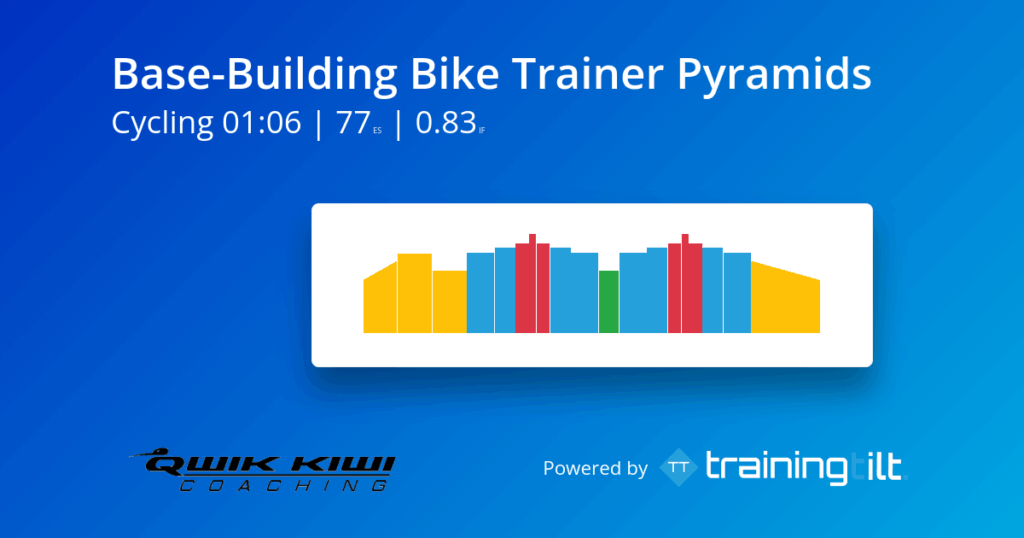
Base-Building Bike Trainer Pyramids — 1 Hour 8 Minutes
| Section | Duration | Intensity |
|---|---|---|
| Warm-Up | 5min | Level II |
| Warm-Up | 5min | Level III |
| Warm-Up | 5min | Level II |
| Pyramid 1 — Step 1 | 4min | 85% FTP — Level III |
| Pyramid 1 — Step 2 | 3min | 90% FTP — Level III+ |
| Pyramid 1 — Step 3 | 2min | 95% FTP — Level IV |
| Pyramid 1 — Peak | 1min | 105% FTP — Level IV+ |
| Pyramid 1 — Step 5 | 2min | 95% FTP — Level IV |
| Pyramid 1 — Step 6 | 3min | 90% FTP — Level III+ |
| Pyramid 1 — Step 7 | 4min | 85% FTP — Level III |
| Recovery | 3min | Level II |
| Pyramid 2 | 19min | Repeat the same pyramid |
| Cool-Down | 10min | Level II |
Total Cycling Duration: 66 minutes
Finish with 10 minutes of stretching.
How to Complete the Workout
Warm-Up: 15 Minutes
Begin with five minutes at Level II.
This should feel comfortable and conversational, allowing you to establish a smooth pedalling rhythm.
Increase your intensity to Level III for the next five minutes.
This should feel noticeably stronger than your initial warm-up but still controlled.
Return to Level II for the final five minutes before beginning the first pyramid.
The objective is to prepare your legs and cardiovascular system for the sustained work ahead without creating unnecessary fatigue.
Main Set: 2x 19-Minute Pyramids
Each pyramid follows the same seven-stage progression.
Building the Pyramid
Start with four minutes at 85% FTP (Level III).
Increase to 90% FTP (Level III+) for three minutes.
Then increase to 95% FTP (Level IV) for two minutes.
Finally, complete one minute at 105% FTP (Level IV+).
This is the peak of the pyramid.
Although the effort is challenging, avoid treating it as an all-out sprint. Your goal is to maintain the prescribed intensity for the entire minute.
Descending the Pyramid
After the peak, reduce your power to 95% FTP (Level IV) for two minutes.
Then reduce to 90% FTP (Level III+) for three minutes.
Finish with four minutes at 85% FTP (Level III).
The descending portion should remain controlled.
Don’t allow your power to fall below the prescribed intensity simply because you’ve completed the hardest minute.
Recovery Between Pyramids
After completing the first pyramid, ride for three minutes at Level II.
Use this opportunity to settle your breathing, relax your upper body and prepare for the second pyramid.
Then repeat the complete 19-minute sequence.
After the second pyramid, move straight to your cool-down.
Cool-Down: 10 Minutes at Level II
Conclude the session with 10 minutes of easy cycling at Level II.
Focus on maintaining a relaxed, smooth pedalling rhythm while allowing your breathing and heart rate to settle.
Finish with 10 minutes of stretching.
Coach Ray’s Tips for Getting the Most from This Session
Don’t Start the Pyramid Too Hard
The first four minutes at 85% FTP should feel controlled.
Resist the temptation to ride above the prescribed intensity simply because your legs feel fresh.
You’ll have plenty of opportunity to work harder as the pyramid progresses.
Make Each Power Change Deliberate
One of the purposes of this workout is learning to control your cycling intensity.
When moving from 85% to 90%, make a small, controlled adjustment.
The same applies when progressing to 95% and 105%.
Avoid surging well above your target power each time the intensity increases.
Respect the Descending Intervals
The hardest part of the workout isn’t necessarily the one-minute peak.
After riding at 105% FTP, maintaining 95% FTP for another two minutes can feel demanding.
Continue to focus on consistent power and smooth pedalling as you work your way down.
Keep the Recovery Periods Easy
The three-minute Level II recoveries are there for a reason.
Don’t turn them into additional tempo efforts.
Allow yourself to regroup before returning to the next section of the workout.
Compare Your Two Pyramids
Ideally, your second pyramid should closely match the first.
Look at how consistently you maintained your prescribed power targets.
If your power drops substantially during the second pyramid, consider whether your opening efforts were too aggressive or whether you’re carrying excessive fatigue.
Common Mistakes to Avoid
Riding above the prescribed power targets: More power isn’t automatically better. The purpose is to follow the progression accurately.
Turning the 105% FTP effort into a sprint: It’s a controlled one-minute effort above threshold, not a maximal acceleration.
Backing off too much on the descent: The descending intervals remain important training work.
Riding the recoveries too hard: Keep the Level II sections controlled.
Ignoring fatigue during the second pyramid: Maintaining technique and pacing becomes increasingly important as the workout progresses.
Using an outdated FTP: If your FTP setting is significantly inaccurate, the prescribed intensities may be too easy or too demanding.
How This Workout Fits into Your Training
Base-Building Bike Trainer Pyramids is a useful session for athletes who have already established a foundation of aerobic cycling.
It combines sustained aerobic work with relatively brief periods close to and above threshold.
This makes it suitable for developing the ability to handle changes in intensity while continuing to produce consistent power.
For triathletes, the workout can help prepare you for undulating bike courses and situations where maintaining steady power is interrupted by climbs or other demands.
Road cyclists may find it useful for sustained climbs and rolling terrain.
Mountain bikers can benefit from practising controlled changes in power while maintaining their overall endurance.
Despite the name, this isn’t an easy recovery or purely low-intensity base ride. It contains a meaningful amount of work close to threshold and should be scheduled accordingly.
Coach Ray’s Workout Data
I completed this workout myself, and my training data provides an example of how the two pyramids can be executed.

View My Ride on Strava
Want to see how the workout looked in practice?
Who Should Try This Workout?
This session is particularly useful for cyclists and triathletes looking to develop their ability to sustain strong aerobic and near-threshold efforts.
It may suit athletes preparing for:
- Road cycling events featuring rolling terrain or sustained climbs
- Sprint and Olympic-distance triathlons
- Ironman 70.3 events
- Mountain bike races
- General improvements in cycling muscular endurance and threshold performance
Athletes who are relatively new to structured cycling training may benefit from developing their aerobic fitness before attempting the complete session.
Frequently Asked Questions
What is a cycling pyramid workout?
A pyramid workout involves gradually increasing intensity through a series of intervals before progressively reducing it again.
In this session, power increases from 85% to 105% FTP before returning to 85%.
Why does the workout use different interval durations?
The intervals become shorter as the intensity increases.
This allows you to spend more time at sustainable aerobic intensities while still including brief periods of harder work.
Is this a threshold workout or a base-building workout?
It combines elements of both.
Much of the main set is completed below FTP, while the higher stages challenge your ability to ride close to and briefly above threshold.
It’s best described as a demanding aerobic and threshold-development session rather than an easy base ride.
Do I need a power meter?
A power meter or smart trainer makes it easier to follow the prescribed FTP percentages accurately.
However, you can also complete the workout using the corresponding training intensity Levels, adjusting your effort according to your established zones.
Should the second pyramid be harder than the first?
The prescribed power targets are identical.
The second pyramid may feel harder because of accumulated fatigue, but your objective is to maintain the same intensity and technique.
Can I shorten the workout?
You can reduce the session by completing one pyramid instead of two.
However, doing so reduces the total training stimulus.
Choose a session duration appropriate for your current fitness and training goals.
Ride Base-Building Bike Trainer Pyramids on Qwik Kiwi Velocity 🚴
Ready to build your cycling endurance and develop stronger, more sustainable power?
You can ride Base-Building Bike Trainer Pyramids directly on Qwik Kiwi Velocity, following a structured, coach-led video workout that takes you through two progressive pyramids.
Starting at 85% of FTP, each pyramid builds towards a challenging one-minute effort at 105% before gradually descending through the intensity levels.
It’s a great workout for cyclists, triathletes and mountain bikers looking to improve their aerobic endurance, threshold tolerance and ability to maintain power as fatigue accumulates.
Already a Velocity Member?
Jump straight into the session and follow the workout with Coach Ray.
Not Riding with Us Yet? Try Velocity FREE for 14 Days!
Join Qwik Kiwi Velocity and experience structured, coach-led indoor cycling workouts designed to help you train smarter and ride stronger.
Your 14-day free trial gives you access to our extensive on-demand workout library, including this pyramid session, plus our live squad rides on Tuesdays and Thursdays.
Whether you’re building your aerobic foundation, improving your FTP or preparing for your next event, there’s a workout to help you achieve your goals.
Build gradually. Control the peak. Stay strong on the way down.
Final Thoughts from Coach Ray
Base-Building Bike Trainer Pyramids is a great example of how changing intensity within a structured workout can challenge your cycling fitness.
The progressive increases in power teach you to manage harder efforts, while the descending intervals test your ability to maintain control as fatigue builds.
The objective isn’t to produce your highest possible power during the one-minute peak.
It’s to complete both pyramids with consistent power, good technique and disciplined pacing.
Build gradually. Control the peak. Stay strong on the way down.
Happy training!
Coach Ray
Head Coach & Director
Qwik Kiwi Coaching