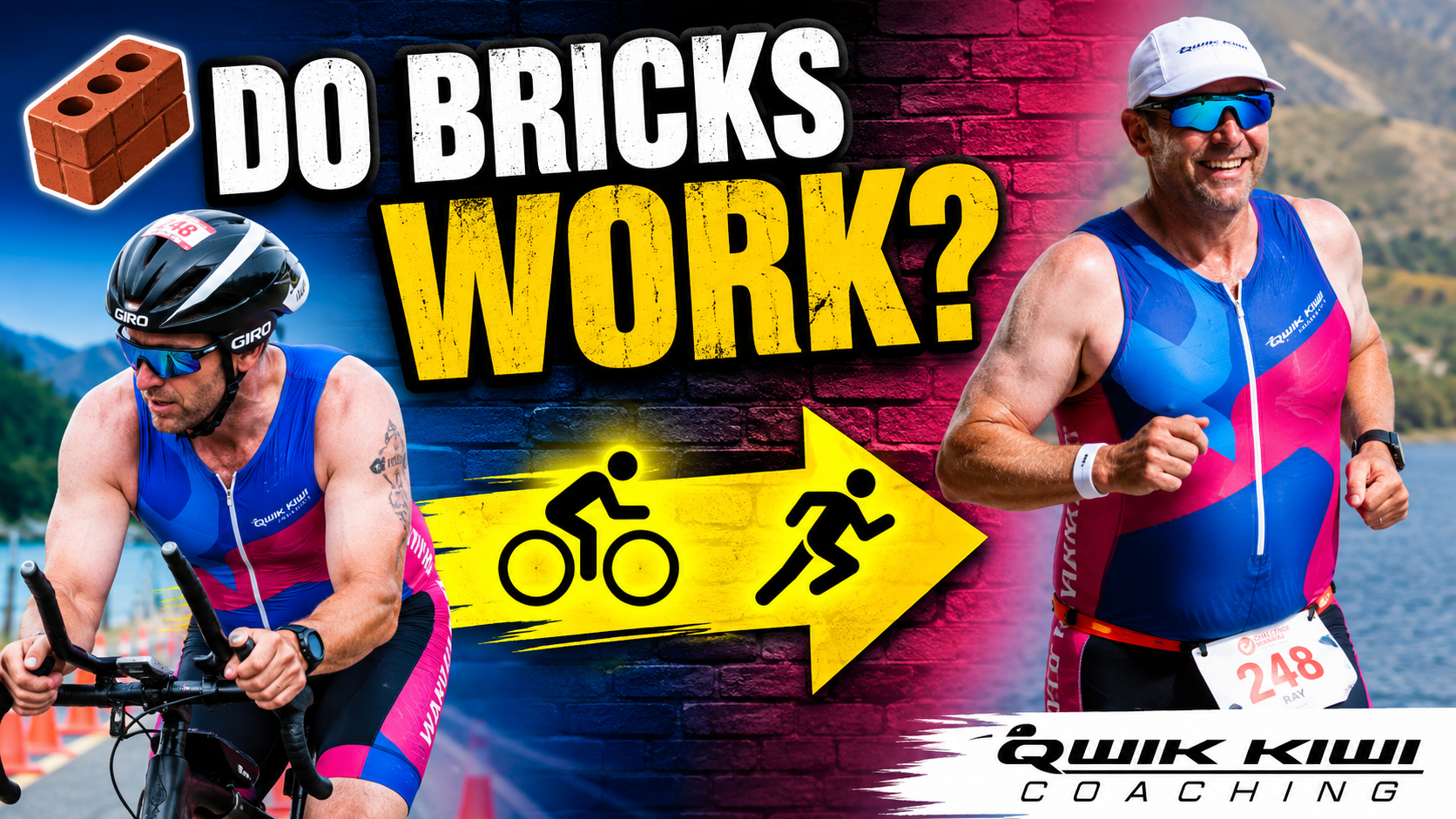
If you’ve spent any time around triathlon, you’ve almost certainly heard someone say:
“You need to do more brick sessions.”
It’s one of the most common pieces of advice given to triathletes, yet very few athletes actually understand why brick sessions are so important.
Even more concerning, many athletes perform brick workouts for the wrong reasons.
Some think they’re designed to make your legs “strong enough” to run after cycling. Others believe every long ride should be followed by a long run. Both are common misconceptions.
The truth is that brick sessions have a very specific purpose, and when used correctly they can become one of the most valuable sessions in your entire training programme. When used incorrectly, they simply create unnecessary fatigue and increase your risk of injury.
What Is a Brick Session?
A brick session combines two disciplines back-to-back, most commonly:
- Bike → Run
- Swim → Bike
- Occasionally Swim → Bike → Run
The bike-to-run combination is by far the most common because it prepares you for one of the most challenging parts of race day—Transition 2 (T2).
Nobody knows for certain where the term “brick” originated. There are several popular theories:
- It describes the feeling of running with legs that feel like they’re made of bricks.
- It refers to “building blocks” of successful triathlon training.
- It has been linked to early triathlon pioneers and even New Zealand duathlon legend Dr Matthew Brick.
Whatever the true origin, the term has become synonymous with preparing your body for the unique demands of triathlon.
Brick Sessions Are About More Than Running Off the Bike
Many athletes believe the purpose of a brick session is simply to get used to “heavy legs.”
That’s only part of the story.
A well-designed brick session can help develop:
- Transition skills
- Neuromuscular adaptation
- Running technique
- Race pacing
- Nutrition strategies
- Mental confidence
One workout can achieve several objectives if it’s planned correctly.
The Real Reason Running Feels So Strange After Cycling
This is probably the biggest reason I programme brick sessions for my athletes.
During the bike leg your body has been directing the majority of its blood flow and oxygen delivery towards the muscles doing the work—primarily your quadriceps and glutes.
The moment you begin running, your body has to reorganise.
Different muscles now become the primary movers.
Your hamstrings, calves and other running muscles suddenly require much more oxygen.
Your brain needs to recognise this change and redirect blood flow accordingly.
That process isn’t instantaneous.
Initially your stride feels awkward.
Your cadence feels wrong.
Your legs don’t quite cooperate.
The more often you practise this transition, the faster your body adapts.
That’s why even a short run after cycling can provide enormous benefits.
Brick sessions don’t teach your legs how to run.
They teach your brain and body how to transition efficiently.
Practise the Skills That Matter on Race Day
Brick sessions are also the perfect opportunity to rehearse everything surrounding the transition.
For example:
- Removing your helmet efficiently.
- Changing shoes quickly.
- Mounting and dismounting your bike safely.
- Starting your run at the correct pace.
- Practising your race-day nutrition.
- Developing confidence in your transition routine.
These small details can save valuable time and reduce stress during your race.
By race day, nothing should feel unfamiliar.
The Biggest Brick Myth
One of the most persistent myths in triathlon is:
“Every long ride should be followed by a long run.”
I don’t agree.
In fact, for many athletes it’s one of the quickest ways to accumulate excessive fatigue.
After a long ride, your body is already under considerable stress.
Following it with a long run often provides very little additional fitness while substantially increasing recovery time and injury risk.
Instead, I commonly programme:
- A long ride.
- Followed immediately by a 10–15 minute easy run.
That short run is enough to stimulate the neuromuscular adaptation we’re chasing without turning the session into an unnecessarily exhausting day.
Different Goals Require Different Brick Sessions
One of the biggest mistakes athletes make is assuming every brick session should look the same.
They shouldn’t.
Your brick workouts should change depending on:
- Your race distance.
- Your phase of training.
- Your experience.
- Your specific weaknesses.
During your base phase, a brick might consist of:
- Steady aerobic ride.
- Easy controlled run.
Closer to race day, that same session might become:
- Bike intervals at race intensity.
- Followed by race-pace running.
The purpose changes throughout the season.
Five Types of Brick Sessions
Rather than thinking of bricks as one type of workout, I prefer to think of five different categories.
1. Transition Brick
Usually 10–15 minutes of easy running immediately after your bike ride.
Purpose:
- Improve neuromuscular adaptation.
- Practise changing movement patterns.
- Build confidence.
2. Race Pace Brick
Designed to rehearse exactly how you intend to race.
Purpose:
- Dial in pacing.
- Practise maintaining effort.
- Build confidence.
3. Nutrition Brick
Race-day fuelling should never be left to chance.
Purpose:
- Test nutrition.
- Practise hydration.
- Refine race-day strategy.
4. Fatigue Resistance Brick
Typically longer and lower intensity.
Purpose:
- Develop endurance.
- Learn to maintain technique while fatigued.
5. Confidence Brick
Often completed during the final preparation for your event.
Purpose:
- Simulate race day.
- Build mental confidence.
- Confirm pacing and nutrition plans.
Common Brick Mistakes
Some of the most common errors I see include:
Running too far
Longer isn’t always better.
Running too fast
The intensity should match the purpose of the session.
Turning every brick into a race
Not every session needs to be hard.
Ignoring nutrition
Brick sessions are ideal opportunities to practise your race-day fuelling.
Never practising race pace
You should know exactly what your target pace feels like.
Accumulating excessive fatigue
The best training plan is one that allows you to recover and train consistently.
How Often Should You Do Brick Sessions?
That depends on your experience.
First-time triathletes
One structured brick every couple of weeks is usually sufficient, combined with regular short transition runs after long rides.
Experienced age-group athletes
Weekly brick sessions during race preparation are appropriate.
Elite athletes
Bricks become highly specific and carefully integrated into the overall training programme, sometimes occurring several times per week depending on the training phase.
The Key Take-Home Message
Brick sessions aren’t about making you tired.
They’re not about proving how tough you are.
They’re certainly not about following every long ride with an exhausting long run.
A good brick session has a clearly defined purpose.
Sometimes that purpose is transition practice.
Sometimes it’s race pacing.
Sometimes it’s nutrition.
Sometimes it’s simply teaching your brain and body how to perform efficiently when moving from cycling to running.
The most effective brick session is the one that fits your race, your goals and your current phase of training.
Train with purpose, and every brick becomes another building block towards a stronger race performance.
Ready to Train Smarter?
Whether you’re preparing for your first Sprint Triathlon or chasing a new personal best over the Ironman 70.3 distance, having the right brick sessions in your programme can make a significant difference.
If you’d like a structured training plan that includes purposeful brick sessions designed specifically for your goals, I’d love to help.
Book a free, no-obligation 40-minute coaching consultation, and together we’ll build a training programme that helps you arrive on the start line confident, prepared and ready to race.