You rack your bike.
Pull on your running shoes.
Grab your race belt.
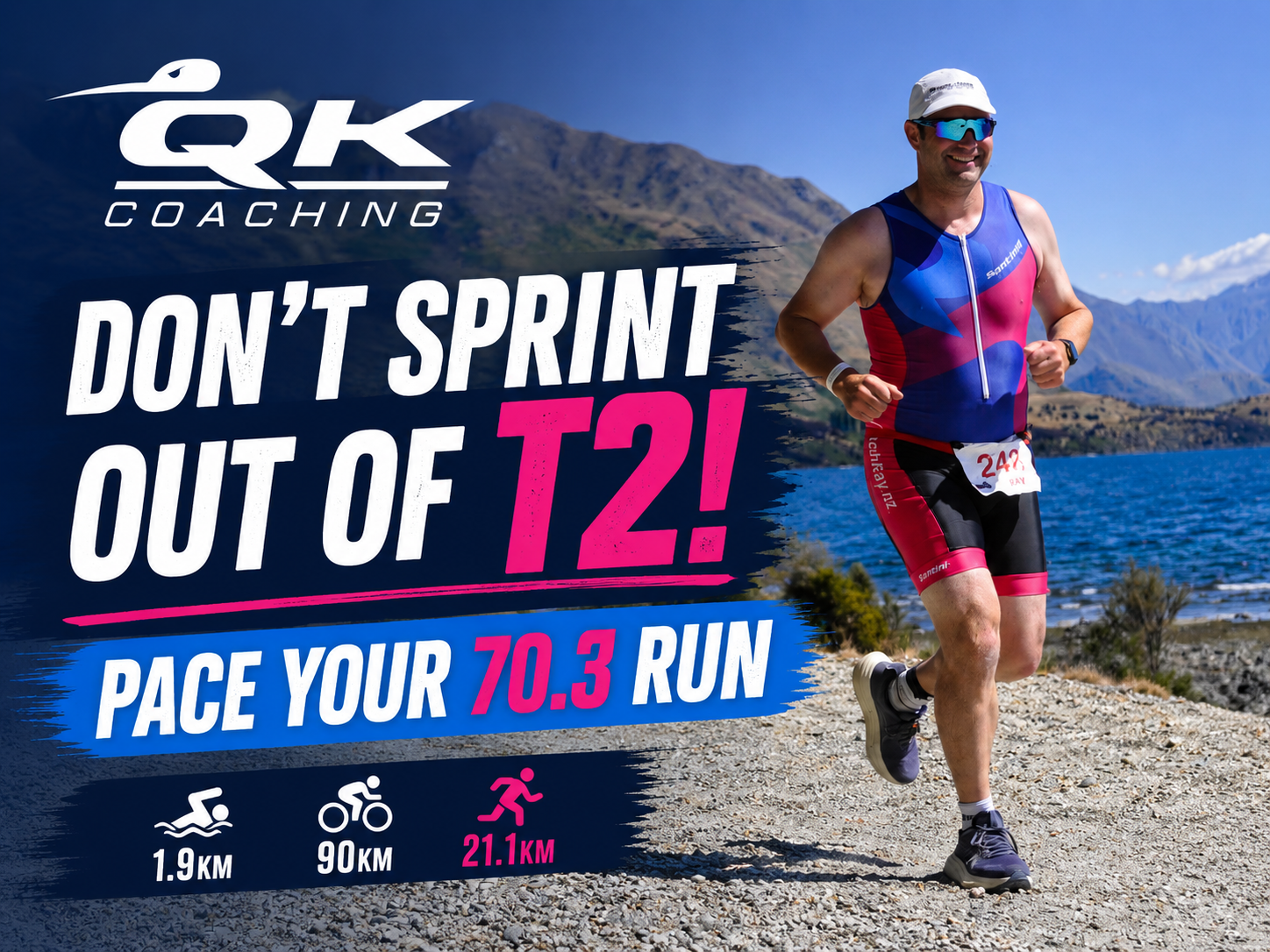
And suddenly, after 90 kilometres of cycling, you’re running.
There are spectators cheering, other athletes around you, and the adrenaline of finally beginning the last discipline of your Ironman 70.3.
Your legs might feel surprisingly good.
So you start running fast.
Too fast.
One of the easiest mistakes to make in an Ironman 70.3 is sprinting out of T2 because your early running pace feels easier than expected.
The problem?
You’ve still got 21.1 kilometres to run.
Your Legs Need Time to Adjust
Running immediately after cycling feels different from starting a normal run.
You’ve spent the previous few hours sitting on your bike, repeatedly producing force through a cycling-specific movement pattern.
Then you jump off, change shoes, and ask your body to run.
For the first few minutes, your stride can feel unusual.
Your legs might feel heavy.
Or strangely, they might feel fantastic.
Either way, don’t judge your run by those opening few hundred metres.
Give your body time to transition.
The Danger of Feeling Too Good
The dangerous scenario isn’t always heavy legs.
Sometimes it’s the opposite.
You leave T2 and feel brilliant.
Because your perception of movement has been influenced by riding the bike, your early running pace may feel surprisingly comfortable.
Add spectators, adrenaline, and the excitement of being off the bike, and it becomes very easy to run significantly faster than planned.
You look at your watch and think:
“Wow, I’m flying!”
The question isn’t whether you can run that pace for the first kilometre.
The question is whether you want to be paying for it at kilometre 16.
Your First Kilometre Should Feel Controlled
Your objective when leaving T2 is simple:
Settle into the run.
You don’t need to prove anything during the first kilometre.
Keep your effort controlled.
Relax your shoulders.
Find your posture.
Allow your breathing to settle.
Let your running rhythm develop.
If your planned race pace initially feels ridiculously easy, that’s okay.
Give it time.
You can always increase your effort later.
It’s considerably harder to undo the damage from starting too fast.
Run by Effort, Not Emotion
The opening stages of the Ironman 70.3 run are full of emotion.
You’ve made it through the swim.
You’ve completed the bike.
The finish suddenly feels achievable.
But emotion is a terrible pacing strategy.
Instead, return to the strategy you practised during training.
Depending on how you train, you might use:
- Pace.
- Heart rate.
- Power.
- Perceived exertion.
- Or a combination of these.
Whatever method you use, remember that your body has already completed a 1.9km swim and a 90km bike ride.
Your normal standalone half-marathon pace isn’t automatically your Ironman 70.3 run pace.
Don’t Chase People Leaving Transition
This is particularly important if another athlete leaves T2 with you.
They might take off.
Let them.
You don’t know their ability.
You don’t know their pacing strategy.
You don’t know whether they’re about to run the half marathon of their life—or completely blow themselves to pieces.
Neither possibility changes your race plan.
Run your pace.
There is plenty of time to catch people later.
Use the First Aid Station to Settle In
Rather than thinking about the entire 21.1km immediately, give yourself a simple first target.
Get to the first aid station under control.
Use those opening minutes to assess yourself.
How do your legs feel?
How is your breathing?
How is your stomach?
Are you running at the planned effort?
What do you need from the aid station?
This shifts your mindset from racing immediately to executing your race.
Once you’ve settled, move on to your next target.
A Few Seconds Now Can Save Minutes Later
Athletes often worry that starting conservatively means giving away time.
But consider the bigger picture.
Running your opening kilometre 10 or 15 seconds faster than planned might feel fantastic.
You’ve gained a few seconds.
But if that aggressive start contributes to slowing dramatically later in the race, those seconds become irrelevant.
A good Ironman 70.3 run is about what you can sustain across the whole 21.1 kilometres.
Not what you can produce while everyone is cheering outside transition.
Build Into Your Run
Think of the opening section as establishing your foundation.
Start controlled.
Find your rhythm.
Settle into your nutrition and hydration strategy.
Then allow the race to develop.
If you’re still feeling strong later, you can gradually increase the effort.
That is a much better position to be in than desperately trying to reduce your effort because you started too aggressively.
I’d rather have an athlete reach the final five kilometres thinking:
“I’ve got more to give.”
Than reach 10 kilometres thinking:
“I really hope I can hold this together.”
Practise Running Out of T2
This is exactly why brick sessions are valuable.
A brick session isn’t simply about proving you can run after cycling.
It gives you an opportunity to practise the transition.
During race-specific training, pay attention to those opening minutes of the run.
Notice how your legs feel.
Notice whether your natural pace is faster or slower than expected.
Practise deliberately holding yourself back.
Learn what your appropriate Ironman 70.3 run effort feels like immediately after the bike.
The more familiar that sensation becomes in training, the less likely you are to make a poor pacing decision on race day.
Practise the First Kilometre, Not Just the Run
Athletes often rehearse race pace during training but forget to practise how they arrive at race pace.
There’s a difference.
During selected brick sessions, make your first kilometre deliberately controlled.
Don’t immediately chase your target pace.
Allow your body to transition from cycling to running and then gradually settle into your planned effort.
You’re teaching yourself a race-day behaviour.
When you eventually leave T2 during your Ironman 70.3, it won’t feel like something new.
You’ve done it before.
Don’t Confuse a Fast Transition With a Fast Start
You can move efficiently through T2 without sprinting the opening kilometre.
These are two completely different things.
Know where your equipment is.
Rack your bike.
Change your shoes.
Grab what you need.
Get moving.
A smooth transition saves time without costing much energy.
Once you exit T2, however, switch your mindset.
The transition might be fast.
Your opening run pace should be controlled.
Think About Kilometre 18
Here’s a useful question when you’re tempted to run too hard out of T2:
“Will I still be happy with this decision at kilometre 18?”
That’s where your pacing decisions really matter.
Almost everyone can feel good during the opening kilometre.
Ironman 70.3 rewards the athlete who can still run effectively when there’s only three or four kilometres remaining.
Your job early in the run is to give that future version of yourself the best possible opportunity.
Final Thoughts
Leaving T2 is exciting.
Your legs may feel strange.
They may feel heavy.
They may even feel fantastic.
None of those sensations should convince you to abandon your race plan.
Stay controlled.
Find your rhythm.
Let your body adjust from cycling to running.
Settle into your planned effort.
Then start racing when the race actually demands it.
You’ve already completed 91.9 kilometres.
There’s no prize for being the fastest athlete through the first kilometre of the run.
Don’t sprint out of T2.
Run the first kilometre so you can still be running strongly at kilometre 20.
Want to Run Stronger Off the Bike?
A strong Ironman 70.3 run starts long before you leave T2. Your bike pacing, fuelling, brick training, run pacing, and race-day decision-making all contribute to what happens over that final 21.1 kilometres.
If you’re preparing for your first Ironman 70.3, chasing a personal best, or struggling to turn your running fitness into a strong triathlon run, I’d be happy to help.
Book a free, no-obligation 40-minute coaching consultation and we can discuss your goals, your current training, and how you can set yourself up for a stronger race.
You’ll leave with practical advice and a clearer idea of your next steps, whether we end up working together or not.