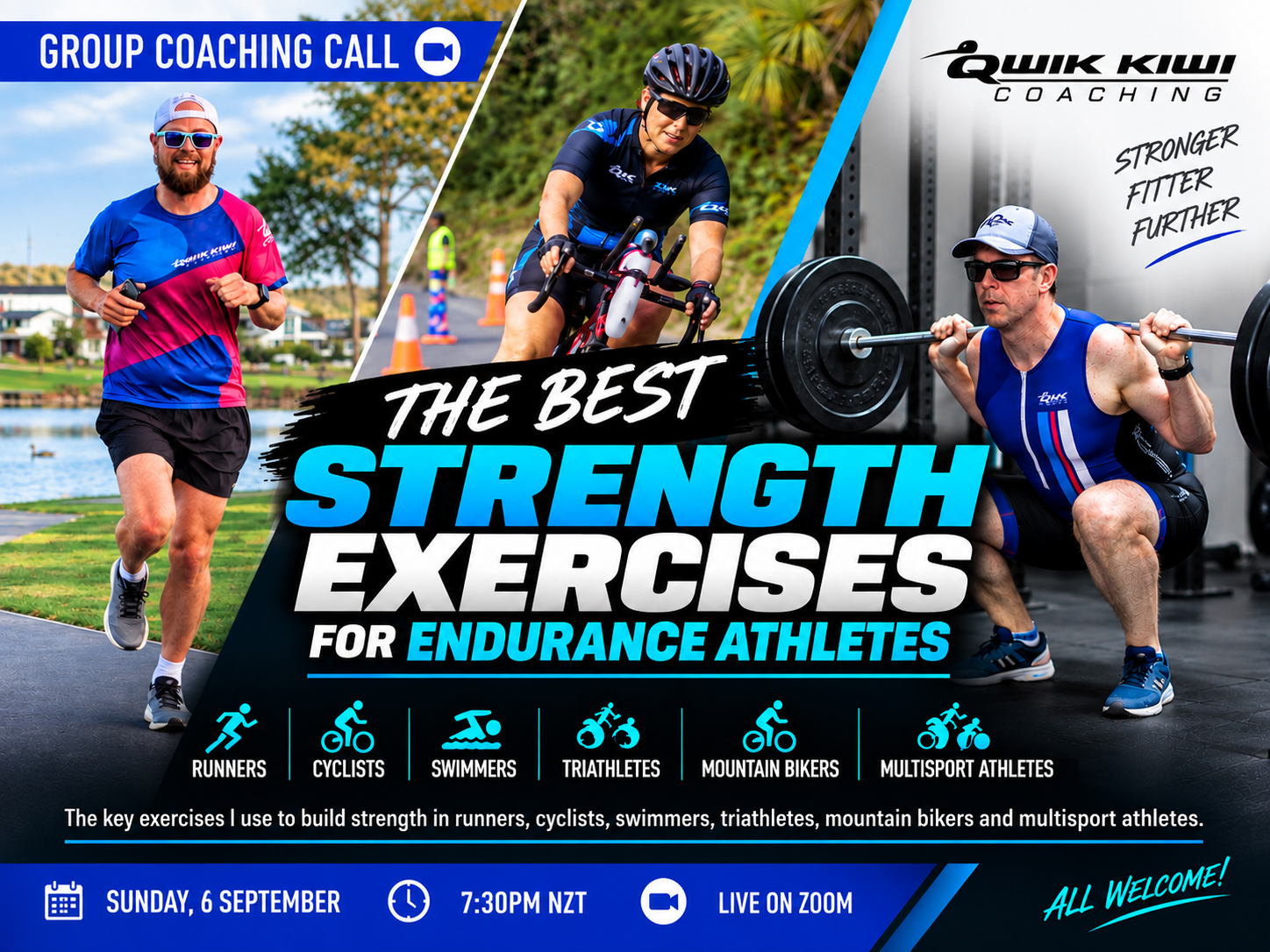
Do runners need running-specific strength exercises? Do cyclists need cycling-specific strength exercises? Should triathletes be doing something completely different again?
Probably not.
When I prescribe strength training for runners, cyclists, swimmers, triathletes, mountain bikers and multisport athletes, I use largely the same relatively small collection of exercises.
That’s because when you go to the gym, the objective is actually quite simple:
Get stronger.
Your running provides your running-specific training. Your cycling provides your cycling-specific training. Your swimming provides your swimming-specific training.
Strength training has a different job.
In this article, I’ll take you through some of the key exercises I use with my endurance athletes, why I use them and how they progress as an athlete becomes stronger.
Why Should Endurance Athletes Strength Train?
As endurance athletes, most of our training is naturally devoted to our chosen sport. Runners run, cyclists ride, swimmers swim and triathletes spend plenty of time doing all three.
But simply doing more endurance training doesn’t necessarily develop all the physical qualities we want.
One of the main purposes of strength training is to increase the amount of force your muscles are capable of producing.
We’re not trying to turn endurance athletes into powerlifters or bodybuilders. We’re developing strength that supports what you do outside the gym.
As you become stronger, the force required to produce each individual stride or pedal stroke represents a smaller proportion of your maximum capability. When you’re repeating those movements thousands of times, that can become important.
Strength training also develops the muscles, tendons and supporting structures that have to tolerate the repetitive demands of endurance training. It provides an opportunity to address weaknesses and imbalances while challenging the body differently from the movements you perform over and over again in your sport.
Ultimately, what we’re looking for is performance and durability — becoming strong enough to train consistently and continue producing good movement as fatigue develops.
Strength Is Strength — Whatever Your Endurance Sport
There is a huge amount of information available about “running-specific strength”, “cycling-specific strength” and supposedly sport-specific gym exercises.
But I essentially use the same exercise library across the different endurance sports I coach.
A cyclist doesn’t need to make every gym exercise resemble pedalling.
A runner doesn’t need every strength exercise to resemble running.
If you’re a runner, you’re already doing an enormous amount of running-specific training every time you head out for a run. A cyclist gets their sport specificity by riding, and a swimmer gets it by swimming.
The role of your strength session is different.
We’re developing fundamental physical qualities including:
- Lower-body strength
- Hamstring strength
- Pushing and pulling strength
- Trunk control
- Posture
There can certainly be differences in how I prescribe and programme strength training for individual athletes, but that doesn’t mean we need to invent an entirely different collection of exercises for each endurance sport.
A simple way of remembering my philosophy is:
Train your sport to improve your sport. Strength train to get stronger.
Back Squat — Building Lower-Body Strength
One exercise you’ll see repeatedly throughout my strength programmes is the back squat.
It’s a large compound movement involving the hips, knees and ankles, and it allows us to develop strength throughout much of the lower body.
The objective isn’t to find out how much weight you can possibly put on the bar.
I’m looking for good technique combined with the progressive development of strength.
That’s an important distinction. I’d much rather see an athlete perform a controlled movement correctly with an appropriate resistance than chase a bigger number at the expense of their technique.
Barbell Reverse Lunge — Adding a Unilateral Challenge
Another lower-body exercise I use is the barbell reverse lunge.
Whereas the back squat has both legs working together, the reverse lunge introduces a unilateral component and places greater demand on one leg at a time.
That’s particularly relevant to endurance athletes because so much of what we do involves alternating or predominantly single-leg force production.
That doesn’t mean we should abandon bilateral movements such as the squat in favour of doing everything on one leg.
I like having both bilateral and unilateral movements available within the programme.
Swiss Ball Hamstring Curl — Developing the Posterior Chain
Although the squat and reverse lunge give us plenty of lower-body work, I also specifically want to develop the hamstrings.
One exercise I use for this is the Swiss ball hamstring curl.
It might look relatively straightforward, but when performed properly it provides a useful combination of hamstring work with hip and trunk control. The hamstrings have to produce force while the athlete maintains their body position.
As the athlete progresses, we can move from the standard Swiss ball hamstring curl to a single-leg Swiss ball hamstring curl.
This illustrates an important principle:
Progression doesn’t always mean adding more weight.
Sometimes we can make an established exercise substantially more demanding simply by changing how we perform it. Going from two legs to one dramatically increases the demand of the hamstring curl.
For an endurance athlete, I want strong hamstrings as part of a balanced lower body, rather than concentrating solely on the musculature at the front of the thigh.
Wide-Grip Lat Pull-Down, Seated Row & Bent-Over Row
Strength training for endurance athletes shouldn’t stop at the waist.
If you’ve followed one of my programmes, you’ll probably have noticed that I prescribe quite a bit of pulling work. Three exercises you’ll see are the:
Wide-Grip Lat Pull-Down
This gives us a vertical pulling movement.
Cable Seated Row
This provides a horizontal pulling movement.
Bent-Over Barbell Row
Now we’re combining the pulling movement with the requirement to maintain body position while performing the exercise.
They’re therefore not simply three versions of the same exercise.
Think about the positions endurance athletes maintain for long periods. A cyclist can spend hours leaning forward over their bike. A runner needs to maintain their posture as fatigue develops. For swimmers, upper-body strength has an even more obvious role.
But that doesn’t mean I prescribe these exercises exclusively to swimmers.
A strong back and upper body are useful qualities for endurance athletes generally.
We’re developing a strong and balanced body — not just strong legs.
Swiss Ball Dumbbell Press
Pulling movements are only part of the equation. We also want to develop pushing strength.
One exercise I use is the Swiss ball dumbbell press.
Performing the dumbbell press on a Swiss ball changes the demands compared with lying on a fixed bench. You’re pressing with the upper body while simultaneously having to maintain your position through your trunk and hips.
This reflects one of the reasons I like using the Swiss ball with endurance athletes.
During the discussion following the presentation, one of my athletes asked about introducing Swiss ball exercises into her gym training. As I explained during the call, the Swiss ball creates an unstable environment. Rather than completely isolating a muscle, other muscles have to contribute to stabilising the body while we perform the movement.
Swiss Ball Russian Twist & Oblique Curl-Up
Trunk training is another important component of the programme.
Two exercises I use are the Swiss ball Russian twist and Swiss ball oblique curl-up.
The Russian twist introduces rotational movement and control, while the oblique curl-up targets the oblique and lateral trunk musculature.
The purpose isn’t simply to develop visible abdominal muscles.
We’re looking to develop a strong trunk that provides a stable platform between the upper and lower body.
Prone Cobra — Don’t Forget Posture
Another relatively simple exercise you’ll see is the prone cobra.
This provides useful work for the posterior musculature involved with maintaining posture.
It’s not intended to replace the bigger strength movements. Instead, it complements them as part of developing the whole athlete.
Why I Don’t Prescribe a Traditional “Leg Day”
An interesting question came up during the coaching call about the traditional gym approach of training legs on one day and upper body on another.
That’s not how I generally approach strength training with endurance athletes because we’re not training to be bodybuilders.
When you run, your legs may be doing much of the obvious work, but your trunk is stabilising you and helping maintain your posture, while your upper body contributes to rhythm and balance.
When cycling, your upper body and trunk help hold you in position while your legs produce the power.
For multisport athletes, paddling places an obvious demand on the upper body while the lower body and trunk contribute to bracing and stability.
The body is working together.
That’s why my endurance strength workouts combine lower body, upper body and trunk exercises within the same session, rather than dividing training into bodybuilding-style body-part days.
You Don’t Need to Constantly Change Exercises
Another misconception is that you need to continually introduce new exercises if you want to keep improving.
You don’t.
The back squat, for example, appears across multiple phases of my strength programmes. That’s deliberate.
If an athlete is performing an exercise well and it’s developing the physical quality I want, I don’t need to replace it simply because they’ve been doing it for several weeks.
Instead, we can manipulate variables such as:
- Sets
- Repetitions
- Resistance
- Recovery
Those variables can change according to the training phase and the adaptation we’re trying to achieve.
Sometimes the exercise itself can progress, as we saw when moving from a bilateral Swiss ball hamstring curl to the single-leg variation.
But progression and variety aren’t the same thing.
The objective isn’t to continually entertain your body with new exercises.
The objective is to progressively develop the athlete.
As we move towards strength maintenance, the objective also shifts towards retaining the strength we’ve developed without allowing the gym work to interfere unnecessarily with endurance training.
Keep Your Strength Training Simple
If there’s one thing I’d like you to take away from this, it’s that you don’t need dozens of different strength exercises.
Look at the exercise library we’ve just covered:
Lower body:
Back squat and barbell reverse lunge
Hamstrings:
Swiss ball hamstring curl and single-leg Swiss ball hamstring curl
Pulling:
Wide-grip lat pull-down, cable seated row and bent-over barbell row
Pushing:
Swiss ball dumbbell press
Trunk:
Swiss ball Russian twist and Swiss ball oblique curl-up
Posture:
Prone cobra
That’s not an enormous collection of exercises.
Together, however, these movements give us the foundations of a very solid whole-body strength programme for endurance athletes.
I’d rather have an athlete learn how to perform a relatively small number of exercises properly and progressively develop them than continually jump from one exercise to another because something new has appeared on social media.
Train Your Sport. Strength Train to Get Stronger.
Don’t try to recreate your endurance sport in the gym.
Your swim training makes you a better swimmer.
Your cycling makes you a better cyclist.
Your running makes you a better runner.
The gym has another important job: to make you stronger.
That’s why I can use these same fundamental exercises whether I’m coaching a runner, cyclist, swimmer, triathlete, mountain biker or multisport athlete.
Keep your exercise selection relatively simple. Learn to perform those exercises well. Progress them appropriately. And use your strength training to build a stronger, more durable body that supports everything else you’re asking it to do.
💪 Ready to Put These Exercises Into a Structured Programme?
Knowing which strength exercises to do is one thing. Knowing how to put them together, when to progress them and how to fit strength work alongside your swim, bike and run training is another.
That’s exactly what I’ve done for you with TriStrong: 8 Weeks to a Stronger, Faster You.
TriStrong gives you two progressive strength sessions each week for eight weeks, taking you through three structured phases:
Strength Endurance → Strength Development → Strength Maintenance
Rather than randomly picking exercises in the gym, you’ll follow a structured progression using the same types of strength exercises I’ve discussed in this article — developing a stronger, more resilient body to support your triathlon training.
TriStrong is now just NZ$79
You’ve seen why I use these exercises. Now let TriStrong show you how to train them progressively over the next eight weeks.
Get stronger in the gym so you can put that strength to work in the swim, on the bike and on the run.