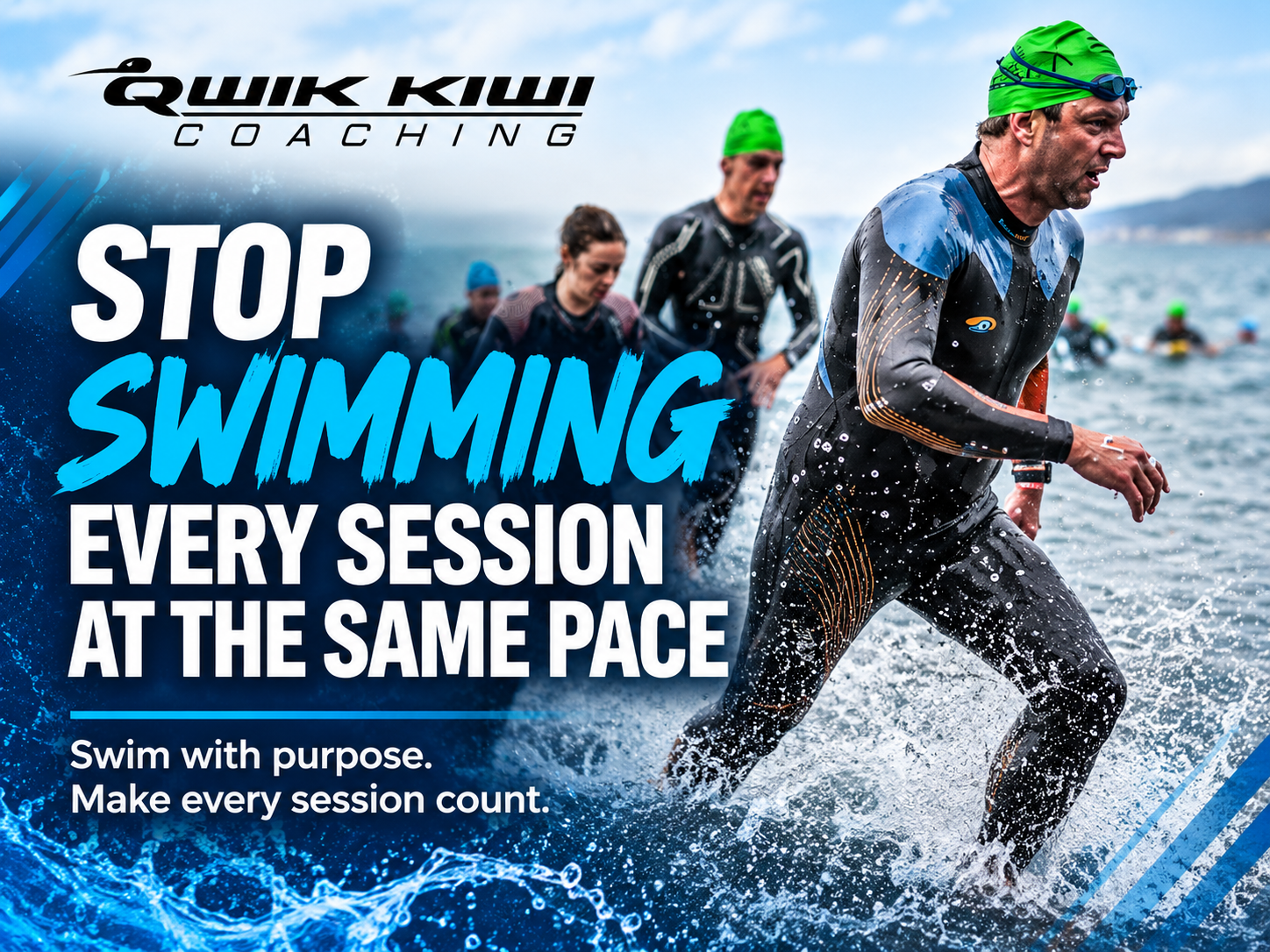
If every length of every swim feels exactly the same, you’re probably leaving fitness on the table.
Many triathletes have a default swimming pace. They get into the pool, settle into a comfortable rhythm and spend most of the session swimming at roughly the same intensity.
There’s nothing wrong with steady swimming. It has an important place in your training.
The problem comes when every session becomes the same steady swim.
If you want to become a stronger, faster and more efficient triathlon swimmer, your swimming needs variety. Some sessions should develop endurance. Others should challenge your speed. Some should focus heavily on technique, while others prepare you for the specific demands of racing.
The important thing is that every swim has a purpose.
The Comfortable-Pace Trap
Swimming at a comfortable pace feels productive.
You’re accumulating metres. Your heart rate is elevated. Your shoulders are working. You leave the pool knowing you’ve trained.
But completing more metres isn’t necessarily the same as improving your swimming.
This is particularly important with swimming because technique has such a significant influence on how efficiently you move through the water. You can become very good at swimming at your familiar pace without necessarily developing the ability to swim faster.
Think about your cycling or running.
You wouldn’t expect every workout to be completed at exactly the same intensity. You might have an easy endurance session, a tempo workout, threshold intervals or short, harder efforts.
Your swimming shouldn’t be any different.
Different Swim Sessions Develop Different Things
A good triathlon swim programme isn’t simply a collection of swims.
Each session should be there for a reason.
Depending on where you are within your training programme, your swimming might include a mixture of:
- Easy and aerobic swimming to develop endurance while reinforcing efficient movement.
- Technique-focused swimming to work on aspects such as body position, breathing, catch, pull and overall efficiency.
- Tempo swimming to develop your ability to maintain a controlled but purposeful effort.
- Threshold swimming to improve the pace you can sustain for longer periods.
- Short, fast repetitions to develop speed while maintaining good technique.
- Race-specific swimming to prepare for the particular demands of your upcoming event.
- Open-water skills such as sighting, drafting, navigating buoys and changing pace.
You don’t need all of these elements in equal amounts every week.
What you need depends on your ability, weaknesses, goals, race distance and where you are within your training programme.
That’s the difference between simply going swimming and actually training for the swim.
Technique Still Matters When You Swim Fast
One mistake athletes can make when introducing faster swimming is believing technique work and hard swimming are two completely separate things.
They aren’t.
The objective isn’t simply to thrash your way down the pool as quickly as possible.
You want to learn to swim faster while maintaining good technique.
That’s particularly important for triathletes because eventually you need that technique to hold together in open water while you’re fatigued, surrounded by other swimmers and potentially dealing with waves, chop or currents.
When I prescribe short 50m repetitions as hard efforts, I want athletes swimming as fast as possible while continuing to swim with good technique and staying consistent with pace (the last rep should be as fast as the first rep).
That’s an important distinction.
If your first 50m is spectacular but you’re several seconds slower by the final repetition and your technique has fallen apart, you probably started too hard.
Fast swimming should develop your ability to swim well at speed, rather than simply teaching you how to survive a few frantic lengths.
Triathlon Swimming Isn’t Always Steady
There’s another important reason to develop different swimming speeds.
A triathlon swim isn’t necessarily completed at one perfectly even intensity.
The start is an obvious example.
Depending on the event and your race strategy, you may need to swim harder initially before settling into your sustainable race effort.
Later, you might accelerate briefly to get onto another swimmer’s feet.
You could increase your effort going around a buoy.
You might lose the group you’re swimming with and need a short surge to regain contact.
Changing water conditions might require you to alter your stroke rate or effort.
Then you need to settle back into your sustainable pace.
This ability to change speed and then regain your rhythm is worth practising. Mixing swimming speeds in training can help prepare you for precisely these changes in racing.
If you’ve only ever trained at one swimming speed, suddenly finding another gear on race day becomes considerably harder.
Don’t Make the Opposite Mistake
Once athletes understand that swimming needs variety, there’s a temptation to go too far in the other direction.
Every swim doesn’t suddenly need to become hard.
That’s not the message.
You still need easy swimming.
You still need aerobic development.
You still need technique work.
And you certainly don’t need to turn every pool session into a competition with the swimmer in the next lane.
The goal is purposeful variety, not random intensity.
A recovery-oriented swim should feel very different from a threshold-focused session.
A technique session shouldn’t accidentally turn into a race.
A speed session shouldn’t become one continuous moderate swim because you were reluctant to swim the fast repetitions genuinely fast.
Know what the session is trying to achieve before you push off from the wall.
Give Every Set a Purpose
The same principle applies within an individual workout.
A structured swim might include several different components, and each can have a specific job.
Your warm-up prepares your body for the main work ahead.
Your drills allow you to concentrate on technique.
Your main set provides the primary training stimulus.
Shorter, faster repetitions can develop speed.
Easy swimming between sets allows you to recover while continuing to move.
Your cool-down gradually brings the session to an end.
This is one reason I prefer structured swimming rather than simply jumping into the pool and swimming continuously until you’ve reached a particular distance.
For example, I’ve previously used sessions specifically designed around developing threshold pace, with repeated efforts and short recoveries allowing the athlete to accumulate quality swimming around that intensity.
It’s still swimming.
You’re still accumulating metres.
But those metres now have a specific training purpose.
Learn Your Different Swimming Gears
One of the benefits of varying your swimming is that you develop a better understanding of what different efforts actually feel like.
Can you deliberately swim easy?
Can you increase your pace without your technique falling apart?
Can you hold a strong, sustainable effort across repeated intervals?
Can you swim genuinely fast for a short distance?
Can you surge and then settle back into your sustainable pace?
Can you recognise when you’re swimming harder than you should be?
These are useful skills for a triathlete.
Instead of having only two swimming settings — swimming and stopped — you begin developing a range of gears.
Those gears give you more options both in training and on race day.
Remember That You’re Training for Open Water
Pool swimming gives us an excellent environment for developing fitness and technique, but ultimately most triathletes are preparing to race in open water.
And open water removes many of the things that make pool swimming predictable.
There’s no black line underneath you.
There’s no wall every 25 or 50 metres.
Other swimmers can disrupt your rhythm.
You need to navigate.
Conditions can change.
Your ability to settle into a rhythm after a harder effort can therefore become particularly valuable. Open-water preparation also needs to address skills such as sighting, navigating, dealing with other swimmers and adapting to changing conditions.
That’s another reason your preparation shouldn’t consist entirely of swimming endless steady lengths at one comfortable pace.
Variety Doesn’t Mean Random
There is one other important point.
Variety doesn’t mean constantly changing your workouts just to make training interesting.
You still need consistency.
You need to repeat appropriate sessions often enough for your body to adapt. You also need enough consistency to determine whether your swimming is improving.
So the message isn’t:
Different workout every time = better training.
It’s:
Different sessions have different purposes within a consistent, progressive training programme.
That’s a significant difference.
Your training should progressively develop the qualities you need rather than simply providing an endless collection of interesting workouts.
What Should You Do at Your Next Swim?
Before you get into the pool, ask yourself one simple question:
What is the purpose of today’s session?
If the answer is endurance, swim with the appropriate control.
If it’s technique, concentrate on the technical objective rather than chasing the clock.
If it’s tempo, settle into the prescribed effort.
If it’s threshold, commit to the intensity you’re supposed to be developing.
If it’s speed, don’t turn the fast repetitions into comfortable aerobic swimming.
And if it’s recovery, resist the temptation to make the session harder simply because you’re feeling good.
You don’t need to make every workout as difficult as possible.
You need to execute the purpose of each workout as well as possible.
Stop Swimming Every Session at the Same Pace
If you’re swimming consistently, you’re already doing something valuable.
But don’t let consistency become monotony.
Your body needs different training stimuli, and your triathlon swim requires more than the ability to cruise up and down a pool at one comfortable speed.
Develop your technique.
Build your endurance.
Improve your sustainable pace.
Practise swimming fast.
Develop different swimming gears.
Prepare for the changing demands of open water.
Most importantly, give every session a reason for being there.
Don’t just swim more metres.
Swim with purpose.
Want More Purpose Behind Your Triathlon Training?
If you’re putting in the training but aren’t sure whether your swim, bike and run sessions are developing the right things at the right time, I can help you put more structure and purpose behind your programme.
Book a free, no-obligation 40-minute coaching call, and we can talk about your current training, your upcoming goals and where you could make the biggest improvements.
Train with purpose. Race with confidence.