Three structured triathlon swim workouts to develop swimming efficiency, sustainable speed and consistent pacing.
Swimming faster isn’t simply about working harder in the pool. It’s about improving your technique, learning to maintain your pace and developing the endurance to keep swimming efficiently as fatigue accumulates.
This week’s Saturday Swim Session brings together three workouts from my Triathlon Swim Performance Plan, including the return of a technique-focused session from Week 1 and two new workouts.
Across the week, you’ll complete 7,400m of purposeful swimming, with each session developing a particular aspect of your performance.
- Qwik Kiwi Performance Swim Session 02 – Freestyle Technique & Efficiency (2,400m)
- Qwik Kiwi Performance Swim Session 07 – Broken 400s & Sustainable Swimming Speed (2,400m)
- Qwik Kiwi Performance Swim Session 08 – Extended Technique & Swimming Efficiency (2,600m)
Whether you’re preparing for an Olympic-distance triathlon, Ironman 70.3 or T100 event, these sessions will help you become a more efficient swimmer who can maintain a stronger pace throughout your race.
Today’s Goal
This week’s goal is to improve three important qualities:
Freestyle efficiency: Develop better body position, rotation, coordination and stroke mechanics through repeated Drill/Swim combinations.
Sustainable swimming speed: Learn to swim at the fastest pace you can maintain consistently, rather than starting too quickly and slowing as the workout progresses.
Technique under fatigue: Maintain effective freestyle mechanics even as your swimming volume increases and your arms begin to tire.
Each session has a specific purpose, but all three contribute to your overall swimming performance.
Why You’re Doing These Sessions
Session 02 – Why We’re Repeating a Technique Workout
You might recognise Session 02 from the first week of the programme.
That’s intentional.
Swimming technique doesn’t improve simply because you’ve completed a particular drill once. Improvements come from repeatedly practising effective movements and gradually incorporating them into your normal freestyle stroke.
Session 02 provides another opportunity to concentrate on your technique without the pressure of swimming fast.
By repeating this session, you can build on the technical awareness developed during Week 1.
Perhaps you struggled to maintain good body position during your Kick On Side drills. Maybe your rotation improved during the 6/1/6 drill, but you found it difficult to maintain that movement when swimming normally.
This is your opportunity to revisit those areas.
The objective isn’t to complete the workout faster than last time. It’s to swim with better technique.
Session 07 – Learn to Swim Faster With Broken 400s
Session 07 introduces a workout structure known as the Broken 400s.
The concept is straightforward.
First, swim 400m continuously.
Then swim another 400m, but break it into four separate 100m repetitions.
You’ll complete this entire sequence twice.
The shorter repetitions allow you to reset your breathing and technique more frequently, while the continuous 400m challenges you to maintain your swimming rhythm without those breaks.
Your objective is to swim at the fastest pace you can consistently maintain for the prescribed repetitions and Rest Intervals.
This workout helps you develop sustainable swimming speed, pacing awareness and the ability to maintain effective technique across different repetition lengths.
Session 08 – Build Efficiency Through Greater Swimming Volume
Session 08 builds on the technique emphasis of Session 02.
However, this workout starts with a substantial 1,000m Warm Up and includes two sets of 12x 50m Drill/Swim repetitions.
The longer Warm Up provides an opportunity to settle into your swimming rhythm before beginning the more concentrated technique work.
As the session progresses, you’ll need to maintain your concentration on body position, rotation and coordination.
The challenge is to continue swimming efficiently even when your shoulders and arms begin to feel the accumulated workload.
This Week’s Workouts
| Workout | Distance | Primary focus |
|---|---|---|
| Session 02 | 2,400m | Freestyle technique and efficiency |
| Session 07 | 2,400m | Broken 400s and sustainable pacing |
| Session 08 | 2,600m | Extended technique development |
| Weekly total | 7,400m | Technique, endurance and sustainable speed |
Qwik Kiwi Performance Swim Session 02 – Freestyle Technique & Efficiency
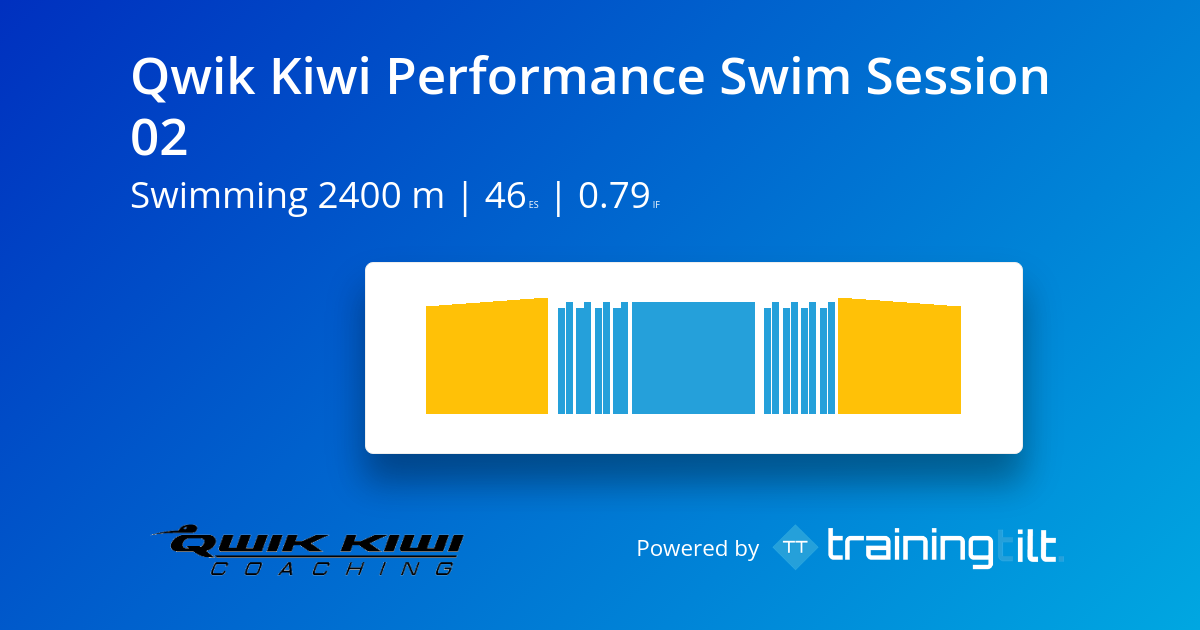
Today’s Workout
- 400m Warm Up (WU)
- 12x 50m Drill/Swim
- 400m Easy
- 12x 50m Drill/Swim
- 400m Cool Down (CD)
Workout Breakdown
400m Warm Up
Begin with 400m of comfortable swimming.
Gradually settle into your normal freestyle stroke, concentrating on maintaining a relaxed breathing rhythm and effective body position.
Use a mixture of strokes if you prefer.
12x 50m Drill/Swim
Each 50m repetition consists of:
25m Drill / 25m Normal Freestyle
Choose drills that address specific aspects of your swimming technique.
Suitable options include:
- Kick On Side (KOS) – Left and Right, developing body position and rotation.
- 6/1/6 – Improving the coordination between your kick, rotation and arm movements.
- 6/3/6 – Developing rhythm, balance and timing.
- Popov – Improving stroke coordination and rotation.
- Broken Arrow – Developing recovery mechanics and body rotation.
You don’t need to use every drill.
Choose those that address the technical areas you want to improve.
The most important part of each repetition is the transition from the drill into normal freestyle.
Concentrate on transferring the movement you’ve just practised into your swimming stroke.
Take a short pause between repetitions when needed to prepare for the next drill.
400m Easy
Return to relaxed freestyle swimming.
Concentrate on incorporating the improvements from your drill set into your normal swimming.
Pay particular attention to body position, rotation and maintaining a smooth, coordinated stroke.
12x 50m Drill/Swim
Repeat the Drill/Swim structure.
You can continue using the same drills or select alternatives that address another aspect of your technique.
Aim to make the transition between drill and normal freestyle increasingly natural.
400m Cool Down
Finish with 400m of comfortable swimming.
Continue concentrating on good technique, allowing your breathing and effort to gradually settle.
Coach Ray’s Focus
Because this session has appeared earlier in the programme, consider what you’ve learned since completing it previously.
Can you maintain better body position?
Does your rotation feel more natural?
Are you finding it easier to incorporate the technical movements into your normal freestyle?
Those improvements are more important than swimming the session quickly.
Qwik Kiwi Performance Swim Session 07 – Broken 400s & Sustainable Swimming Speed
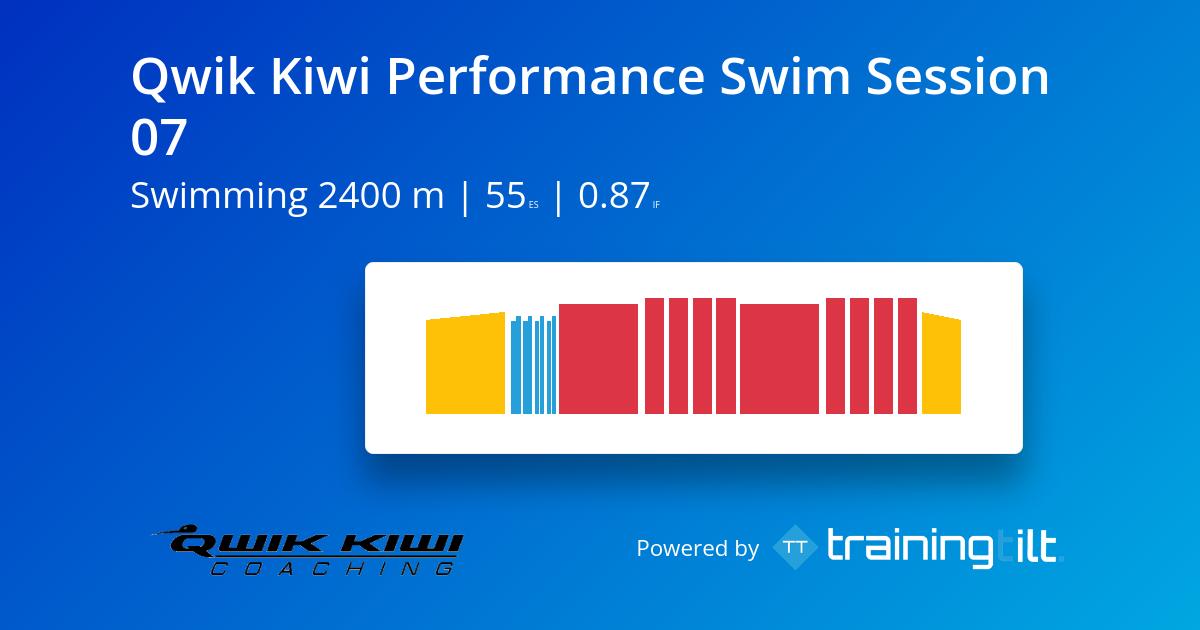
Today’s Workout
- 400m Warm Up (WU)
- 4x 50m Drill/Swim
- 2x:
- 400m Freestyle – 30sec Rest Interval (RI)
- 4x 100m Freestyle – 20sec RI
- 200m Cool Down (CD)
Workout Breakdown
400m Warm Up
Begin with 400m of comfortable swimming.
Gradually increase your effort as you prepare for the main set.
Concentrate on establishing a smooth stroke, relaxed breathing and good body position.
4x 50m Drill/Swim
Complete four repetitions of:
25m Drill / 25m Normal Freestyle
Choose four drills that help prepare you for the main set.
A suitable selection would be Kick On Side left, Kick On Side right, 6/1/6 and 6/3/6.
Concentrate on carrying the technical focus of each drill into the freestyle portion.
Main Set – 2x Broken 400
This is where the workout becomes particularly interesting.
Each round consists of 800m of swimming:
First Round
- 400m Freestyle – 30sec RI
- 100m Freestyle – 20sec RI
- 100m Freestyle – 20sec RI
- 100m Freestyle – 20sec RI
- 100m Freestyle – 20sec RI
Second Round
Repeat the complete sequence, beginning with another continuous 400m, followed by four 100m repetitions.
The main set totals 1,600m.
How Fast Should You Swim?
The objective is to swim as fast as you can maintain consistently.
That means selecting a challenging but sustainable pace for each repetition distance and its prescribed recovery.
During the continuous 400m, concentrate on settling into a strong rhythm.
Avoid sprinting the opening 100m.
Instead, establish a pace you can maintain throughout the entire repetition.
After the 30-second Rest Interval, complete the four 100m repetitions.
These shorter efforts allow you to reset between repetitions, but you should still aim for consistent swimming times.
Your fastest 100m shouldn’t be dramatically quicker than your slowest.
When you return to the second continuous 400m, concentrate on maintaining the same quality of swimming as during the first round.
Ideally, your second 400m should be as fast as your first.
Similarly, aim to maintain consistent 100m times throughout both rounds.
What Should You Record?
If possible, record:
- Your first continuous 400m time.
- Your four 100m times from the first round.
- Your second continuous 400m time.
- Your four 100m times from the second round.
You can also add the four 100m times together to compare your total swimming time with the continuous 400m.
Remember that the broken version includes recovery periods, so it isn’t a direct like-for-like comparison with the continuous effort.
Instead, use the results to understand how well you maintain your pace and how your swimming changes when you have short opportunities to recover.
Common Mistake: Starting Too Fast
The biggest mistake is treating the opening 400m like a Time Trial.
If you swim it substantially faster than you can sustain, the rest of the workout becomes a struggle.
Your 100m repetitions may become progressively slower, and your second 400m could be significantly slower than the first.
Instead, establish the fastest pace you can realistically maintain across the complete main set.
Consistency is the priority.
200m Cool Down
Finish with 200m of relaxed swimming.
Allow your breathing to settle and concentrate on maintaining a smooth, comfortable stroke.
Coach Ray’s Focus
The Broken 400 is an opportunity to develop pacing awareness.
Pay attention to how your swimming feels during the continuous 400m compared with the shorter 100m repetitions.
Do you maintain better technique during the shorter efforts?
Does your stroke deteriorate during the second round?
Can you maintain your pace without increasing your effort dramatically?
Use the workout to understand your swimming rather than simply chasing fast times.
Qwik Kiwi Performance Swim Session 08 – Extended Technique & Swimming Efficiency
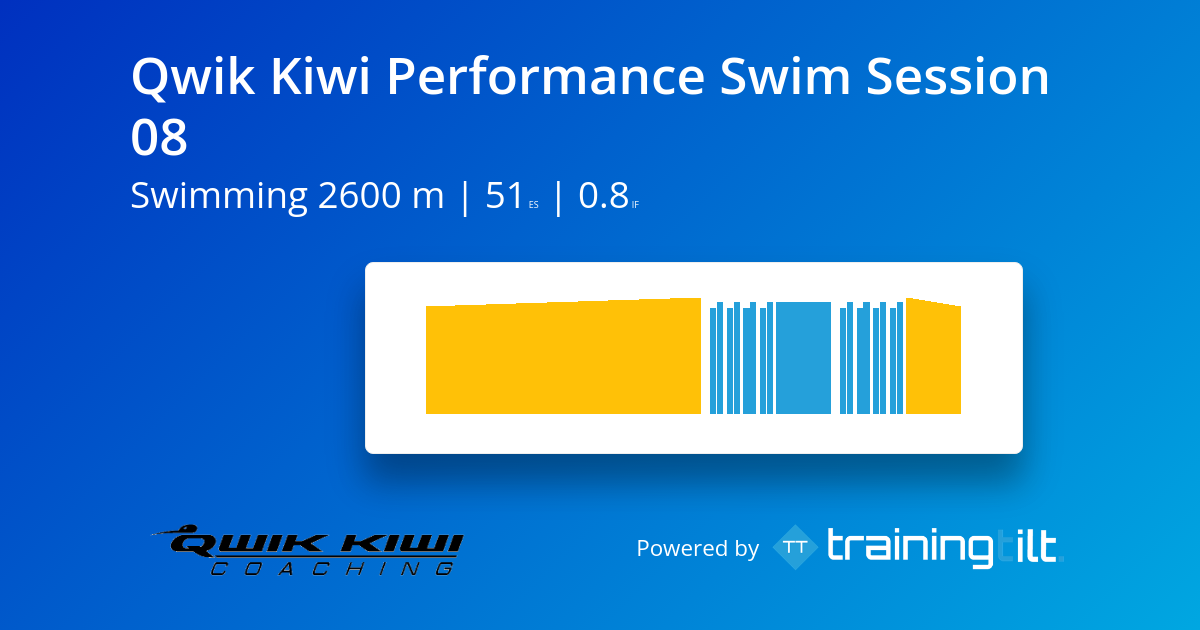
Today’s Workout
- 1,000m Warm Up (WU)
- 12x 50m Drill/Swim
- 200m Easy
- 12x 50m Drill/Swim
- 200m Cool Down (CD)
Workout Breakdown
1,000m Warm Up
This session begins with a longer Warm Up than the other two workouts.
The objective is to prepare your body for the technique work while developing a comfortable, efficient swimming rhythm.
Start gently and gradually settle into your normal freestyle stroke.
You can break the 1,000m into smaller sections if that helps you maintain concentration.
For example, you might swim 200m at a time, briefly checking your breathing, body position and stroke mechanics before continuing.
Keep the swimming comfortable.
The purpose isn’t to make the Warm Up unnecessarily demanding.
12x 50m Drill/Swim
Complete each repetition as:
25m Drill / 25m Normal Freestyle
As with Session 02, choose drills that address the areas of your technique that need attention.
Concentrate on making each movement deliberate and controlled.
During the 25m freestyle section, apply the technical improvement immediately.
200m Easy
Return to relaxed swimming.
This provides an opportunity to consolidate the technical work and prepare for the second drill set.
Concentrate on maintaining good body position and a smooth swimming rhythm.
12x 50m Drill/Swim
Repeat the technique set.
By this stage, you’ve already completed 1,800m of swimming.
Maintaining concentration on your technique becomes increasingly important.
Avoid rushing the repetitions simply to finish the workout.
Instead, focus on the quality of each drill and the way you transfer it into your normal freestyle.
200m Cool Down
Finish with comfortable swimming.
Allow your effort to gradually decrease while continuing to concentrate on effective freestyle mechanics.
Coach Ray’s Focus
This session challenges your ability to maintain technical quality as swimming volume accumulates.
It’s relatively easy to concentrate on technique when you’re fresh.
The more important challenge is maintaining those movements when your shoulders and arms begin to tire.
Pay attention to whether your body position changes, your stroke becomes shorter or your rotation becomes less effective.
The goal is to finish the workout swimming as efficiently as you did near the beginning.
What These Three Workouts Teach You
Although each session has a different structure, several important principles connect them.
1. Better Technique Requires Repetition
Repeating Session 02 isn’t a lack of variety.
It’s an opportunity to reinforce effective swimming movements.
Technical improvements take time, particularly when you’re trying to replace established habits.
Regularly revisiting purposeful drills helps you develop greater awareness and consistency.
2. Swimming Faster Requires Pacing Discipline
Session 07 demonstrates why swimming your opening repetition as quickly as possible isn’t always the best approach.
Your objective is to maintain the fastest pace you can sustain throughout the prescribed work.
If your opening 400m is considerably faster than your second, you may have started too quickly.
If your 100m times deteriorate significantly, reconsider your pacing.
Learning to distribute your effort effectively is an important part of improving your swimming performance.
3. Efficiency Matters When You’re Tired
Session 08 provides an opportunity to concentrate on maintaining effective technique as your total swimming volume increases.
During a triathlon, you need to maintain your swimming mechanics over the entire swim leg.
If your technique deteriorates significantly as you tire, you may expend more energy without maintaining your speed.
Developing the ability to swim efficiently under fatigue can help you maintain a stronger pace without unnecessary effort.
Common Mistakes to Avoid
1. Completing drills without a clear purpose
Every drill should address a particular aspect of your swimming technique.
Don’t simply complete the prescribed distance.
Think about the movement you’re practising and how it should improve your normal freestyle.
2. Forgetting the drill during normal swimming
The objective of Drill/Swim repetitions isn’t simply to become better at performing drills.
It’s to improve your freestyle.
During the 25m Swim, concentrate on applying what you’ve just practised.
3. Swimming the opening Broken 400 too quickly
Starting too fast can compromise the remaining repetitions.
Establish a challenging but sustainable pace and aim to maintain it throughout both rounds.
4. Extending the Rest Intervals
The 30-second and 20-second Rest Intervals are part of Session 07’s structure.
Taking substantially longer recovery periods changes the workout.
Maintain the prescribed recovery and adjust your swimming pace to suit.
5. Allowing technique to deteriorate
As fatigue accumulates, concentrate on maintaining body position, an effective catch and coordinated rotation.
Avoid simply increasing your stroke rate to compensate for inefficient swimming.
Tips for Getting the Most From This Week
Choose drills that address your individual needs. There’s no requirement to use every available drill. A small selection of purposeful drills can be more valuable than constantly changing exercises.
Keep the technique sessions controlled. Sessions 02 and 08 aren’t races. Their primary purpose is to improve swimming efficiency.
Record your Broken 400 results. Your 400m and 100m times will help you understand your pacing and identify whether you maintained your target speed.
Spread the sessions across the week. Allow appropriate recovery and consider how your swimming fits alongside your cycling and running workouts.
Concentrate on consistency. Whether you’re repeating a drill or swimming a demanding 400m effort, aim to maintain the quality of your swimming throughout the workout.
Who Are These Workouts For?
These sessions are designed for triathletes who are already comfortable swimming approximately 2,000–3,000m per session and want to improve through structured training.
They are particularly relevant for athletes preparing for:
- Olympic-distance triathlons.
- Ironman 70.3 events.
- T100 triathlons.
Session 02 is particularly useful for swimmers who want to improve their technique and develop more efficient freestyle mechanics.
Session 07 suits swimmers looking to develop sustainable speed, pacing consistency and endurance.
Session 08 is valuable for athletes who want to maintain good swimming technique as their training volume accumulates.
Frequently Asked Questions
Why are we repeating Session 02 from Week 1?
Because swimming technique improves through consistent, purposeful practice.
Repeating the workout gives you an opportunity to reinforce movements you’ve already practised and evaluate whether you’re swimming more efficiently.
The goal is technical improvement rather than completing the workout faster.
What is a Broken 400 swimming workout?
A Broken 400 involves swimming 400m as shorter repetitions rather than continuously.
In Session 07, you first complete a continuous 400m, then swim the same distance as four 100m repetitions.
You repeat that complete sequence twice, with prescribed Rest Intervals.
How fast should I swim the Broken 400 workout?
Swim at the fastest pace you can consistently maintain for the prescribed repetitions and recovery periods.
Avoid starting so quickly that your times deteriorate significantly during the second round.
Should my four 100m repetitions be faster than my continuous 400m pace?
They may be, because the shorter repetitions include recovery periods.
However, the objective isn’t simply to swim the 100m repetitions faster.
Your priority is to maintain the fastest consistent pace you can sustain across the complete workout.
Can I use fins during the Drill/Swim sets?
Yes.
Fins can be useful when they help you concentrate on body position, rotation or coordination.
However, the objective remains improving your normal freestyle swimming.
Do I need to swim the entire 1,000m Warm Up continuously in Session 08?
No.
You can break the Warm Up into shorter sections if necessary.
The important thing is to complete the prescribed distance while gradually preparing your body for the technique work.
Should I complete all three workouts during the same week?
Yes. These sessions are designed to complement one another as part of a structured three-swim training week.
Spread them across the week where possible and allow appropriate recovery.
Coach Ray’s Final Thoughts
Swimming improvement comes from combining purposeful training with consistent execution.
This week’s three sessions demonstrate that you don’t need to swim every workout at maximum intensity to become a faster triathlon swimmer.
Session 02 reinforces the technical foundations that help you move efficiently through the water.
Session 07 challenges you to develop sustainable speed through a structured Broken 400 workout.
Session 08 builds your ability to maintain effective freestyle mechanics as your swimming volume increases.
Together, they provide 7,400m of structured swimming designed to help you become a more efficient, consistent and confident triathlon swimmer.
The key is understanding the purpose of each workout and concentrating on executing it properly.
Train smarter, swim more efficiently and develop speed you can maintain when it matters.
Ready to Take Your Triathlon Swimming to the Next Level?
These three sessions are part of my Triathlon Swim Performance Plan – 16 Weeks, a structured programme designed to help you develop your technique, endurance and sustainable swimming speed.
Rather than wondering what to swim each time you visit the pool, you’ll have a clear training progression to follow.
The programme is designed for Olympic-distance, Ironman 70.3 and T100 triathletes, with three purposeful swimming sessions each week.
You’ll work on developing efficient freestyle technique, improving your ability to maintain a strong pace and building the swimming fitness needed for race day.
And the investment?
Just NZ$59 for the complete 16-week training plan.
That’s less than NZ$4 per week for a structured programme to guide your swimming development.
Stop guessing what to swim. Start following a structured programme designed to help you improve.
Coach Ray
Qwik Kiwi Coaching
www.CoachRay.nz