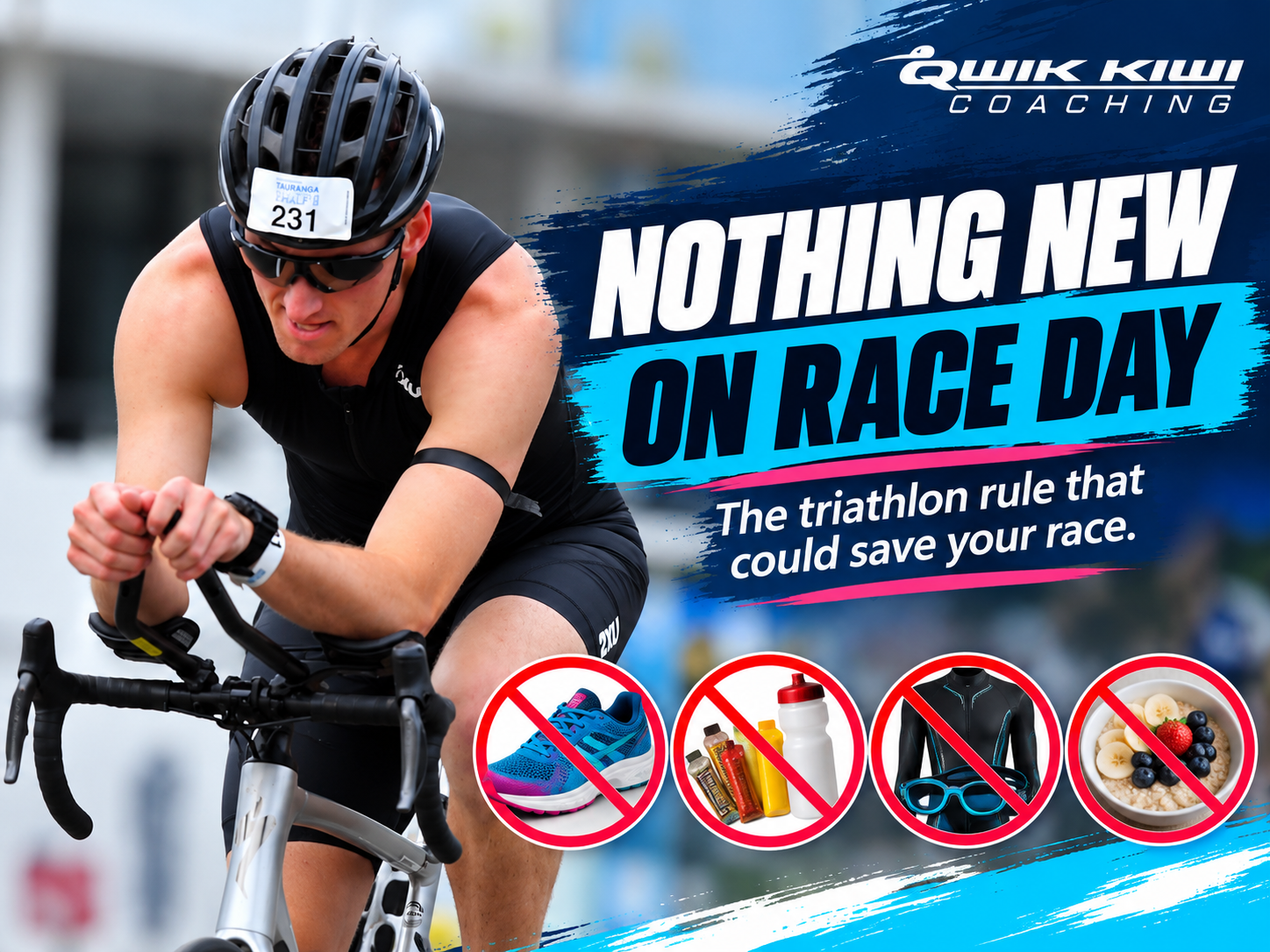
Race morning is the worst possible time to discover that your new running shoes give you blisters.
You’ve spent weeks, perhaps months, preparing for your triathlon.
You’ve completed the swim sessions, built your cycling fitness, worked on your running, practised your transitions and hopefully developed a sensible race-day pacing and fuelling strategy.
Now race day has arrived.
And suddenly, you’re tempted to change something.
Perhaps you’ve bought a new pair of running shoes that you haven’t worn yet.
Maybe you’ve found a different energy gel that promises better performance.
Or you’ve decided to try a new breakfast because another athlete swears by it.
It might even be something as simple as wearing a new pair of goggles, changing your bike position or choosing a different pair of socks.
Individually, these decisions can seem insignificant.
But when you’re about to put your body through several hours of swimming, cycling and running, even a small change can create an unnecessary problem.
That’s why one of the simplest rules I teach athletes is:
Nothing new on race day.
Your training is the time to experiment.
Race day is the time to execute what you’ve already practised.
Why Race Day Isn’t the Time for Experiments
Triathlon is already a complicated sport.
You’re combining three disciplines, two transitions, equipment management, pacing, nutrition, hydration and the environmental conditions you’ll encounter throughout the event.
Even when everything goes according to plan, there’s plenty to manage.
The last thing you need is another unknown.
When you introduce something new on race day, you’re making an assumption that it will work.
And sometimes it does.
But sometimes that new piece of equipment causes discomfort, your nutrition doesn’t agree with your stomach or a seemingly minor change disrupts something you’ve spent months practising.
The frustrating part is that many of these problems are avoidable.
You can’t control everything that happens during a triathlon, but you can reduce the number of unnecessary surprises you create for yourself.
Don’t Wear New Running Shoes on Race Day
Let’s start with one of the most common mistakes.
You’ve bought a new pair of running shoes.
They’re lighter than your usual shoes, they feel fantastic walking around the house and you’re convinced they’ll help you run faster.
So you decide to save them for race day.
The problem?
You haven’t actually run in them.
You don’t know whether they’ll cause blisters after 10 kilometres.
You don’t know how they’ll feel when your feet are swollen or wet after the swim and bike.
You haven’t practised putting them on quickly during transition.
And you haven’t established whether they’ll remain comfortable when you’re running on fatigued legs.
A new pair of shoes might feel great for the first few minutes.
That doesn’t guarantee they’ll feel great towards the end of a half marathon.
What should you do instead?
If you plan to race in new shoes, introduce them into training well before your event.
Use them for some shorter runs.
Try them during a brick session.
Complete an appropriate longer run in them if that’s relevant to your event.
Practise running in the socks you’ll wear on race day.
If you use elastic laces, make sure you’ve tested those too.
You don’t necessarily need to complete hundreds of kilometres in your race shoes, particularly if you’re trying to preserve their performance characteristics.
But you should have enough experience to know that they’re comfortable and suitable.
Race day should confirm your equipment choices, not test them for the first time.
Your Race Nutrition Needs Rehearsing
Nutrition is another area where last-minute changes can cause significant problems.
Perhaps you’ve trained using one brand of energy gel, but the race organiser is providing a different product at the aid stations.
Or you’ve read that another athlete consumes substantially more carbohydrate per hour than you do.
Suddenly, you decide to change your fuelling strategy.
After all, more carbohydrate might mean more energy, right?
Not necessarily.
Your ability to tolerate nutrition during exercise depends on several factors, including the amount consumed, the concentration of carbohydrate, the type of product, exercise intensity and your individual gastrointestinal tolerance.
Something that works brilliantly for another athlete might not agree with you.
And a strategy that works while sitting at home might feel very different when you’re racing hard.
Practise your fuelling during training
Your longer rides, race-specific sessions and brick workouts are excellent opportunities to rehearse your nutrition.
You should know:
- What products you’ll use.
- How much carbohydrate you’re planning to consume.
- When you’ll begin fuelling.
- How frequently you’ll eat or drink.
- How much fluid you expect to need under different conditions.
- Whether your stomach tolerates the strategy at race intensity.
- How you’ll carry and access your nutrition.
If you’re planning to use the nutrition supplied on course, find out what it is and practise with it beforehand.
If it doesn’t agree with you, organise an alternative strategy rather than hoping for the best.
Your race nutrition should be familiar, predictable and practised.
Don’t Experiment With Breakfast
Race-morning breakfast deserves the same attention.
You might normally have porridge, toast or another familiar carbohydrate-rich meal before your longer training sessions.
But on race morning, someone suggests something different.
Perhaps it’s a new breakfast cereal, a large smoothie or a meal you’ve never eaten before exercising.
It sounds healthy.
It might even be nutritionally excellent.
But that doesn’t automatically make it appropriate immediately before your triathlon.
Food tolerance varies considerably between athletes, and the timing, quantity and composition of your pre-race meal can influence how comfortable you feel during exercise.
A breakfast that works well for someone else isn’t necessarily the right breakfast for you.
Rehearse your race morning
Before your event, practise your intended breakfast ahead of a long training session or race-specific workout.
Consider:
- What you’re going to eat.
- How much you’ll eat.
- How long before the start you’ll eat it.
- What you’ll drink.
- Whether you’ll need a small additional snack closer to the start.
Remember that your race may begin considerably earlier than your normal training sessions.
You may need to adjust the timing of your breakfast accordingly.
And if you’re travelling, think about whether your usual foods will be available.
Don’t wait until race morning to discover that the hotel breakfast doesn’t suit your fuelling plan.
Your Goggles and Wetsuit Should Be Familiar
The swim presents its own collection of potential problems.
Imagine standing on the beach before your event, surrounded by hundreds of other athletes.
You’re already feeling nervous.
Then you put on a brand-new pair of goggles.
They seem fine.
But once you start swimming, they leak.
You stop to adjust them.
They leak again.
Now you’re frustrated, your breathing has become unsettled and you’ve lost your rhythm.
A small equipment issue has become a much bigger distraction.
The same applies to wetsuits.
A wetsuit that feels comfortable standing in the shop might feel restrictive when you’re swimming.
It could rub around your neck, restrict your shoulders or make breathing feel uncomfortable.
Test your swim equipment
Before race day, make sure you’ve practised with the goggles and wetsuit you intend to use.
Ideally, test them in conditions similar to those you’re expecting during your event.
Practise sighting, swimming continuously and getting comfortable in open water.
If you use anti-chafing products, test those too.
And consider carrying a spare pair of goggles that you’ve already used successfully.
The objective is simple.
When the starting horn sounds, you should be concentrating on your swimming, not worrying about your equipment.
Your Tri Suit, Socks and Accessories Matter Too
It’s not always the expensive equipment that creates problems.
Sometimes it’s something as simple as a pair of socks.
A new pair might have a seam that rubs.
A different tri suit could cause chafing around your shoulders or underarms.
An unfamiliar race belt might bounce around during the run.
Even a new pair of sunglasses could become uncomfortable after several hours.
These are small things, but their effects can become increasingly noticeable as your race progresses.
Practise in your race kit
During your race preparation, complete some sessions wearing the equipment you intend to race in.
This is particularly important for longer events.
A tri suit that feels comfortable during a short ride might behave differently after several hours in an aerodynamic position.
Likewise, something that feels fine while cycling might become uncomfortable when you start running.
Brick sessions provide an excellent opportunity to discover these problems before race day.
You don’t need to wear your race kit for every workout.
But you should know that it works.
Don’t Change Your Bike Position at the Last Minute
Here’s another mistake that can be particularly costly.
You’ve been training consistently on your bike.
Your position is comfortable.
You know how it feels.
Then, a few days before your race, you decide to make an adjustment.
Perhaps you lower your handlebars to become more aerodynamic.
Move your saddle.
Change your cleat position.
Or install a new component that alters your riding position.
The change might look faster.
But you haven’t established whether you can comfortably sustain it for the duration of your event.
A change in bike position can alter how you distribute pressure, recruit muscles and tolerate prolonged riding.
And remember, you’re not simply cycling.
You still need to run afterwards.
A position that looks faster isn’t necessarily faster overall if it compromises your comfort, power production or subsequent run.
Make meaningful bike-fit changes early enough to test them properly.
Race week is generally the time to check that everything is functioning correctly, not to redesign your position.
Of course, if you discover a genuine mechanical or safety issue, fix it. The rule isn’t an excuse to race unsafe equipment.
Practise Your Transitions
Triathlon involves more than swimming, cycling and running.
You’ve also got to move efficiently between them.
And race morning isn’t the time to introduce a completely new transition technique.
Perhaps you’ve watched professional triathletes perform flying mounts.
Or you’ve seen someone leave their cycling shoes attached to the pedals.
It looks quick.
It looks impressive.
And you think it might save a few seconds.
But if you’ve never practised the technique, race day isn’t the time to try it.
A rushed or poorly executed transition can cost considerably more time than a controlled one.
It can also create an unnecessary safety risk.
Instead, practise your transition routine during training.
Know where your equipment goes.
Know the order you’ll put things on.
Know how you’ll get your bike moving safely.
And make sure you’ve familiarised yourself with the transition layout and event rules.
A simple transition performed confidently is better than an ambitious transition performed badly.
Don’t Introduce a New Pacing Strategy
The principle of nothing new on race day extends beyond equipment and nutrition.
It also applies to how you intend to race.
You’ve spent months preparing for an event.
You’ve practised your target bike intensity.
You’ve completed race-specific running sessions.
You have a sensible idea of how to pace yourself.
Then race morning arrives.
You feel fantastic.
The atmosphere is exciting.
Other competitors are moving quickly.
And suddenly, your carefully prepared pacing strategy seems a little conservative.
So you decide to go harder.
That’s another experiment.
And potentially a costly one.
Race-day adrenaline can make your early effort feel easier than expected.
But that doesn’t mean your physiological limits have suddenly changed.
Your pacing strategy should be informed by the training you’ve completed and the demands of the course.
If conditions require an adjustment, make it intelligently.
Don’t abandon months of preparation simply because the first few kilometres feel easy.
Use Training as Your Race-Day Rehearsal
One of the most valuable things you can do during your preparation is rehearse the details of race day.
That doesn’t mean you need to complete an entire Ironman in training.
Nor does every session need to resemble your event.
But as your race approaches, some sessions should give you the opportunity to test the things you’ll rely on.
For example, a race-specific brick session might allow you to:
- Ride at your intended race intensity.
- Practise your planned carbohydrate and fluid intake.
- Wear your intended cycling and running equipment.
- Rehearse your bike-to-run transition.
- Run at an appropriate race-specific effort.
- Identify any equipment or nutrition problems.
You might discover that your race belt bounces.
Your gels are difficult to reach.
Your running shoes need adjusting.
Or your planned fuelling schedule needs more practice.
That’s valuable information.
Because you’ve discovered the problem during training, when you still have time to solve it.
A successful race rehearsal doesn’t need to be perfect. It needs to teach you something useful.
What About the Week Before Your Race?
The final week before your triathlon is particularly important.
By this stage, most of your fitness development has already taken place.
You’re not going to transform your endurance or threshold with one last-minute workout.
But you can certainly introduce unnecessary fatigue, stress or equipment problems.
This is why I encourage athletes to keep race week relatively predictable.
Follow your planned taper.
Maintain familiar foods.
Check your equipment.
Prepare your nutrition.
Review the course.
Organise your transition gear.
And resist the temptation to make major changes.
If you discover a genuine problem, deal with it.
But don’t go searching for last-minute improvements that you haven’t had time to test.
Race week is about arriving ready to perform, not trying to squeeze in another few weeks of preparation.
A Simple Nothing-New-on-Race-Day Checklist
Before your next triathlon, work through these questions.
| Area | Have you tested it? |
|---|---|
| Swim | Goggles, wetsuit, anti-chafing products and open-water skills |
| Bike | Position, cycling shoes, helmet, hydration setup and equipment |
| Run | Shoes, socks, clothing and race belt |
| Nutrition | Gels, drinks, carbohydrate intake and timing |
| Breakfast | Food, portion size and timing before the start |
| Transitions | Equipment layout and T1/T2 routines |
| Pacing | Swim effort, bike intensity and run pacing |
| Race logistics | Course, rules, aid stations and transition access |
You don’t need to become obsessive about every tiny detail.
But the more familiar your race-day routine becomes, the fewer decisions you’ll need to make when you’re nervous, excited or fatigued.
What If Something Has to Change on Race Day?
There is an important qualification to this rule.
Nothing new on race day doesn’t mean you should blindly follow a plan when circumstances make it inappropriate.
Weather conditions might change.
The swim could be altered.
Your preferred nutrition might become unavailable.
A piece of equipment could fail.
You might wake up feeling unwell.
Sometimes you have to adapt.
The important thing is to make those adjustments thoughtfully.
If the weather is considerably hotter than expected, your pacing and hydration strategy may need to change.
If your goggles break, use the familiar spare pair you’ve packed.
If your bike develops a mechanical problem, address it rather than ignoring it.
If your planned nutrition isn’t available, choose the most suitable alternative you can tolerate rather than assuming that any replacement will work identically.
The purpose of this rule is to reduce avoidable risks, not prevent sensible decisions when circumstances change.
Confidence Comes From Preparation
There’s another benefit to rehearsing your race-day routine.
Confidence.
When you’ve practised your equipment, nutrition, transitions and pacing, you have fewer things to worry about.
You know your goggles fit.
You know your shoes are comfortable.
You know your nutrition works.
You know how to move through transition.
And you have a sensible plan for managing your effort.
That doesn’t guarantee a perfect race.
Triathlon will always contain some uncertainty.
But it allows you to approach the start line knowing you’ve prepared for the things within your control.
And that can make a considerable difference to how calmly and confidently you execute your race.
Nothing New on Race Day
It’s easy to become distracted by the excitement of race week.
A new product.
A last-minute recommendation.
Something another athlete is doing.
A piece of equipment that promises to save time.
But your preparation should already have answered most of the important questions.
You know what works.
You’ve practised your routine.
You’ve developed your fitness.
Now it’s time to trust that preparation.
Don’t introduce unnecessary uncertainty when you’ve already invested so much effort in getting ready.
Training is where you experiment. Race day is where you execute.
So before your next triathlon, remember:
Nothing new on race day.
Your feet, your stomach and your finishing time might thank you.
Want to Arrive at Your Next Triathlon Better Prepared?
Getting race-day preparation right involves more than completing your swim, bike and run training.
Your equipment, nutrition, pacing and transitions all need to work together.
If you’re preparing for your first triathlon, stepping up to a longer distance or trying to improve your race execution, I can help you develop a training programme that prepares you for the demands of your event.
I offer a free, no-obligation 40-minute coaching consultation where we can discuss your goals, training and race-day preparation.
👉 Book your free 40-minute coaching consultation
Train with purpose. Practise the details. Race with confidence.